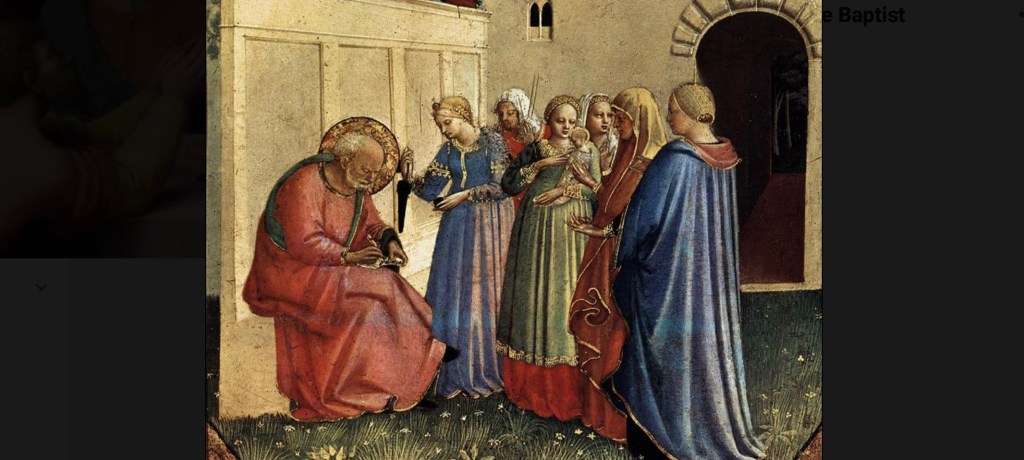
“No. He will be called John” (Lk 1:60).

With these simple words, three inter-related points arise. First, Elizabeth is beginning to shift the momentum of original sin. Eve was tempted by the serpent to eat of the fruit that God had told her and Adam not to eat of, yet she did. Adam did not support her nor step in to protect Eve during her dialogue but remained silent in the face of the temptation Eve was experiencing. Both of them slipped into sin by disobeying the will of God and grasping for what God would have given to them freely if they were willing to receive their fulfillment of participating in his divinity.

At the time of the birth of Elizabeth’s son, there was even more cause for celebration, for Elizabeth had not born a child and was past child-bearing years. The eighth day had come in which following the Abrahamic law the boy was to be circumcised and named. Her relatives and neighbors gathered around with great excitement and there appeared to be a unanimous decision to name the boy after his father. Elizabeth chose not to. Nor did she, like Eve, cave to the pressure and temptation surrounding her. Unlike Adam who lost his voice at the time he needed to speak up, Zechariah found his voice, and had Elizabeth’s back. Both Elizabeth and Zechariah knew what God wanted them to do and were faithful to follow through.

Elizabeth and Zechariah were faithful to God even while facing the familial and social pressure placed upon them. Some today may be removed by such familial pressure when naming a child, but for this time, names were important ways to continue family continuity. Elizabeth, despite the pressure, held her ground and stood firm to the will of God that the boy would be named John. John was a common name during the time of Elisabeth which from the Hebrew, Yochanan, which means God is gracious.

Sounds like a pretty good name to name a son to me! Yet, Elisabeth’s family was exasperated with her and deferred to Zechariah, the boy’s father, thinking he would have more sense. Without hesitation Zechariah supported Elizabeth. The point here is not so much the name, but the following of God’s will in the face of pressure to do the opposite.

We can see in this short account a powerful lesson: when we trust in God, we grow. We begin to feel safe and secure and so begin to the mature and are able to move from finding our security in our identity to instead finding it in our faithfulness to God. Culture and traditions are not sacred, but God is. Elizabeth and Zechariah faced a lot of familial and social pressure to conform, yet they chose to be true to God, to be true to themselves, and they chose integrity over their identity.

The very simple account of Elizabeth and Zechariah naming their child John in opposition to the pressure offers for us a way to counteract the rising tide of polarization and conflicts that we face in our families, communities, and country today. Identity provides safety, support, and security and when properly ordered, health and good. It fuels one of our deepest pangs of hunger to belong, to be a part of something bigger than ourselves. We can find our identity in family, friendships, our religious traditions, culture, political affiliations, common interests, clubs, activities, hobbies, and sports. watch a World Cup game of soccer and you will see national identity and pride on full display!

Our identity when tied to these cultural norms, provides us with security and stability, which is good, but doing so can also be a trap. We want to belong so much, the drive is so strong, that we may feel the pressure to make decisions, act in certain ways, and support others who go against who we are, just so that we can belong. We may have known what God wants from us in a particular situation, heard the whispers of his voice in our conscience, yet were pulled by the louder voices of the group. We are sometimes so ingrained by our identity that we can be strangled and suffocated by it.

Elizabeth and Zechariah were true to the will of God and won over those placing pressure on them by their family and neighbors. “What, then, will this child be?” For surely the hand of the Lord was with him (Luke 1:66). Often though, being faithful to God, being a person of integrity, does not go so well. Their own son who would grow up to be John the Baptist, would lose his life by speaking truth to power.

John also showed his faithfulness and humility as his own popularity grew and people looked to him as the messiah. He could have easily donned the mantle, and yet his response to the popular acclaim was, “He must increase; I must decrease” (cf. John 3:30). John, like his parents, knew the role God had called him to play. He was the forerunner to prepare the way for Jesus. John embodied the moral courage that we all need today and he points us as he did two of his own disciples to behold the Lamb of God.

More than another wonderful role model, more than words on the page, Jesus is the Word of God incarnate. Allowing ourselves, like John the Baptist did, to become less so that Jesus can become more in our lives is the way of discipleship. We can also have the courage to even face familial pressures against our faith when we daily read, meditate, and pray with Jesus’ teachings and put them into practice. As we are more intentional with our choices and align them to God’s will, our relationship with Jesus will grow. Slowly we will resist internal as well as the external temptations and like Elizabeth and Zechariah, stand up for the truth no matter the pressure.

————————————————————————–

Painting: “The naming of John the Baptist” by Fra. Angelico

Link for the Mass readings for Wednesday, June 24, 2026

Telling the truth is a much more peaceful way to live.

In today’s Gospel, we read about the fourth antithesis where, Jesus said to his disciples: “You have heard that it was said to your ancestors, Do not take a false oath, but make good to the Lord all that you vow. But I say to you, do not swear at all (Mt 5:33-34). The taking of an oath in Jesus’ time became an acceptable practice to confirm that someone was telling the truth. Taking an oath by invoking God made the testimony or presentation of one’s statement more believable because he was willing to receive God’s judgment upon himself if he was lying.

People expanded this oath taking as Jesus pointed out by replacing God’s name with taking an oath by heaven, earth, Jerusalem, or one’s head. The thought being that one would escape God’s judgement if they were not being fully honest. Jesus points out that this would not be the case. For heaven is God’s throne, the earth is his footstool, Jerusalem is the city of the great King, and it was even God who made the color of one’s hair.

As with his other antitheses, Jesus called his disciples to go deeper, to be better. The word of the disciple ought to stand on its own weight such that they need not take an oath at all. Jesus spoke the truth always and his disciples are called to do the same. If his disciple tells the truth, there is no need to take an oath. The “Yes” or “No” of a disciple is sufficient. “Anything more is from the evil one” (Matthew5:37).

We can see remnants of this practice today, when we hear someone say, “I swear on my mother’s grave that I did not…, I swear on our friendship that I did not…, or I swear to God as my witness that I did not…”

Jesus is teaching us as well that we are to resist the temptation to swear an oath at all. We are to just tell the truth in all circumstances. We are to be people of integrity and stand on what we say as the truth. We are living in a time period in our country where the ability to tell the truth is being called into question, where lies and the bending of the truth are becoming common place. This is one of the reasons why so many people have such a low opinion of secular and even religious leadership. But it is also present in our day-to-day interactions with one another.

In a 2014 episode of his television show, Dr. Phil, he gave a list of reasons researchers gave for why people lie: People lie to take what is not rightfully theirs, to escape accountability, to create a fantasy/false self-esteem to escape their mundane life, to avoid punishment, to inflict pain, to feel better in the moment, steal admiration, and to gain advantage to exploit others.

This is by no means an exhaustive list, but it is a very good place to start. Lying destroys the very foundation of our relationships which is trust. Once trust has been broken, it is very hard to come back from and rebuild. Lying also supports our false self. Even if we do not get caught in a lie, we know, and our conscience convicts us of that fact. There is an ache in our soul because we are not being true to who we really are.

Covering up lies expends a lot of energy because we have to constantly remember what we said. Left unchecked, one lie leads to another, and we then string together a web of lies. We also begin to feel sick inside, because we have not been created to be deceitful and dishonest. We have been created good, to be people of honesty and integrity. The worst damage is that when we live a life of lies, have been lied to, not only our trust in each other falters, but so does our trust in God. Anxiety and stress increases because we feel a growing isolation and separation from God and each other. 

Examining our conscience is a good daily practice, and being humble enough to admit where we have lied is the next best step. In the beginning, to undo a habit of lying may feel hard because we have allowed a habitual pathway to form. We experience a knee-jerk or automatic response. Yet with intentionality and prayer we can rework our mental wiring. By asking God to help us to imagine how we could have handled the original situation in a more honest way, we can reach out to the person and apologize, move toward reconciliation, and be better prepared to tell the truth the next time, live a life of honesty, which is a healthier and more peaceful way to live.

Being patient with ourselves and seeking the Sacrament of Reconciliation for habitual patterns, grants us an opportunity to express our contrition and seek not only forgiveness, but Jesus’ grace to help and strengthen us to tell the truth. When we call on Jesus’ name, make a prayerful pause, Jesus will help us to harness the courage to resist the temptation to lie and to instead tell the truth. In time, with the help and love of the Holy Spirit, our vices of deceit will be transformed into new virtues of honesty. Let us live by Jesus’ command to make our, “‘Yes’ mean ‘Yes,’ and [our] ‘No’ mean ‘No.’ Anything more is from the evil one” (Mt 5:37).

——————————————————————–

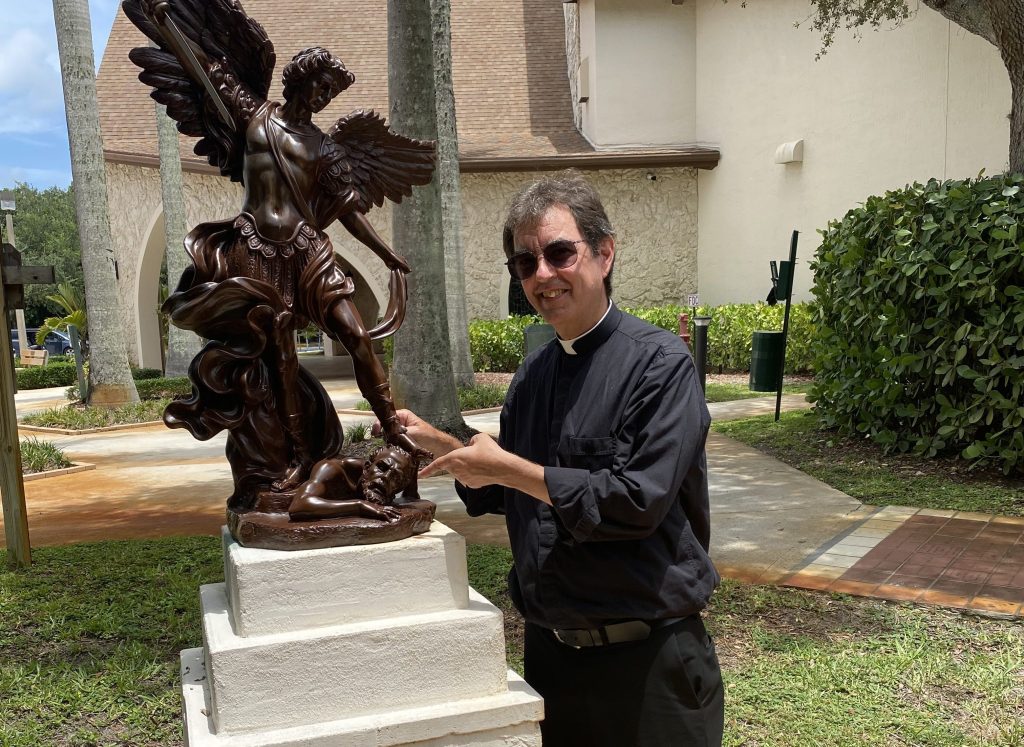
Photo: The father of lies has already lost, let us not give him any entry.

Link for the clip from the Dr. Phil Show showing the list for why we lie

Link for the Mass readings for Saturday, June 13, 2026

The guidance of the Holy Spirit offers us more wonder, beauty, good, and truth than we can imagine.

Benjamin Franklin is quoted as saying, “Wise men don’t need advice. Fools won’t take it.” Most of us fall somewhere in the middle. Hopefully, we are less foolish and moving more along to path of gaining wisdom. Jesus continues his best efforts in today’s Gospel to offer guidance and assurance to his disciples that the Holy Spirit will continue to be their guide after his departure. “I have much more to tell you, but you cannot bear it now. But when he comes, the Spirit of truth, he will guide you to all truth” (Jn 16:12-13a).

Surely, Jesus could see the dimming lamps in the eyes of his disciples. As discussed yesterday, comprehending the death of the Messiah, his Resurrection, and return to the Father was a bit much to understand, let alone digest. Also, there was only so much that they could grasp with their finite intellect. Until they experienced the infused contemplative insights given to them by the Holy Spirit, there was only so much the apostles were able to be able to receive regarding the inner life of the Trinity, the divine communion of love between he Father, and the Son, and the Holy Spirit.

Yet, Jesus, sowed the seeds that his Father gave him to share. His disciples took in what they could and would come to reflect later with more experience. Jesus’ death and Ascension were not to put an end to their learning, deepening of their understanding, healing or further developing their relationship with Jesus and his Father. The Holy Spirit would continue what Jesus started, and would to lead them to all truth, the fullness of the foundational relationship that is the source of all that exists, the Holy Trinity.

Anyone involved in teaching anyone anything or learning something for one self knows, that just telling someone something does not mean that learning has happened. There is a process of introduction, integration, practice, review, mistakes, corrections, and adjustments until some proficiency is achieved. With the disciples, this is the same. Jesus did not just present things once and move on to the next order of business. That is why John declared at the end of his Gospel that: “There are also many other things that Jesus did, but if these were to be described individually, I do not think the whole world would contain the books that would be written” (Jn 21:25).

I am sure a part of what John was talking about here were the lessons, corrections, and guidance Jesus offered. Just as Joseph modeled for and guided Jesus in his trade in carpentry, so Jesus learned from him through observation, practice, mistakes, adjustments, and corrections. Jesus guided his disciples in the same way, as a mentor with apprentices. He was now assuring them that even though he would be leaving them, the guidance and leading would continue with the support of the Holy Spirit.

The lessons about the immanence of God, God within himself as a Trinitarian communion, that Jesus taught were not as concrete as sawing, hammering, and planing wooden beams though. God is not a being, not even a supreme being, meaning that he transcends our ability to comprehend the fullness of his reality. We will never fully comprehend God or exhaust the richness and the depth of our relationship with God. What the apostles and the saints to follow and we can still experience today is God’s grace building on our nature. When we read, pray, and meditate with these sacred texts, the Holy Spirit will communicate with us and grant us insights beyond any intellectual endeavor. Context and study is important, but the understanding and transformation is gained through the guidance of the Holy Spirit.

On the human level, we are guilty of malpractice in our relationships when we assume that we know everything there is to know about someone else. The gift of the person, the human being, is that we are ever-developing and growing in the mystery and wonder of who we are and who we are called to be. We can always surprise each other. If this is true for us in our relationships with each other, it is much more true in our relationship with God. Once we get to one level of understanding, we plateau for a time, but that is not the end of the journey. That is only a time to savor, to ponder, and contemplate until we are ready to go ever deeper into the truth that the Holy Spirit will reveal to us.

Our tradition teaches us that the fullness of God has been revealed in Jesus Christ, which is true, yet to comprehend that revelation will take a lifetime and continue on into eternity just to scratch the surface. St Thomas Aquinas (1225-1274), a Dominican Friar, who is considered the Angelic Doctor of the Church, was one of the top theological influences during the Scholastic Period, yet close to the end of his life he had a deep and intimate encounter with God in which he came to realize that all of his intellectual achievement, all that he had written, mattered no more than a pile of straw compared to that which God had revealed to him in a single moment of infused contemplation!

Arguably one of the wisest persons of his time, and some would say one of the most brilliant minds ever, was also one who was steeped in daily prayer and continued to be open to the majestic wonder of the glory of God. May we too continue to embrace the gift of wonder, the gift of learning, and never settle, rest and savor yes, but continue to learn and grow, to seek and hunger for the Good, the True, and the Beautiful, to continually allow our hearts and minds to be open to the Holy Spirit that he may guide us “to all truth”!


Photo: Experienced a nudge of the Holy Spirit to take a longer walk before Mass yesterday morning. A wonderful moment of joy from a simple activity that then heightened as I celebrated Mass.

Link for the Mass readings for Wednesday, May 13, 2026

“You have heard what I said… But I say to you…”

“Do not think that I have come to abolish the law or the prophets. I have come not to abolish but to fulfill” (Mt 5:17). Jesus then went on to teach what he meant by that statement by following up with his six antitheses. Four of which are covered in today’s reading.

Upon first reading, Jesus may appear to be opposing, this is why these statements are labeled antitheses, the teachings passed down generation after generation from Moses. Jesus is doing no such thing. He is digging deeper to expose the root of each condition. As he himself said, he has not come to abolish the law and the prophets, the Hebrew sacred scrolls, he has come to fulfill them and give them deeper context and meaning.

When Jesus recounts Moses’ prohibition against killing, he follows up by stating that we are not to give in to the temptation of anger or lashing out with derogatory words. By being more intentional with our words and less reactive, we have a better chance of making more sound and rational statements. When we are more conscious of our thoughts and think them through before letting them lose, we are more apt to respect the dignity of the person we are speaking with as well as ourselves. We are also less likely to unleash our anger or lash out with harsh words. Doing both, will help us not to escalate to physical violence. Something we are very much in need of in our time.

Jesus then addressed the prohibition against committing adultery. Not only are we not to have sexual relations with someone else’s spouse, but we are also to resist the temptation of thinking about anyone in any lustful way. Again, Jesus is lifting up the dignity of the person. People are not to be objectified and lessened to mere carnal objects of satisfaction through our actions or our thoughts.

Now in both cases above, Jesus is not saying the we are robots. We will get angry, we will experience attractions, neither which are bad nor what Jesus is asking us to resist. With each emotion, we are to experience them. They are not to have free reign and to be disordered. Instead as we experience each, we bring them to Jesus with a prayerful pause or period so to properly order them to the will of his Father. Anger properly channeled can lead to healthy fraternal correction and attraction can lead to a chaste and blessed friendship.

Such a friendship can then blossom into marriage. Jesus, upholds the dignity and sacredness of marriage, recognizing that this is to be a covenantal relationship. There were some prescriptions for dismissing a wife in ancient Israel considered to be valid just because the wife had cooked a bad meal. Jesus recognized that the reality of a bill of divorce, especially for the women in his time, placed them in a very precarious position economically as well as socially. Not to mention the toll that the rupture of the relationship could cause. Women, without any means to support themselves, would seek to remarry or sought prostitution. Often their families would not take them in to care for them.

This is why Jesus stated that “whoever divorces his wife – unless the marriage is unlawful – causes her to commit adultery and whoever marries a divorced woman commits adultery” (Matthew 5:32). A bill of divorce in this time is not equivalent to the civil divorce of our time. The couple was still considered married. Moses made an allowance for a bill of divorce, because of the hardness of men’s hearts and to protect women from abuse. In the most egregious of cases, men would kill their wives to marry another.

Jesus is holding up the dignity and sacredness of marriage which is a sacrificial gift of love between husband and wife, with the openness to bring forth life into the world. The Church continues to follow Jesus’ teaching today, considering marriage, even in the event of a civil divorce as valid until proved differently. Thus a declaration of nullity granted is not considered Catholic divorce, nor if one is issued does the ruling consider the children of the marriage illegitimate. God brings about a greater good, even from marriages that he did not bring together. The good in this circumstance can be the children.

One more antithesis presented in today’s account was the value of giving our word. What we say reveals something about our character. We are to resist saying what is expedient in the moment, as well as swearing false oaths to justify false claims. Instead, Jesus commands us to be honest and truthful in each situation such that our “‘Yes’ mean ‘Yes,’ and [our] ‘No’ mean ‘No'” (Mt 5:37). If we are telling the truth, there is no need to make an oath. We speak the truth and stand on the truth.

In each of the four antitheses that we read about today, resisting not only murder but also anger and unleashing dehumanizing words, not only committing adultery but also remaining chaste in mind and heart, being faithful in marriage which is a unbreakable covenant, and being true to our word, Jesus calls his disciples to a higher standard. This is just as true for us today.

The light of Jesus reveals to us the darkness of our survival and fight or flight instincts. By slowing down, stepping out of the constant noise and business, we can resist the disordered affections and baser temptations of our fallen nature. This begins in our thoughts. For if we choose to be more aware of and intentional in engaging with our interior lives, our thoughts and emotions, begin to breathe into and experience them instead of deny or not pay attention to them, we will become less reactive and impulsive. We then stand a much better chance of thinking and speaking about and acting better toward one another.

Unfortunately, the effects when we don’t can be devastating, dehumanizing, and isolating. We can see results of not following God’s laws and its destabilizing effects all too often in our culture and society. Lowering the bar of these foundational principles is not the answer. We need not separate ourselves from the commands of Jesus, but yolk ourselves to him, and then we can heal and move closer to putting into practice his teachings. The sprouts of our words and actions spring forth from the seeds of our thoughts, for good or for ill.

Practicing the teachings of Jesus begins by acknowledging the value and relevance of them. We need to resolve with a deeper commitment and firmer intent to be more careful in what we feed our thoughts, words, and actions with, while at the same time understanding that on our own we will fall short. God is God and we are not. We need the support of the Holy Spirit as well as the support and accountability of others. Aligned with Jesus, trusted family and friends, we too can fulfill the law and the prophets, by fulfilling the way of love Jesus calls us to aspire to, and will become more human in the process.


Photo: Jesus can make the antithesis statements, “You have heard that it was said” relating to the Hebrew Scriptures, and then, “But I say to you…”, expanding the teaching of the law and the prophets by his own authority because he is the Son of God come to save us.

Link for the Mass readings for Sunday, February 15, 2026


We are to reflect the light of Jesus with every thought, word, and deed.

Our readings today embody the core of the Gospel message, in fact, the core of the written record of the Bible and our Tradition as Catholics. The Son of God became one with us in our humanity so that we can become one with him in his divinity. Jesus is the incarnation of the Son of God, he is God made man so that through our participation in his life we can become like God, we can be restored to the likeness of God that we were originally created to be and that has been lost to us through our sin.

Ultimately, what is Jesus saying to his disciples then and to us his disciples today when he said, “You are the salt of the earth” and “You are the light of the world”? We are called by him to be holy, we are to be deified or divinized. Our likeness is meant to be like God’s likeness and so we need to be transformed, perfected in and by Christ and through the Holy Spirit. As we are, our likeness to and the glory of God will gradually be restored.

We are a living, craving, hunger, and desire to be one with God and each other. This is true for the atheist as well as the mystic alike. God did not create us just to survive and merely exist, to take up space and then die. He created us to be fully alive, to be loved and to love, and to collaborate with him to bring about his reign on earth as it is in heaven. We are to breathe, receive, rest, and abide in the love of God, experience his consolation and joy, just as we are as his beloved daughters and sons. Yet, we all fall short of the glory of God when we sin and curve in upon ourselves.

Sometimes that happens because of the deep physical, emotional, psychological and spiritual wounds that we have experienced. It also happens when we listen to the father of lies and demons that seek to distort, divert, and destroy the love of God and the good he has created. We are tempted to turn away from the love God offers and feed the anxieties and fears that arise as we feel isolated and alone. Jesus is the light that has come to reveal to us a path that leads to forgiveness, healing, and a clearer vision of the truth.

Jesus came to save us and he opened up heaven for us in the humanity he assumed. God loved us into existence out of the abundance of a trinitarian communion of love, and loves us so much he is willing to risk that we will reject him. He desires that we choose him freely. Jesus shines the light in our darkness to reveal to us those ways in which we have said no to God and invites us to repent, to turn away from our sin and to restore our relationship with our loving God and Father.

Our yes to God is not a one time yes for all time. We need to make a daily, moment by moment yes to God in every aspect of our life. God loves us more than our worst mistakes, our greatest sin, and more than we can ever mess up. He is just waiting for us to turn to him, so he can forgive us and release us from our bondage. God loves us so that we can receive his love, return to communion with him, and love others as he has loved us.

Jesus calls us to be the salt of the earth, to preserve that which is good and holy in God’s creation and to add the flavor of Christ to our human lives. Jesus calls us to be the light that shines in the darkness leading people to experience that which is good, true, and beautiful about being a human being fully alive. That means we need to be cleansed of our sin, healed from our wounds, and better discern the voices that we are listening to. Each thought, word, and action that we take will help us to be salt and light when we discern each through a prayerful pause. If we make the time to breathe and pray before entertaining any thought, speaking any word, and engaging in any action, we will make choices for God and our holiness.

On our own merits and efforts, this is impossible, but in union with Jesus all things are possible. We become holy by following the guidance of the psalmist. Our hearts are to be firm and steadfast as we trust in the Lord (cf Psalm 112: 8-9) and along with St. Paul we need to believe that we “rest not on human wisdom but on the power of God” (I Cor. 2:5). As we are more and more conformed to the life of Jesus, people no longer see us, but Jesus working in and through us. As we mature in our walk with Jesus we too will be able to say with Saint Paul that I have been crucified with Christ, yet it is no longer I who live, but Christ who lives in me (cf. Galatian 2:19-20).

We become the salt of the earth and a light to the world, we become holy, when we accept the reality that God is God and we are not. When we willingly and with firm intent say yes to the grace, the free gift, of the invitation of Jesus. When we read from and meditate and pray with the words of the Bible, and are willing to be led into contemplation by the Holy Spirit; when we slow down on a daily basis to hear the Word of God who speaks to us in the silence of our hearts; and when we allow the love of the Holy Spirit to purge and purify us from us all that is not of God, we experience forgiveness, healing, and freedom to be ourselves.

Our prayer and practice and transformation is not for us alone. Prayer, meditation, and contemplation are where we become aware of the invitation to experience God vertically, where he calls us through the love of the Holy Spirit and sends us out on mission. This outward action directed toward others is our relationship with God horizontally. The two directions, vertical and horizontal, intersect as the trinitarian love of the Cross.

When we become people of prayer, allow our eyes to see the needs of our neighbor, and allow our hearts to feel again compassion for one another, we will hear with the prophet Isaiah:  “Share your bread with the hungry, shelter the oppressed and the homeless; clothe the naked when you see them, and do not turn your back on your own” (Isaiah 58:7). We will also hear Jesus say, “I was hungry and you gave me food, I was thirsty and you gave me drink, a stranger and you welcomed me, naked and you clothed me, ill and you cared for me, in prison and you visited me” (Mt 25:35-36).

These words may not be easy to hear nor to put into practice, but the Word of God is the kindling we need to ignite the embers of our soul. Our “light will shine before others” (Mt 5:16) when we ponder these words and are willing to allow the Fire of the Holy Spirit to burn the dross of our sin, pride, prejudice, and selfishness from within, and allow ourselves to be set ablaze by the Love of God. When we allow Jesus to live in and through us we will no longer be shaped by the world, but we will set the world on fire with his love.

Aflame with the fire of God’s love, we become “the light of the world” (Mt 5:14). This light does not come from ourselves. We are to reflect the light of Jesus in our homes, our places of worship, and in our communities. Let us not be afraid of this present age or each other. Let us allow the light of Christ to help us to see each other as brothers and sisters. Let us love one another, will each other’s good, as Jesus loves us.


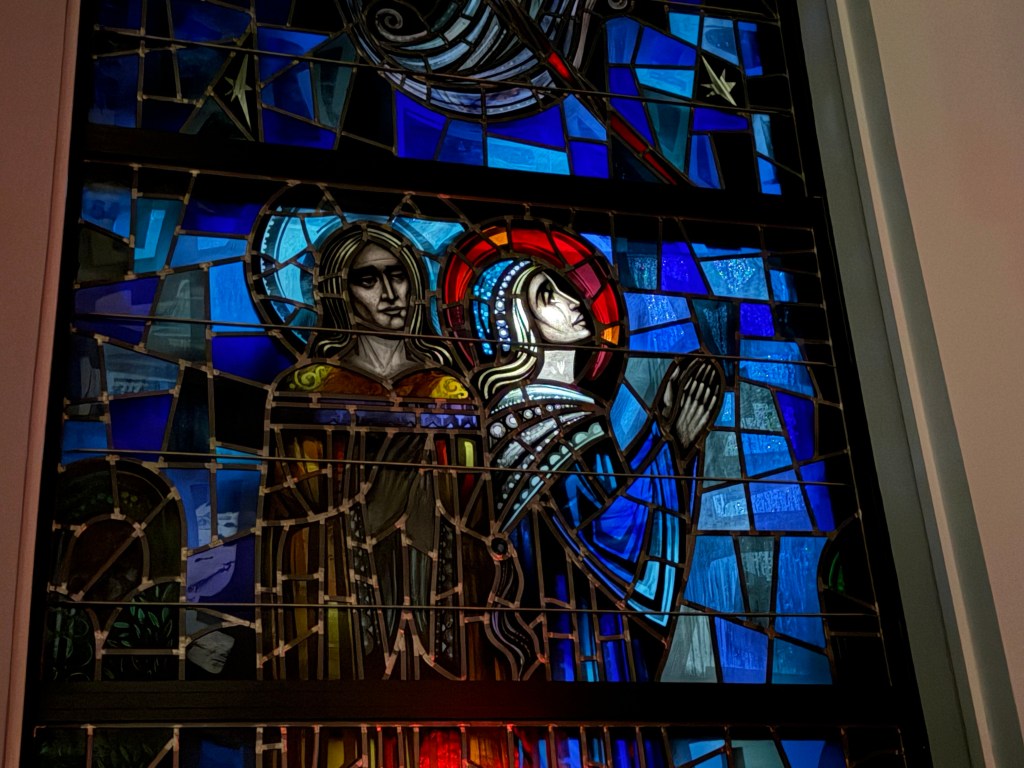
Photo: Who better than Mary reflected the light of Jesus? Mary’s face is illuminated from the rising moon outside the stained glass window.

Link for the Mass readings for Sunday, February 8, 2026

The love of Jesus can help us in our times of conflict.

The question raised by “the chief priests and the elders of the people” regarding what authority Jesus was teaching was not an uncommon question. Rabbis and teachers often began their presentations by sharing with their listeners who was their teacher. It would be comparable today to say what university we received our degree from.

There is also a bit of edginess in their question as well because Jesus has not only consistently been challenging their authority but he had also just purged the temple by driving out the sellers and money changers (see Mt. 21:12-17).

Although Jesus’ authority came directly from God, Jesus did not fall for their trap, wanting him to say just that. Then they could accuse him of blasphemy or force him to say his authority did not come from God and show him to be a fraud. Jesus did not give them the satisfaction. Instead of answering their question, Jesus asked one of his own. “Where was John’s baptism from? Was it of heavenly or of human origin” (Mt: 21:24)?

The answer given by these priests and elders showed further their unwillingness to accept who Jesus was. They were the shepherds of the people of Israel, yet they would not speak the truth. They were like reeds swaying in the wind (see Mt. 11:7). Unlike John the Baptist who stood on the truth and spoke truth to power, these chief priests and elders offered an answer that was calculated and weighed out by taking a quick opinion poll among themselves. Their answer was a lukewarm, “We do not know.” 

In answering this way, their authority as leaders was diminished. For if they were the religious guardians and guides, why could they not answer the simple question regarding the origin of John’s baptism? Jesus was not deflecting the question. He was prefacing his response. For if they recognized that John’s baptism originated from God, then why would they refuse to believe Jesus? They knew the answer, they were not willing to give it.

How about us? Are we like reeds swaying in the wind? Do we weigh our answers solely on a perceived response or do we speak the truth as the Holy Spirit leads us? We want to be liked, respected, to belong and to fit in, to be affirmed and accepted, which is healthy and natural, but at what cost? Sometimes we feel uncomfortable speaking what we believe because we fear another’s reactions. This is even more challenging these days because a simple response can affect a harsh reaction.

To live out our baptismal call as prophets, there will be times that we need to resist the perceived and real pressures we feel, resist our own insecurities, lean into conflicts, trust in God, seek his guidance, and speak the words the Holy Spirit gives.

As we do so, we need to remember to speak from a place of understanding and love. It is better to engage in a dialogue, not just mutually imposed monologues. A good reminder is to follow the lead of Jesus and ask more questions rather than offer ultimatums and pronouncements. Our goal in any encounter is not to impress or prove we are right and the other wrong, but to express what we believe and allow others to do the same. We can grow from one another when we are willing to listen and dialogue even when we disagree.

Sometimes God invites us to be silent and sometimes to speak boldly with passion. The key is to prayerfully pause, then choose to speak or to be silent. It is possible to move away from the extremes of talking past or shouting over one another and avoiding talking altogether. This happens when we listen first, breathe, pray, pause, and respect each other.

Jesus, please forgive us for giving into automatic reactions, not speaking as you have led, and disrespecting others. Help us in each encounter to breathe, to have ears to hear your guidance, to be understanding and respectful. Give us the courage and words to speak with charity and help us to know when to be silent and to listen. Above all, help us to love.

———————————-

Photo: Quiet times alone with God help us to experience peace that we can carry with us in times of conflict and disagreement.

Link for the Mass readings for Monday, December 15, 2025

“Religious confession is no substitute for personal relationship with Jesus”.

Jesus said to his disciples: “Not everyone who says to me, ‘Lord, Lord,’ will enter the Kingdom of heaven, but only the one who does the will of my Father in heaven” (Mt 7:21).

I have written quite often, quoting and paraphrasing one of my favorite quotes from St. Irenaeus, that Jesus came to be one with us in our humanity so that we can become one with him in his divinity. In his becoming one with us in our humanity he invites everyone, no one is excluded, to participate in his divinity. Yet if everyone is invited, how can Jesus say that not everyone will enter the Kingdom of heaven?

The answer to that question is in the line that follows. The one who will enter heaven is, “the one who does the will of my Father in heaven.” If this verse does not help, then it might be helpful to understand a little about heaven, as best as we can, as the mere mortal, finite beings that we are.

Heaven is not so much a place but a state of being in relation to God, in which we are privileged to share communion and a deeper intimacy with God for all eternity. We will still not know everything about God because God is infinite and we will still be finite even in heaven. God is without limit, we are limited. We will never exhaust our relationship, never get bored with God.

Maybe a more three dimensional, an earthly example may be of help. If we were invited to play a sport, an instrument, or to act in a play, with the end goal being that we would play in the upcoming game, concert, or performance, we might feel pretty excited about the offer. We tell the coach, conductor, or director “That’s great news!” Yet, in the days that follow, we do not attend any of the practices, we do not practice the skills required to play the position, instrument, or role and we do not return any of the follow-up invitations by phone, email, or text. The day of the big game, concert, or performance comes, we gather our self together and head on over to the arena or hall. We arrive to see the coach, conductor, or director but are denied entrance. We might say, “I don’t understand, you invited us to play!” The reply is, “Not everyone who says to me coach, coach (conductor, conductor, or director, director) is ready and prepared.”

Jesus invites us to play a part in God’s theodrama, everyone. Some say yes and some say no. Some say yes, and then don’t put into practice what is then asked, some say yes and do some things, some say yes and dive in. Most of us take a few steps forward and a step or two back. Just like preparing to play in a big game or perform in a big concert, or play, we need to be committed, disciplined, and persistent. Unlike a missed opportunity to participate in a game or performance, that we can correct and make another attempt down the road, we don’t want to miss the opportunity to spend eternity with God in heaven.

The above analogy does not imply in any way that we earn our way into heaven, or we can do so on our own effort and will power. The bottom line is that Jesus gave his life for all of us and through his grace, we have been saved. Our salvation is a gift freely given. Yet, we have to be willing to receive and open the gift. Our time here on earth is the time we are given to: open the gift we have received, work out our salvation, not just hear but to also put into practice Jesus’ teachings, and be about building our relationship with him. As we do so, we will be transformed by and conformed to Jesus, so that we can come to know his Father as he does, and then we can reflect the light and love we have received to others.

It is not enough to say that we believe in Jesus. “Religious confession is no substitute for personal relationship with Jesus and the obligation to obey his Father’s will. If our creed and our conduct are out of alignment, then our profession of Jesus as Lord is not a true submission to his lordship. The mere fact that believers can perform miracles in Jesus’ name, which is an exercise in charismatic grace, is no proof that sanctifying grace has penetrated their lives or brought them closer to Christ” (Mitch and Sri, 121).

If we want to know and put into practice God’s will, we need to know God. Advent is a time of preparation, a time of getting to know Jesus who is already with us and inviting us to let him have reign of every part of our lives. Jesus helps us to recognize and see what our lives are like without God and how they are with God. If we are willing to see, that clarity helps us to better choose our thoughts, words, and actions.

When we are humble enough to acknowledge ways that weaken our relationship with God, we can then repent and seek forgiveness. God never tires of forgiving us. Let us never tire of asking for forgiveness and committing more to knowing and putting into practice his will. Each time we seek and receive forgiveness, our minds and hearts are not only expanded but properly aligned to Jesus so that we may experience more of the love of the Holy Spirit, which helps our relationship to grow and to put into practice our Father’s will.

——————————————————————————

Photo: “Prayer can truly change your life, for it turns your attention away from yourself and directs your mind and your heart towards the Lord.” – St. John Paul II

Mitch, Curtis and Edward Sri. The Gospel of Matthew. Grand Rapids, MI: Baker Academic, 2010.

Link for the Mass readings for Thursday, December 4, 2025

The Spirit of God will reveal the truth of his infinite love for us.

Today we celebrate Trinity Sunday. The Trinity is the foundation of not only our faith but the reality of all that exists. God has been, is, and always will be. God exists as a communion of three Persons, God the Father, God the Son and God the Holy Spirit. Three Persons in one God, but not three beings.

Anything we say about God is going to be woefully inadequate regarding the truth of who God is. Jesus, as the Son of God incarnate, revealed to his disciples the truth of who he is and who his Father is. As he approached his crucifixion, he began to prepare his disciples for the coming of the Holy Spirit. “I have much more to tell you, but you cannot bear it now. But when he comes, the Spirit of truth, he will guide you to all truth” (John 16:12-13).

We consistently how hard it was for the disciples to understand that he was the Son of God, that he in fact is God. Jesus to explain the Holy Spirit to them he knew would not happen. But the seeds that he planted would take firm root for the appointed time at Pentecost which we celebrated last Sunday. The Holy Spirit would come upon Mary and the Apostles, and then we see them, as expressed in the Acts of the Apostles, coming into their spiritual maturity as they are willing to be led by the Holy Spirit.

We are not going to understand the deepest truth of our faith and who God is by intellect and reason alone. To begin we have a better chance of saying what God is not. God is not a being, not one being among many, nor the greatest of all beings. God is not in the same genus as us, nor in any genus. God is not even a supreme being, because God transcends beyond all space and time. God is completely self sufficient, thus he does not need us for our existence, nor does he need anything to exist. God is the very ground and source of all being.

God is infinite act of existence, or in the Latin of St Thomas Aquinas, ispum esse subsistens, the sheer act of “to be”. This means that God has no limitations. To say that God is three Persons is even harder for us to comprehend because we often in our modern sense use the words person and being synonymously. To use the word person in speaking of God means to speak relationally.

We describe God as Father because he begets God the Son, God the Son is the one begotten. The Son is not generated or created, because the Son has always existed with the Father. This is true because they are not finite beings separate from one another. They are infinite, though distinct, in their relation to one another. God the Holy Spirit is then the Love shared between God the Father and God the Son. God within himself then is an infinite communion because of the infinite giving, self-emptying, and infinite receiving between each other. Each Person gives and receives infinitely, perfectly giving all and holding nothing back.

We will never fully comprehend God because he transcends our finite reality. We will be frustrated also if we treat the mystery of God as a problem to be solved. God is not an equation to formulate but a person that we can encounter and develop a relationship with. This is possible because to be in relationship with God and one another is the very reason we have been created. God draws close to us, he reveals himself to us, he seeks us out, his created beings. We are blessed to live in a time when he has already drawn close to us in the Person of his Son through the love of the Holy Spirit.

Jesus and the Holy Spirit continue to reveal the truth of God the Father to us. When we allow the Holy Spirit to dwell within us and follow his guidance, we too can experience the communion of love shared between God the Father, God the Son, and God the Holy Spirit.

The best way to understand, to know, to build our relationship with God, is not to force God to fit into our finite reality, mindset or limited view, but to be open to, “the Spirit of truth,” and “he will guide [us] to all truth” (Jn 16:13). The Holy Spirit will guide and lead us to all truth when we resist curving or turning in upon ourself and instead make the time to be still, to breathe, to ponder his living word, and lift our hearts and minds to him in prayer. When we do so we will be expanded and transformed by his love and conformed to God’s will. This gift of grace will grow the more we are open to opportunities to be loved and to love in our everyday moments. For where the willing of the good of each other is, God is, because God is love” (1 John 4:8).

When we as fathers follow the will of the Father, when we are willing to be loved by the Holy Spirit and to love our children and others in return, and when we are willing to sacrifice and serve as Jesus, we are at our best. Happy Father’s Day!


Photo: Spending some quiet time receiving the love of God.

Link for the Mass readings for Sunday, June 15, 2025

The Holy Spirit will help us to continually embrace wonder and experience truth.

Benjamin Franklin is quoted as saying, “Wise men don’t need advice. Fools won’t take it.” Most of us may fall somewhere in the middle. Hopefully, we are less foolish and moving more along to path of gaining wisdom. Jesus continues his best efforts in today’s Gospel to offer guidance and assurance to his disciples that the Holy Spirit will continue to be their guide after his departure. “I have much more to tell you, but you cannot bear it now. But when he comes, the Spirit of truth, he will guide you to all truth” (Jn 16:12-13a).

Surely, Jesus could see the dimming lamps in the eyes of his disciples. As discussed yesterday, comprehending the death of the Messiah, his Resurrection, and return to the Father was a bit much to digest. Also, there was only so much that they could grasp with their finite intellect. Until they experienced the infused contemplative insights given to them by the Holy Spirit, there was only so much the apostles were going to be able to digest of what Jesus was sharing with them about the inner life of the Trinity, the divine communion of love between he Father, and the Son, and the Holy Spirit.

Yet, Jesus, though, still needed to share what his Father gave him to share, and the disciples were to take in what they could. Jesus’ death and Ascension were not to put an end to their learning, deepening of their understanding, or further developing their relationship with Jesus and his Father. The Holy Spirit would continue what Jesus started, and would to lead them to all truth, the fullness of the foundational relationship that is the source of all that exists, the Holy Trinity.

Anyone involved in teaching anyone anything or learning something for one self will know, that just telling someone something does not mean that learning has happened. There is a process of introduction, integration, practice, review, mistakes, corrections, and adjustments until some proficiency is achieved. With the disciples, this is the same. Jesus did not just present things once and move on to the next order of business. That is why John declared at the end of his Gospel that: “There are also many other things that Jesus did, but if these were to be described individually, I do not think the whole world would contain the books that would be written” (Jn 21:25).

I am sure a part of what John was talking about here were the lessons, corrections, and guidance Jesus offered. Just as Joseph modeled for and guided Jesus in his trade in carpentry, so Jesus learned from him through observation, practice, mistakes, adjustments, and corrections. Jesus guided his disciples in the same way, as a mentor with his apprentices. He was now assuring them that even though he would be leaving them, the guidance and leading would continue with the support of the Holy Spirit.

The lessons about the immanence of God, God within himself as a Trinitarian communion, that Jesus taught were not as concrete as sawing, hammering, and planing wooden beams though. God is not a being, not even a supreme being, meaning that he transcends our ability to comprehend the fullness of his reality. We will never fully comprehend God or exhaust the richness and the depth of our relationship with God. What the apostles and the saints to follow and we can still experience today is God’s grace building on his nature. When we read, pray, and meditate with these sacred texts, the Holy Spirit will communicate with us and grant us insights beyond any intellectual endeavor.

On the human level, we are guilty of malpractice in our relationships when we assume that we know everything there is to know about someone else. The gift of the person, the human being, is that we are ever-developing and growing in the mystery and wonder of who we are and who we are called to be. We can always surprise each other. If this is true for us in our relationships with each other, it is much more so in our relationship with God. Once we get to one level of understanding, we plateau for a time, but that is not the end of the journey, that is only a time to savor, to ponder, and contemplate until we are ready to go ever deeper into the truth that the Holy Spirit will reveal to us.

Our tradition teaches us that the fullness of God has been revealed in Jesus Christ, which is true, yet to comprehend that revelation will take a lifetime and continue on into eternity just to scratch the surface. St Thomas Aquinas (1225-1274), a Dominican Friar, who is considered the Angelic Doctor of the Church, was one of the top theological influences during the Scholastic Period, yet close to the end of his life he had a deep and intimate encounter with God in which he came to realize that all of his intellectual achievement, all that he had written, mattered no more than a pile of straw compared to that which God had revealed to him in a single moment of infused contemplation.

Arguably one of the wisest persons of his time, and some would say one of the most brilliant minds ever, was also one who was steeped in daily prayer and continued to be open to the majestic wonder of the glory of God. May we too continue to embrace the gift of wonder, the gift of learning, and never settle, rest and savor yes, but continue to learn and grow, to seek and hunger for the Good, the True, and the Beautiful, to continually have our hearts and minds open to allow the Holy Spirit to guide us “to all truth”!


Photo: A momentary pause during my Rosary walk to observe the interplay between some mangrove stems and barnacles. Many invitations to experience God’s wonder when we get out and about!

Link for the Mass readings for Wednesday, May 28, 2025

May we pray that we will be more willing to help “one another to walk in love and truth.”

When Jesus said to his disciples: “If the world hates you, realize that it hated me first”, Jesus was not proposing an-us-verses them mentality, for he had just spoken to them about loving others as he loves them. Falling into an-us-verses mentality for those suffering from persecution is an understandable posture. It is just not the stance that Jesus proposes for us to take. We are to love our enemies, we are to love those who hate us and persecute us. Impossible? On our own will power alone, yes, for apart from Jesus we can do nothing, but with him all things are possible, even loving our enemies, haters, and persecutors.

Jesus is making it plain to his disciples that they need to be prepared, that they will face the same that he did. They will be persecuted, mocked, imprisoned, and many will give their lives just as Jesus did. The gospel message is a challenge. We are challenged to have a change of mind and heart and not to think in the ways of the fallen world. Our minds are instead to be transformed by and conformed to the love of Jesus the Christ. This means that our focus must shift away from being self first and foremost to putting God first. God is to have the primary place in our lives.

We know we are putting God first instead of our fallen nature when we react less and love more. Reactions are based in fear, defensive, and slipping into an-us-verses them mentality. “They”: are responsible for the state I am in, are taking my jobs, are not allowing me to worship or speak in the way I want to, it is all their fault, they made me do it. These are all reactive thoughts that lead to uglier statements and actions. Jesus invites us to assume the disposition resisting the temptation of reaction and instead choosing intentional action grounded in God’s love for us and making our decisions from God’s guidance and not our reactions.

The way we can be more intentional and less reactive is to spend more time making friends with silence, being more still to pray and meditate with God’s word in the Bible and also in his word of creation. Much of our reaction comes from our harried pace, keeping us from being in touch with our deep-seated wounds, fears, and prejudices. We run from the mirror Jesus holds up to us. It is important to stop and pray regularly. When we do and we are willing to face the sin in our hearts, we can identify them and let them go. We can bring our struggles, pain, and areas in need of healing to Jesus for healing. A way to begin to turn away is by taking some deep breaths and ask Jesus to shine the light of his love in our hearts so that we can see what lies hidden in those dark corners. Then we can identify those sins, renounce, let it go, be forgiven of them, and set free.

Embracing the humility to confess our sins and to die to our sinful ways helps in our healing. We are not only forgiven, Jesus gives us the grace to grow in our relationship with him and each other and we are strengthened to resist temptations. We become more patient, understanding, and truer to who Jesus calls us to be, which is people who love. We will each other’s good by treating each other as brothers and sisters. We are better able to accept that we are all imperfect, make mistakes, experience loneliness, and just want to belong, and be loved.

Pope Leo encouraged us in his Regina Caeli address on May 11 to, “ask our Heavenly Father to assist us in living in service to one another, each according to his or her state of life, shepherds after his own heart, (cf. Jer 3:15) capable of helping one another to walk in love and truth.”

Jesus and Pope Leo show us the way to the Father is to ask him for help. Let us ask God, our Heavenly Father to help us to live more consciously and pray to renew and conform our lives to the Jesus who gave his life that we might be free from the grip of our own sins, prejudices, and darkness. May we allow the love of the Holy Spirit to guide and flow through us, so as to dissolve attitudes of hate and division, and instead soften our hearts that they would be more open to dialogue and healing.

May we no longer turn away from the temptation of revenge and fueling contempt, hate, and dehumanization, and instead choose to pause, breathe, receive, rest, and abide often in Jesus’ love for us. Empowered and embodied by his love, obeying God’s will and his commandments, we will be empowered to resist the easy and impulsive reaction so as to not retaliate in kind, but instead choose to intentionally respond in ways that are understanding, compassionate, and loving. In this way, we can heal and help others to heal and to “walk in truth and love.”

———————————————————————————-

Photo: Pope Leo offering his first Regina Caeli address on May 11, 2025. Vatican News photo credit.

Link for Regina Caeli Pope Leo

Link for the Mass readings for Saturday, May 24, 2025