Called, loved, and sent.

The rejection of Jesus by those in his hometown did not slow down his mission. We can imagine that Jesus knew what he was going to do already, but en route wanted to stop by to see if any from his “native land” would like to participate in his public outreach. Apparently, no one, or only a very few, those who were healed by him, did. Jesus, as he does throughout the Gospel of Mark moves on without missing a beat, much like Mary going in haste to bring the good news to Elizabeth. Jesus went ahead and, “summoned the Twelve and began to send them out two by two and gave them authority over unclean spirits” (Mk 6:7).

Could the rejection of the people of Nazareth then also have been a preparation for the sending of the Twelve? They had experienced his exorcisms, teaching with authority and healing with miracles, and also saw the reaction of the crowds. Before he gives them some final instructions, maybe the most important of all was to be faithful to the message of repentance that they were sent to preach. They were to bring the light of Christ to those for him they were sent to reveal those sins they needed to turn away from those sins, attachments, and idols and instead turn to God and invite them to give their whole hearts and minds to them.

Jesus summons us and sends us out as well. We too have been accompanying Jesus and his disciples through each chapter. The word of God is living and alive and Jesus still reaches out and calls us as he called the Twelve.

At the end of each Mass, we are sent, just as the Apostles, to proclaim the Good News! All of us as the Body of Christ, believers in Jesus the Christ, those of us baptized into his death, are to live as his disciples and bear witness to how Jesus has transformed our lives. This is best done by repenting ourselves and placing God at the center of our lives. Jesus gives us each a unique call of evangelization with a particular charism and gift that the Holy Spirit imparts within us at our Confirmation.

Jesus is the one who calls, sends, and empowers us for mission. We are sanctified, made holy, and set apart when we say yes to his invitation, participate in his sacramental life, and follow the will of his Father. Jesus not only teaches with authority, but he also calls and sends us with that same authority. We are to rely on the divine providence of our Father. He prepares us and provides that which we need to accomplish the task he has given, and he will also send the Holy Spirit and others to provide help, aid, guidance, and support. We see this over and over again in the lives of the Apostles and each generation of saints thereafter.

At first sight, we may not agree with God’s choosing. Me, really? Those he sends to walk with us, are you sure! Yet, we only need to recall what he accomplished with the Apostles, remembering the imperfections of each apostle and their simple beginnings. Just as mustard seeds, that grew to mighty bushes, what wonders they accomplished in Jesus’ name. God does not see as we do, for we are often misled by appearances “or lofty stature” but God sees into the depths of the heart (cf 1 Samuel 16:7).

Ultimately it is not about us after all. It is about our willingness to be open to and led by God and to work arm in arm with those he has invited to walk with us. That makes all the difference. We are not to go forward alone. We are called to be in community as the Body of Christ. Jesus sent his disciples out two by two in the beginning, so that they could provide mutual support, guidance, encouragement, prayer, and accountability. We each begin best each day by making time to be still, to breathe, receive, rest, abide in God’s love, and listen to his word and guidance. Then we begin, step by faithful step, walking with our brothers and sisters to follow the light that Jesus shines before us.

—————————————————————————

Photo: Blessed to have begun my seminary journey with these my brothers in Christ!
Link for the Mass for Thursday, February 6, 2025

It is wonderful to be found. It is wonderful to be reconciled.

Those who edited the lectionary readings for the day chose to present the parable of the lost son and skip the parable of the lost sheep and the lost coin. This trilogy of parables is all found in Luke chapter 15. Reading the three together allows us to get a better sense of what Jesus is revealing to us. There is great joy in finding what has been lost, there is great joy in being found! Maybe we can recall something or someone that had been lost and then found, or have we ever experienced a time where we have been lost or separated, or a time when we have experienced a time of reconciliation from someone that we have been estranged?

I was somewhere in the age range from about six to eight when I came to the realization that I was separated from my parents in the Enfield Mall. I believe it was close to Christmas and we were in the toy store. I must have become distracted by something interesting, and stayed to investigate, while my parents and sister continued on. At some point, I became aware of that fact. It did not take long for the anxiety and fear to rise within me and the tears to well up. I walked through a few isles with no success in finding my family and then I headed toward the entrance that led out into the main mall.

Before continuing, I remembered my mother telling me that if I ever got lost, that I was to stay where I was, and she would find me. As I stood indecisively and wondering what to do, a woman noticed my predicament and led me to a stone bench outside the store. We sat and she stayed with me until my parents returned. I am sure the time of separation seemed a lot longer to me than the actual time, and much of the memory is fuzzy, but the anxiety of separation had an impact on me as did the relief and joy of reconciliation!

In my story as well as each of these parables, there is a great joy for that which has been lost and found. How many of us are not even aware of our separation from God or each other? While I was in my own world of material wonder, I was left behind. The son who had squandered every bit of the inheritance he asked of his father before his death, realized not so much that he had really messed up, but that he was in a dire situation, and he made the right decision to come back home. His father never stopped looking for him, he actually saw his son returning “while he was still a long way off” and “filled with compassion. He ran to his son, embraced him and kissed him” (Lk 15:20).

This father is not seeking his son to bow before him and prove his repentance, his loyalty, and allegiance. The father runs to his son without hesitation. This act is no small thing, for an elder to run to a younger family member was unheard of and simply not done. He was breaking this social taboo, most likely to redirect the focus away from his returning son; the one who had betrayed his father, the son who would receive glares and snide remarks. Instead, the father rushed out with a reckless abandonment of love to embrace his son. The jaw-dropping, followed by echoes of gossip surely rose in chorus about the father’s present actions, not his son’s past actions.

God is watching and waiting, seeking opportunities to run to us with compassion and love to welcome us home as the father did in the parable of the prodigal son. God is also like the shepherd who does the absurd in his outpouring act of love, leaving the ninety-nine sheep to go and find the one stray. God seeks for each and every one of us just like that shepherd. God is represented by the woman who rejoices over finding one seemingly insignificant coin, for God rejoices in our turning back to him because not one of us is insignificant to him. We are all precious to God, each in our own unique way, and he loves us more than we can ever imagine.

No matter the reason that we have strayed, no matter the temptations and distractions we have fallen for, and/or how far we have wandered away, God loves us more than we can ever mess up. Lent is a season to open our eyes and recognize where we are in our relationship with God and with each other, to recognize the separation our choices have caused. To say, “I am sorry.” “Please forgive me.” and “I forgive you.” are powerful words of healing. This is how we can turn back to God and those we are estranged from within our lives. There is indeed great joy in the healing of relationships and reconciliation! Lent is a time to be found, Lent is a time to come home.

——————————————————————–

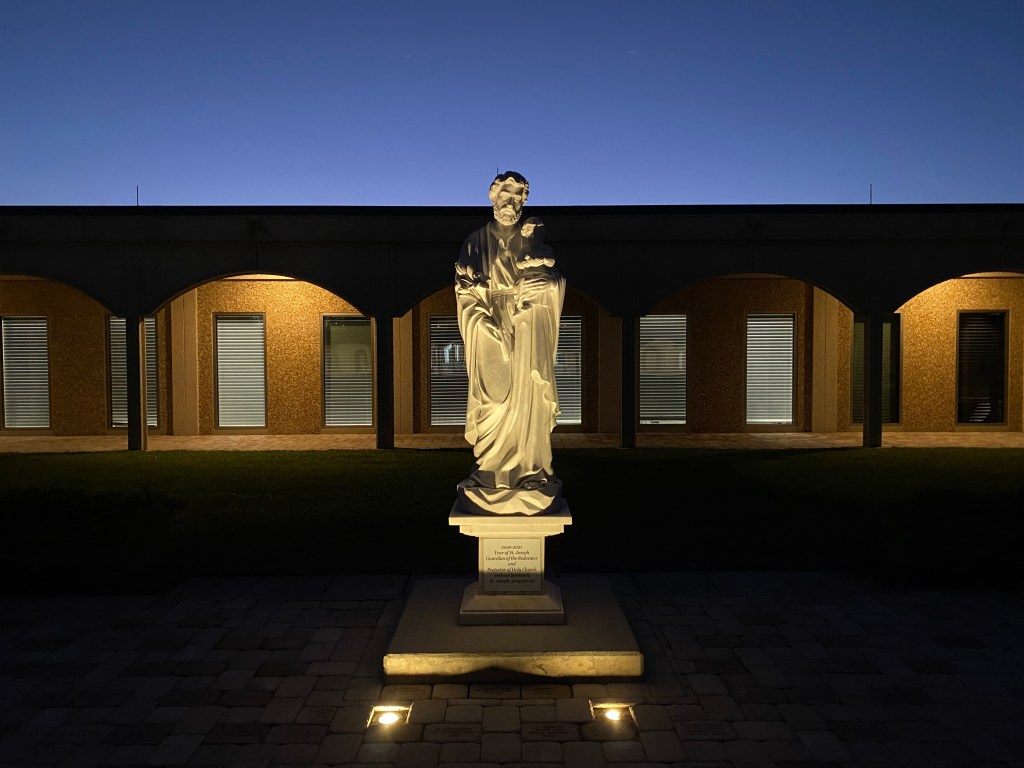
Photo: St. Joseph with Jesus in his arms, St. Vincent de Paul Regional Seminary, Boynton Beach.

Link for the Mass readings for Saturday, March 2, 2024