prayer


Jesus “spent the night in prayer.” Can we give God ten minutes a day?
Jesus went up to the mountain to pray, and he spent the night in prayer to God (Lk 6:12).
Jesus spent the whole night in prayer to God. What is prayer? All of us as human beings seek for meaning and to belong. We desire security and stability, as well as direction and adventure. We want to be accepted, to be loved, to love, and to experience meaningful relationships. These primary yearnings are present within us. Often though we confuse what we truly desire for temptations that ultimately leave us unsatisfied and more importantly ignore what will truly fulfill us: developing a relationship with God through prayer.
If you want to pray, you have already begun. The desire in and of itself to pray is prayer. The danger of reading about prayer is that we think we are praying. In the turning of a page or the completion of a chapter, we feel as if we are accomplishing something, but we are only imagining how prayer can be. “It is tempting to remain in the comfortable theater of the imagination instead of the real world, to fall in love with the idea of becoming a saint and loving God and neighbor instead of doing the actual work, because the idea makes no demands on you” (Peter Kreeft, Prayer for Beginners, 12).
There is a myriad of ways to pray and each practice will match each of our unique personalities and temperaments. The key to prayer is to make a commitment to a time and a place to pray each day and then show up at that time and place to pray. Start with a timeframe, such as five minutes that you know you can do. Depending on the discipline of prayer you practice, your family, school, work, and/or ministerial demands will be indicators as to how much you might be able to increase the time you pray once you have built a consistent practice.
The amount of time that we dedicate to prayer is not as important as the commitment to pray each day. We need to set in our daily schedule our non-negotiables for prayer first and build around that. Again, this will depend on our station in life. Young parents’ non-negotiables are their infant whereas someone who is retired will possibly have some more time.
Mass, the liturgy of the Hours, reading the Bible, sitting or walking quietly outside, at the morning table with a favorite devotional, the Rosary, Chaplet of Divine Mercy, spiritual reading, and all with a healthy sprinkling of silent meditation and contemplation are all practices that can help us to grow in our relationship with God.
St Therese of Lisieux offers us a good approach to prayer: “For me, prayer is a surge of the heart; it is a simple look turned toward heaven, it is a cry of recognition and of love, embracing both trial and joy” (CCC, 2559). No matter how we pray, our goal is that we don’t seek to bend God’s will to our’s but to allow our lives to be conformed to Jesus, that we encounter and build a relationship with him and each other, such that our experience of prayer matches St Augustine’s: “True, whole prayer is nothing but love” (Foster, 1).
Photo: One of my favorite daily practices, Rosary night walk!
Foster, Richard J. Prayer: Finding the Heart’s True Home. NY: HarperCollins, 1992.
Kreeft, Peter. Prayer for Beginners. San Francisco: Ignatius Press, 2000.
Link for the Mass readings for Monday, October 28, 2024

Experiencing God with us in everything is the gift of prayer.
“And I tell you, ask and you will receive; seek and you will find; knock and the door will be opened to you. For everyone who asks, receives; and the one who seeks, finds; and to the one who knocks, the door will be opened” (Lk 11:9).
Prayer can become frustrating when we make the time to pray and then we feel or think that nothing is happening or has happened. We may pray for a specific petition for our self, or for a particular intention for another and felt, or thought, that there was not an answer from God. One may pray a sincere, seemingly selfless prayer for a loved one, a child, a spouse, a friend, to be healed and the person still dies. They may be deeply hurt because they did what Jesus said; they asked, they pleaded and begged, but felt they did not receive the healing; that which they sought for, was not given and, instead what they found was nothing but pain and heartache from the loss; they knocked until their knuckles were raw and experienced no one on the other side.
Our attitude and orientation to prayer matters. When we sincerely turn our hearts and minds to God in prayer, something happens between us and God, though it may be beyond our cognitive grasp to understand or our sensory awareness to experience. There may indeed be emotional highs and consolations experienced in prayer, but if seeking those is the primary motivation for prayer we will find ourselves more frustrated than not. There may also be lows in prayer, dryness, even desolations, and even feeling God’s absence. Emotions are fleeting and not a good barometer when measuring the effectiveness of prayer.
Another big misconception is that we pray to God as if he were a gumball machine. It may seem a silly analogy but how many of us really do pray and only pray that way, and when we do not receive the specific thing we asked for, at the time specified, when we wanted and as we wanted, we brood and think God doesn’t care or does not, in fact, even exist. We may even slip into the barter posture. God if you grant me this, I will do that. If we are only open to receive what we want on our terms, again we are setting ourselves up for frustration.
The very desire to pray is the beginning of our awareness of God’s invitation offered to us to join him in prayer. God is the one who reaches out to us first. The answer to what or who we ask, seek, and knock is found at the end of the Gospel reading for today: “If you then, who are wicked, know how to give good gifts to your children, how much more will the Father in heaven give the Holy Spirit to those who ask him” (Lk 11:13)?
God knows what is best for us, he sees our potential, he wants us to experience joy and be fulfilled. How can we best live our lives in this world to attain that reality? We do so by receiving the Holy Spirit. Who is the Holy Spirit? The infinite, communal love expressed between God the Father and God the Son. Our goal in prayer is to enter into God’s reality, the infinite communion of Love.
Through building a relationship with God, which we are able to do through our participation and conformation to the life of Jesus, we come to see the truth of empty promises, apparent goods, substitutes to fill our emptiness and faulty defense mechanisms that we have been utilizing as guideposts to merely survive and get through life. When we stay consistent in an authentic life of prayer, we will change, we be aware and be able to let go of that which is false and will begin to bear the fruit of the Holy Spirit which are love, joy, peace, patience, kindness, goodness, gentleness, and self-control (cf. Galatians 5:22-23)?
We need to resist running away from apparent unanswered prayers, the pain of loss, and accept sometimes not knowing, and to trust that God has not abandoned us. He is with us in everything. Prayer is not primarily what we ask and that we receive. Prayer is a willingness to hear God’s invitation to enter into a deeper and more intimate relationship with him. Accepting this as a starting point will open a doorway leading into the open arms and embrace of his Son, Jesus, who awaits us in the depth of our need, confusion, grief, and pain. Even our loved ones who have died have not come to an end but have experienced a new beginning with our loving God and Father. JoAnn said in her last few weeks that she was just changing her address.
Ultimately, what we ask, what we seek, and what we knock for when we pray is to be loved, to belong, to be a part of someone greater than ourselves. We have been created as a living, craving hunger, and desire to be in relationship with God and each other. This is true for the atheist and the mystic alike. We have been created to be loved and to love. To experience God’s love in our time of prayer, it is important to make time consistently to do so, to then breathe and recollect, to be still and let our thoughts come, go, and settle down. Then we can have a conversation, speak with God and listen to him and experience the Holy Spirit in the silence of our hearts.
The Holy Spirit is the gift of prayer that is open to us all. He is the love shared between the Father and the Son, that we too can experience even during our sorrow, trials, and tribulations, as well as during our times of celebrations, overcoming, and rejoicing. This is why he is the answer to our prayers. Sometimes to be aware of his presence takes perseverance. It may not be that God is not answering, but that we are not patient enough to receive the answer. We may not be silent enough to hear. Prayer is about building a relationship and like any other relationship, we may need more time to heal and/or to build trust, and a willingness to consistently spend time together. Most importantly, we need to learn to communicate and that means learning God’s profound language of silence.
Photo: Damage from tornado taken last night. Compare to picture posted for last Sunday’s reflection. Walking in God’s silence and asking him to help all effected by this storm and us here at Holy Cross Catholic Church, Vero Beach.
Mass readings for Thursday, October 7, 2021
“Lord, teach us to pray.”
The disciples asked Jesus to teach them to pray and he shared with him the prayer we know as the “Our Father” or “The Lord’s Prayer”. This version from Luke is a bit different than what most of us are used to. Praying with these different words can help us to be more attentive to the words and to Jesus who gave them to us. Imagine, we have been and can continue to pray with the words that Jesus taught his disciples directly, and which have been passed down generation after generation to our reading of them in this moment!
God’s word is alive, it touches our hearts when we are open. God reaches us with his words each in our own unique way, in our own unique moments of sorrows, challenges, needs as well as our successes, joys, and healings. Another good point when approaching prayer is that we are not seeking to change God, but allowing him to transform us by his loving embrace that we can experience when we answer his invitation to pray together. I invite you to do so now, slowly and prayerfully.
“Father, hallowed be your name,
your Kingdom come.
Give us each day our daily bread
and forgive us our sins
for we ourselves forgive everyone in debt to us,
and do not subject us to the final test.”
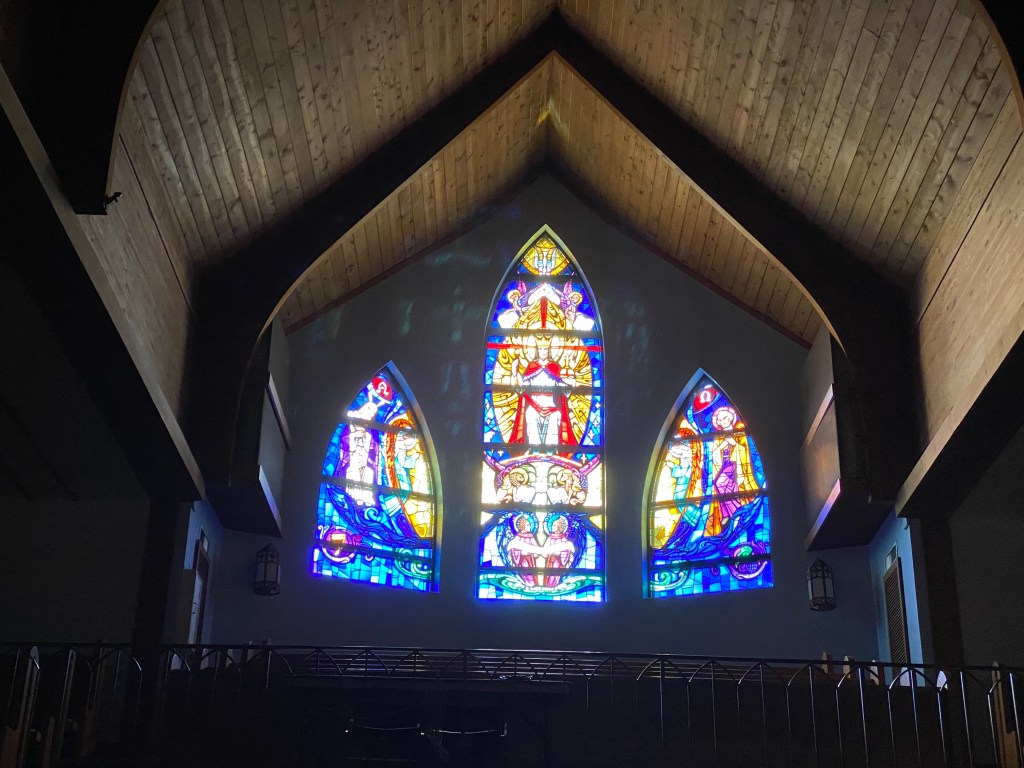
Photo: And Jesus please keep all those who are in the path of Milton safe, and help to bring about an end to violence and war in all its forms. Stain glass, Holy Cross Catholic Church, Vero Beach, FL.
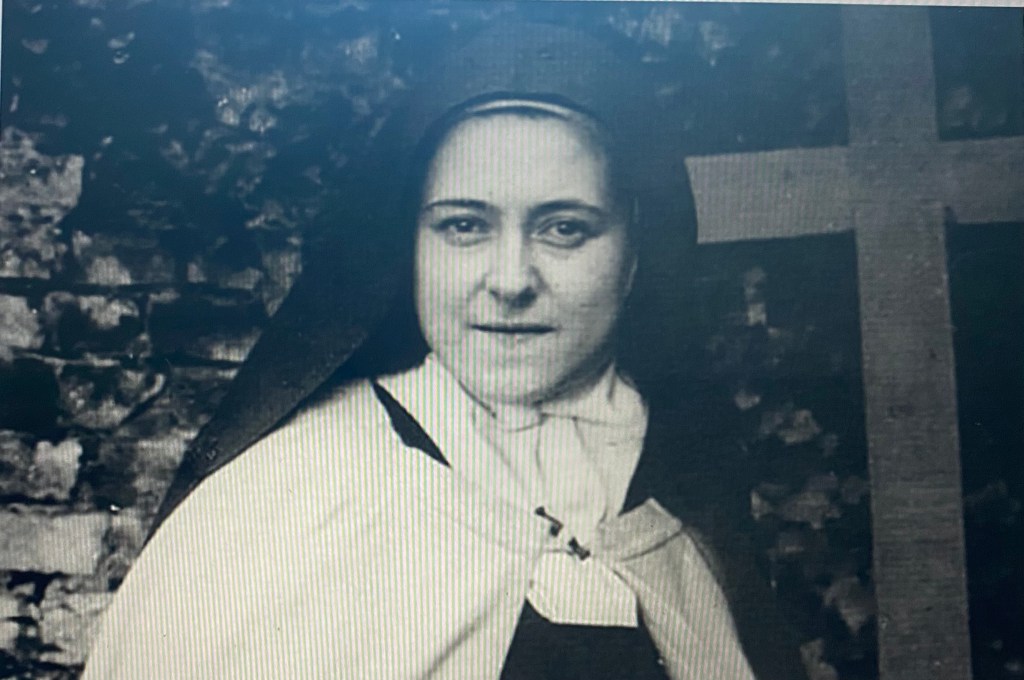
“When tempted to answer her sharply, I made haste to smile”. – St. Thérèse of Lisieux
“Lord, do you want us to call down fire from heaven to consume them?” Jesus turned and rebuked them, and they journeyed to another village (Lk 9:54-56).
James and John’s request of Jesus ought to be recognizable to many, if not all of us. How many times when feeling slighted or disrespected do we want to act in kind or offer some retribution to our perceived offender? Often, we do not even think, we just react or we engage in our own tumultuous, internal maelstrom.
Jesus rebuked James and John’s request immediately and moved on. He did not allow the rejection of the Samaritans to deter his course for even one second.
The most helpful response to today’s Gospel is to affirm that Jesus’ response to the Samaritan’s lack of hospitality is a healthier one than that of James and John. If we can agree with resisting to react as our starting point, then we will have a better chance to seek to understand what Jesus can teach us when encountering others.
One approach to others extending unkind behavior is to be understanding. We are all dealing with a lot, and much of what others are dealing with are unknown to us. If we approach another’s unkind or disrespectful action from a place of understanding instead of seeking revenge, we will have a better chance of not reacting in kind and possibly being able to help another to get in touch and reveal something they are struggling with.
Often a negative response may come from misunderstandings. Another response can be one of giving the person the benefit of the doubt. We are not mind-readers and we also are not often the best of communicators so resisting jumping to rash conclusions is a better course of action.
A third approach is to receive a critique with humility. Maybe, we have done something to cause hurt toward another, intentionally or unintentionally. By taking responsibility for that which we have done and apologize for it, we create a better bridge for reconciliation.
We are only responsible for our own actions. We cannot dictate or change the behaviors of others nor are we to be doormats for another’s abuse. We will experience healthier interactions when we approach conflicts and obstacles with patience, understanding, and humility for acknowledging what we have done and what we have failed to do. Even with a more understanding approach, sometimes there are those who will not be open to our efforts. St. Thérese of Lisieux found herself annoyed by one of the sisters. Whenever Thérèse saw her she would pray for her and wrote that, “when tempted to answer her sharply, I made haste to smile and change the subject”.
A smile can go a long way as well as praying for and respecting the dignity of each person we feel challenged by. There is a path between aggressive reaction and passive submission. Jesus is very clear that we are to love in all situations. We will each other’s good by clearly communicating our experience of our interaction, are willing to forgive and seek forgiveness, and to love each other through our idiosyncrasies, mistakes, and sins.
Human relationships are difficult in the best of scenarios, but still well worth the effort. Above all, when conflicts arise it is important to take a few deep breathes, pray, seek, and rely on the guidance of Jesus, and when possible seek out those who we trust. In this way, we will be less apt to react, have a healthier outlet for our frustrations, and instead see some options available that will help us to grow and mature in our relationships.
—————————————————
Photo: St. Thérèse of Lisieux pray for us!

Curiosity from a distance, like Herod, or intimate, Lord and Savior, like Teresa?
‘Who then is this about whom I hear such things?'” And he kept trying to see him” (Lk 9:9).
Herod Antipas, the ruler over Galilee and Perea, heard stories about Jesus. The range of his thoughts, expressed by Luke, is confusion to curiosity. Herod may have started to feel concern over the possibility of a growing revolt, some guilt for his execution of John the Baptist, or just curiosity to see what this man was all about. Could this Jesus accomplish even half of the things Herod had heard about him? One question that did not seem to cross Herod’s mind was, did he have any interest in changing his life and becoming a follower of Jesus?
Herod was not the only one in Luke’s Gospel who asked questions about who this man, Jesus, was. Nor did the asking of those questions die with Jesus on the cross. They continued after his resurrection and ascension, they continued into the first centuries of the Church, which led to the calling of the first ecumenical councils which dealt directly with who Jesus was, and they continued in each following century and continue today. There are even at present in some academic circles, the question arising as to whether Jesus even existed at all.
One could ask why this question about Jesus persists? One answer is that we are finite beings seeking to understand an infinite Mystery. The full comprehension of the reality of Jesus existing as fully human and fully divine, dying on the cross, conquering death through his resurrection and ascending to the Father transcends even the wonderful intellect and ability to reason that we have been blessed with. Also, Jesus’ invitation is a universal but personal one. Each individual person has to encounter Jesus for her or himself.
Jesus called the Twelve, one by one as well as Mary Magdalene, St. Irenaeus, St Thomas Aquinas, St Francis and Clare of Assisi, St Catherine of Siena, St Teresa of Avila and St John of the Cross, St Ignatius, St Mother Teresa, Thomas Merton, Dorothy Day, and he calls each one of us as well. He did not call us to just merely embrace a new philosophy, a new ethical way of life, or even a new religion. Jesus called and calls us to be a part of his Body, the Mystical Body of Christ.
Who is Jesus, Herod asks in today’s Gospel? It is a good question for us to ask as well. For me, Jesus is the Christ, the Son of the living God, who became incarnate, becoming one with us in our humanity so that we could become one with him in his divinity. This same Jesus who called others through the ages invites us to follow him today as well and he continues to walk this journey with us whether we say yes or no to his invitation. We are just aware of and receive more of his help when we say yes!
Life with Jesus isn’t perfect, and we will at times echo St. Teresa of Avila, who stated after she was thrown from a carriage into a mud puddle, “If you treat your friends this way, it is no wonder you have so few.” But we will, as did Teresa, also experience moments of inexpressible joy, of wonder and exhilaration, and feel blessed when Jesus works and loves through us.
St. Teresa of Avila had a deep and intimate relationship with Jesus and knew him as her closest friend because she heard him knocking and let Jesus in. She spent determined and intentional time consistently with him. She spent an hour before and an hour after Mass each day. She set aside specific, daily anchor times of personal prayer, meditation, and contemplation which allowed her times of closeness that she could then experience Jesus as well in her daily activities. She was able to share with him her joys and frustrations because Jesus was that close to her.
Let Jesus not be just a passing curiosity as he was with Herod Antipas. Jesus is standing, knocking, (cf. Revelation 3:20) inviting us to open the door and let him in. Jesus is inviting us as he did with Zacchaeus to come down from the tree and take him to his home (cf. 19:5). Jesus is calling us to come and follow him as we read with Matthew just a few days ago (cf. Matthew 9:9-13). Jesus is not just some person from history. True, he died at a specific point in time and yet also was resurrected at a specific point in time, and he is alive and well, and inviting us to follow him today. All Jesus waits for is our, “Yes.” and a few steps. Jesus will take care of the rest!
Photo: Spending some quiet time with Jesus before heading to the land of dreams.
Link for the Mass readings for Thursday, September 26, 2024

Jesus calls us too.
“While he was at table in his house, many tax collectors and sinners came and sat with Jesus and his disciples” (MT 9:10).
We as the Church, followers of Jesus, still have much to learn from Jesus. Today’s reading provides another wonderful example. Once Jesus begins his public ministry he is constantly on the go. Going where? Meeting people in the midst of their daily lives as he did with Matthew. And what is the response to Jesus calling Matthew, a tax collector, and then partaking in table fellowship with other tax collectors and sinners?
Matthew accepts his invitation to follow. The Pharisees question the disciples about his practice and curious onlookers follow at a distance. But to those who have, maybe for the first time in their lives, been respected as fellow human beings, their response is hope. A hope that there actually may be a path leading in from the peripheries. A hope that they no longer have to be on the outside looking in. A hope that they, for the first time in their lives might finally belong.
Jesus is shown time and again encountering the person as they are in their present circumstances and the chaos of their lives. He welcomes, is present, and embraces each person as they are. Yet he doesn’t want them to stay where they are. He invites people to be part of something greater than their self-absorbed posture, their self-imposed and externally imposed limitations and instead to actualize their potential and embrace a life of meaning and purpose. The only requirement is that they are willing to: repent, be forgiven, be healed, be loved, be human, be free, and once experiencing this encounter with Jesus, share what they have received with others.
When we are willing to follow Jesus and become his disciples as Matthew did, then we can experience the same hope for a new beginning. To follow we must have the humility to recognize our sinfulness, repent, recognize our dependence on God and our need for him and his love more than anyone or anything else. As we do so, we can begin to heal and let go of the apparent goods that we thought would bring us happiness which have instead led us astray, and renounce those false hopes that we have placed our security in.
We will find that, only in God alone will we find our fulfillment, hope, and security. Jesus invites us to experience: “one Lord, one faith, one baptism; one God and Father of all, who is over all and through all and in all” (Ephesians 4:4-6). This is the promise and fulfillment that no other pursuit or person can bring. God is the foundation and source of all, and at the same time he knows each and every one us better than we know ourselves. He invites us to grow in our relationship with him so we can know him too.
We do this best as we get to know his Son, Jesus whom he sent, not to condemn us, but to save us. Jesus draws close to us as he did with Matthew so that he can experience the chaos of our lives. He loves us in the midst of the best and the worst and invites us to experience something better. Called and willing to be healed, forgiven, and transformed like Matthew, we too, can experience God’s mercy. Jesus will then send us as well to be beacons of the light, hope, and love for those who are in need of God’s healing and peace.
——————————————————
Painting: The Calling of St. Matthew, Michelangelo Merisi da Caravaggio, 1600. We may be as surprised as Matthew, but Jesus does call us as well!

Praying today
Praying today for those who lost their lives on September 11, 2001. Praying for those first responders who gave their lives seeking to save others as well as those who lived and are suffering from the physical, emotional, and psychological effects of that day. Praying today for those still grieving and mourning the loss of those they love.
Praying for the people of our country and our leaders at the local, state, and federal levels. Praying that we see each other as human, as fellow citizens that can embrace our differences and diversity, praying that we can work together to welcome the stranger, provide for the various needs of each other in every area of our nation, urban and rural, and seek for ways to empower and lift each other up. Praying that each person is willing to play their part no matter how small so that we can be one nation under God united in a common purpose that respects the dignity of everyone from the moment of conception throughout every step of life until natural death. Praying that each of us may learn to be better, learn to forgive, learn to heal, and learn to breathe, rest, receive, and abide in God’s love and from that space think, speak, and act.
Praying.
Photo: Veteran’s Memorial Island Sanctuary where I will often walk and pray.
As we pray consistently with Jesus, our lives will change.
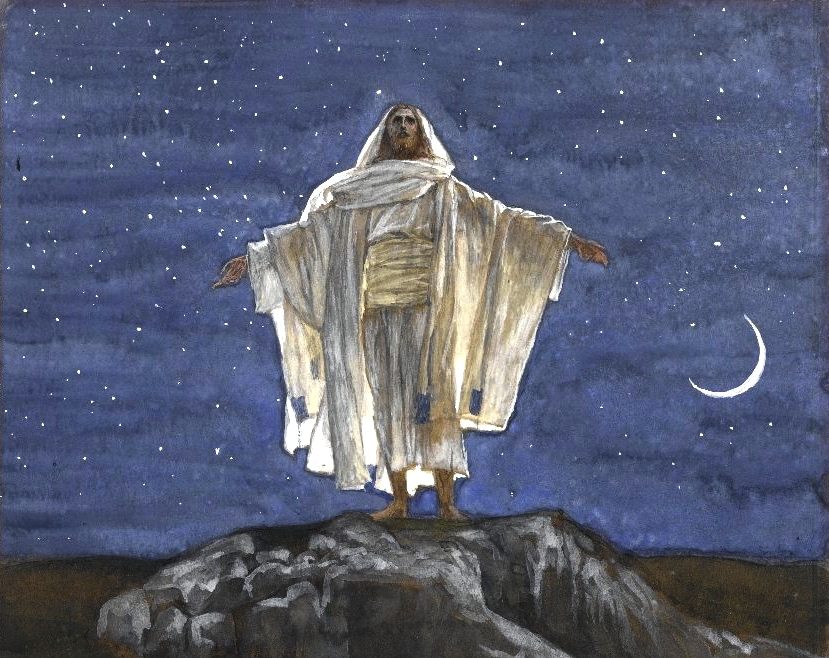
Jesus departed to the mountain to pray, and he spent the night in prayer to God (Lk 6:12).
In the midst of a busy ministry, Jesus spent time alone with God in prayer. In Luke’s Gospel, Jesus often did so before making important decisions, as in today’s reading that recorded the choosing of his Apostles. Prayer is an important, foundational principle to experiencing and knowing God as well as discerning his will for living a fully human life.
The Mystery of God is not a problem to be solved. In our language today, we often use mystery and problem interchangeably, as, “I lost my keys, it is such a mystery.” Strictly speaking, the loss of keys is a problem that can be solved. We can backtrack our steps, and through a process of elimination, the problem becomes smaller until we solve the whereabouts of the missing keys.
We cannot solve or prove God exists as if he is a problem to be solved. This is because God is not a being, not even the supreme being. God is a mystery that transcends any finite dimension of reality. We have nothing to measure him by, we cannot prove his existence, nor can we solve him as we would a problem.
Yet we can come to know God intimately just as Jesus did. Even though God is transcendent, beyond our reach and comprehension, he is at the same time closer to us than we are to ourselves. We come to know God through his invitation, and as we enter into the mystery of his reality through developing a relationship with him, as we come to know him. He does not become smaller, but vast, always beyond our comprehension and reach. His mystery is luminous as if we were in a completely dark room and someone turned on and shined a flashlight into our eyes. We wince from its brightness, yet in time, our eyes adjust and we eventually are able to see what was beyond our ability apart from the light. Jesus wants us to experience and embrace the mystery of the radiance and warmth of his Father’s light and love.
Jesus called each apostle by name. He calls us by name too. When we accept the call to be a follower of Jesus, when we are baptized, receive our first Holy Communion, and are confirmed, when we participate in the Mass at least weekly and Confession regularly, when we pray, read the Bible, and serve others, our lives will no longer be the same.
We will begin to experience the life of Jesus within us. We will begin to see also what is incompatible. What thoughts and behaviors we may have allowed for ourselves in the past, in the light of Christ, we now see for ourselves that which is no longer acceptable because it separates us from the love of God. We come to see our lives apart from God and with God. We are given the freedom to choose death or life.
Jesus meets us in the chaos of our lives and invites us to something better, a life that is real. Jesus loves us in this moment and does not lower the bar but empowers us to reach the height of his truth and divine law. Jesus is there for us and we remain close to him when we are consistent in prayer, in reading and meditating upon and putting into practice his word. Breathe upon breathe, day after day, we will be drawn ever deeper into the mystery of the Trinity and experience the intimacy of communion and relationship with God that we have been created for.
————————————
Painting: James Tissot – Jesus Goes Up Alone on a Mountain to Pray, 1886-1894

Focus on God who alone matters now.
“But the seed sown on rich soil is the one who hears the word and understands it, who indeed bears and yields a hundred or sixty or thirtyfold” (Mt 13:23).
God loves us. All of creation and each one of us have been created out of an outpouring of his love. God wants to be in relationship with us and like a good Father wants the best for us. He has sent his Son to be one with us in our humanity so that we can become one with him in his divinity. Time and again, generation after generation, since Adam and Eve, there are those who have rejected the Father’s love, rejected his Son, and the stirrings of the Holy Spirit.
In Jesus explaining the Parable of the Sower to his disciples, he is expressing why people may turn away from the generosity of God’s love. In a modern context we can experience hearing a word that touches our heart in Mass during one of the readings, prayers, homily, or verse from one of the hymns, or while in our own personal time of prayer. We are moved or even challenged. The devil can then threaten to take it away, we can meditate upon it for a time and then move onto other things forgetting this graced moment, we may even bring it back to mind for a time, but not apply it or put what we have learned into practice. Instead of taking firm root, maturing, sprouting and bearing fruit we remain spiritually immature.
Those who have “rich soil” to receive Jesus are those who hear his word, ponder it, return to it often, and put it into practice. The discipline of putting into practice what we have received from Jesus is the key for it taking firm root and transforming our lives. We are so focused too many times on completing and moving on to the next thing that, even when moved, touched, or challenged by his word, we can set the wondrous experience aside to move onto the next task.
I have been inspired and challenged recently by the words of Romano Guardini: “This restless being wants to pray. Can he do it? Only if he steps out of the stream of restlessness and composes himself. This means discarding roaming desires and concentrating on that thing alone which, for the time being, is the only one that matters… to become still; to free oneself of everything which is irrelevant, and to hold oneself at the disposal of God, who alone matters now” (Guardini, 12).
The message imparted by these words is not new, and this is a practice that I have been engaged in for years. Yet, these words engaged me, especially, “hold oneself at the disposal of God, who alone matters now.” They have been like rich compost that has been nourishing my prayer life and daily experiences for the past week. When my mind starts to wander, I bring it back, “God alone matters now.” and then a calming breath follows and I continue.
This is a good practice to begin to prepare rich soil, to return to, and go deeper with! All the invitations, temptations, apparent goods and glitter, pale in comparison to the hunger and desire that we all experience which is for a deeper intimacy with God. No one or nothing else fulfills. When we put all else aside and focus on God alone, he satisfies. Grounded in his infinite love, our relationships improve because we no longer cling out of a fear of losing them. We enjoy the material more because we no longer project onto them what they could never provide. Anxieties and fears lessen because we feel more safe and secure.
Photo: Enjoying a Rosary walk and the oaks of the neighborhood of Vero Beach, FL.
Link for the Mass readings for Friday, July 26, 2024
Guardini, Romano. The Art of Praying: The Principles and Methods of Christian Prayer.Manchester, NH: Sophia Institute Press, 1985.
 Spiritual Stepping Stones