quiet

Consistent time in quiet, stillness, and prayer helps our relationship with God to grow.
Jesus told his disciples a parable about the necessity for them to pray always without becoming weary (Lk 18:1).
In the parable that Jesus offered in today’s gospel account, he is not saying that persistence in prayer is changing God or somehow bending his will to our’s. We are not wearing him down like the woman did with the judge. God does not need us. God is completely and totally self-sufficient. We are the ones who need him. Our persistence, our daily habit of prayer, changes us, transforms us, helps us to develop our relationship by interacting with God more consistently. Things happening in our lives help us to see that we are fragile and vulnerable and in need of help. Our persistence in prayer will help us to experience that we are not alone in our challenges. When we are dealing with a crisis or very real trauma, our persistence and faithfulness in prayer will help us to experience the closeness of Jesus in our midst as he accompanies us through our suffering and grant us the strength not just to endure but to overcome.
In fact, the practice of stopping everything and praying for five minutes when a crisis arises, often helps us to resist slipping into a fight or flight mode and helps us to resist reacting automatically based on our emotions. Consciously choosing to breathe while praying helps us to act more prudently than impulsively. We may also come to see that what we thought was a crisis, may have been more of a problem to be solved rather than something catastrophic. Our instant reactions to perceived crises can often escalate an issue rather than de-escalate one.
In the greater scheme of things, God answers all prayers of petition or intercession by saying yes, no, or not yet. Most seem to fall in the not yet or not the way we originally intended category. Remaining patient and faithful can help us to move away from seeking to conform God to our will and instead allow him to expand our hearts and minds to his will. Through this expansion, we can come to see the situation from a broader perspective. Our persistence in prayer also helps us to move away from seeking instant gratification and instead trust more in God’s will and timing. Sometimes we are blessed for unanswered prayers because with time, hindsight, and some distance, we find our original request was more an apparent than an actual good.
Persistence in prayer is also a discipline that deepens the roots of our relationship with God. Ready access through our modern technology, higher internet speeds, one-click access, and overnight shipping, can offer plusses, but we have to be careful that this mindset does not shape our mental, psychological, and spiritual growth. Physical fitness, wisdom, or spiritual maturity does not happen in an instant. More importantly, development as human beings and our relationships take time, experience, discipline, prayer, and trust in God’s plan.
Patience, persistence in prayer, freeing ourselves from attachment, developing an authentic and intimate relationship with God and one another are all worth the effort. We need to take some time to breathe deeply, slow down our pace, discipline ourselves to resist even seeking small acts of instant gratification each day. No matter how busy we are, it is important to slow down. Even when we stop to pray and feel like nothing has happened and that doing so was a waste of time, God has happened. God has our back and we can trust in that.
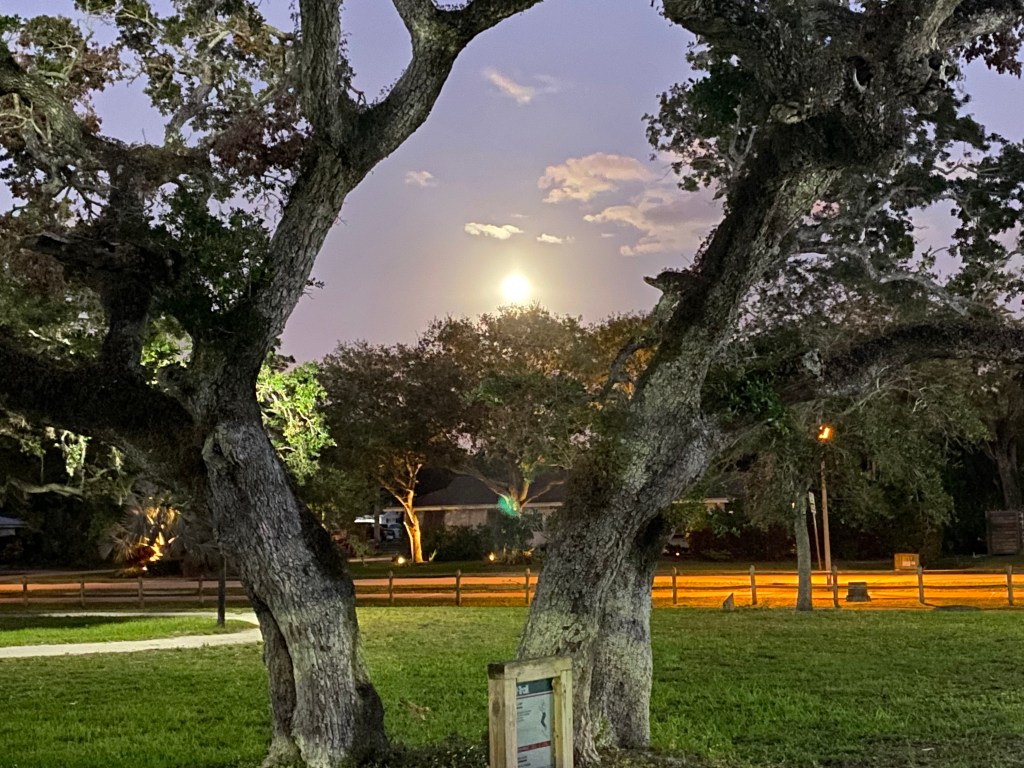
Photo: Rosary walk has been providing opportunities for some wonderful sights!
Link for the Mass readings for Saturday, November 16, 2024

In times of quiet, we come to learn the Good Shepherd’s voice.
I am not sure how many people reading this reflection are shepherds, live on a farm, or raise sheep. The greater majority of us are most likely removed from the daily life and commitment of a shepherd. With such ignorance as our starting point, we can fall prey to a false romanticism of the life of a shepherd as a reaction to the fast pace and hustle and bustle of modern urban and suburban life. The commitment and demands of shepherds during Jesus’ time were demanding, all consuming, with little acknowledgment or recognition. In fact, many shepherds were looked down upon, and groveling at the bottom of the social class of ancient Palestine. Yet, Jesus compared himself to being a shepherd.
Just scratching the surface of the social context of shepherds could help to shed light on John’s Gospel today where Jesus paints an image of himself as the Good Shepherd: “I am the good shepherd, and I know mine and mine know me, just as the Father knows me and I know the Father; and I will lay down my life for the sheep” (Jn 10:14-15).
Jesus is not just a shepherd, but the good shepherd. A good shepherd lived among his sheep, watched over them, cared for them, helped to birth and raise them, as well as was willing to protect them from predators and thieves. As Pope Francis has shared, the shepherd ought to smell like his sheep. This could be another reason that people were not fond of shepherds. Sheep smell.
His disciples and we may not be fond of being compared to sheep. Yet, the Son of God, has come close to us. He was willing to enter into our humanity so to not only to smell like us, he has taken upon our sin for us on the Cross. He watches and cares, protects and nourishes us with his own Body and Blood, and has given his life for us.
We get in trouble when we stray from his protective care and wander away. Yet, even when we have strayed, Jesus will come when we bay for help and when we are in need. Each one of us is precious and important to him. He will find us if we are willing to be found, if we just call out to him, for he knows our voice. He will come to us and will carry us back home on his shoulders.
Coming to know and understand the voice of the Good Shepherd helps to prevent us from getting lost in the first place. For when we begin to walk in the wrong direction, Jesus calls us back. Are we willing to listen? We come to recognize his voice when we are willing to spend some quiet time with him. Intentionally resting and renewing in his presence and love with the humility and simplicity of a lamb can do wonders.
We can rest our heads on his lap, surrender to him all our cares, doubts, anxieties, and fears. We can rejoice with and share our joys, hopes, and dreams. In his presence we can be healed by confessing any sins that are weighing upon us, allow him to impart some healing balm on past hurts, and let him bind up any recent wounds. At some point in our contemplation, may we abide in the reality and truth of the ultimate gift the Good Shepherd gave: his life given for us, that we might have life in him. A life not merely to exist or survive, but a life of joy, fulfillment, and meaning that will lead to eternity with him and his Father to experience the love of the Holy Spirit.
Photo: Some quiet time to pray and listen, Rosary walk, St. Vincent de Paul Regional Seminary, Boynton Beach, FL.
Link for the Mass readings for the fourth Sunday of Easter, April 21, 2024
“Awake my soul, awake lyre and harp, I will awake the dawn.”
Rising very early before dawn, he left and went off to a deserted place, where he prayed” (Mk 1:35). This was a common practice of pious Jews at the time. The intent was to spend time away from the everyday hustle and bustle, to be still, to better be able to connect with God. Jesus is making the effort and time to do the same, to go off to a place of quiet and stillness before the day’s activity begins, and to seek guidance from his Father as to how best to proceed in his ministry. When Simon Peter tracked Jesus down, Jesus shared the guidance he received to move on to the nearby villages to preach there also.
I have found this practice beneficial as well. In the early 90’s when I entered the Franciscans, I learned how to pray the Liturgy of the Hours. During my first week of participating in this practice, a verse resonated with me: “My heart is ready, O God, my heart is ready. I will sing, I will sing your praise. Awake my soul, awake lyre and harp, I will awake the dawn” (cf. Psalm 57). Even though my body and mind groan in protest, there is a feeling and experience of peace, renewal, and empowerment with making the time to “awake the dawn.”
I have been blessed to do so over the past eighteen years or so. Having the privilege and opportunity to teach for eight and a half years at Rosarian Academy and then nine years at Cardinal Newman HS, I began each day in the chapel sitting quietly and praying the Office of Readings and Morning Prayer. For the past year and a half, I have been able to not only pray the Liturgy of the Hours but also participate in daily Mass with the clergy, religious, and my brother seminarians at St. Vincent de Paul Regional Seminary.
It is nice to begin the morning slowly with God, to be infused with his Word and to be in the presence of Jesus in the Eucharist, then to go forward into the day to share the joy of that morning’s encounter. I also introduced a “Holy Hour” into my day as well since coming to the seminary which has been an opportunity to grow even closer in intimacy with Jesus and experience moments of healing and growth.
How we go off to a deserted place will be different for each of us based on our station and responsibilities in life. There is much pulling at us to distract and divert us from making the time, but our lives will be transformed when we do. To commit to 10 to 20 minutes of quiet a day to start will mean we need to let go of something else. It may mean hitting the snooze button is no longer an option, maybe it is getting up 20 minutes before your spouse and kids, quiet time with morning coffee or breakfast, sitting quietly on the porch, at the kitchen table, or favorite quiet spot, quiet time in the car, maybe there is a gap in between classes, any time outside for a quiet walk or sitting by water is great. There are so many options.
There is something for me that is special about the stillness before the dawn, experiencing night giving way to the morning light, hearing the bird song, and yet, there are many ways, as there are many places and times that we can create for ourselves to show up with God and allow him to happen. I also enjoy ending the day with a quiet walk around our lake after supper. As we make time to experience stillness, we will also begin to notice God more often in our activities, interactions, and interruptions. Making time to go off to a deserted place is a wonderful gift that I pray you may give to yourself this week.
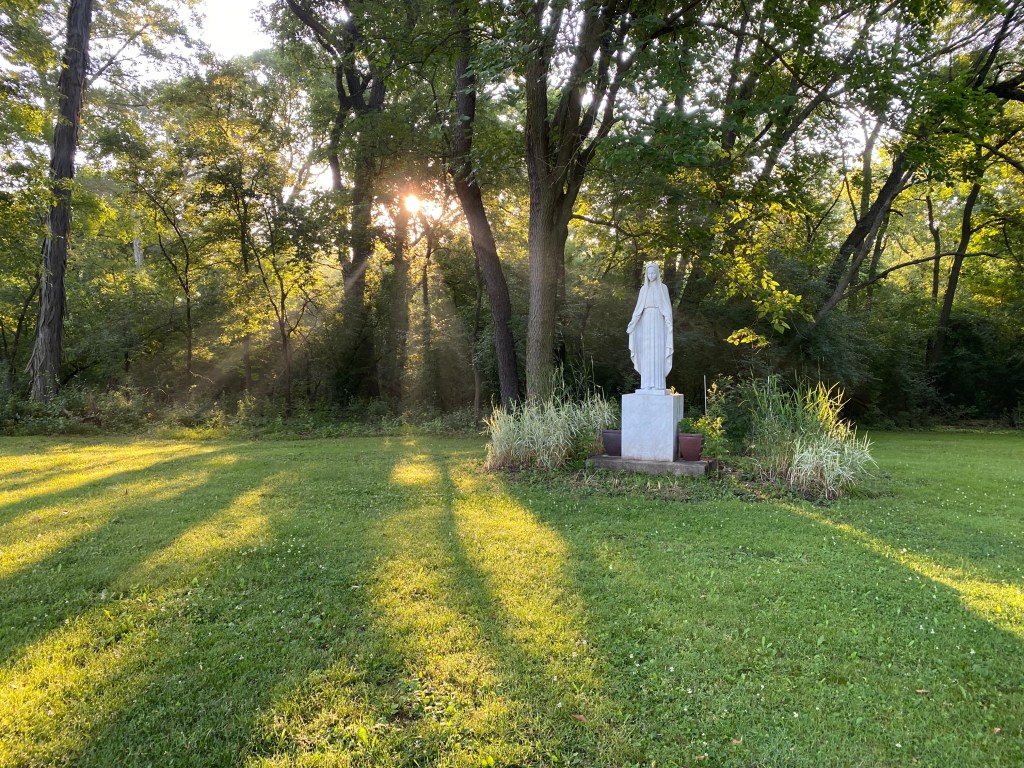
Photo: Waking the dawn during my 30-Day silent retreat this past July at Joseph and Mary Retreat House, Mundelein, Illinois.
 Spiritual Stepping Stones