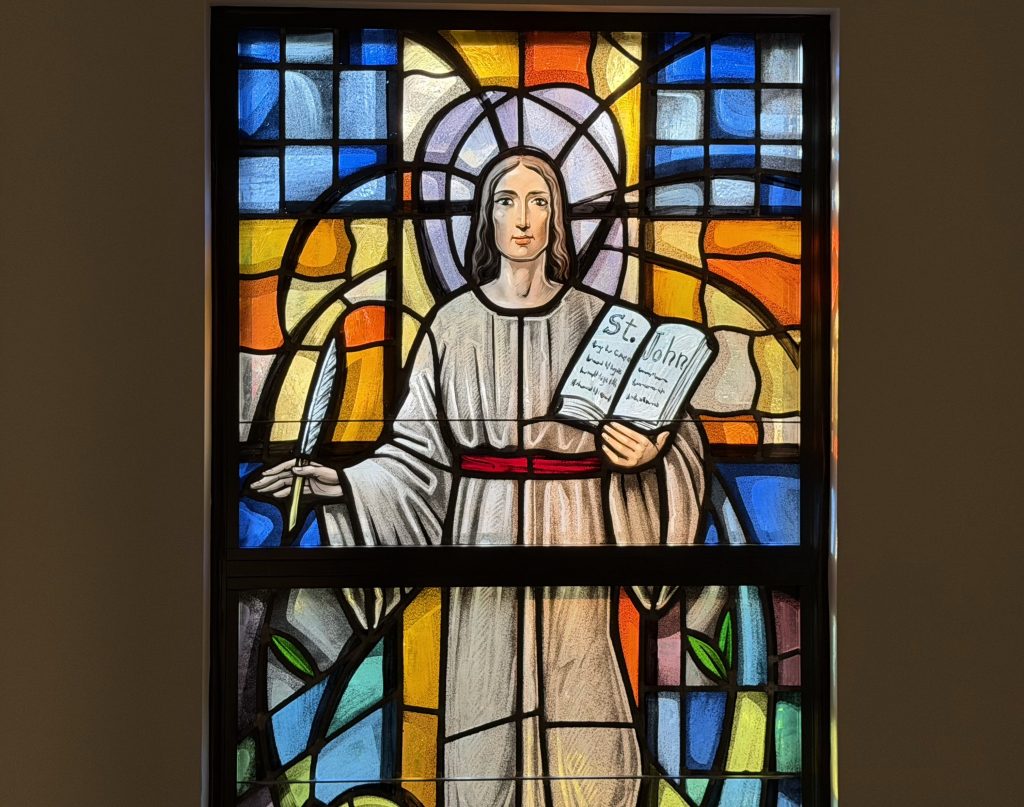
When we take the time to be still, we will see and believe.

Jesus Christ is born for us. Jesus Christ dies for us. Jesus Christ conquers death and rises again for us. Because of our place in time, December 27, 2025 AD – Anno Domini, In the year of our Lord, we are capable of experiencing his life, suffering, death, Resurrection, and Ascension into Heaven. The important question we need to answer is, “Does this new fact, this new reality in human history, make a real difference in our lives?”

Christmas did not end two days ago. We are still in the Octave of Christmas. The Church celebrates two octaves in the Church liturgical calendars, Christmas and Easter. These eight days are celebrated to impress on us the solemnity of the event of remembrance. From the vigil celebration of Christmas Eve on December 24 to January 1, the Solemnity of Mary the Mother of God, we celebrate the significant event of the Incarnation, the Son of God, the second Person of the Trinity, becoming one with us in human history.

“And the Word became flesh and made his dwelling among us” (John 1:14). The Masses celebrated within the Octave of Christmas, as well as the readings of Evening Prayer in the Liturgy of the Hours, reflect the celebration of Christmas Day each day for the eight days. It is like having a week-long birthday party. More importantly, we are invited to meditate and ponder this wonderful gift, that God has come close to dwell among us.

If we are solely focused on gifts, the returning of gifts, and celebrations apart from the celebration of Jesus’ birth; if we are removed from the liturgical cycle and rhythm of the Church, it is easy to fall into the daily harried pace again and post-Christmas blues may creep in because it can feel like everything is done but the returning of gifts and getting a good after Christmas deal. Christmas music has been alive and well on many radio channels for weeks, but at some point on Christmas Day and often the following day, they stop. They stop at the time when they ought to begin!

The material and finite, no matter how wonderful, even our closest relationships, will never satisfy our deepest hunger and thirst. If you are experiencing any post-Christmas blues, today is a great opportunity to let go of the material for a bit and enter into the gift of silence, and to spend some time meditating and contemplating on who will satisfy our deepest longing. The greatest gift that we have been given, we began to celebrate again two days ago.

The Son of God changed human history through his conception and birth and we are invited to participate in God’s great theodrama of human transformation. Today’s Gospel reading is a fast forward from this birth we are celebrating and the gift that keeps on giving, the reality of the purpose of the incarnation.

Jesus was born to die. He obeyed and trusted his Father at every stage of his life, even in the garden and on the cross. He died and experienced our greatest fear: death. That Mary, Peter, and John, “saw the burial cloths there, and the cloth that had covered his head, not with the burial cloths but rolled up in a separate place” was not just a random detail. Grave robbers would not have taken his body without the cloths of the corpse. When Lazarus was called out of his tomb, he shuffled out still tied in his burial cloths and his head still covered. Lazarus was resuscitated but would die again. “Something radically different has happened to Jesus” (Martin and Wright, 333).

The Holy Spirt overshadowed Mary at Jesus’ conception, helped Jesus conquer death and rise again, and through the Holy Spirit again, Jesus is made present through the priest at each celebration of the Mass. Mary Magdalene was the first to experience the empty tomb and shared this good news with the apostles. Peter and John ran to see. John arrived first. John remained outside, possibly out of respect, to allow Peter to go first. Peter saw the empty tomb except for the burial clothes. When John entered, “he saw and believed” (Jn 20:8).

Are we willing to take the time to ponder as John did? To pause and to be still. To allow God to speak to us in the silence of our hearts? John, Mary, and Peter’s lives were changed and transformed because they encountered Jesus, and no matter the challenge, gave their lives to him. We are invited to do the same. We were created to be in relationship with Jesus and our hearts will be restless until we allow ourselves to slow down, embrace the gift of silence, be led by the Holy Spirit, and so that in his presence in the Eucharist, we too may experience him, see, and believe.

————————————————————–

Painting: St. John stained glass window from Holy Cross CC, Vero Beach, FL

Link for the Mass readings for Saturday, December 27, 2025

God is always present, are we aware?

“You know how to interpret the appearance of the earth and the sky; why do you not know how to interpret the present time” (Lk 12:56).

Reading this verse brought two memories from my childhood. The first one is from when my friend Steve and I as kids were interested in reading the natural signs and weather patterns, and we enjoyed watching our local weatherman, Hilton Kaderli, forecasting the weather each night. Another memory was with my cousin Danny. We were at my Uncle Pierre and Aunt Claudette’s house one afternoon and we saw a storm rising. We headed to the road and started running as fast as we could in the opposite direction to see how far we could get before the storm caught us, and when it did we walked home, sucking in air, being pelted by the rain, and enjoyed a good soaking. Steve, Danny, and I read the signs of the earth and the sky, but we didn’t pay all that much attention to the things of the spirit at that time.

Not only through his teachings, but also through his public actions, Jesus revealed some powerful signs that God was in their midst. Jesus taught and preached on his own authority, he cast out demons, forgave sins, healed people, met and ate with sinners and women. These were amazing signs that the Messiah came to dwell among them, yet some did not or would not see this truth. They rationalized away that he could not be who he showed himself to be.

Some did see and believe in his and each successive generation. Some two thousand years later because of their faithfulness, Jesus speaks to us again today. The accounts and encounters of Jesus have been preserved and passed on. the Bible is not just a dead letter, nor is the sacred deposit of our faith tradition some inanimate object passed on blindly generation after generation. We are invited time and again to be aware, to look for how Jesus still works in our lives each day.

Nor is Jesus a mere historical figure. Jesus conquered death, rose again and became the first born of the new creation. He is present in his glorified Body in the Eucharist and through each of us, “for what you do to the least of these, you did it to me” (Matthew 25:31-46). The good news is that he invites us to read the signs of his presence in our lives in our times.

Do we see coincidences or God-incidences? Do we see God’s presence working in our lives? If not, could it be because our lives are so busy and fast-paced? If so, schedule some time each day to stop, breathe, and reflect. Even if for only five to ten minutes, we can slow down and ask God to help us review the past twenty-four hours with the express purpose of noticing how he has been involved and engaged in our lives.

It is often by reflecting and looking back over the course of a day, a week, or a month, that we will recall some God-incidents no matter how small. Being thankful for this growing awareness and asking God for greater insight each day will help us to grow in our awareness of how much he has been accompanying us all along in our daily experiences.

For those times that we have refused or failed to recognize this closeness to Jesus, especially in his presence coming to us through others seeking our help, we can ask for forgiveness and for Jesus to assist us in being more aware and more intentional in following the stirring of the Holy Spirit going forward. Opening our hearts and minds to God will help us to better read the signs that the kingdom of heaven is indeed at hand, in our very midst. Do we have eyes to see and ears to hear: his word, his presence in the Eucharist, in each other, in creation, and in the silence of hearts?


Photo: God reveals himself to us each day in so many ways. Just one for me coming home early Wednesday evening.

Link for the Mass readings for Friday, October 24, 2025

Let us choose to walk out of the darkness and into the light of Jesus.

Wars continue to rage on, violence continues to be a steady diet, division, demonization, and polarization doesn’t appear to be slowing down anytime soon. What gets lost in the headlines of all this is the real people, human beings, family members, friends, classmates and colleagues. No wonder feelings of anxiety and stress are escalating exponentially. How are we to respond? In the Gospel today Jesus sheds some light on the darkness that beleaguers not only our country but our world.

On hearing that it was Jesus of Nazareth, he began to cry out and say, “Jesus, son of David, have pity on me.” And many rebuked him, telling him to be silent.  (Mk 10:47-48).

Though Bartimaeus is blind, he seems to “see” better than those around him and know who Jesus is. He does not just call out the name of Jesus, but “Jesus, son of David.” This is not merely a genetic marker, but a Messianic title. Bartimaeus may have physical blindness, but he is one of the few in the Gospel of Mark to recognize Jesus as the Messiah. The disciples and the crowd walking with him, the many who “rebuked him”, showed their spiritual blindness, in that they prevented the blind man from coming to Jesus.

Where might we see ourselves in this scriptural account, who are we? Are we like those in the crowd who follow and identify with Jesus, yet rebuke others seeking to come to Jesus? Do we foster a posture of a fear of the other, embrace tribalism, nationalism, and contribute to and foster division, polarization, and prejudice? If we do, we then are suffering from the very spiritual blindness that Jesus has come to heal.

We can better help to bring about change by making an assessment of ourselves. Each thought we ponder and action we take ripples out from us and touches everyone. In what way do we contribute to the violence? Do we gossip, spread false reports knowingly about others only to degrade and belittle? Do we pass dehumanizing images and memes on social media? Do we talk over or at people, do we impose our views not even willing to listen to another? The smallest act of indignity shown to another, whether it be a snide remark, a racial, ethnic, or sexist epithet, or any manner of disrespect contributes to the darkness that seeks to blind us.

There is another way. There is another path we can walk upon. The one that Bartimaeus, once he could see, walked upon. To walk it, we need to be willing to allow Jesus to light the way, to convict us in the depths of our souls. In so doing, we are better able to counter the impulse to build walls that promote division, hate, and violence, and instead build bridges of forgiveness, unity, and love. We can then reflect his light in our present darkness.

Jesus did not rebuke Bartimaeus for causing a ruckus and calling out to him. Jesus called Bartimaeus to him. Jesus came close to others cast aside as well. He saw and sees each person as human beings, brothers and sisters created in the image and likeness of God. Jesus called the Apostles and Bartimaeus to him. We too are called to Jesus, called to be present to those within our realm of influence to be more understanding, and to meet each other with compassion and empathy. Darkness only spreads when we contribute to it and become the darkness. It dissipates when we remain in the light of Jesus. Hate only wins if we feed hate. Love wins when we are willing to forgive and love each other.

Let us have the humility to recognize our interconnectedness, that we cannot get through this life on our own. We, like Bartimaeus, need to be healed and made new. We need the Son of David in our lives, we need a savior, a healer, and we need each other. When we acknowledge this reality, we may better be able to resist the temptation to be indifferent to or dehumanize others. Instead let’s be more willing to notice, recognize, pray for and act to provide aide for each other. Jesus calls us to arise from our defensive posture and to open our arms wide to love, to will the good of each other as other.

Jesus asked Bartimaus, “What do you want me to do for you?” The blind man replied to him, “Master, I want to see.” Let that be our request of Jesus as well. May we ask Jesus to help us to see with the eyes of love, the eyes illumined by his light, and the wisdom of his Father. May we be willing to see each other as God sees us, as his beloved daughters and sons.


Photo: Night Rosary walk in Riverside Park, Vero Beach, FL.

Link to the Mass readings for Sunday, October 27, 2024

Let us listen carefully to, pray and meditate upon the word from the Word of God.

Since diving deeper into John Chapter 6 about a month ago, the refrain, “This saying is hard, who can accept it?” (John 6:60) continues to rise up with almost every reading from the weekday and Sunday Masses since then. To read, listen, meditate upon and pray with, the teachings of Jesus is not easy, especially if we want to also put them into practice into our lives. Which means deciding as to whether or not we want to be his disciple.

We may have been tempted to not listen closely while at Mass so not to recall anything that we have heard, we may let it go in one ear and out the other, or we may actually hear God’s word, and then when it is challenging, rationalize why we don’t have to follow it in today’s day and age.

My invitation is to go back and read each of the readings from today’s Mass carefully, slowly, prayerfully, and meditate upon them. This we are invited to do with each of God’s word proclaimed to us or in our own time of prayerful reading. The words we hear or read are not just a dead letter, they are not just an account of history, they are not just lessons to be shared, they are God’s living word in which we are invited to take in, chew upon, struggle with, and allow ourselves to be changed, to be transformed.

The appropriate response to hearing God’s word that we have received comes from the first line of Isaiah: “The Lord GOD opens my ear that I may hear; and I have not rebelled, I have not turned back” (Isaiah 50:5). As with the deaf man who Jesus healed last week, God seeks for all of us to hear his word and when we are willing to allow him to open our ears to hear, he will do so, and when we hear his word may we, like Isaiah, not rebel but receive his word.

Because Isaiah did so, he received the help of the Lord GOD.

Jesus not only healed the man of his deafness, but he also continually strove to heal the spiritual ears of his disciples. But we all have the freedom to choose. We can rebel and walk away as did so many after hearing Jesus’ Bread of Life discourse, and even when we don’t understand, we can answer with Peter, “Where else are we to go? You have the words of eternal life” (Jn 6:68).

Why ought we listen to this man who died almost two thousand years ago? In a sense, Jesus asked his disciples the same question when he asked them, “Who do people say that I am?” and then directly to his disciples: “Who do you say that I am?” Peter answer for them, “You are the Messiah” (cf. Mk 8:27-29).

In Matthew’s account he shares more of Peter’s response. “You are the Messiah, the Son of the living God” (Mt 16:16). Peter got it right, almost. Once Jesus saw that Peter received this insight from the Holy Spirit and was able to articulate it, Jesus shared with them all what kind of Messiah his Father sent him to be. He was not to be in line with any image the disciples thought of. He was more aligned to the suffering servant that Isaiah prophesied about.

As soon as Jesus began to speak about his suffering and being killed, Peter moved him away and rebuked him and Jesus without hesitation called Peter out: “Get behind me Satan.” Satan is the father of lies, the one who opposes. In one breath, Peter was listening to the guidance of the Holy Spirit and in the next he was listening to the words of the enemy. Jesus was making a clear distinction for Peter, the disciples and us. Whose voice we are to listen to?

Why are we to listen to Jesus’ words, even when they are hard, even when they are challenging? We listen to him because he is the Son of God, the second person of the Holy Trinity, the Son of God incarnate. He came not to condemn us but to save and free us from the sin of the world. Jesus came to open our spiritual ears so that we can hear the Holy Spirit, so that we may discern clearly between the voice of the enemy which leads us to death and the words of God that leads us to eternal life.

And if we want to be his disciples, we are invited to hear anew: “If any want to become my followers, let them deny themselves and take up their cross and follow me. For those who want to save their life will lose it, and those who lose their life for my sake, and for the sake of the gospel, will save it” (Mk 8:34-35).

“This saying is hard, who can accept it” (Jn 6:60)? Resist the temptation to water this invitation down. Instead, let us be like Isaiah and Peter, let us implore our loving God and Father to open our ears that we may hear his word, receive his word, breathe, pray and meditate upon his word and put what we have received, like James guided in our second reading, into action.

How we take up our cross, how we lose our life for Christ, how we surrender is unique to each of us. God meets us where we are and leads us. He shines his light just enough so that we can see two steps ahead. When we take those steps, he will shine a little more of his light ahead of us.

How do we take up our cross and lose our life for Christ? We begin with our willingness to listen and hear the living word of God daily and allow it to transform every aspect of our lives. Such that God’s word becomes our own in our lived experiences. We start with a posture of humility that recognizes that we need and depend upon God for everything, and he desires nothing less than all our mind, heart, and soul.

We begin to deny ourselves and take up our cross when we make the words of Mary our own: “Behold, I am the handmaid of the Lord, let it be done to me according to thy will”(cf. Lk 1:38). And the words of Jesus, “Not my will but yours be done” (cf. Lk 22:42). The words of St. Thomas, “My Lord and my God.” (Jn 20:28) and St. Peter, “You are the Messiah. The Son of the living God” (Mt 16:16).

As we say these words to ourselves, as we meditate and pray with them, as we bring them into our daily experiences, as we say them before entertaining any thought, speaking any word, and following through on any action, we invite God’s word into our being so that we may be healed of our blindness and our deafness; so that we will hear the Holy Spirit speak and guide us to understand how to receive and put Jesus’ teachings into practice and so reflect his light into the dark places of our hearts and into the dark corners of our world in the unique ways that God invites us.


Photo: Icon of Christ from the 6th century in St. Catherine’s Monastery in Sinai Peninsula in Egypt.

Link for the Mass readings for Sunday, September 15, 2024