We too ought to wash one another’s feet.

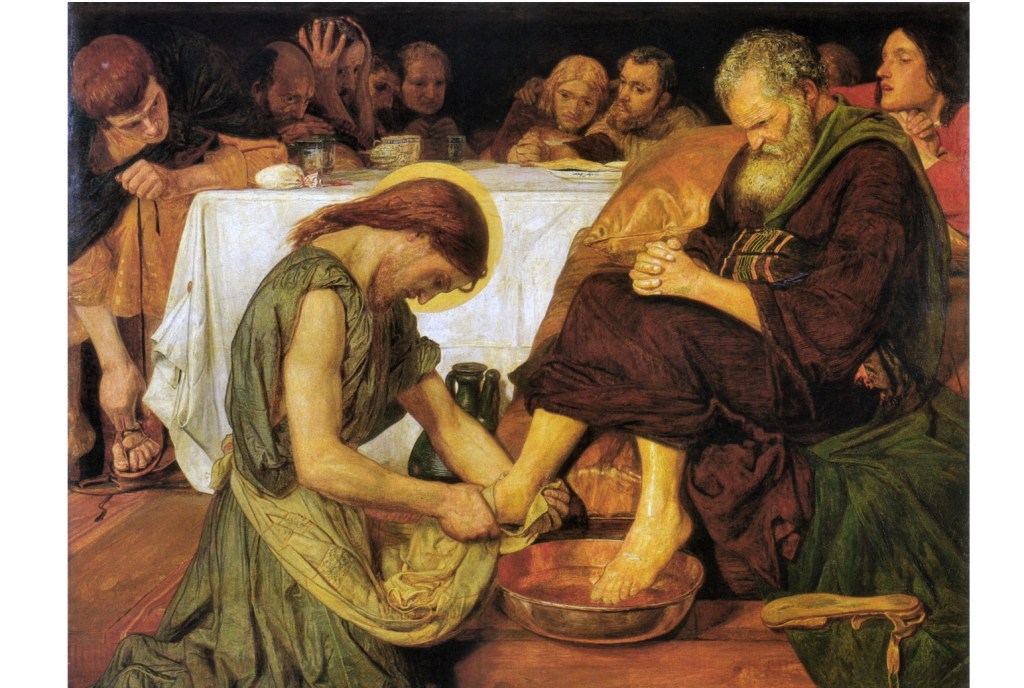
A key focal point of the last supper narrative in the Gospel of John is Jesus washing the feet of his disciples. Washing feet was certainly a custom in the ancient Near East, for either people walked barefoot or wore sandals. In either event, people’s feet became quite sore and dirty getting from here to there. What accumulated on a person’s feet was also substantial. Washing of the feet was a hospitable way to welcome guests into one’s home. This action though was the most menial of tasks and often performed by slaves or the lowest of servants.

After washing his disciples’ feet and sitting down, Jesus said to them, “Do you realize what I have done for you? You call me ‘teacher’ and ‘master,’ and rightly so, for indeed I am. If I, therefore, the master and teacher, have washed your feet, you ought to wash one another’s feet” (Jn 13:13-14). Jesus shared with those who were to carry on his message and ministry that they were not to feel so high and mighty in this appointment. The Apostles, those sent by Jesus, were to look at their ministry as seeking how best to serve others, not seeking to be served themselves.

The ultimate service will be displayed in only a few more days. Jesus’ washing of his disciples feet was a foreshadowing of the ultimate act of humility and service that Jesus would show in giving his life for them on the cross. The most degrading, humiliating, and painful of deaths. Jesus gave his life on the cross as did Peter: “Unless I wash you, you will have no inheritance with me” (John 13:8). Peter did not grasp what Jesus was talking about. He followed Jesus on the literal level of the feet washing and much as he did when Jesus told him that he must die, Peter did not understand then either.

Traditionally, this evening at the Mass of the Lord’s Supper, select members of the parish will come to have a foot washed by the priests, following the model set by Jesus washing his disciples’ feet. This would remind all of us, as members of the Church, that we are all an integral part of the Body of Christ. Reenacting the actions of Jesus proclaimed in the Gospel, brings the vivid reality of Jesus’ invitation. We are at our best when we are willing to serve, support, and lift one another up. This is to be true when all is well and rosy, in addition to when conflict and challenges arise in the messiness of our daily lives.

Pope Francis, in his homily on April 5, 2020 highlighted this same point: “Dear brothers and sisters, what can we do in comparison with God, who served us even to the point of being betrayed and abandoned? We can refuse to betray him for whom we were created, and not abandon what really matters in our lives. We were put in this world to love him and our neighbors. Everything else passes away, only this remains. The tragedy we are experiencing summons us to take seriously the things that are serious, and not to be caught up in those that matter less; to rediscover that life is of no use if not used to serve others. For life is measured by love.”

We best exemplify Jesus’ washing of the feet when we resist the allure and temptation of pride because our life is not about us. We are not the center of the universe. Jesus shows us a better way and invites us to walk away from the table presenting a buffet of false substitutes for God: pleasure, wealth, fame and power. We are not to curve in upon ourselves either, afraid that our sins are not forgivable. Jesus has not abandoned us and he never tires of loving, forgiving, and serving us. Jesus gave his life for us, and is with us every step of our journey. As we receive and experience his love and forgiveness, may we be more willing to love and serve one another.

————————————————————

Painting: “Jesus Washing Peter’s Feet” by Ford Madox Brown

Link for the Mass reading for Holy Thursday Evening

Surrender all to Jesus.

We are now beginning the fifth week of Lent. We are coming closer to the cross, to remembering the suffering, crucifixion, and death of Jesus. In today’s Gospel, Jesus is sharing with those in his midst that he will lose his life in fulfillment of his Father’s will: “I am troubled now. Yet what should I say? ‘Father, save me from this hour’? But it was for this purpose that I came to this hour. Father, glorify your name” (Jn 12:27-28). Jesus has come among us, to be one with us and to experience the fullness of being human. In becoming human, he is opening the door for us to experience his divinity.

To be able to experience the divinity of Jesus, we have to die to our self. Death is not a partial thing, it is a total surrender. As Christians, our first experience of this death is Baptism. In Baptism we die with Christ, and we rise to new life with him. We are purified from the condition of Original Sin as we are born again in water and Spirit. We are conformed and indelibly marked to Jesus and incorporated into the living organism of the Church, the Body of Christ. We become a part of his new creation.

In Confirmation, we continue the path of giving more of our life to Jesus. We are sealed with the gift of the Holy Spirit, we are empowered through the imposition of the laying on of hands and the anointing with chrism. We join in the apostolic mission of those who were and continue to be sent by Jesus to proclaim the Gospel, the Good News, that Jesus has become one with us so that we can be one with him. Jesus has given his life and returned to the Father in the fullness of his humanity, so to unleash the power and fullness of the love that he shares with his Father.

This is possible because what one human being experiences, sin or grace, all people experience. Each one of us are distinct and unique, one of a kind, while at the same time in communion with God and one another and all of creation. The Son of God, in becoming human, and in his willingness to experience our suffering and death, has risen from that experience and returned to the Father in the fullness of his humanity. What Jesus experiences with the Father, we have access to, in the degree that we are willing to accept our humanity and his invitation to participate in his life and divinity.

When we reject our humanity, reject the fact that we are created beings, not self-sufficient within ourselves; when we assume, grasp at, and appropriate for ourselves, self-autonomy, and stand firm that we need no help from God, we assume that we are the center of the universe and all revolves us instead of God, we separate ourselves from the source of the very communion we live, crave, and hunger for.

Any disordered affections or attachments toward anyone or anything that we place before God must be renounced, let go of. To the extent that we can surrender our whole mind, heart, soul, and strength to Jesus, is the extent to which we will participate in his life and divinity. Jesus died for us so that he can also be with us always. We are abandoned and not left as orphans, for he continues to be with us in the Mass. We come to receive him, Body and Blood, Soul and Divinity, during each liturgical celebration. We consume him and so continue to be nourished, to be transformed into his Body. When we are dismissed from our time of worship and communion, we are sent to be bearers of Christ. We are sent to bring him to those we encounter in our realm of influence through the corporal and spiritual works of mercy. At the very least we are to respect the dignity of each person we interact with.

By participating in the Sacraments of Initiation; Baptism, Confirmation, and Eucharist, we become the grain of wheat that dies, germinates in the ground, then sends forth roots and shoots. As we continue in our daily surrender to God and participate in the disciplines of prayer, fasting, worship, study, service, and almsgiving those shoots will become stalks and eventually bear fruit. For whoever serves Jesus, must follow him, and wherever he is, there his servants will be. The Father will honor whoever serves his Son (cf. Jn 12:26). Surrendering our lives in this way to Jesus we can say with St. Mother Teresa of Calcutta: “Each time anyone comes into contact with us, they must become different and better people because of having met us. We must radiate God’s love” (Mother Teresa, pp. 18-19).

Let us, like the grain of wheat, die to our false self, allow the shell of our ego to be cracked open, so to rise with Christ in his glory of being fully alive in him, to actualize who he calls us to be, and to bear the fruit of his mercy and love with others!

———————–

Photo: Sun setting as I began my Rosary walk, St. Vincent de Paul Regional Seminary, Boynton Beach, FL.

Mother Teresa and Devananda, Brother Angelo, ed. Total Surrender. Ann Arbor, MI: Servant Publications, 1985.

Link for the Mass readings for Sunday, March 14, 2024