son-of-god

Blasphemer or Son of God?
Two groups of Jews emerged in today’s Gospel account. There were those about to stone Jesus for blasphemy and those who began to believe. The first group did not recognize Jesus as the Son of God. There may have been some opening, which Jesus appeals to, in the good works that Jesus had done. These works came from his Father, and so Jesus sought to reason with them, “even if you do not believe me, believe the works, so that you may realize and understand that the Father is in me and I am in the Father” (Jn 10:38). They listened to the claim that Jesus was making but they refused to accept the fulfillment of the assertion: Jesus did the works of his Father because he was then and still is today the Son of God. Jesus knew the voice of his Father and was obedient to his Father’s will.
The more that Jesus sought to help them to understand that he was who he says he is, the more they dug in their heels. They may have left the stones on the ground but then moved to have him arrested. Jesus evaded their grasp and moved on to the region across the Jordan where John first baptized. John did not preach in the Temple precincts either, even though he was the son of a priest. John followed the lead of God to prepare the way for Jesus and his eternal priesthood. The Temple had not been the seat of God for some time. Jesus would become the new living Temple.
Jesus returned to the place of his baptism, where he joined in solidarity with sinful humanity. This visible image of consecration revealed what happened silently in his conception and birth: the Son of God took on flesh and became man to open up heaven for us in the humanity he assumed. As people came to John in the Jordanian wilderness, so too, people came to Jesus. Not all rejected his message. Many came to him and said, “John performed no sign, but everything John said about this man was true.” And many there began to believe in him (Jn 10:41-42).
The question that arises for us as our steps take us closer to Palm Sunday and Holy Week is to which group of Jews recorded in today’s Gospel account will we align ourselves with? Will we label Jesus as a blasphemer or accept that Jesus is the Son of God? The scriptural record does not reveal indifference as an option, the accounts do not leave any room for Jesus being only human; a good teacher, a wise man, or a revolutionary radical.
We either accept Jesus is fully human and fully divine or we don’t. If he isn’t who he claimed to be, the Son of God, then Christianity is just another philosophical, theological pursuit. If we accept that Jesus is the Christ, the Son of the Living God, then our lives ought to be aligned to his. Our thoughts, words, actions, and even our faces need to reflect that truth.
A good way to begin each day is affirming this fact by stating with an attitude of prayer, “Jesus I believe in you, I need you,” and asking him what works of the Father he would have us offer in his name this day? In what ways can we be of help and support to those around us? May we have the openness of mind and heart to hear his words and the courage to act upon his guidance, so to be the precious, living stones we are, radiating the light from our source, Jesus the Christ, the Son of the Living God.
————————————————————————-
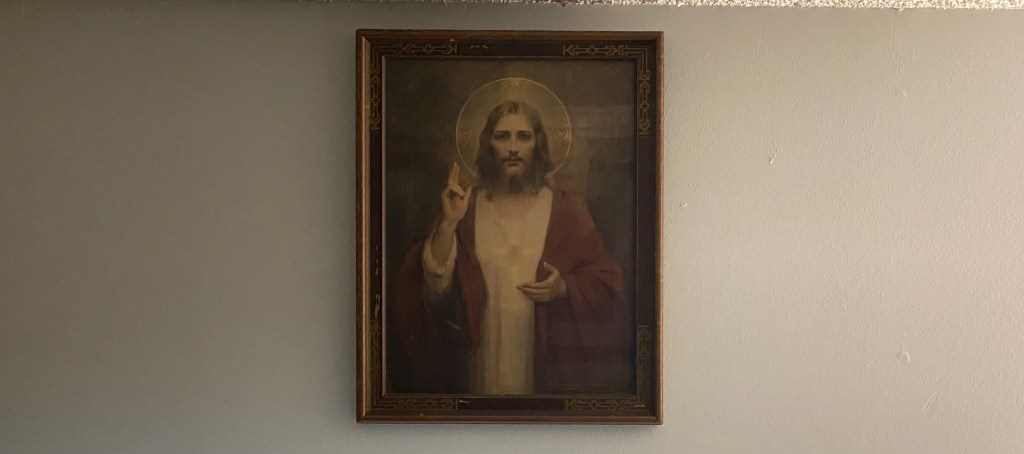
Painting credit: Sacred Heart of Jesus by Charles Chambers, hanging in my bedroom.
Jesus never sinned because he never doubted who he is and we can get there too!
Filled with the Holy Spirit, Jesus returned from the Jordan and was led by the Spirit into the desert for forty days, to be tempted by the devil (Luke 4:1-2).
He did so for the same reason he was baptized and crucified. Jesus experienced the temptations of Satan, the one who tempted Adam and Eve, to undo the effects of their original fall. Diabolos, translated as devil in English, means “slanderer” in Greek. Ha satan in Hebrew means accuser or adversary. Satan is the fallen angels, seeped in pride, who seeks divide, brings disorder to all that is good, and ultimately seeks death. We dismiss the reality of his presence at great risk. On the other hand we often give him more power than he deserves. Jesus is tempted, but unlike Adam and Eve, as well as the Hebrews following Moses in the desert, he does not give in. Jesus remains grounded in the will of his Father and so Satan has no power over him.
Jesus knows who he is and whose he is. Jesus is the Son of God, the second person of the Holy Trinity, who willingly was sent by his Father to conquer the effects of sin and death by taking upon himself the sin of fallen humanity. Jesus was willing to become a sin offering on our behalf.
Jesus could have dismissed Satan, yet he endured his temptation to teach us “how to triumph over temptation” (St Augustine 1976, 87). Jesus not only teaches us how, but empowers us to overcome Satan. The weakest Christian is more powerful than Satan himself, because we can call on the name of Jesus. This is not some magic incantation, but when we call on the name of Jesus, he, in the fullness of his humanity and his divinity, is present with us. God has given Jesus the name above every other name, so that as his word is spoken, every knee shall bow in heaven and on earth (cf. Philippians 2:9-10). Just as a floodlight shines in the darkness, the darkness gives way to the light. This is even more true with Jesus. Where Jesus is present there is love, such that no fear or evil can remain.
I had a dream some time ago, I am not sure how long now, but it is still just as vivid. I was sitting on a couch in the first floor of a house. The scene shifted so that I was seeing myself sitting on the couch from above and then my view was redirected to the attic. I witnessed a misshapen, dark figure rummaging through old boxes and newspapers. He embodied pure evil. I was then back in my body, and knew this creature was moving out of the attic and coming down the stairs to the room I was sitting in. My heart was pounding and I felt petrified as I heard his steps drawing closer. I was frozen in fear. In a few more moments, he came into view. What I saw was not the figure in the attic, but a handsome man, but I knew it was him. As he continued closer my fear increased, fearing that he would touch me, then a hymn came to mind. He stopped the moment I began to sing, my fear began to dissipate and I woke up.
Evil tends to present itself at first as an apparent good, as attractive, as normal, otherwise we would reject it outright. Satan and his demons are active through whispers and nudges, they look for our weaknesses and through the same tactics as peer pressure, seek to inject their poison and manipulate our actions. I am not talking about possession here, I am just talking about their divisive influence and seeking to present disorder into God’s plan of order. The most dangerous evil is the one masked in faith. Someone who can speak the verses of a Bible and quote chapter and verse does not a Christian make.
Satan himself quoted from Psalm 91 to Jesus, tempting him to throw himself off from the parapet such that the angels would protect him, catch him, and bring him down safely lest he “dash his foot against a stone.” Jesus in today’s account from Luke deftly countered each of Satan attacks with the sword of the Word of God. Even the subtle attacks of seeking to sew doubt into the reality and truth of who he was by stating, “If you are the Son of God…” Jesus did not flinch or doubt. He grounded himself in the love he had experienced from his Father, from the faith he, as fully human, learned from and experienced with Mary and Joseph, and he stood his ground until Satan left him.
Jesus’ encounter with Satan in the desert is one for us to pray with and meditate upon often because Jesus shows us how to counter his attacks. It is not with the weapons of this world but by placing our trust in God our Father and remembering, no matter how hard the father of lies tries to convince us otherwise, we too must ground ourself in the truth that we are God’s children and he loves us and seeks our best. As we trust in him with each temptation and with every aspect of our lives, our relationship and trust in him will grow.
We will no longer rationalize what we know to be unacceptable in ourselves as well as others. We leave less room for the allurements and see the lies of Satan more clearly when we keep ourselves grounded: in the truth of who we are as the Father’s beloved daughters and sons, in Jesus’ word, and in our growing relationship with the Holy Spirit.
It is important to assess our thoughts, actions, and words with honesty and humility each day, thank God where we have said yes to his will and followed through on acting where he has led us, where we have loved, and ask for forgiveness for when we have forgotten who we are and have been led astray by the father of lies. Also, it is important to ground ourselves in the Scriptures and allow the Word of God to become a daily nourishment. Reading, meditating, and praying with a few sections slowly each day will be transforming. We can start with the reading from Luke from today and with each reading, as with Jesus, the words will become as much as part of us as the air we breathe.
———————————————————————-
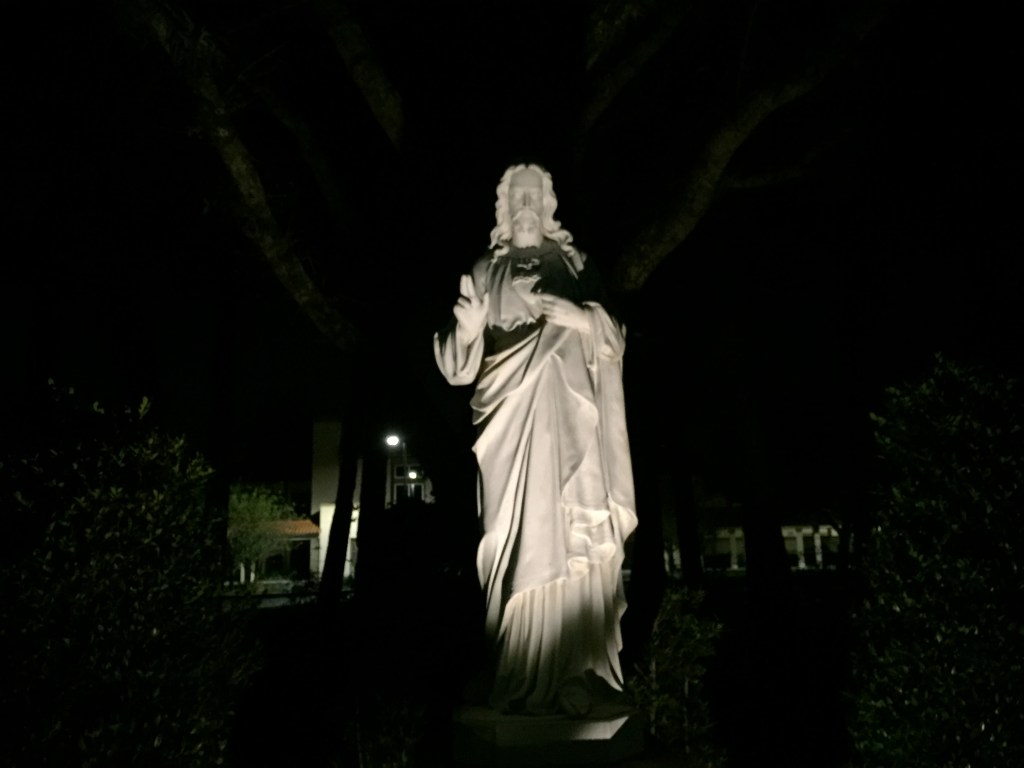
Photo: Jesus, though tempted, remained a light in the darkness so we can follow!

“Behold the Lamb of God.” He who was born and died for us.
John the Baptist saw Jesus coming toward him and said, “Behold, the Lamb of God, who takes away the sin of the world” (Jn 1:29).
The only one who can take away sins is God. The unblemished lamb is the animal that is sacrificed at the Passover meal, commemorating when the angel of death passed over the Hebrews whose doorposts were marked with the blood of the lamb. The next day they were freed from their slavery under pharaoh, and the exodus event began culminating in their passing through the Red Sea to freedom.
The Son of God became human to become the Lamb of God. He experienced laughter, pain, suffering, love, tears, and all of our human condition even temptation, but he did not sin. The Son of God became human so that what he assumed in his human condition, he could redeem. As the Lamb of God, Jesus approached John for baptism, he took upon himself the sin of the world and submitted his divinity to his human condition and was willing to be baptized for repentance not because he sinned, but so that he could take upon the sin of the world upon himself. This act was also a foreshadowing of his crucifixion on the cross.
The Incarnation, the Son becoming fully human while remaining fully divine, was the premiere act of mercy, in that Jesus entered the chaos and woundedness of our lives. His allowing himself to die on the cross the greatest expression of his love. The same love that he shares with his Father, his receiving and returning all that he received to the Father and holding nothing back, we can see him doing so visibly when we look upon a crucifix. He was born and died, he gave everything, including his life for each and every one of us.
Alone we cannot be redeemed, we cannot be fully healed or restored to who we have been created to be. We need a savior. Jesus is, while at the same time, more than a model to follow or a teacher to guide us, he became one with us in our humanity to lead us up out of our brokenness and sin. In saying yes to his invitation, we can say with Paul, “yet I live, no longer I, but Christ lives in me; insofar as I now live in the flesh, I live by faith in the Son of God who has loved me and given himself up for me” (Galatians 2:20). This is the gift we have received again this Christmas, a reminder that when enter into a relationship with Jesus, he grants us the grace to access and share in the divine power of the Love experienced between God the Father, God the Son, and God the Holy Spirit.
Jesus holds his hand out to each one of us today. May we receive his hand in our own, and as our fingers touch his palm may we feel the wound there, embrace the remembrance of the nail that pierced his flesh, the pain that he endured, so we could have this very moment with him. Even in our brokenness, anxiety, confusion, fear, and sin, may we resist pulling away. May we feel the warmth of his hand grip ours. Let our gaze be drawn up to see his face, his smile, his forgiveness, and experience his infinite love for us.
I am blessed at each Mass as I hold up the consecrated host to be able to say, “Behold, the Lamb of God, behold him who takes away the sin of the world.” May we see, believe, and receive the Body and Blood of Christ. Amen.
———————————————————-
Photo: Christmas Morning Mass, Holy Cross Catholic Church, Vero Beach, FL.
Jesus is the Son of God? Yeap.
Jesus’ listeners “picked up stones to throw at him” (Jn 8:59). Though less violent, this interaction has some similarities found in Jesus’ Bread of Life discourse (cf. John chapter 6), where Jesus made the statement, that, “I am the bread of life” (Jn 6:48). In both cases, the people do not understand what Jesus is sharing and yet Jesus resists softening his approach and instead doubles down.
In John 6, Jesus holds firm to the truth that his followers will consume him and in today’s Gospel Jesus does not equate himself as being just a representative of God, a prophet or a rabbi, but that he is, in fact, God when he states: “Amen, amen, I say to you, before Abraham came to be, I AM” (Jn 8:58). With these words, Jesus has just done the unthinkable, the unimaginable for the people of his time. He not only has spoken God’s sacred name, which is not to be uttered because it is considered to holy to do so, he equates this sacred name, “I AM”, with himself. Jesus is making his point very clear. Jesus is God. During the Bread of Life discourse, people walked away from him because they were repulsed and most likely considered him mad, here they may also think he is mad, but the issue is that to them he is speaking blasphemy. The reactions would be appropriate in both cases, unless of course, Jesus is who he said he is.
As his listeners then, we too have a choice to disbelieve or believe in the words of Jesus. One option that is off the table, if we give the Gospel accounts any rational reading, is that Jesus presented himself as just another teacher, philosopher, or prophet. Jesus, during his public ministry, is consistently embroiled in conflict, which is evident in all four Gospels because Jesus presents himself as God incarnate. Jesus heals on the Sabbath because he is the Lord of the Sabbath, Jesus is the Bread of Life, Jesus is: “I AM.”
The Apostles struggled time and again to make sense of the words and actions of Jesus and we may also struggle as well. We may have doubts, concerns, and unanswered prayers and/or questions. To walk the path of discipleship is not to walk with constant assurance, for we walk by faith and not by sight (cf. 2 Corinthians 5:7). Walking by faith though does not mean that we just throw up our hands, toss out all reason, and believe blindly. Dr. Holly Ordway defined faith as, “trust based on a reasoned knowledge of the evidence.” We trust that Jesus is who he claimed himself to be based on the scriptural evidence, our own experiences with the truth based on these claims, and our encounters with him in our everyday interactions and times of prayer.
We are to follow the apostles in that, even though we don’t fully understand, when Jesus calls, we also trust him and follow where he leads. He does not give us the full picture all at once, but as we step out with each faithful step, he will reveal a little more light and truth. He will be present with and work through us as we continue to turn our life over to him and one another more and more each day.
When doubts arise, we can lean on Peter’s claim, “Master, to whom shall we go? You have the words of eternal life.” (Jn 6:68). Peter made this claim based on his experience and trust in his relationship with Jesus. Our relationship and belief in Jesus will also grow more deeply and intimately, moment by moment, with each yes to the invitation of Jesus, the Holy One of God.
———————————————————————————-
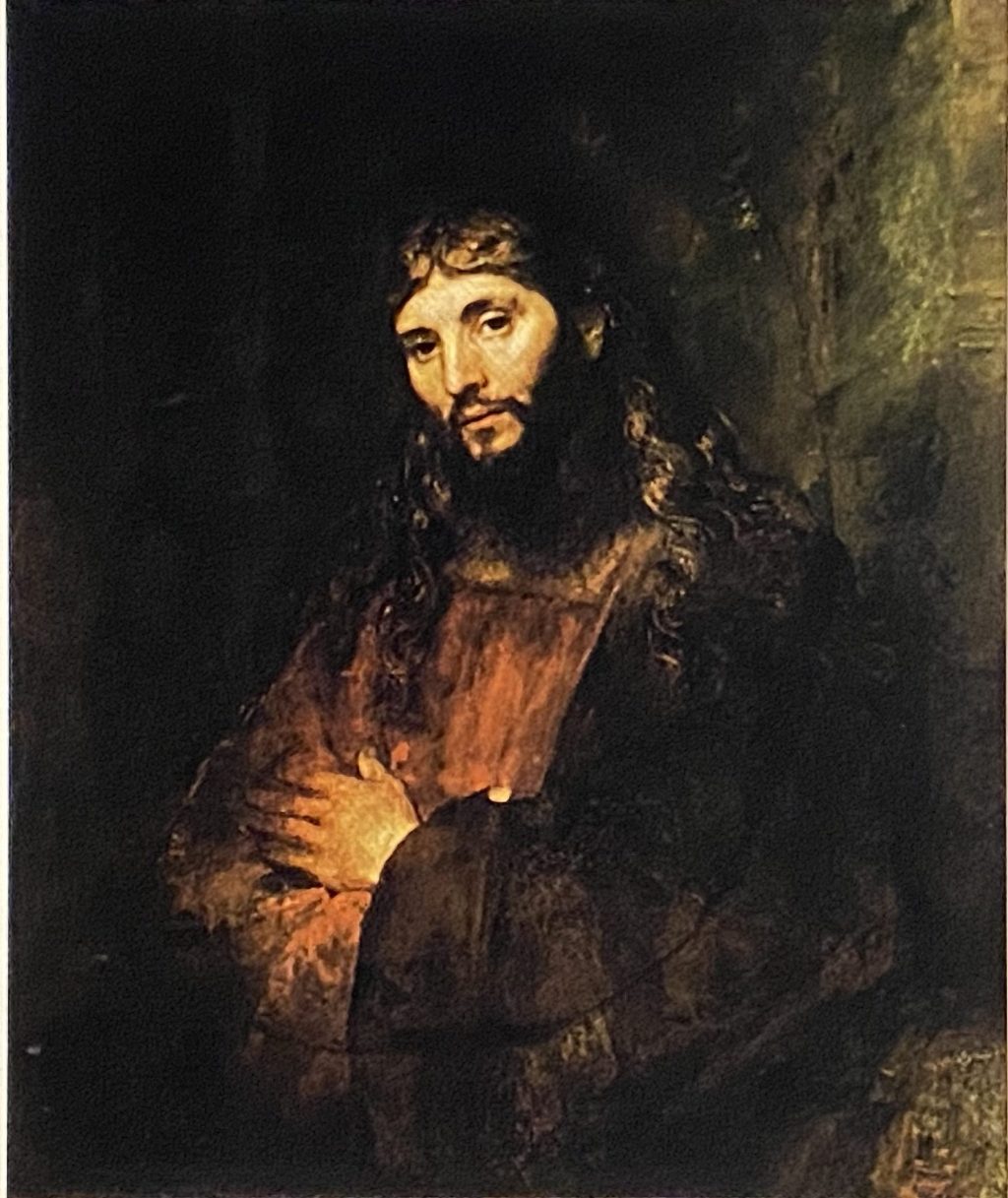
Photo: Rembrandt’s Christ With Arm’s Folded
Holly Ordway’s quote comes from Lesson 2: Bridging the Meaning Gap in her course: Imaginative Apologetics which can be accessed by registering for the Word on Fire Institute, the home page of which can be accessed: https://wordonfire.institute/
Link for the Mass readings for Thursday, March 21, 2024
 Spiritual Stepping Stones