Jesus said to his disciples: “Not everyone who says to me, ‘Lord, Lord,’ will enter the Kingdom of heaven, but only the one who does the will of my Father in heaven” (Mt 7:21).
I have written quite often, quoting and paraphrasing one of my favorite quotes from St. Irenaeus, that Jesus came to be one with us in our humanity so that we can become one with him in his divinity. In his becoming one with us in our humanity he invites everyone, no one is excluded, to participate in his divinity. Yet if everyone is invited, how can Jesus say that not everyone will enter the Kingdom of heaven?
The answer to that question is in the line that follows. The one who will enter heaven is, “the one who does the will of my Father in heaven.” If this verse does not help, then it might be helpful to understand a little about heaven, as best as we can, as the mere mortal, finite beings that we are.
Heaven is not so much a place but a state of being in relation to God, in which we are privileged to share communion and a deeper intimacy with God for all eternity. We will still not know everything about God because God is infinite and we will still be finite even in heaven. God is without limit, we are limited. We will never exhaust our relationship, never get bored with God.
Maybe a more three dimensional, an earthly example may be of help. If we were invited to play a sport, an instrument, or to act in a play, with the end goal being that we would play in the upcoming game, concert, or performance, we might feel pretty excited about the offer. We tell the coach, conductor, or director “That’s great news!” Yet, in the days that follow, we do not attend any of the practices, we do not practice the skills required to play the position, instrument, or role and we do not return any of the follow-up invitations by phone, email, or text. The day of the big game, concert, or performance comes, we gather our self together and head on over to the arena or hall. We arrive to see the coach, conductor, or director but are denied entrance. We might say, “I don’t understand, you invited us to play!” The reply is, “Not everyone who says to me coach, coach (conductor, conductor, or director, director) is ready and prepared.”
Jesus invites us to play a part in God’s theodrama, everyone. Some say yes and some say no. Some say yes, and then don’t put into practice what is then asked, some say yes and do some things, some say yes and dive in. Most of us take a few steps forward and a step or two back. Just like preparing to play in a big game or perform in a big concert, or play, we need to be committed, disciplined, and persistent. Unlike a missed opportunity to participate in a game or performance, that we can correct and make another attempt down the road, we don’t want to miss the opportunity to spend eternity with God in heaven.
The above analogy does not imply in any way that we earn our way into heaven, or we can do so on our own effort and will power. The bottom line is that Jesus gave his life for all of us and through his grace, we have been saved. Our salvation is a gift freely given. Yet, we have to be willing to receive and open the gift. Our time here on earth is the time we are given to: open the gift we have received, work out our salvation, not just hear but to also put into practice Jesus’ teachings, and be about building our relationship with him. As we do so, we will be transformed by and conformed to Jesus, so that we can come to know his Father as he does, and then we can reflect the light and love we have received to others.
It is not enough to say that we believe in Jesus. “Religious confession is no substitute for personal relationship with Jesus and the obligation to obey his Father’s will. If our creed and our conduct are out of alignment, then our profession of Jesus as Lord is not a true submission to his lordship. The mere fact that believers can perform miracles in Jesus’ name, which is an exercise in charismatic grace, is no proof that sanctifying grace has penetrated their lives or brought them closer to Christ” (Mitch and Sri, 121).
If we want to know and put into practice God’s will, we need to know God. Advent is a time of preparation, a time of getting to know Jesus who is already with us and inviting us to let him have reign of every part of our lives. Jesus helps us to recognize and see what our lives are like without God and how they are with God. If we are willing to see, that clarity helps us to better choose our thoughts, words, and actions.
When we are humble enough to acknowledge ways that weaken our relationship with God, we can then repent and seek forgiveness. God never tires of forgiving us. Let us never tire of asking for forgiveness and committing more to knowing and putting into practice his will. Each time we seek and receive forgiveness, our minds and hearts are not only expanded but properly aligned to Jesus so that we may experience more of the love of the Holy Spirit, which helps our relationship to grow and to put into practice our Father’s will.
——————————————————————————
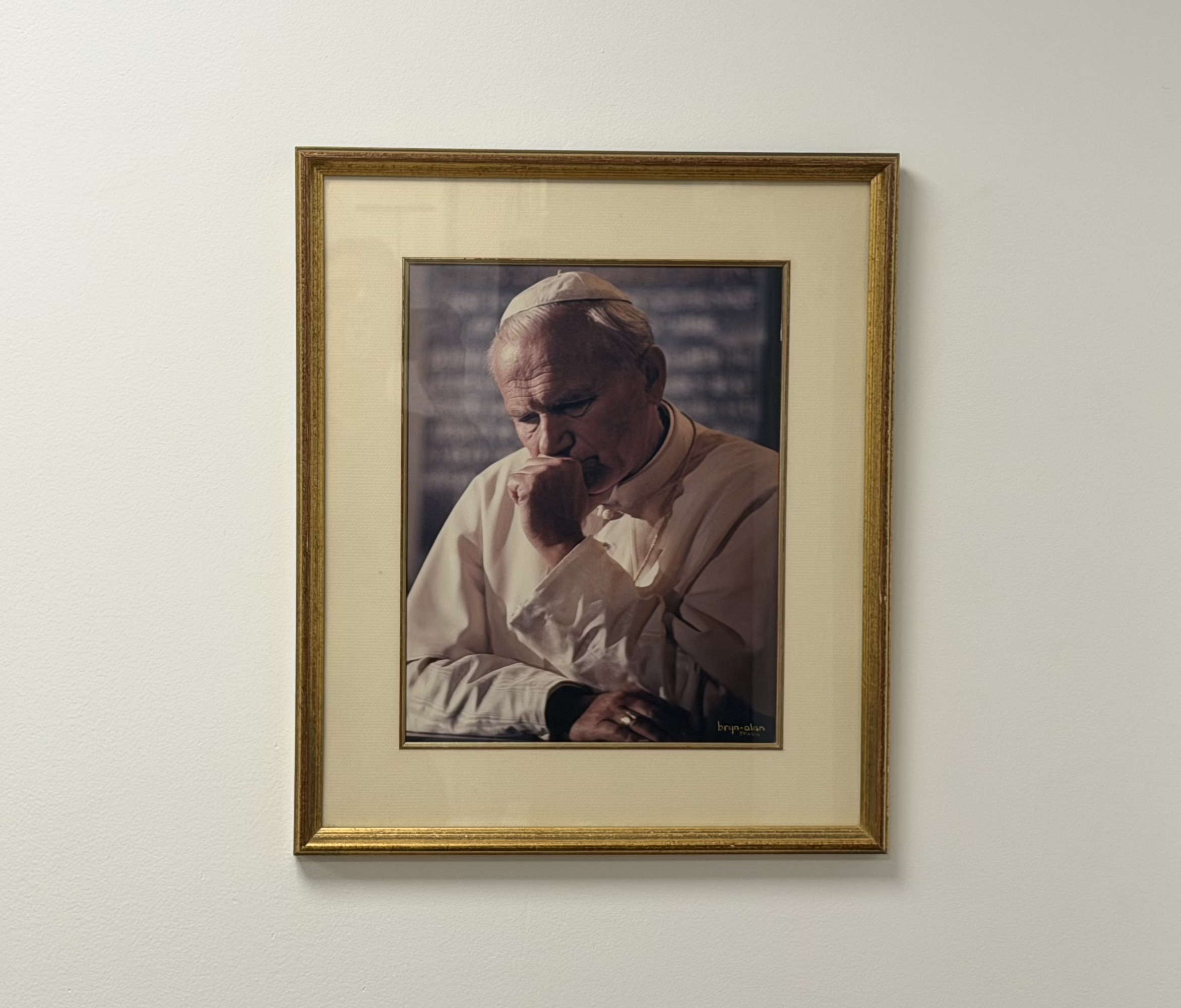
Photo: “Prayer can truly change your life, for it turns your attention away from yourself and directs your mind and your heart towards the Lord.” – St. John Paul II
Mitch, Curtis and Edward Sri. The Gospel of Matthew. Grand Rapids, MI: Baker Academic, 2010.

 Spiritual Stepping Stones