There is a danger when we read a comment from Scripture such as when Jesus, “cured many who were sick with various diseases, and he drove out many demons” (Mk 1:34). The danger is that we may not believe we are capable of healing as Jesus did, so we don’t do anything active with our faith. We also might think that Jesus is divine, so of course, there is no way we can measure up to what he has done. An even less helpful line of thought would be to disbelieve that the healings of Jesus happened at all, they were all made up, and that they never really happened.
Another challenge can be pride. We may want to heal like Jesus, for the purpose of our own aggrandizement, so people look at us, not God. That was the sin of Simon the magician, who saw the Apostles healing, just as Jesus had, and offered payment for the power to accomplish the same (cf. Acts 8:9-25). Along the same line is wanting to do something grandiose, something beyond our own unique gift and charism, again so the focus is placed on us.
A more helpful perspective is ponder about the truth that Jesus had a specific mission to accomplish, and yes he is divine, but, as I have shared often and the Church maintains, Jesus is also fully human. He had a specific mission from his Father, he gave a specific mission to his Apostles, and his Father has a specific mission for each and every one of us as well. Jesus himself proclaimed: “Amen, amen, I say to you, whoever believes in me will do the works that I do, and will do greater ones than these, because I am going to the Father” (Jn 14:12). Not only works as Jesus did, but even greater ones! Jesus knows the plan God has for our life, the part we are to play, and he will share it with us and empower us with that which we need to accomplish it.
We all have the capacity to provide God’s healing presence to others. God works through us when we embrace the love of the Holy Spirit and are conformed by it such that we come to know how God wants us to love and be present. There is some way for all of us to contribute. Throughout the Bible there are accounts of how God invites others to service, each in very small and humble ways – Jesus himself began his days on this earth wrapped in swaddling clothes, in a feeding trough, as vulnerable and humble a beginning as there can be. He then lived the next thirty years in obscurity until his public ministry began.
We need to resist the temptation to limit and define Jesus, but instead embrace the gift of a “sitting theology” in which we allow ourselves to look at Jesus, take him in, for he is “infinite Love incarnate” (Barron). Then to place ourselves before Jesus and allow him to expand us so that we can receive his revelation and guidance and come to know the mission God has planned for us. We also need to be willing to allow his Spirit to work through us.
Then as we go about our lives each day, we become contemplatives in action. We take time away to pray as Jesus did, listen for his guidance, and be open to the experiences that arise. Facing opportunities and interruptions in which we can be present to another with a smile, an active listening ear, and a helping hand, leads to more joy. In each small act, we say yes to God’s invitation, are present and accompany others by our willingness to love as he has loved us. Small acts of presence and willing each other’s good, leads to healing.
—————————————————————————–
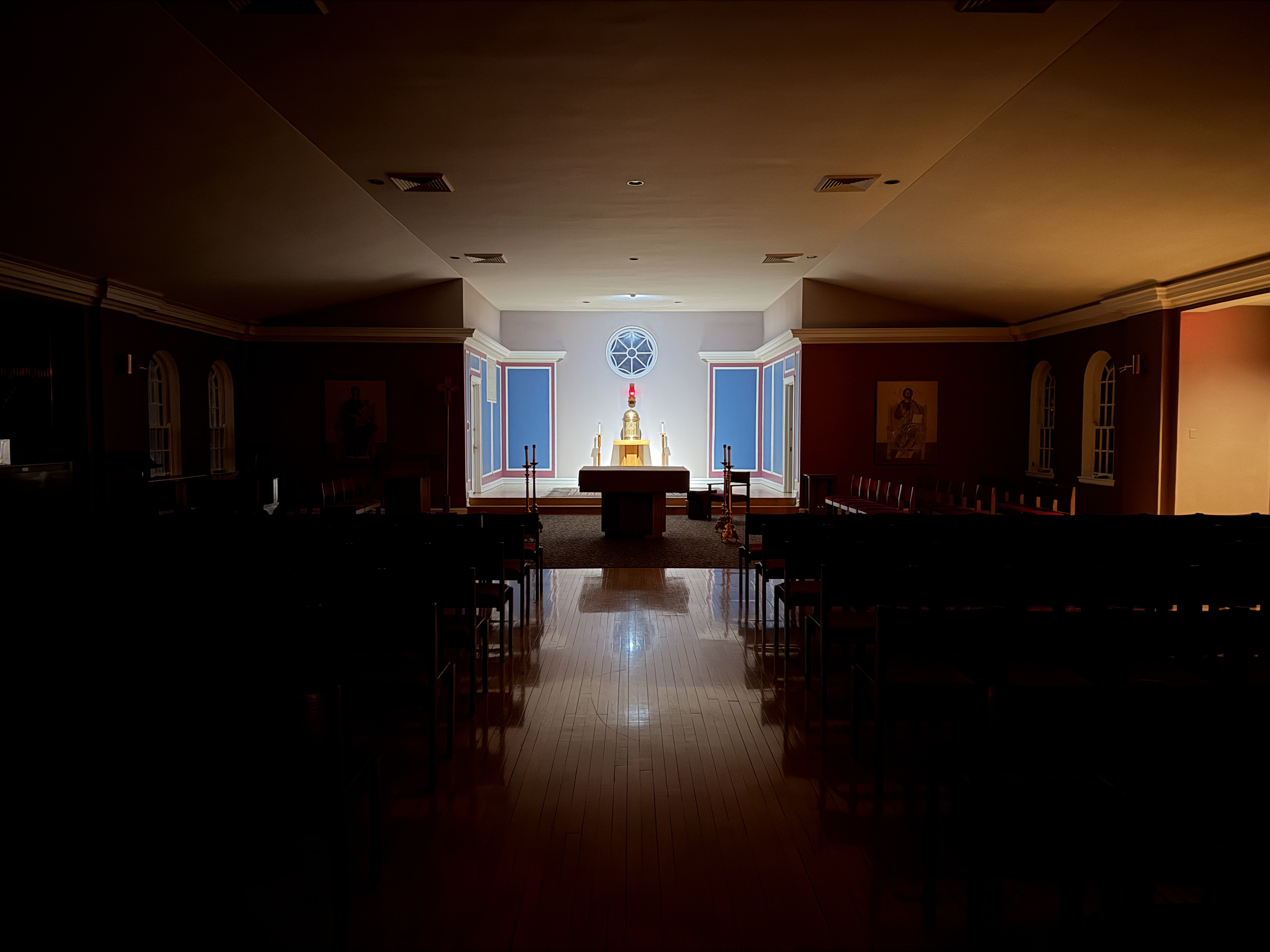
Photo: Jesus often went off to a deserted place to pray, who better to teach us how to do the same. Some quiet time with Jesus to end the day back at USML.
The thought of a sitting theology comes from Bishop Robert Barron Lesson 5 lecture that he gave on Hans Urs von Balthasar from his Word on Fire Institute. To learn more about the WOFI and what it offers, type the following link into your web browser: https://wordonfire.institute
 Spiritual Stepping Stones