Upon a first reading of today’s Gospel from Mark it appears that Jesus woke up on the wrong side of the bed. He and the disciples were heading to Jerusalem, he was hungry, so spying a fig tree in leaf, he walked up to it and when he saw that there were no figs growing, he unleashed the words, “May no one ever eat of your fruit again”(Mk 11:14)!
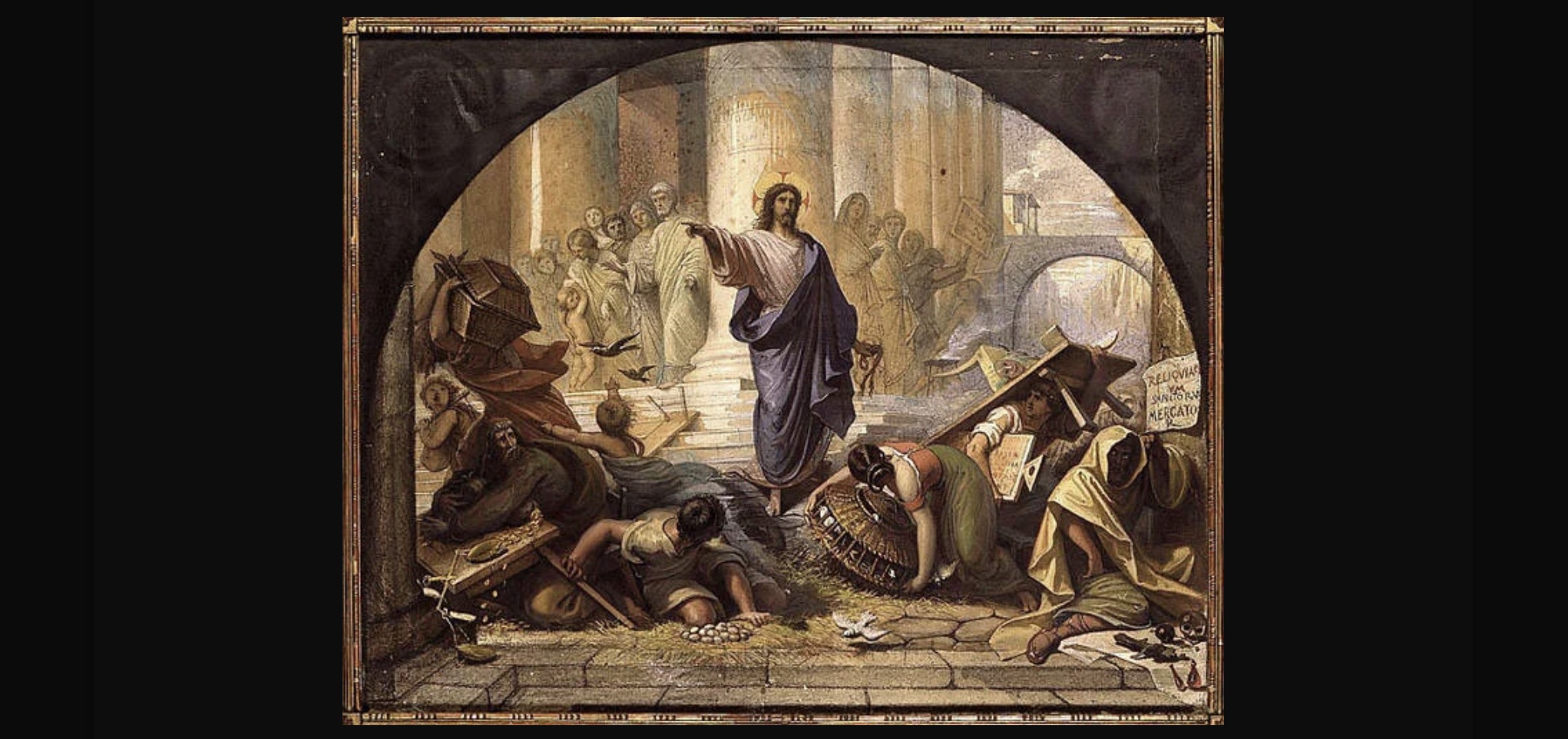
In the next scene, we find Jesus returning to the Temple. He witnessed the money changers in the outer court, and he began to drive out those selling and buying there. He overturned the tables of the money changers and the seats of those who were selling doves (Mk 11:15). Good thing for the doves that Jesus only went for the seats!
There was a series of commercials which ran a while back in which a character was very hungry and acting out of sorts until they were able to eat the candy bar being promoted. Once they did so, the character transformed back into themselves. Is this what is going on with Jesus? Is he just hangry? Has his blood-glucose level taken a nosedive? Or is there something deeper going on?
Remembering that Jesus fasted for forty days in the Judean desert, I would speculate that there is something else going on. What is more likely is that Jesus is asserting his prophetic role. As with other prophets recorded in the Old Testament, like Jeremiah, who gathered the elders of the people, then smashed a potter’s flask, then shared that this is what God would do to them for being unfaithful (cf. Jeremiah 19), Jesus is most likely going with a similar hyperbolic display to make a dramatic point.
The fig tree is often a sign for Israel and is recorded as such in both Hosea and Jeremiah. When Jesus comes to the fig tree, his reaction is an expression of the unfaithfulness of Israel not so much at the fig tree. The chosen people are to be faithful to God in and out of season. When the disciples and Jesus passed by the fig tree the next morning, Peter exclaimed that the fig tree Jesus had cursed had withered to the roots. Jesus, not missing a step, mentions to his disciples that they are to: “Have faith in God” (Mk 11:22). By doing so, they will not whither and fade as those not being faithful to the covenant.
Jesus assumes his role as a prophet again when he is casting out the money changers in the temple precincts. It is no minor detail that the tables with caged doves were spared. If Jesus was going off in some kind of unabandoned rage, he would not have thought twice about turning over the tables on them as well. Jesus is making a spectacle that people would take notice. “Is it not written: My house shall be called a house of prayer for all peoples? But you have made it a den of thieves” (Mk 11:17).
Jesus is cleansing and restoring the Temple to its proper place as a house of prayer, but he is also showing that the temple tax that has been paid and the sacrifices that have been offered will no longer be needed. “Jesus’ actions signal the arrival of ‘that day’ prophesied by Zechariah, when the Lord would gather all the nations to worship him in Jerusalem, and ‘there shall no longer be any merchant in the house of the LORD of hosts’ (Zech 14:21)” (Healy, 227).
Jesus is foreshadowing how he will replace the brick and mortar and he himself will become the New Temple. Jesus will be scourged and crucified, he will be the sacrifice offered and the price paid for our sins. The altar will be the new table where his sacrifice will be memorialized and re-presented.
Jesus’ message at the fig tree and the cleansing of the Temple are just as important for us today. As his followers, we are to bear fruit in and out of season, this means that we are to live out his teachings in all areas of our lives, individually and in communion with one another. Jesus has given us all a gift to offer, something that no one else can or ever will quite do in the way we can. This is how we are to bear fruit. Jesus in cleansing the Temple, shows that he is the new Temple. We too are to be a part of this Temple. We are to resist the corrosive and corruptive temptations that assail us.
May we not be transformed by the fallen tendencies of the culture, but instead transformed by the love of God and remain steadfast and true to our calling. Let us be faithful to God’s will as members of the living Temple. We are precious stones, to be polished and refined, that we might radiate the light of Christ to those in our midst.
Painting: Raymond Balze, “Jesus Chasing Merchants from the Temple”
Healy, Mary. The Gospel of Mark. Grand Rapids, MI: Baker Academic, 2008.

