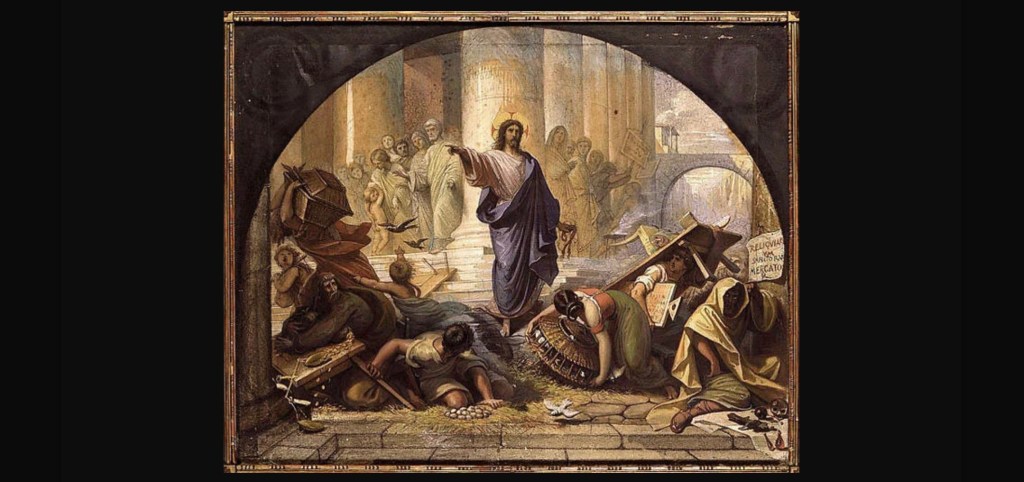
Not hangry but a holy zeal for God’s house.

Upon a first reading of today’s Gospel from Mark it appears that Jesus woke up on the wrong side of the bed. He and the disciples were heading to Jerusalem, he was hungry, so spying a fig tree in leaf, he walked up to it and when he saw that there were no figs growing, he unleashed the words, “May no one ever eat of your fruit again”(Mk 11:14)!

In the next scene, we find Jesus returning to the Temple. He witnessed the money changers in the outer court, and he began to drive out those selling and buying there. He overturned the tables of the money changers and the seats of those who were selling doves (Mk 11:15). Good thing for the doves that Jesus only went for the seats!

There was a series of commercials which ran a while back in which a character was very hungry and acting out of sorts until they were able to eat the candy bar being promoted. Once they did so, the character transformed back into themselves. Is this what is going on with Jesus? Is he just hangry? Has his blood-glucose level taken a nosedive? Or is there something deeper going on?

Remembering that Jesus fasted for forty days in the Judean desert, I would speculate that there is something else going on. What is more likely is that Jesus is asserting his prophetic role. As with other prophets recorded in the Old Testament, like Jeremiah, who gathered the elders of the people, then smashed a potter’s flask, then shared that this is what God would do to them for being unfaithful (cf. Jeremiah 19), Jesus is most likely going with a similar hyperbolic display to make a dramatic point.

The fig tree is often a sign for Israel and is recorded as such in both Hosea and Jeremiah. When Jesus comes to the fig tree, his reaction is an expression of the unfaithfulness of Israel not so much at the fig tree. The chosen people are to be faithful to God in and out of season. When the disciples and Jesus passed by the fig tree the next morning, Peter exclaimed that the fig tree Jesus had cursed had withered to the roots. Jesus, not missing a step, mentions to his disciples that they are to: “Have faith in God” (Mk 11:22). By doing so, they will not whither and fade as those not being faithful to the covenant.

Jesus assumes his role as a prophet again when he is casting out the money changers in the temple precincts. It is no minor detail that the tables with caged doves were spared. If Jesus was going off in some kind of unabandoned rage, he would not have thought twice about turning over the tables on them as well. Jesus is making a spectacle that people would take notice. “Is it not written: My house shall be called a house of prayer for all peoples? But you have made it a den of thieves” (Mk 11:17).

Jesus is cleansing and restoring the Temple to its proper place as a house of prayer, but he is also showing that the temple tax that has been paid and the sacrifices that have been offered will no longer be needed. “Jesus’ actions signal the arrival of ‘that day’ prophesied by Zechariah, when the Lord would gather all the nations to worship him in Jerusalem, and ‘there shall no longer be any merchant in the house of the LORD of hosts’ (Zech 14:21)” (Healy, 227).

Jesus is foreshadowing how he will replace the brick and mortar and he himself will become the New Temple. Jesus will be scourged and crucified, he will be the sacrifice offered and the price paid for our sins. The altar will be the new table where his sacrifice will be memorialized and re-presented.

Jesus’ message at the fig tree and the cleansing of the Temple are just as important for us today. As his followers, we are to bear fruit in and out of season, this means that we are to live out his teachings in all areas of our lives, individually and in communion with one another. Jesus has given us all a gift to offer, something that no one else can or ever will quite do in the way we can. This is how we are to bear fruit. Jesus in cleansing the Temple, shows that he is the new Temple. We too are to be a part of this Temple. We are to resist the corrosive and corruptive temptations that assail us. 

May we not be transformed by the fallen tendencies of the culture, but instead transformed by the love of God and remain steadfast and true to our calling. Let us be faithful to God’s will as members of the living Temple. We are precious stones, to be polished and refined, that we might radiate the light of Christ to those in our midst.


Painting: Raymond Balze, “Jesus Chasing Merchants from the Temple”

Healy, Mary. The Gospel of Mark. Grand Rapids, MI: Baker Academic, 2008.

Link for the Mass readings for Friday, May 29, 2026

Jesus, please send us the purifying fire of the Holy Spirit.

Jesus entered the temple area and proceeded to drive out all those who were selling things, saying to them, “It is written, My house shall be a house of prayer, but you have made it a den of thieves” (Lk 19:45-46).

Luke’s account of Jesus casting out the money changers is the most succinct of all four Gospels. Luke uses the Greek term for “drive or cast out” – ekballō, eight other times. Each time he used it, Luke was making reference to exorcising demons and unclean spirits. The profanation of the body through possession of evil is equivalent to the desecration of the Temple precincts.

Jesus justified his actions of driving the sellers out of the Temple precincts by saying: “Destroy this temple, and in three days I will raise it up” (Jn 2:19). Jesus showed the dignity of our humanity, when he, as the Son of God, entered our humanity. He entered into the chaos of our lives, our faults and foibles, as well as our sins, while remaining sinless himself. He showed that even though we have turned away from God, we were not destroyed and lost beyond hope. He reminds us that what God has created is good and that includes us. Even when we turn away, he continually and infinitely reaches out to us in love and calls us back into relationship with him.

One of the wonderful features of the upcoming holidays is that many families seek to come together and to return home. For some coming home has been longer than for others, for some there may be many miles of separation, and for others, coming home is no longer possible because they have changed their address from this life to the next. There are also those suffering today that are estranged from their families, those who are homeless, displaced, refugees and immigrants, or living in fear of deportation.

No matter who or where we are, Jesus remains close. He became one with us to restore our communion with his Father and one another. He provides the living water that quenches the thirst of our deepest longings. Jesus is our Temple, our new covenant, the dwelling place of God. He is alive and present to each one of us in every condition, situation, time, and place. Through his resurrection, ascension, and our participation in his life, we become precious stones of his Temple.

Jesus meets us where we are and loves us as we are, yet he wants the best for us and for us to settle for nothing less. Jesus, please cast out, as you did in the temple precincts, all from our being that would defile, distract, or divide us, and purge anything that would keep us bound in sin. Send the Holy Spirit as a purifying fire that will reign in our hearts so that each thought, word, and action may proceed not from our survival instincts or reactions, but from deciding to think, speak, and act according to our Father’s will.


Photo: Breathe in – Come Holy Spirit – Breathe out – repeat

Link for the Mass readings for Friday, November 21, 2025

Be still, and allow the Holy Spirit to burn!

Then the disciples approached Jesus in private and said, “Why could we not drive it out?” He said to them, “Because of your little faith.” (Mt 17:19-20).

How do the disciples get from this recurring theme of having little faith in the Gospel accounts to Peter healing a crippled beggar by saying with boldness, “I have neither silver nor gold, but what I do have I give you: in the name of Jesus Christ the Nazorean, [rise and] walk” (Acts 3:6)? And the man did just that!

A helpful definition “is to say that faith always entails a relationship between persons which stands or falls with the credibility of the person who is believed” (Rahner and Vorgrimler 1965, 164). Faith is not just an intellectual exercise, it is a lived experience. Christian faith is the conviction, belief, and relationship experienced with Jesus the Christ. The disciples learned from Jesus but more importantly developed an intimate relationship with him, such that the love they received and shared became so strong that there was no more room for doubt, distraction and/or fear, such that they would align themselves with the will of God and do what Jesus did.

The disciples did have some moments of doing as Jesus had done, but it was not until Jesus ascended and the Holy Spirit descended upon them at Pentecost that everything changed. Jesus had tilled the soil, he helped to unearth the rocks of the hardness of their hearts, he forgave them, and healed them. But it was not until they let him go after his Ascension that they were able to receive the Holy Spirit and by his power working through them they would do even greater deeds than he (cf. Jn 14:12-14)!

We are invited to do the same. If we only read the Gospels or hear them read we may know something about Jesus, but our life will for the most part remain unchanged. When we read, meditate, and pray with the Gospels and put into practice what we read, we will encounter Jesus as did his disciples. We too will come to know and develop a relationship with Jesus and our hearts and minds will be transformed by him. In this way, we are not just reading a dead letter but encountering the living Word, the Son of God, who invites us to share in the infinite dance of Love that he participates in with God the Father and God the Holy Spirit.

The enemy will do everything in his power to distract, divert, and tempt us from setting aside time to pray with God each day. And when we actually begin to discipline ourselves, enter into quiet time daily, we are invited not to stay there but to go deeper, to move beyond only reading, meditating, and praying. There will be times Jesus invites us to set aside our Bible, notes, journal, prayer cards, and/or vocal prayers of petition, and to just be still, to listen, and receive the love that Jesus and the Father experience, the Holy Spirit.

The same Holy Spirit who empowered the Apostles to fulfill what Jesus had begun with them is quietly nudging us on each day. Please listen! He is inviting us to see more clearly those subtle ways we are being distracted, tempted, and diverted from his guidance and what has been inhibiting the growth of our relationship with God. The love and light of the Holy Spirit will reveal, when we are willing to remain still, where and how, in minute and massive ways, we are refusing to follow the will of God.

One of the reasons that we have “little faith” is that we rely too much on ourselves. We are invited to stand in the presence of the Holy Spirit and let his fire burn, to purify us from our own misguided thoughts of self sufficiency. As gold and silver is placed in a crucible and heated, the dross is purified. We are purified in the crucible of our meditation, prayer, and contemplation by the love of the Holy Spirit. Through this purifying light we will see that we cannot save ourselves, that we need a savior, Jesus, with his arms wide open ready, willing, and able to forgive us and love us unconditionally and continually.

———————————————————————–

Photo:  A moment of stillness and purification back in December.

Rahner, Karl and Vorgrimler, Herbert. Theological Dictionary. New York: Herder and Herder, 1965.

Link for the Mass readings for Saturday, August 9, 2025

“When the perfect comes, the partial will pass away.”

Pilgrims numbering two to four million would ascend to Jerusalem to participate in the annual observance of Passover. During this time the Jewish officials were on edge because their primary concern was to keep order and peace for fear that the Roman military occupation also in presence would step in if need be. If the centurions asserted their enforcement, it would be swift and brutal. Even the slightest infraction of civil unrest would be dealt with harshly.

Jesus whirling a whip made out of chords, driving out the merchants, turning over tables, sending coins flying would have been quite the scene! The disruption certainly would not have gone unnoticed and some biblical scholars believe this was the main incident leading to his crucifixion. In this act of cleansing the Temple, Jesus gave a visual display to his sometimes figurative teachings. Jesus came to shake things up, to wake people up from their spiritual slumber, to bring people back to right worship and praise.

Let us enter the scene of today’s gospel. We are those among the vast crowd in the temple precincts, shoulder to shoulder amidst the hustle and bustle of the day. A cacophony of words echoes about, haggling of prices for animals being purchased for sacrifice mingle with arguments over unjust money exchanges. Then we experience a lull in the crowd, we look over our shoulders and see people stepping aside, parting, and opening. Then Jesus, rope chords in hand, his face hard, and eyes set on the tables ahead of him, strides by us. We can feel the electricity of a gathering thunderstorm, and then he lets loose like a lightning bolt. The first table goes over, coins launch into the air and jingle as they scatter across the stone amidst a chorus of the money changer’s cries of outrage.

The scene shifts. A knock is heard at the door of our own home as we are in the midst of what we do on any given Sunday. We walk to the entrance and spy the same Jesus we just experienced in the temple precincts standing outside. We feel the drop in pressure of a gathering storm, we witness the same hard expression on his face, and in his hand are the same chords. If we do let Jesus in, where does his stride take him, what does he overturn and toss aside? We are invited to allow Jesus full reign and access to every nook and cranny of our home, as well as our heart, mind, and soul.

In both cases, these are not acts of Jesus having a temper tantrum or bad day. They are acts of love and purification. “For when the perfect comes, the partial passes away” (I Corinthians 13:10). Jesus, the perfect, knows what does not and what does belong in the temple as well as our homes and in our hearts. He knows what is preventing us from receiving the fullness of his and his Father’s love. Are we willing to know, to purge, and allow that which is partial to pass away, so that we may enter into a deeper life of authentic prayer, worship, intimacy of relationship with God, and service to each other?

———————————-

Painting: Rosary walk last Fall, St. Vincent de Paul Regional Seminary, Boynton Beach, FL.

Link for the Mass readings for Sunday, March 3, 2024