“‘Who then is this about whom I hear such things?'” And he kept trying to see him” (Lk 9:9).
Herod Antipas, the ruler over Galilee and Perea, heard stories about Jesus. The range of his thoughts, expressed by Luke, is confusion to curiosity, and regarding what he did to John the Baptist, his rumination could have been much worse. Herod may have started to feel concern over the possibility of a growing revolt, some guilt for his execution of John the Baptist, or just as had feared John while at the same time “liked to listen to him” (Mark 6:20). Could this Jesus accomplish even half of the things Herod had heard about him? One question that did not seem to cross Herod’s mind was whether he had any interest in changing his life and becoming a follower of Jesus.
Herod was not the only one in Luke’s Gospel who asked questions about who this man, Jesus, was. Nor did the asking of those questions die with Jesus on the cross. They continued after his resurrection and ascension, they continued into the first centuries of the Church, which led to the calling of the first ecumenical councils that dealt directly with who Jesus was, and they continued in each following century and continue today. There are even at present, within some academic circles, the question of whether Jesus even existed at all.
One could ask why this question about the identity of Jesus still persists? One answer is that we are finite beings seeking to understand an infinite Mystery. To comprehend the reality that Jesus is the incarnate Son of God, fully divine, who took on human flesh in the womb of Mary, lived fully human, died on the cross, conquered death through his resurrection, and ascended to and sits at the right hand of the Father, transcends and stretches the capacity of our reason. Also, Jesus’ invitation is a universal but personal one. Each individual person has to encounter Jesus for her or himself.
Jesus called the Twelve, as well as Mary Magdalene, St. Ignatius of Antioch, St. Irenaeus, St Thomas Aquinas, St. Francis and St. Clare of Assisi, St. Catherine of Siena, St. Teresa of Avila and St. John of the Cross, St. Ignatius of Loyola, St. Francis de Sales and St. Jane Frances de Chantal, St. Mother Teresa, Thomas Merton, Dorothy Day, along with two of our newest saints – St. Pier Giorgio and St. Carlo Acutis. He also calls each one of us. He did not call us to just merely embrace a new philosophy, a new ethical way of life, or even a new religion. Jesus called and calls us to be a part of his Body, the Mystical Body of Christ.
Who is Jesus? Herod asks in today’s Gospel. It is a good question for us to ask as well. For me, Jesus is the Christ, the Son of our loving God and Father, who became incarnate, became one with us in our humanity so that we could become one with him in his divinity. This same Jesus who called others through the ages invites us to follow him today as well and he continues to walk this journey with us. Whether we say yes or no to his invitation, Jesus is with us. We are more aware of his presence though and receive more of his help when we accept his invitation and/or ask for his help!
Life with Jesus isn’t perfect, and we will at times echo St. Teresa of Avila, who stated after she was thrown from a carriage into a mud puddle, “If you treat your friends this way, it is no wonder you have so few.” But we will, as did Teresa, also experience moments of inexpressible joy, of wonder, exhilaration, consolation, and feeling blessed when Jesus works and loves through us.
St. Teresa of Avila had a deep and intimate relationship with Jesus and knew him as her closest friend because she heard him knocking and let Jesus in. She spent determined and intentional time consistently with him. She spent an hour before and an hour after Mass each day. She set aside specific, daily anchor times of personal meditation and prayer, contemplated upon and experienced deep intimacy with God, which allowed her times of such closeness that she experienced Jesus as well in her daily activities. She was able to share with him her joys and frustrations because Jesus was that close to her.
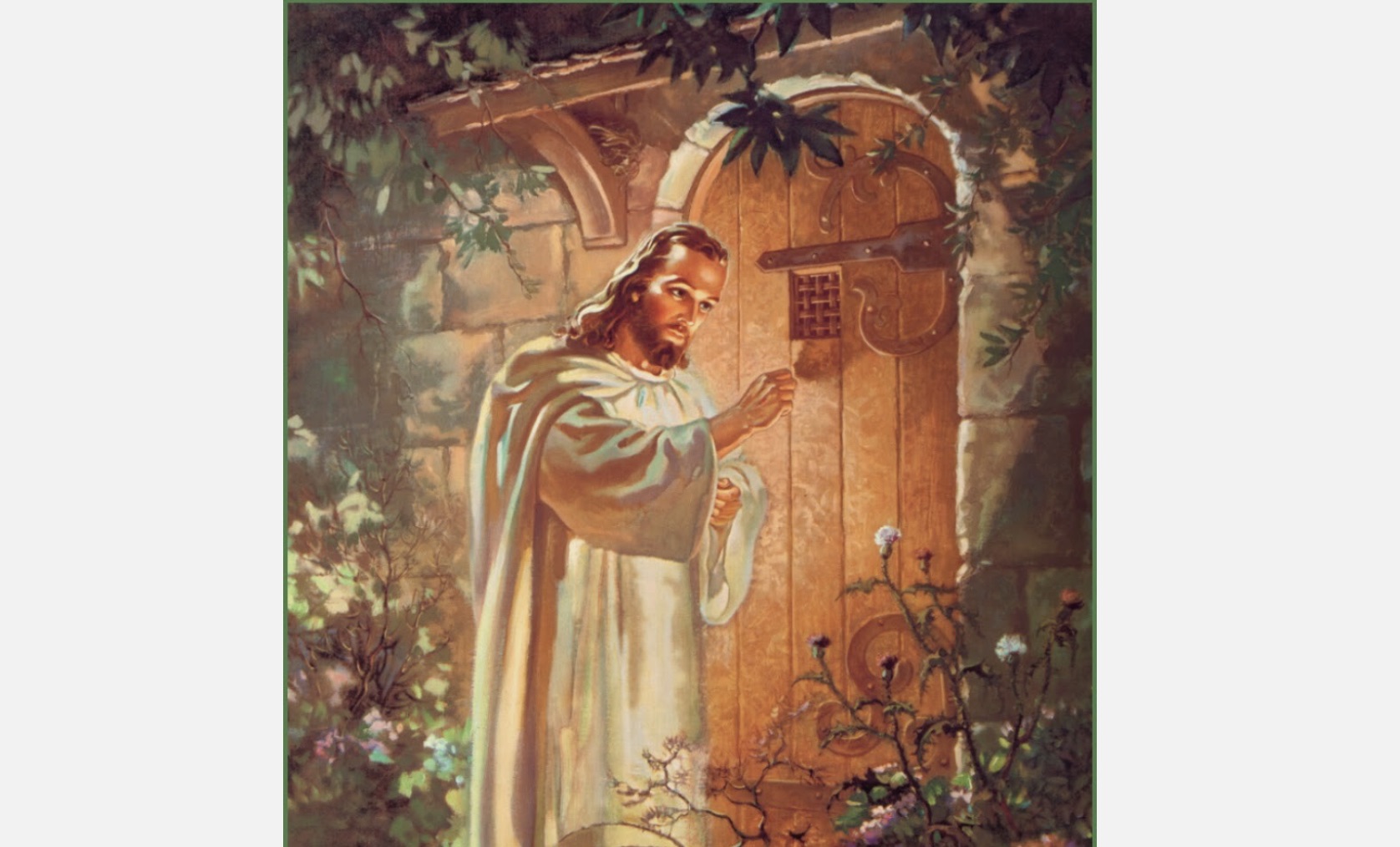
Jesus is not just a passing curiosity as he was with Herod Antipas. Jesus is standing and knocking, (cf. Revelation 3:20) at the door of our hearts and minds. Jesus invites us as he did Zacchaeus to come down from the tree and take him to his home (cf. 19:5). Jesus is calling us to come as he did with Matthew (cf. Matthew 9:9-13). Jesus is no myth, nor was his death the end. He died and conquered death for us in a radical and particular way. Jesus is alive and well, and inviting us to follow him today. All Jesus waits for is our, “Yes”, and for us to make a few steps with him. When we do, Jesus will take care of the rest!
Painting by Warner Sallman, 1942. Maybe we don’t know Jesus as well as we like because when we pray, we just say words, instead of realizing that we have the opportunity to pray with Jesus.

