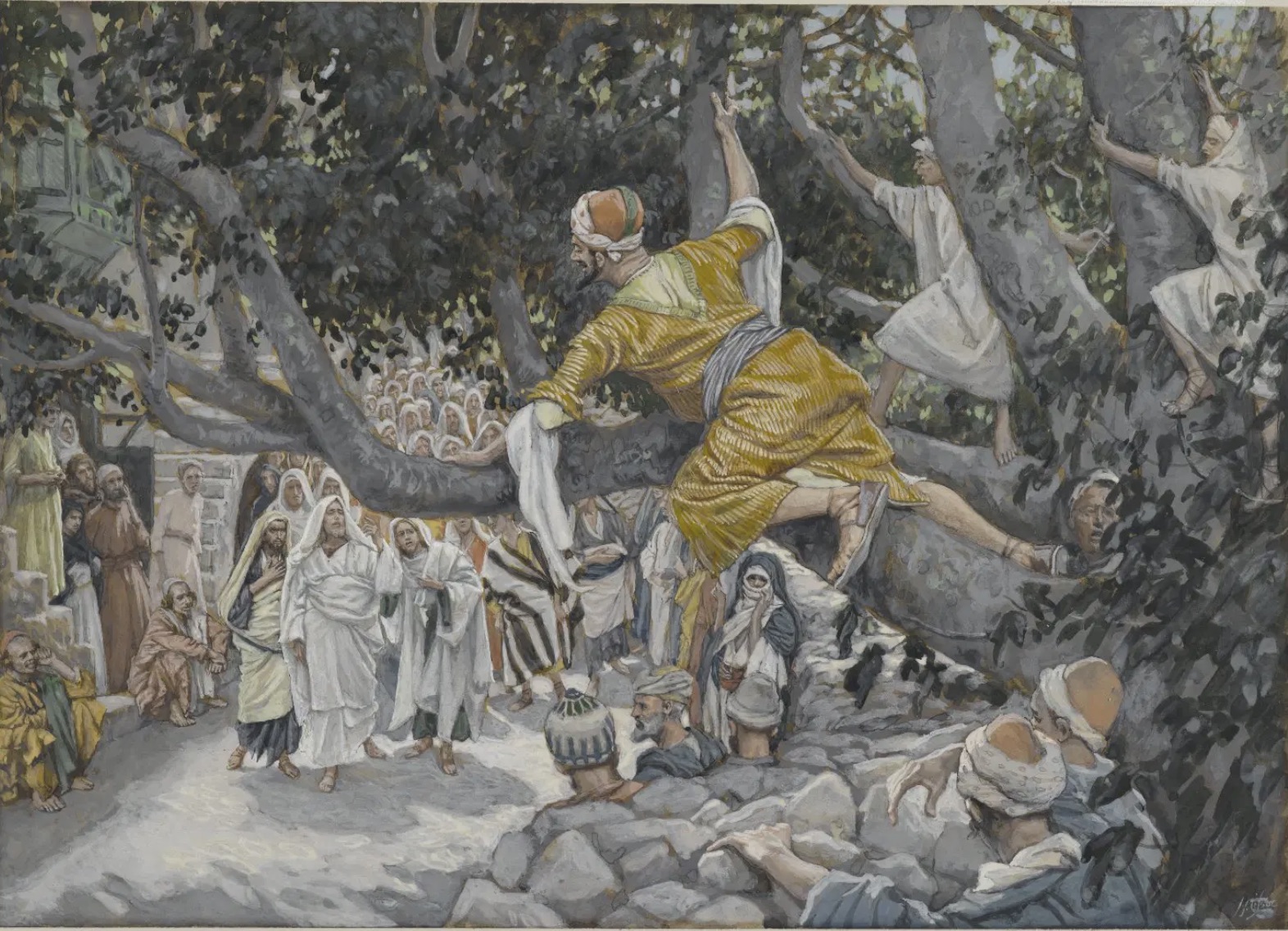
Yet again, as in the Gospel from yesterday, the crowd gets in the way of someone seeking access to Jesus. The wall of people that has gathered around Jesus does not appear to be overtly keeping Zacchaeus from seeing Jesus. They may be so focused on seeing him themselves that they are not aware. Yet, there is also the strong possibility that the people were aware that this man was trying to get through. They knew Zacchaeus, and many judged him to be the sinner of sinners.
He was the chief tax collector of the area and he was most likely reviled by most in his community. He would have also likely have been considered unclean because he was breaking the commandment of stealing, which he and the majority of the tax collectors did at the time. They collected what Rome required and then asked for more for their services. As the chief tax collector he was also dealing with the Gentile occupiers. Could there be a possibility that each time Zacchaeus attempted to move into a better position, made an attempt to get through a gap to get a better look, the individuals may have closed the way.
Zacchaeus would not be thwarted. He ran ahead of the crowd and climbed a sycamore tree. From his perch he was not only able to see Jesus, but Jesus saw him and said, “Zacchaeus, come down quickly, for today I must stay at your house” (Lk 19:5). Jesus did not see a tax collector or a sinner, he saw a seeker. Someone who was willing to humble himself by climbing a tree, much like a child.
Jesus did not see the 99% nor the 1%. Jesus saw and sees people in need of compassion and mercy. He sees those lost that need to be found, those sick in need of healing, those alone who seek to belong, to be accepted. Jesus did not meet Zacchaeus with judgment but with love and compassion, and that made all the difference for this man’s conversion.
Jesus was willing to draw close to the one so many despised and kept at a distance. By inviting himself to dine with Zacchaeus in his own home, Zacchaeus must have felt overwhelmed. Maybe for the first time in his life, he felt welcomed instead of disdained. He repented without hesitation to the unconditional invitation and love he had received: “Behold, half of my possessions, Lord, I shall give to the poor, and if I have extorted anything from anyone I shall repay it four times over” (Lk 19:8). Unlike the other rich man who left sad (Lk 18:18-23) because he was not willing to relinquish his riches, Zacchaeus was filled with joy because he could.
This expressive act of generosity arose from his encounter with Jesus. This exchange offers the invitation for us also to receive Jesus in the same way and to greet others more openly as well. One way to do so is to resist the temptation to “grumble”, to gossip, to pre-judge, and/or to dehumanize. Salvation came to Zacchaeus’ house in the person of his savior and in the act of his repentance. Zacchaeus did not have to change first for Jesus’ invitation. In receiving Jesus’ love as he was, that brought about the radical change.
Life is hard enough without adding more barriers or negativity. Jesus wants to dwell with us too. While at the same time, he challenges us to see beyond the exterior caricatures we project on to others, and instead invites us to seek to know the heart and character of the person, free from our knee jerk reactions. We can do so when we resist the temptation to grumble, to focus on the worst aspects of a person, and instead, are willing to approach others with an understanding heart and mind. Loving does not condone a wrong or a hurt, it just means we will the good of another, we want their best, and seek their healing. With God that is possible. Even if the person isn’t open, we can still experience healing.
Painting: Zacchaeus in the Sycamore Awaiting the Passage of Jesus by James Tissot.

