With Jesus, each day is a new beginning.

There are a handful of incidents in today’s Gospel reading from John that refer back to encounters Jesus had with his Apostles before his death and resurrection. Jesus waits on the shore as seven of his disciples; Peter, Thomas, Nathanael, James, John, and two others, return from a night of fishing. This is reminiscent of when Jesus first came to Andrew and Simon, James, and John as they were casting and mending nets and he invited them to follow him.

The disciples are on their way back to shore with their nets empty, and Jesus suggests that they cast their net over the right side, and they quickly find that they “were not able to pull it in because of the number of fish.” Peter had this experience in one of his first encounters with Jesus when he had been fishing all night and Jesus encouraged him to put out into the deep water, and that time they were able to fill two boats with fish.

After their great catch “of one hundred fifty-three large fish,” John told Peter that the Lord was the one who had instructed them. Just as when Jesus approached his disciples that night walking on the stormy waters, Peter jumped out of the boat and walked on water until he took his eyes off Jesus and began to sink. Peter again “jumped into the sea.” Did he walk on water all the way to shore this time? And when Peter and the disciples came to shore “they saw a charcoal fire.” The most recent event with another charcoal fire was outside the gate where Jesus was led for his judgment. To keep warm Peter joined the servants and slaves huddled around a charcoal fire. It was at that charcoal fire that Peter denied Jesus. The final scene in today’s account was when Jesus offered cooked fish and bread to his disciples, this is reminiscent of Jesus feeding the five thousand with two loaves and a few fish.

Throughout our lives, we will have encounters with people and experience incidents that we have experienced before. We may not have been as present as we may have wanted to be when attempting to comfort someone, we may have given in to temptation we regretted, we may have been involved in some task and made a mistake, or as Peter had done gone against our better instincts, as he had denied Jesus three times at that charcoal fire. Peter wept when he heard the cock crow. The sound brought back Jesus’ prediction, brought to light Peter’s own denial and cowardice. How many times must he have berated himself, how many times have we done so when we have sinned, fallen short of our goals, or made mistakes?

Making mistakes and taking risks, are necessary for learning and growing in any endeavor in life. Jesus does not want us to beat ourselves up when we fall short, fail, nor even when we sin. What is required for maturation is an honest assessment of the situation, an acknowledgment of our mistakes and sins, a healthy sense of guilt but not a turning in upon ourselves and steeping in our own guilt. Once we have recognized what we have done or have failed to do, we then repent, correct our mistakes, confess, and make the proper adjustments. Often, we overcompensate in the beginning, but as we remain persistent and seek God’s help and guidance, we will reach a healthy balance.

Jesus returns to be with his disciples after his resurrection, he meets them in very similar settings as he had before his death. All of his disciples failed him. Jesus did not condemn, but instead forgave them. Jesus showed them how far they had come since he first called them, while at the same time helped them to see how far they still had to go to. Jesus is not only their teacher but the divine source of their own transformation.

Jesus has risen, he is new life, he appeared to his disciples to guide, encourage, and empower them to be who God called them to be. Jesus offers us the same access to the wellspring of his humanity and divinity. Our repentance and Jesus’ forgiveness go beyond helping us to become better people. Through the love of Jesus, we are invited to experience a new beginning each day. When we are willing to surrender to him, participate in the sacraments, and pray, our minds, hearts, and souls will change, we will be redeemed, transformed, and conformed to Jesus and share more in his life. Good news to not only share in word but in deed. Alleluia!!!

————————————————-

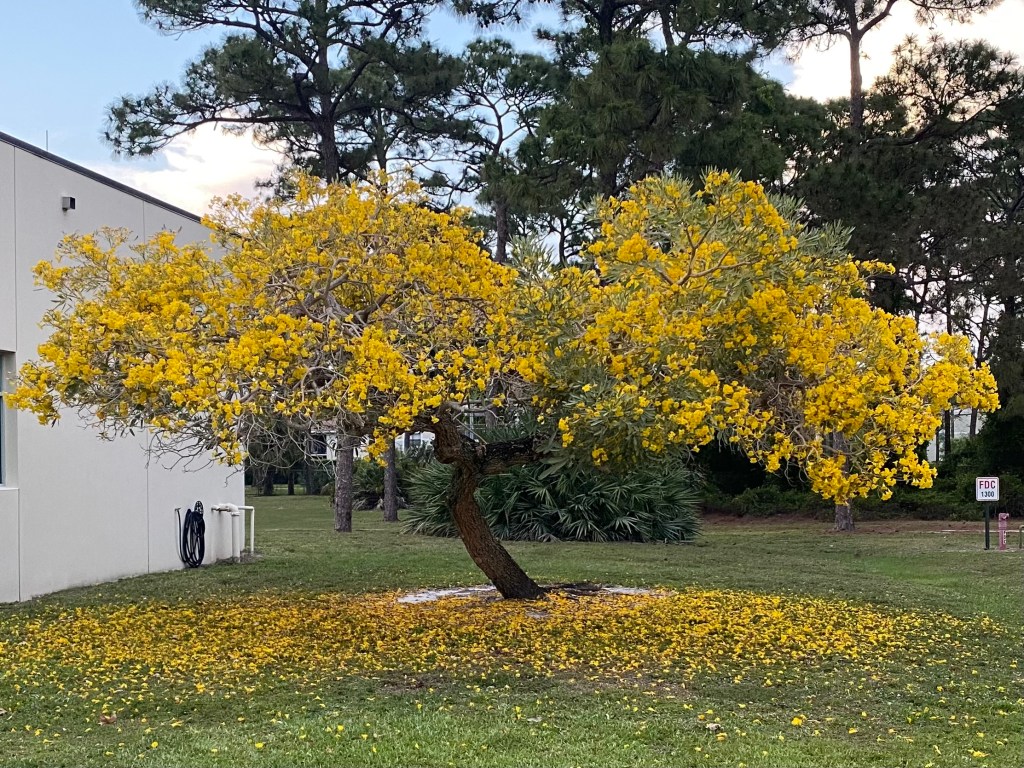
Photo credit: While on my evening Rosary walk, a new bloom of Bermuda Buttercups. In Jesus’ name, may this day be a new beginning for us as well! St. Vincent de Paul Regional Seminar, Boynton Beach, FL.

Link for the Mass readings for Friday, April 5, 2024
 

God reaches out to us in so many ways, to let us know that he cares and we are not alone.

Just as Jesus came among Cleopas and the other disciple on their journey toward Emmaus, Jesus does so again as the pair was recounting their encounter with the risen Jesus. What Jesus does differently in this interaction is that he clarifies that he is not a ghost, “Look at my hands and my feet, that it is I myself. Touch me and see, because a ghost does not have flesh and bones as you can see I have” (Lk 24:39). He then asked for something to eat. They gave him fish and he ate, something a ghost or spirit would not do. He talked with his disciples as he had done during their time together before his crucifixion.

We have heard about the resurrection of Jesus, maybe for years, but it is important not to get complacent with the amazing miracle that this is, who Jesus was, and continues to be: a hypostatic union, meaning that Jesus is one divine person, subsisting in two natures, the human and divine.

The humanity of Jesus through his resurrection was fully actualized and transcended the limitations of the three-dimensional realm that he had experienced in his humanity before his death and resurrection. This is how he could disappear after making himself known in the breaking of the bread and how he will come through a locked door to interact with his disciples.

The relevance of the bodily resurrection of Jesus for us is that he, in dying and conquering death, is now the reality of who we will one day be. We will be fully actualized as God has created us to be. The good news is that we do not have to wait to go to heaven for this process to begin! The path of becoming redeemed and whole begins in this life, now, as we accept Jesus as our Lord, Savior, and Redeemer. Jesus in his encounter with his disciples from today’s reading from Luke continues the message he began at the beginning of his ministry, which is one of repentance and forgiveness.

When we were baptized, we were born again as an integral part of the new creation given to us by the death and resurrection of Jesus. Through this grace, our humanity has been redeemed. Each day we are to live in humility, calling to mind our sins and repenting daily. As we do so, Jesus will forgive us, and as we receive his mercy and forgiveness, we will not only be more and more conformed to him, we are also to offer the same to others. Jesus suffered and died for each and every one of us, and he also seeks to live through us. Jesus is the foundation and source of our life and salvation. Jesus has come to show us that we are not in competition with God, but that his Father, our Father, seeks to be in solidarity with us.

There have been times when I have felt pretty wiped out physically, working second shift full time while student teaching in my last year of college; the balance of family life, teaching full time, and five years studying for the permanent deaconate; taking care of JoAnn in her final months; recovering from pneumonia; and over these past two years studying for the priesthood. Through each of these episodes and the regular day in and day out in between each of these more intense moments, I have found peace and renewal, and even more importantly, a deepening of my intimacy in my relationship with Jesus. This has grown as I have been more consistent in the daily anchor practices of praying with the liturgy of the hours and the daily Mass readings, participating in Mass, meditation and contemplation during my holy hour, the Rosary, and Chaplet of Divine Mercy.

Most recently, in the days before taking my Cura Animarum, our final, oral exams, I headed out for my Rosary walk and saw a unique rainbow to the west (the picture of which I posted a few weeks ago), then the next day during my holy hour I was drawn to Jeremiah 1:7-9 in which God was encouraging me to have no fear and that he would place his words in my mouth, and then the day before the exam as I was genuflecting before Jesus present in the tabernacle, I surrendered all of myself to him and felt this overwhelming sense of closeness. Jesus was affirming not only that I would pass my oral exams, which I did, thank God, I felt he was affirming again my vocational path to the priesthood.

Since my late teens, God has revealed himself in these small ways. No mere coincidences have they been but God-incidences. These are moments where God says hello and lets us know that he walks with us and that we are not alone. Even in the midst of our trials and tribulations, when weary and worn, we can experience joy! God is reaching out to us in so many ways, all the time. We just need to take a moment, take a breath, and look up, listen, and be willing to feel. The more we do so, not only in our trials but in every situation, the more we will experience God-incidents – Alleluia!!!

——————————————————-

Photo: While praying the glorious mysteries, came upon this glorious bloom! – St. Vincent de Paul Regional Seminary, Boynton Beach, FL.

Link for the Mass reading for Thursday, April 4, 2024

“Were not our hearts burning within us while he spoke to us?”

Our Gospel reading for today begins with a feeling of despair. The hope of Jesus being the Messiah, the promised one who came to redeem and deliver his people Israel died a brutal death. Even though Jesus sought to prepare his followers for this reality, they could not conceive or believe that the promised Messiah could die.

Cleopas and his companion are in mourning as they walk along the road to Emmaus. They have left Jerusalem and are commiserating among themselves about their dashed hopes. They were so sure that Jesus was who he said he was, now what were they to do? Jesus met them where they were and wove his way into the conversation and their journey.

When the time for them to part arrived, Jesus motioned to them that he was continuing on. The pair of disciples urged him, “Stay with us, for it is nearly evening and the day is almost over” (Lk 24:29). Jesus did just that and he revealed himself to them “in the breaking of the bread”(Lk 24:35).

The account of the road to Emmaus has significant relevance for our own spiritual journeys. How many times have we had an inaccurate understanding of Jesus in such a way that we felt let down? Have we domesticated Jesus, or limited who he is, seeing only one aspect of his totality, attempted to shape or conform him into our image and likeness? Have we prayed for something and then that petition or intention was not fulfilled in the way we had hoped? Have we sought Jesus and felt that he wasn’t there for us in our time of struggle or during those times that we felt that we needed guidance?

We need to remember that Jesus meets us where we are, accepts us as we are, walks with us even when we are walking in the wrong direction. While at the same time, he reveals to us the truth. We then need to decide to continue on the path leading away from the love of God or to turn back and into his open arms waiting for our return.

Following the truth that Jesus sets out before us means that we will be stretched beyond our comfort zones, urged to let go of our safety nets and training wheels, called to repent from our sinful ways by resisting the temptation to curve in upon and isolate ourselves. Instead we need to be willing to risk, to be loved, and to love in return. Through our relationship with him, Jesus invites us to nothing less than experiencing the transfiguring flames of Trinitarian Love.

Spending time reading and meditating upon the wonderful, daily readings from the Acts of the Apostles and the Gospels available to us right now will set our hearts aflame as happened with Cleopas and his companion. As this pair returned to the community of Jerusalem, may we gather each Lord’s Day, to hear his word proclaimed and to experience him revealed in the breaking of the bread.

As we put into practice what we hear and receive, we too then will begin to: see Jesus more active in the midst of our everyday activities, recognize him in our daily events and even in interruptions, be more inspired to share the sacrificial love we have received from Jesus with those around us, and come to realize that Jesus is more present and closer to us than we are to ourselves. We just need to invite him to walk with us on our journeys, even and especially when we are heading the wrong way!!!

————————————————————-

Photo: While praying with the mysteries of the Rosary, not only my heart, but the sky was burning!

Link for the Mass reading for Wednesday, April 3, 2024

We experience the miracle of the Resurrection at each Mass!

As we continue through our Easter readings we are given glimpses of encounters with the risen Jesus. This is good news for us, as the risen Jesus of the Gospels is the same Jesus who we can encounter each day.

In today’s Gospel, Mary does not return with Peter and John after having observed the empty tomb. Mary stayed by the side of the tomb and wept. She then peered into the tomb and witnessed two angels. As she turned back, she saw who she believed to be the gardener. She questioned him as to the whereabouts of Jesus. Mary sought a rational reason for where the dead body had gone. When the man did not immediately answer, she must have turned away again, because Jesus said to her, “Mary” (Jn 20:16)!

Upon hearing her name, Mary Magdalene recognized Jesus.

Peter and John left the empty tomb. We do not know why. Maybe they wanted to confirm to the other disciples that Mary was correct about the empty tomb? Mary could have gone back also, but something impelled her to stay. It could have been the sorrow that brought her to tears, it could have been her dedication and faithfulness to Jesus to find him, to anoint him as she had come to do that first early Easter morning, it could have been that she did not know what to do next, or that there was a sense beyond her understanding that compelled her to stay. Whatever the reason shortly thereafter, Jesus came to her. She recognized him not at first, but when he called her by name. When she called him “Rabbouni”, Jesus asked her to, “Stop holding on to me”.

What was Mary holding on to? Though mistaking him for the gardener at first, she came to recognize that he had indeed come back to life. But in calling Jesus Rabbouni, teacher or master, Mary was going back to the relationship she had with him before. Jesus was transfigured, he was different than he was before. Jesus actualized the perfection of his humanity, while still retaining the fullness of his divinity. Though his mission would not be complete until he returned back to the Father with his Ascension.

In the accounts of the Resurrection of Jesus, there was not only a newness to his appearance, but his relationship with his followers were also transformed. He was not coming back to avenge those who betrayed him. Jesus charged Mary to return and convey the message he gave her to his “brothers”. Jesus is revealing to Mary the intimacy of relationship with him that she personally experienced when Jesus called her by name. And this was only a foretaste of the greater intimacy to come at his Ascension, when he would return to the Father and unleash the power of their divine communion of love through the power of the Holy Spirit that would be experienced by his brothers and sisters at Pentecost.

We are heirs to the same promise that Mary Magdalene, the Apostle to the Apostles, shared with the Twelve. Jesus has become the firstborn of the new creation and through our baptism in the name of the Father, and of the Son and of the Holy Spirit, we are offered the invitation to participate in his death and resurrection as well and share in the same intimacy of Jesus’ life and love that he shares with his Father.

The miracle of the Resurrection is revealed at each Mass when Jesus, Body and Blood, is represented again. Around the altar we gather as his brothers and sisters to be configured to his Body, and as we consume him, we are not only being nourished by the Bread of Life, we are being perfected, divinized by the trinitarian love, and being transformed into the image and likeness of the Father that we have been created to be. This is why Easter is such a cause for joy and celebration!!! This is why, like Mary who was sent by Jesus, at the end of Mass we to are sent forth to, “Go and announce the Good News of the Resurrection” in our everyday lives! Alleluia!!!

———————–

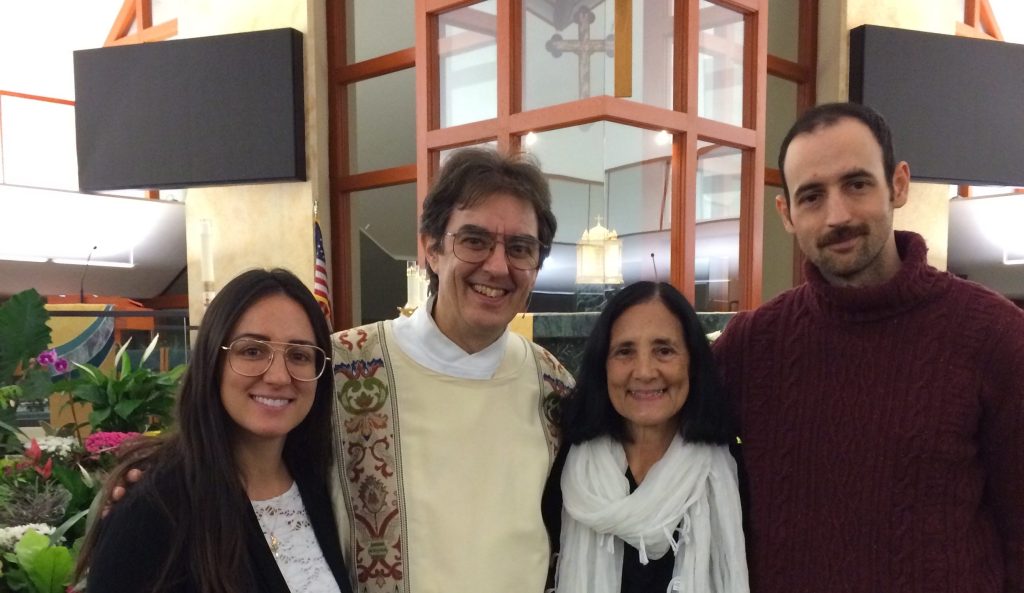
Photo: Beginning of Easter morning Mass where I was blessed to assist Fr. Nick and his parishioners at St. Clare Catholic Church, North Palm Beach, FL.

Link for the Mass readings for Tuesday, April 2, 2024

Stolen or Resurrection?

Mary Magdalene and the other Mary were bewildered from their encounter with the angel and the empty tomb. As they ran to get the news to the disciples, they were also dealing with mixed emotions, feeling both “fearful yet overjoyed” (Mt 28:8). Then in the midst of their travel they were greeted by Jesus, he assured them and then sent them to tell his“brothers to go to Galilee, and there they will see me” (Mt 28:10). Off the pair went to share the message: Jesus had risen!

At the same time, some of the guards who witnessed the event at the tomb took a different way and headed into the city to meet with the chief priests. They relayed the incident about the earthquake and the angel appearing to them and the two women. After deliberating, the chief priests and the elders paid the guards a large sum to perpetuate the tale that his disciples took Jesus away.

Who would be believed, the two women or the guards? Apparently both! Mary Magdalene and the other Mary fulfilled their first apostolic role and passed on Jesus’ message to his disciples for them to meet him in Galilee. Galilee was where the public ministry of Jesus began. They would all go back to the beginning. The tale spread by the guards would also be believed, because by the time of the writing of the Gospel of Matthew, the community, to which he wrote, were aware that, “this story has circulated among the Jews to the present day” (Mt 28:15).

Did Jesus really rise again from the dead as the angel, Mary Magdalene, and the other Mary claim or was this an elaborate plot by the disciples of Jesus to stage his resurrection, as the guards portrayed? How we answer these questions ought to make a difference in our lives. If we say that we believe in Jesus and that he rose again, do we live our lives any differently than those who say they don’t believe?

We, who follow Jesus who rose again, are to be like the angel and each Mary. We are to be an Alleluia people, allowing the risen Christ to proclaim through us to those facing death – the promise of hope and life; to those living in the darkness of sin and addiction – the inviting light of a new direction; to those who are weak and indifferent – our presence and accompaniment. Each day of this Octave and during this Easter Season, may we become less, so that the risen Jesus, who is our Way, our Truth, and our Life, becomes more.

—————————————————————–

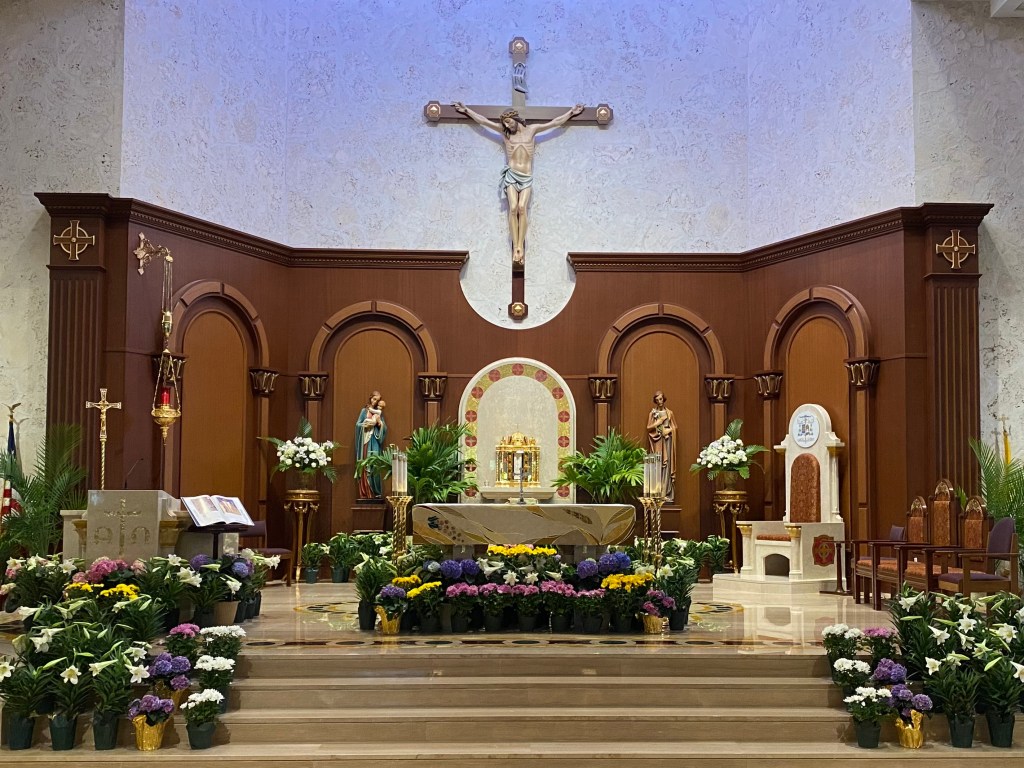
Photo: Sanctuary of St. Ignatius of Loyola, Palm Beach Gardens, FL before the Easter Vigil this past Saturday night. Ready to celebrate the Resurrection!!!

Link for the Mass readings for Monday, April 1, 2024

We are an Alleluia people because death does not have the final answer, Jesus does!

Mary of Magdala comes to the tomb during the wee hours of the morning while it is still dark and finds the stone rolled away. She runs to Peter and John to share with them the news, that: “They have taken the Lord from the tomb, and we don’t know where they put him” (Jn 20:2). Peter and John retrace the steps of Mary, running to find the tomb empty as well. All three are stunned because “they did not yet understand the Scripture that he had to rise from the dead” (Jn 20:9).

How can we blame them? Do we fully understand the reality and fact that Jesus has risen from the dead? Some make the conjecture today that Jesus did not really die, but woke up three days later, aching all over from the excruciating effects of the crucifixion. Others say that the accounts of the resurrection were mass hallucinations, or that the Gospel accounts of Jesus rising from the dead are mere myth. These propositions do not stand up to the fact that Jesus, fully God and fully man died, entered death, and conquered it. In so doing, he then entered a new life, a new reality. Jesus, in becoming the firstborn of the dead, was transfigured from our three-dimensional reality that we all know and experience, such that he now resonates at a higher pitch, in a higher dimensional reality. Jesus is the firstborn of the new creation!

All human history changed in that tomb because of this new fact of the resurrection of Jesus. How this happened is a mystery and seeking to understand, which is good, will fall short and be frustrated if we only approach the mystery of God in the same way that we tackle a problem to be solved. The Apostles and disciples of Jesus struggled to find meaning and understanding regarding how Jesus crucified was now gone from the tomb. They came to understand the mystery of the Resurrection, the same way that they came to understand the mystery that Jesus is fully human and fully divine. Understanding happened in their encounters with Jesus. The mystery of the Resurrection is not a problem to be solved, but a person to encounter, a relationship to embrace, as it was for the Apostles and is so for each of us.

Faith seeking understanding is grounded in having an encounter with a person, Jesus the Christ, the Son of the Living God. Pope Francis writes about this on page nine of his Joy of the Gospel: “The joy of the Gospel fills the hearts and lives of all who encounter Jesus. Those who accept his offer of salvation are set free from sin, sorrow, inner emptiness and loneliness.”

Easter Sunday is the day where this joy first truly became possible, and this joy is needed now more than ever. And yet, as we read in our gospel, Easter Sunday did not begin with a full brass band and banners waving. For: “On the first day of the week, Mary of Magdala came to the tomb early in the morning, while it was still dark and saw the stone removed from the tomb” (John 20:1).

Mary reacted as most of us would. She sought some point of reference. The stone was opened, someone must have stolen the body. When we encounter a mystery, we seek to understand. Jesus, time and again, transcends our comfort zones and the parameters of our finite attempts to seek meaning. When we are willing to seek with our reason, open our minds and hearts to encounter the reality beyond our reason; when we allow ourselves to wonder and allow ourselves to encounter Jesus; our Fridays of pain, suffering, and grief become good, our Saturdays of silence and the between times become holy, and the Resurrection is the fulfillment of the promise that we do not suffer and believe in vain.

Jesus who is the Christ, has truly risen – Alleluia, Alleluia!!!

We are an alleluia people. God has not only loved us into existence, but through his Son, we have also been loved into the promise of eternity, where suffering and death will be no more! A promise I believe even more strongly on this Easter, as I celebrate my fifth one without JoAnn. I hope that she is now celebrating along with Mary and the saints and that she is now where we will one day be rejoicing, because Jesus has opened up heaven for us in the humanity he assumed, death that he conquered, and his Resurrection that we celebrate today! Alleluia!

May God bless each of you and fill you with the peace, joy, and love of Jesus his Son! Happy Easter!!!

————————————————–

Photo: Our last Easter vigil together, April 20, 2019.

Francis. Evangelii GaudiumJoy of the Gospel, Libreria Editrice Vaticana. Frederick, MD: The Word Among Us Press, 2013.

Link for Mass readings for Easter Sunday, March 31, 2024

Jesus and Mary are with us in our experiences of Holy Saturday.

This is Holy Saturday. We remember how Jesus was in the tomb and wonder how the disciples of Jesus feel. Were their hopes dashed by the death of their teacher as they hid in fear that they might be next. Could he really have been the Messiah if he has died? Anguish, fear, doubts, and despair are heavy weights.

Some glimmer of hope though may come as they gathered and recalled what Jesus had said and taught. Peter, James, and John were especially privileged to have seen the transfiguration of Jesus. Jesus had raised Jairus’ daughter, the widow’s son, and Lazarus from the dead. Was Lazarus with them now? Could he have provided some possible hope that since he was raised, that Jesus may indeed rise again as he promised?

A powerful claim. But could it really happen?

Holy Saturday is that in between time. In between the death of Jesus and his resurrection. A place between despair and hope. All may appear to be lost, but then again there is the promise of Jesus. Did Mary and the Apostles trust him? Do we? As I shared yesterday, it is our pain and suffering that we carry into our Holy Saturdays. To heal, we need to be willing to carry those emotions that we would rather not experience and not deal with, because we might fear that if we do, we will be undone or that they will be too overwhelming. And yet, it is in taking that risk, entering into and experiencing our pain that we experience the comforting presence and love of Jesus. Jesus who experiences our pain with us as well as his Mother, whose heart was pierced when the centurion’s lance pierced her Son’s heart. And it is in experiencing our suffering with them that there can be a path to healing.

We often find ourselves in the same emotional maelstrom as did the disciples. We have heard that he is with us and that he loves us no matter what, but there is this period of dead silence. Holy Saturday is that time of waiting, that time of silence, and that time to draw deeper into believing even when we cannot see or experience with our senses. Holy Saturday is also a time to ponder and embrace the truth that it is not all about us. In looking beyond ourselves to the Passion of Jesus: his suffering, crucifixion, and death, our problems and sufferings may be adjusted with our focus and perspective on him instead of us.

Too often our minds tend to focus on the worst case scenario, and in times when we don’t feel or experience Jesus’ presence, we need to trust that he is not absent and that he has not abandoned us. Jesus is right by our side. We may not be aware because of our focus or he just might be challenging us to go deeper in our trust and faith in him. When we do, instead of feeling like we are sinking in the mud, we will come to find that our feet are set on solid rock, the Christ the Son of the living God.


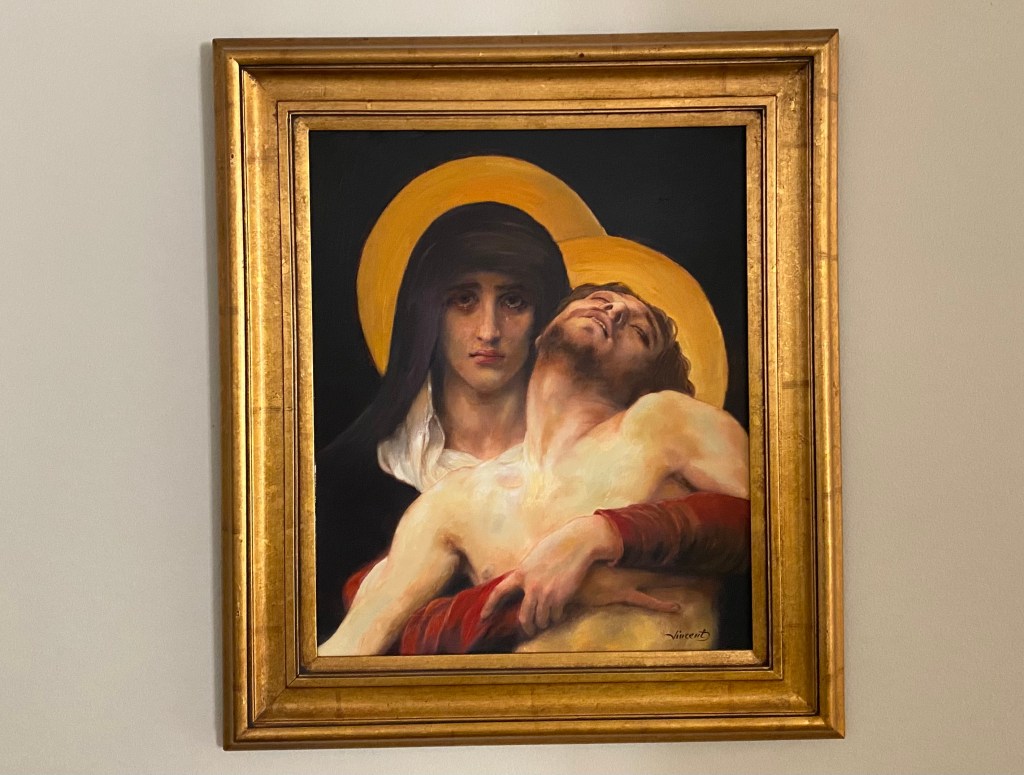
Photo of a closeup painting of William Bouguereau’s, Pieta, hanging in the main conference room at the Our Lady of Florida Retreat Center, North Palm Beach, FL.

The crucifix and Good Friday, a reminder of Jesus’ love for us.

Jesus was betrayed, arrested, falsely accused, tried, scourged, and beaten. Jesus carried his cross, was crucified, and with his words, “It is finished” (Jn 19:30), Jesus died. The gift of a crucifix is that it is an icon of the moment of the death of Jesus. Having a crucifix is not a morbid fascination with death, nor a rejection of his resurrection. The crucifix is not a magic talisman, but a sacramental, that helps us to remember the reality of what the Son of God, who became one with us in the fullness of our humanity. Jesus embraced all of it, all the way even unto his death, giving his life for us that we might have the opportunity to be born again, to be one with him, to be deified, and live with him forever. Without the crucifixion, there would have been no resurrection.

On this Good Friday, let us spend time in venerating Jesus on the Cross, meditating before a crucifix, before this expression of the most intimate act of Love ever expressed in human history. This icon expresses the wonderful bestowal of the grace of God upon humanity. We are reminded that we have a God who has experienced and understands betrayal, loss, suffering, pain, anguish, and even death. Jesus is relevant to our lives because he meets us in our chaos and suffering.

In making time to be still and looking upon the cross upon which he died, seeing his body slumped and lifeless, we can call to mind the times we have been betrayed, the struggles, trials, pains, sorrows, and losses that we have or are enduring right now. We can also recall those times we have betrayed and hurt others with our actions or inactions, as well as caused pain and suffering. With each conflict or experience of injustice, we can be comforted in knowing that Jesus understands because he has experienced them all.

Making time to gaze upon the crucifix in times of fear, anxiety, temptation, or indecision, and also when we are in need of forgiveness, can give us the strength and courage to endure or go through what lies before us. Jesus with his arms outstretched represents for us his eternal welcome, that he loves us more than we can ever mess up, that he does not define us by our sins or worst mistakes, and that he loves us more than we can ever imagine.

When we resist running from our trials, our suffering, and our pain, and instead face them, we will find that Jesus is waiting for us with his arms outstretched and wide open, just as he did on the Cross. Jesus meets us in the depths of the whirlwind of our deepest hurts, struggles, and confusion, as well as when and where we need him most. He may not have an answer or we may not be able to hear it in the midst of our suffering, but he is present.

I did not experience Jesus’ death in person. I did experience my wife, JoAnn’s, death, and as she lost more weight, it was like witnessing a crucifixion. I remember one afternoon when the sun shone through the window, I looked up and saw the side of her face which appeared to be only skin and bone. Even though emaciated, she never lost her beauty or her grace. JoAnn radiated love: for me, for our children, and for any who helped to care for her in her final days. JoAnn’s love, the consistent presence of the Holy Spirit that kept me focused on her and her needs instead of myself, and Jesus holding each of us up were seeds of love that were planted within me that have begun to sprout.

This is my fifth Good Friday without JoAnn. This will also be the first time in even more years that I haven’t led the Stations of the Cross on Good Friday at my home parish of St. Peter. One thing is guaranteed in our life as human beings and that is change. Nothing remains the same. Change faced with Jesus though gives us meaning and a purpose, not right away always, but when we continue to turn to him there is healing and new beginnings.

This is why we venerate Jesus on the cross today, this is why today is Good Friday, because what appeared to be the end wasn’t. Today we remember the love of the Father who sent his only Son to give his life for each and every one of us. My heart closed the day JoAnn died as may have happened for Jesus’ disciples and Mary whose heart was pierced. That is the pain we all carry into our Holy Saturdays. Yet looking at the crucifix now, we know this represents the act of love that made the Resurrection possible. We are not to deny our grief, suffering, and pain, but through our Good Fridays bring our anguish to the open arms of Jesus on the cross. The cross is the doorway to our healing, redemption, and our salvation. The crucifix is a sign not of loss but of victory for in the words of St. Irenaeus, “Jesus opened up heaven for us in the humanity he assumed!”

——————————————————————–

Photo: Crucifix at entry of Our Lady of Florida Spiritual Center, North Palm Beach, FL.

Link for the Mass readings for Good Friday, March 29, 2024

Our lives are “measured by love.”

A key focal point of the last supper narrative in the Gospel of John is Jesus washing the feet of his disciples. Washing feet was a custom in the ancient Near East because either people walked barefoot or wore sandals. In either event, people’s feet became quite sore and dirty getting from here to there. Washing of the feet was a hospitable way to welcome guests into one’s home, though this action was the most menial of tasks and often performed by the lowest of slaves or servants.

After washing his disciples’ feet and sitting down, Jesus said to them, “Do you realize what I have done for you? You call me ‘teacher’ and ‘master,’ and rightly so, for indeed I am. If I, therefore, the master and teacher, have washed your feet, you ought to wash one another’s feet” (Jn 13:13-14). Jesus is sharing with those who will carry on his message and ministry that they are not to feel so high and mighty in their being called to follow him. The Apostles, those who are sent by Jesus, are to look at their ministry as seeking how best to serve others, not seeking to be served themselves.

In many parishes, this evening at the Mass of the Lord’s Supper, some members of the parish will have a foot washed by the priest or priests, following the model set by Jesus. This would remind all of us, as members of the Church that we are all an integral part of the Body of Christ and we are at our best when we are willing to serve, support, and lift one another up. This is true when all is well and good in addition to when conflict and challenges arise in the messiness of our daily lives.

Pope Francis, in his homily given on April 5, 2020 highlighted this same point: “Dear brothers and sisters, what can we do in comparison with God, who served us even to the point of being betrayed and abandoned? We can refuse to betray him for whom we were created, and not abandon what really matters in our lives. We were put in this world to love him and our neighbors. Everything else passes away, only this remains. The tragedy we are experiencing summons us to take seriously the things that are serious, and not to be caught up in those that matter less; to rediscover that life is of no use if not used to serve others. For life is measured by love.”

We best exemplify Jesus’ washing of the feet when we resist the allure and temptation of pride. Our life is not about us. We are not the center of the universe. We need to walk away from the table that offers a buffet of false substitutes for God. Nor are we to curve in upon ourselves and get down on ourselves when we realize our shortcomings and sins because then the focus is still on ourselves.

Let us instead seek to be aware, attentive, discern wisely and even when we fall, be thankful, repent, and begin again. Jesus has not nor will he ever abandon us, and he never tires of loving, forgiving, and serving us. We, as were the apostles, are called to and will be measured by our willingness to wash each other’s feet: to love, to forgive, and to serve one another.

————————————————————

Photo: Painting of Jesus hanging in the monastery here at Our Lady of Florida Spiritual Center, North Palm Beach, FL.

Link for the Mass readings for Holy Thursday, Evening Mass of the Lord’s Supper, March 28, 2024

Being still before making a decision and even after can make a big difference.

As Jesus and his companions shared the Passover, Jesus offered this morsel, “One of you will betray me” (Mt 26:21). I am sure that this bitter herb shifted the mood. Each apostle asked if they were the one to betray him. There is no recorded response, though the assumption is that Jesus says no to each, except for one.

A unique feature about this exchange was that each of the disciples in asking Jesus if they would betray him prefaced their request by calling Jesus, Lord. In doing so, they acknowledged that Jesus was the Messiah. When Judas addressed Jesus, he called him Rabbi. He did not acknowledge Jesus as his Lord. Could this be a tell regarding why Judas was willing to turn Jesus over because he did not believe Jesus to be the Messiah, that he too believed Jesus to be a blasphemer? Jesus’ response to Judas was an affirmation of truth:“You have said so” (Mt 26:25).

Jesus offered this affirmative response two other times, confirming each time the truth presented to him by Caiaphas that he was the Messiah and then later with Pilate when he asked Jesus if he was the king of the Jews. In answering in the affirmative to Judas, was Jesus giving him the opportunity to look at himself in the mirror? Jesus knew that Judas would betray him, he did not have to make this point known. Judas could have remained silent, yet he asked, as did the others who went before him. Could he have been contemplating shifting his prior determination of betrayal? Was Jesus inviting Judas to acknowledge what he had agreed to do, confess, change course, and ask for forgiveness?

Judas chose to betray Jesus, and unfortunately, even with Jesus’ intervention, he was not able or willing to stop what he had started. Often, we set ourselves on a course of action, and even when we get the sense that this is not a good idea, and even when Jesus nudges us to make an adjustment, we do not slow down enough to hear. That is one of the dangers of not making time regularly to be still, to pray for God’s discernment and/or making decisions impulsively. We can often go from our desires and passions, temptations and diversions, without stopping to reflect reasonably upon the consequences.

God speaks to us in the silence of our hearts but too often we are focused on other things and are not able to hear. We can allow fear, anxiety, pride, apparent goods, prejudice, or anger to be our guide. We can be blinded by our determination to do it our own way, regardless of the consequences. Our interpretation of our experience may be that the momentum is already too strong to turn around. That it is too late to change course.

We need to know in the depth of our being, that it is never too late to change course, to make amends, to repent, and to turn back to God. The first step is being willing to be still and stop. Just catching a breath can shift the momentum and then we might be willing to look in the mirror and see what Jesus presents to us, accept what we see, and then seek his forgiveness and his guidance to change course. Sometimes we feel we are digging ourselves into a hole that we can’t escape from. Stop digging and put the shovel down. Jesus will meet us in the deepest of holes and lift us out.

————————————————————–

Photo: Making some quiet time to pray in the chapel at Our Lady of Florida Spiritual Center, North Palm Beach Gardens, FL.

Link for the Mass readings for Wednesday, March 27, 2024