bible
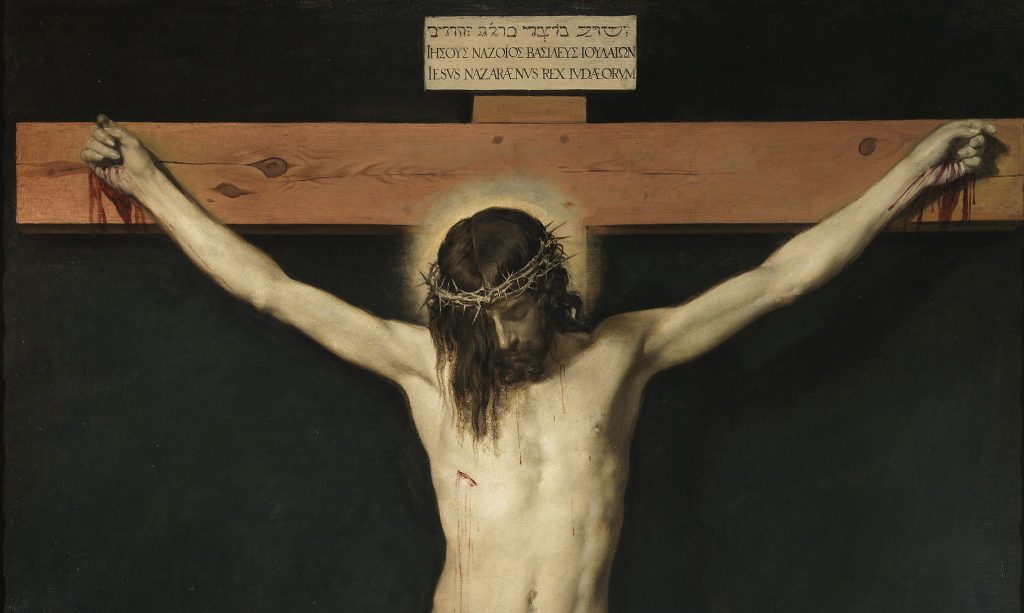

Some guidance from Jesus, St. John, and St. André Bessette, for the new year.
The beloved disciple John shares with us today a wonderful compass to guide us into the new year. From his first letter he writes that God’s “commandment is this: we should believe in the name of his Son, Jesus Christ, and love one another just as he commanded us” (I John 3:23).
Before we can believe in God’s Son, we need to trust him. For many if not all of us at some point in our lives who have experienced being hurt, betrayed, or wounded in any way, trust can be hard.
That is why the Son of God was willing to be sent by his Father. He wanted to become one with us so that he could not only experience all the pain and suffering of our humanity but that he could take that upon himself, even death, so he could conquer them and heal, restore, and show us the way back to the Father, through our suffering and pain and into healing.
We can trust Jesus. Jesus not only has our best interest in mind, but he knows the plan of his Father for our lives and he can lead us to experience his love and our vocation as we trust him by taking one step at a time. He gives us enough light to see two steps ahead and when we take those steps, he will give us enough light to see the next two.
We can trust Jesus, but each thought or invitation we hear in our mind is not necessarily from Jesus. Some may appear good and true, but are only apparently so. For as John continues: “Beloved, do not trust every spirit but test the spirits to see whether they belong to God” (I John 4:1).
The devil and his demons tempt, entice, divert, and distract us, with the ultimate goal to lead us away from the love of God, the source of our true fulfillment. They seek to plant seeds of so doubt, so we believe that God does not have our best interest in mind. And once those seeds of doubt begin to sprout he seeks to isolate us from our Father by fertilizing those doubts with distrust in our minds and hearts. And when we sin, the devil condemns and shames us, and leads us to believe that we cannot be forgiven and that no one will accept us for what we have done or for who we are.
God never tempts us, he invites us and challenges us to move beyond our sins and our fears. He gently coaxes us to come out of the darkness of our self-centered, protective cocoon, and into the gentle light of his love. He does so patiently, sometimes with a firmness of a good parent, but gently. We hear his voice mostly in the quiet and stillness of our heart. When we do make a mistake, he does not condemn us, he convicts us to learn, to renounce our mistake. When we sin and turn back to him, he forgives and embraces us. We then begin again strengthened by his grace and greater clarity.
God loves us more than we can ever imagine no matter what we have or have not done, he loves us more than we can ever mess up, and he loves us even in the act of our sin. He has shown this love most profoundly in sending his Son so we can see his face and experience his love, forgiveness, and mercy. We can experience that he loves us as we are right now, right where we are in our weakness and imperfection.
The key to walk free from the “fowler’s snare” (see Psalm 91:3-4) is to heed the words that Jesus began his public ministry with: “Repent, for the Kingdom of heaven is at hand” (Matthew 4:17). God does not seek to punish us. Neither does he want us to stay in our sin and separation from him. God’s love calls us to more. Feeling guilty and shame is a false humility that keeps us separated from God because our focus remains on ourselves.
God imparts within us a sense of guilt, so that we experience our separation from him. Being in touch with this experience, helps us to choose true humility which leads us to trust in the love of God and believe in his mercy. When we sincerely and contritely confess our sins, do penance, and with his help seek to sin no more, Jesus will forgive, free, save, and restore us to our right relationship with God.
When we are willing to allow the gentle light of Jesus to shine in our darkness, Jesus helps us to see what our life is like without God and with God. He helps us to be able to see the difference between the apparent goods and the true good so that we can make a clearer decision. Will we choose darkness, separation, and death or light, reconciliation, and life?
St. André Bessette, whose feast day it is today, could have fallen for the devil’s tactics. He who was sickly since he was an infant, lived in poverty as a child, and who then lost his parents when he was only twelve, and struggled with illness for all of his ninety-one years, could have been bitter towards God. André chose instead to trust in God and how he could make this statement: “Do not seek to have your trials removed. Ask rather for the grace to bear them well.”
Living a devout life of faith as a youth, his pastor encouraged him to apply to religious life and he sought at twenty-five to enter the Congregation of the Holy Cross. His poor health continued to plague him and at the end of his novitiate year, he was not asked to continue. André continued to trust in his Lord and his long standing ally St. Joseph. His novice master and bishop saw the light of Christ in this young man and petitioned that he be given an extension and he was eventually admitted into the order and served as a brother. His birth name was Alfred. Upon his profession he took the name of André who was the pastor who had mentored and recommended the pursuit of his vocation.
André was assigned the position of porter, the door keeper, because of his lack of education and frail health. A role that many would not look on with any esteem, André welcomed with open arms. Seeing in this position the opportunity to greet Jesus at the door with each knock and person he met. Looking back at his life he would say, “When I entered the Congregation, they showed me the door. And I stayed there for forty years.”
During his time of service, through the intercession of St. Joseph and his unwavering trust in Jesus despite much opposition and his continued frail health, thousands experienced being heard, loved, and healed. Through St. André, they experienced a foretaste of heaven.
St. André is a model for us on how we can in this new year “believe in the name of his Son, Jesus Christ, and love one another just as he commanded us…”, trust only in the Spirit of God without hesitation, and when we do fall, “Repent, for the Kingdom of heaven is at hand.”
God loves us so much and wants to share his life with us so that we can share in his relationship. Are we willing to resist the lies of the enemy, trust in the love of God, seek his guidance in all circumstances, discern and let go of anything that is not of God? When we do so, we will heal, be forgiven, and be set free to love and love in return. This journey begins and continues by trusting in God the Father’s Son whom he sent.
Photo: St. André Bessette, pray for us!

“Come and you will see.”
After hearing John the Baptist point out Jesus as the Lamb of God, Andrew and another disciple of John seem to understand the meaning of what John means. The two follow Jesus as he walks by them. Jesus senses they are behind him. He stops, faces them, and asks, “What are you looking for?”
Their response to the question, “Rabbi” (which translated means Teacher) “where are you staying?” (Jn 1:38), is odd. Unless we understand that, in fact, the two disciples of John did not grasp the full relevance of John calling Jesus the Lamb of God after all. They related to Jesus, from the context of what they knew, their default position. They were approaching his as a rabbi, a teacher. Most rabbis of the time would have a place where they would gather their disciples and teach them. Another thought is that they did not want to come right out and say, “Jesus, are you the Messiah?”, there was some doubt, so they went with addressing him as rabbi.
Jesus said: “Come and you will see” (Jn 1:39). Andrew and the disciple then spent the day with Jesus and that made all the difference. If Andrew had any doubt before, it was now gone. We do not know what he experienced with Jesus in their time together, but the first thing that Andrew does is go and tell Simon, his brother, that he had found the Messiah, the Anointed, the Christ! There was no hesitation. He wanted to share what he had seen and experienced. Most likely as we hear time and again in the Gospels, Andrew witnessed some or all of these examples: the blind saw, the deaf heard, the lame walked, the possessed were exorcised, sins were forgiven, and Jesus taught with authority.
May we place ourselves in this scene of the Gospel today and follow the finger of John the Baptist who points over to this man walking ahead of us at a pretty good clip. As we turn to follow, the brightness of the morning sun catches our eyes. We squint, look down, and lose him for a moment, but take a few steps to keep pace. We hear the crunch of the stone and sand under our sandals and as we look up again to see how far ahead of us Jesus is, and then we notice he is standing still only a few feet away. He is smiling, his eyes are inviting as is his question: “What are you looking for” (Jn 1:38).
Stay with the scene. How do you answer, and what happens next? Allow your imagination and senses to come alive. Place your self in this moment with Jesus. Be aware of any emotions or thoughts that arise. This is not just a mind game. Jesus experienced this scene himself in full and living color. He was there, and when we meditate on Scripture, we pray with the words we read, and ask the Holy Spirit to guide us, we can enter into the memory of Jesus. If we are willing to come and see, as Andrew and the other disciple were, Jesus will lead us as well. Allow yourself some time with Jesus today as Andrew did and let God happen.
————————————————————————————-
Photo: Let us be willing to follow Jesus, the way, the truth, and the life. Photo accessed online from housemixblog.com
Link for the Mass readings for Saturday, January 4, 2024

“Behold the Lamb of God.” He who was born and died for us.
John the Baptist saw Jesus coming toward him and said, “Behold, the Lamb of God, who takes away the sin of the world” (Jn 1:29).
The only one who can take away sins is God. The unblemished lamb is the animal that is sacrificed at the Passover meal, commemorating when the angel of death passed over the Hebrews whose doorposts were marked with the blood of the lamb. The next day they were freed from their slavery under pharaoh, and the exodus event began culminating in their passing through the Red Sea to freedom.
The Son of God became human to become the Lamb of God. He experienced laughter, pain, suffering, love, tears, and all of our human condition even temptation, but he did not sin. The Son of God became human so that what he assumed in his human condition, he could redeem. As the Lamb of God, Jesus approached John for baptism, he took upon himself the sin of the world and submitted his divinity to his human condition and was willing to be baptized for repentance not because he sinned, but so that he could take upon the sin of the world upon himself. This act was also a foreshadowing of his crucifixion on the cross.
The Incarnation, the Son becoming fully human while remaining fully divine, was the premiere act of mercy, in that Jesus entered the chaos and woundedness of our lives. His allowing himself to die on the cross the greatest expression of his love. The same love that he shares with his Father, his receiving and returning all that he received to the Father and holding nothing back, we can see him doing so visibly when we look upon a crucifix. He was born and died, he gave everything, including his life for each and every one of us.
Alone we cannot be redeemed, we cannot be fully healed or restored to who we have been created to be. We need a savior. Jesus is, while at the same time, more than a model to follow or a teacher to guide us, he became one with us in our humanity to lead us up out of our brokenness and sin. In saying yes to his invitation, we can say with Paul, “yet I live, no longer I, but Christ lives in me; insofar as I now live in the flesh, I live by faith in the Son of God who has loved me and given himself up for me” (Galatians 2:20). This is the gift we have received again this Christmas, a reminder that when enter into a relationship with Jesus, he grants us the grace to access and share in the divine power of the Love experienced between God the Father, God the Son, and God the Holy Spirit.
Jesus holds his hand out to each one of us today. May we receive his hand in our own, and as our fingers touch his palm may we feel the wound there, embrace the remembrance of the nail that pierced his flesh, the pain that he endured, so we could have this very moment with him. Even in our brokenness, anxiety, confusion, fear, and sin, may we resist pulling away. May we feel the warmth of his hand grip ours. Let our gaze be drawn up to see his face, his smile, his forgiveness, and experience his infinite love for us.
I am blessed at each Mass as I hold up the consecrated host to be able to say, “Behold, the Lamb of God, behold him who takes away the sin of the world.” May we see, believe, and receive the Body and Blood of Christ. Amen.
———————————————————-
Photo: Christmas Morning Mass, Holy Cross Catholic Church, Vero Beach, FL.

“Who and whose are we?”
“Who are you” (Jn 1:19)? John did not claim or pretend to be something that he was not. He was clear who he was, he was clear of his place in serving God, and he was clear about the mission God gave him. He was preparing the way of the Lord. John shared that “there is one among you whom you do not recognize, the one who is coming after me, whose sandal strap I am not worthy to untie” (Jn 1:26-27).
The question also arose about who Jesus was. It was not only a question during his lifetime, but this query was also addressed during the early development of the Church’s Christology and still arises today. The readings of the Christmas Season, that we are still celebrating liturgically, in fact, all four Gospels, address the question of who Jesus is. In fact, the entirety of the Bible from Genesis to Revelation answers this question!
The majority of the heresies that arose in the Church surrounded this question as well. From the Annunciation, we recognize that at his conception in the womb of Mary Jesus remained fully God and became fully human. He did not become the Christ at his baptism as the heresy of Adoptionism would propose. Nor was Jesus a powerful created being as the priest Arius would suggest in the third century. We counter the heresy of Arianism every Sunday when we recite in the Nicene Creed: “God from God, Light from Light, true God from true God, begotten not made, consubstantial with the Father; through him, all things were made.”
Arianism taught that Jesus was a created being, the highest of beings made by God, but created none the less. The Church teaches that Jesus is begotten not made. He was, is, and always will be God, the Second Person of the Trinity. He is God the Son consubstantial, homoousios, which means of one and the same substance with God the Father. The Father and the Son are one in substance, yet distinct in their operation. The Father begets, the Son is begotten.
Adoptionism and Arianism are but two of the various early heresies that arose, of which Arianism gained more of a following. Arianism still rears its head today in practice as it did then because of the unwillingness of those who will not acknowledge that the divine could become human. This goes back to our starting question that was asked about John. “Who are you?”
A good question to answer for us ourselves. We are human beings created in the image and likeness of God, even though our likeness has been dimmed by sin. We are physical beings with a rational soul, we are invited to embrace the reality that we are human and through our participation in the life of Jesus, beginning with our baptism, we are adopted daughters and sons of God. Do we reject our humanity, our created status, trying to determine our own destiny on our own terms, to put ourselves in the place of God, or are we like John the Baptist, and acknowledge the gift of who we are and the mission God invites us to participate in?
As we continue to celebrate this Christmas Season and the new year that has just begun, may we embrace that each and everyone of us is a unique person, never created before nor will we ever be again, with a particular vocation and part to play in building up of the reign of God. We will come to know our purpose and begin to restore our likeness, as we follow the lead of Mary who made time to ponder and align her human will with the divine will of God.
As we collaborate with Jesus in all the decisions we make, the smallest to the biggest, let us pray for a heart, mind, and soul that is open to following the love of the Holy Spirit so that we can know who we are, whose we are, the mission that the Father has given us, and begin to live it each day. We restore our likeness to God by becoming holy and striving to be saints.
——————————————————————————————-
Photo: Spending some quiet time with God is a good way to begin the year, begin and end each day, and to know who we are and that we are loved more than we can imagine.
Link for today’s Mass readings for Thursday, January 2, 2025

With Mary, Theotokos, as our guide, let us ponder more in 2025.
Mary offers us a wonderful gift today as we begin the new year together. “Mary kept all these things, reflecting on them in her heart” (Lk 2:19). Gabriel shares with Mary that she will conceive a child through the power of the Holy Spirit. Her relative Elizabeth, who is past childbearing years, is six months pregnant when Mary and Elizabeth meet. In their encounter, John leaps in the womb of Elizabeth. The shepherds convey the message they received from the angels that Mary’s baby is the long-awaited Messiah. Simeon and Anna offer prophetic confirmation that Jesus is the Messiah.
These are the events we have been hearing again during Advent and this Christmas Octave. May we like Mary also ponder, not to just read or listen and move on. The Church at her best has followed the model of Mary’s reflection, pondering, and meditating upon what these words mean and has come to call this day the Solemnity of the Blessed Virgin Mary, the Mother of God. This title says more about Jesus than it does about Mary. This is the teaching that the Church Fathers confirmed during the council of Ephesus in 431 AD:
Mary is the Mother of God, in Greek – Theotokos – the God-bearer.
As Paul intuits, “God sent forth his Son, born of a woman” (Galatians 4:4). Paul did not say, born of man and woman but of woman. The second Person of the Trinity was sent by his Father through the overshadowing of the Holy Spirit and was conceived in the womb of Mary. Jesus is the Son of God in his divinity and the son of Mary in his humanity. He remained fully divine as the second Person of the Trinity and the Holy Trinity was not diminished in any way as he developed as a human being in the womb and was born of Mary. This truth and reality is the Mystery of the hypostatic union: Jesus is one divine person subsisting in two natures the human and divine.
Theological insights such as Mary being the Mother of God, the hypostatic union of Jesus, are easily missed or worse dismissed if we conform ourselves to the present age of instant gratification, instant access, surfing, swiping, taking in sound bytes from Facebook, Twitter, and Instagram and amassing information overload. All of these technological avenues can be wonderful if we stop, slow down, and as Mary did, ponder what they offer.
If we still read books, do we do so with pencil and highlighter in hand, take notes and go back to those points underlined, highlighted, and or annotated and ponder the insights we have received, and then put them into practice? Or do we just have a moment of pause and say hmm, interesting, and then move on to the next factoid?
Let us begin the first day of the new year by taking a few deep breaths, slowing down, and pondering. We can reflect on a word, a phrase, or a short statement that we write down and return to it often. The phrase could be as simple as a paraphrase from today’s reading: Mary pondered on these things in her heart. Let us reflect on where God has been calling us to stop and take a deeper look at our lives. It could be one word: Theotokos, expressing that Mary is the God-bearer, the Mother of God, and what that means to us. We can meditate on a picture like the one I posted with this reflection.
If we seek to live a life of joy and fulfillment in 2025, we would do well to follow Mary. That would entail pondering more, slowing down, and reflecting on life, on what is important, what has value, where we are putting our time, energy, and effort, and recognizing where we do not God and where we do welcome God in our lives, where we resit and where we follow his will. Otherwise, we may just float along through another year indecisively or stagnantly with indifference or cynicism, merely reacting to situations that arise, or just plodding along in survival mode or merely bored and listless. Being still can be scary because as we do so, our fears, our past hurts, and our loneliness can come to the surface.
Yet in that willful act of slowing down and even coming to a complete stop, the Holy Spirit can embrace us in these very real emotions with his love, so we can begin to heal and transform beyond merely existing and set a healthier course of being more alive and grateful for the gift of our lives. Hand in hand with Jesus and Mary, we can face and embrace our fears, and heal from our wounds. Surrendering and conforming our lives more to the life and love of Jesus, we will realize that we are not alone, and so can build more authentic and intimate relationships. We can act more decisively and with greater clarity, and experience more fully what we are here for, to bring a little more tenderness, mercy, understanding, forgiveness, and love to the many others around us who are also wounded.
May 2025 be a wonderful new year of healing, joy, and fulfillment, as we, like Mary, come to experience God’s presence in the silence of our hearts, his love that embraces us, so that we may become a people of faith, hope, and love in contemplation and action. Mary Mother of God, pray for us.
Happy New Year! Peace and all God’s good. Take good care of yourselves and those around you.
————————————————————————————
Photo: My favorite icon of Jesus and Mary, St. Mary’s Chapel, SVDP Regional Seminary, Boynton Beach, where I was blessed to spend many hours pondering and healing.
Link for the Mass readings for Wednesday, January 1, 2025

May we become a sanctuary for Jesus to dwell within us.
“And the Word became flesh and made his dwelling among us” (John 1:14). The Logos, the Word, the second person of the Holy Trinity, dwelt or another translation, “tabernacled” among us. The Son of God pitched his tent in our midst. This is a reference to the tabernacle or tent of meeting which was erected whenever Moses and those who had escaped slavery in Egypt camped. Within the tent of meeting was placed the Ark of the Covenant. This tent of meeting was made present because God instructed Moses to do so that he would be present with his people. “They shall make a sanctuary for me, that I may dwell in their midst” (Exodus 25:8).
The Ark of the Covenant and the tabernacle housing it was portable and would move with the people, such that God was always present in their midst. The basic structure would later become the foundation for Solomon’s temple, then Herod’s Temple. The Holy of Holies was believed to be the very seat of God in Jerusalem. In the fullness of time, Jesus was born to us, and he became the living temple, Emmanuel, God with us. “Destroy this temple and in three days I will raise it up” (Jn 2:19).
And why did Jesus come? So that the glory of God could be revealed not just to the temple priest, but to all of us, “and we saw his glory, the glory as of the Father’s only-begotten Son, full of grace and truth” (Jn 1:14). Jesus came to be one with us in our humanity while remaining fully divine to reveal the glory of his Father to us, the same glory that filled the tabernacle. Jesus came to be present, to come close and accompany us, in our very midst as God did in the tabernacle and then the Temple.
Jesus was born to share the fullness of God’s grace and his truth with us. He came to restore the ancient covenant that God has been making with his people throughout the ages. Jesus invites us to share in the infinite, faithful love that he shares, has shared, and always will share with his Father. This free, generous act of love is a pure gift. Jesus, in becoming human, in living among us, in teaching, healing, and so building a bridge of relationship with God, shines his light. A light that is not overcome by the darkness of pride, hatred, prejudice, and violence, so that we can see the truth, that God is our Father and we are all brothers and sisters.
The Incarnation, the reality that the Son of God became human while remaining fully divine, reveals to us that none of us are junk. God created us very good and was willing to send his Son to become one with us. Each of us by our very existence has human dignity, value, and worth because we are created in his image and likeness.
Each and every human being is a part of God’s family. Because of our fallen nature, we are still made in the image of God, but we have lost our likeness to him, in that we have lost our glory. Ezekiel witnessed the glory of the LORD leaving the temple because of the unwillingness of the people to repent (See Ezekiel 10:1-22). We, if we choose to remain in our sin will remain in darkness, separated from God. We are all members of God’s family, all of us. Jesus came to redeem us and restore us to our glory, so that we can regain our likeness to the Father. That is why John the Baptist, Jesus, and his Apostles all called us to repent.
When we repent, turn back to God, and accept his invitation to spend time with him in prayer, we walk out from the darkness and into the light of the Lord’s love along the path of reconciliation that leads to us building a sanctuary for him within us. Our likeness is then restored to the extent that we develop and spend time cultivating our relationship with and allowing him to transform us. Jesus shows us the way to do so.
This unmeritorious gift of grace, that Jesus became one with us in our humanity so that we can become one with him in his divinity, is what we are celebrating this Christmas Season. Let us open and lift up our hearts and minds to receive, rest, and ponder the significance of this wonderful gift. May we also commit to daily abiding in his love through prayer, meditating upon his word, and sharing the love we receive with all we encounter today and each day in this new year.
Photo: Spending some quiet time in our temporary, hall sanctuary early evening of Christmas Day.
Link for the Mass readings for Tuesday, December 31, 2024
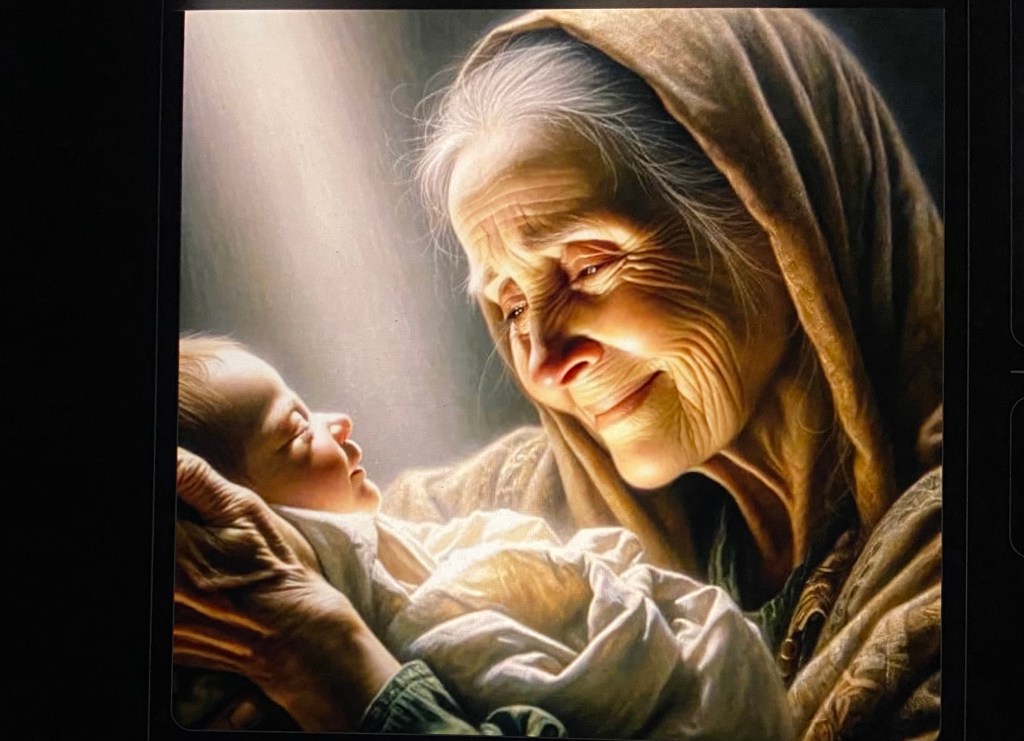
Like Anna, may we do our part to allow God to work through us with great love.
We have no evidence of what the encounter with the baby Jesus meant for Anna, Simeon, the Magi, or the shepherds. What most likely happened was that they all did as Anna did, she “spoke about the child to all who were awaiting the redemption of Jerusalem” (Luke 2:38). Since they followed God’s invitation to come and see the baby in their own unique ways, even though their part in God’s theodrama was no longer recorded in the Bible, their lives were most likely not ever the same as they continued to share the good news they experienced.
The account continued for Joseph, Mary, and Jesus who, “returned to Galilee, to their own town of Nazareth. The child grew and became strong, filled with wisdom; and the favor of God was upon him” (Lk 2:39-40). No ticker-tape parade, no giving the key to the city, and no gala ball awaited the Holy Family when they returned to Nazareth. They went on to live very simple lives preparing for the appointed hour.
The Advent and Christmas accounts of these past few weeks have revealed a wonderful tapestry of men and women accepting God’s invitation. In their own small and unique ways they have collaborated with God who works through the everyday events of people’s lives, more often than not unseen. We would do well to ponder and follow their examples. St. Mother Teresa learned from her namesake, the Little Flower, St Therese of Lisieux, to just that, to not get caught up seeking to do great things, but to do little things with great love.
As the Christmas Season continues, let us do the same as life has already or has begun to shift; families and friends have come and gone or are readying to go, vacation days are coming to an end. Let us resist the temptation to get lost again in the busyness of life. Let us appreciate the gift we have been given, to meditate and think a bit more about the accounts of Jesus and the supporting cast around him. What do these stories mean for each of us? Life can be hard and can change in an instant because it is fragile. Let us not take our family and friends for granted. May we take a deep breath and renew our commitment to God and each other.
As the Holy Family begins their journey to Nazareth and their simple life, as we begin to return to our regular daily routines, may we be a little more aware and open to the quiet and gentle ways of how God is working in our lives. May we commit to supporting and caring for one another, be a little more aware and reach out to those in need, express our need for help and allow others to assist us. As we do so, we will start to recognize the simplicity of divinity operating within the midst of our human interactions. The Holy Spirit is inviting us to be transformed in this new year, to watch, pray, and cooperate, so that he may kindle in us the fire of his love so that it may spread to others and renew the face of the earth.
Photo: May we, like Anna, speak about how Jesus has changed our lives.
Link for the Mass readings for Monday, December 30, 2024

Spending time with Mary and sharing in her memory will help us in healing ourselves and our relationships.
Our gospel today is relatable to anyone hearing or reading it because each of us have experienced family life in all of the different ways family life can be expressed today. At one point or another we have experienced conflict, misunderstanding, and anxiety.
The Bible is good about not covering over the complexities and challenges of life. If the Holy Family can have difficulty, then that can give us comfort if we have gone, or are going through some challenges right now.
One point that jumps out from the start is that Joseph and Mary are not helicopter parents. After celebrating the Passover, they have left the temple and Jerusalem and are heading back home to Nazareth. Because such a journey was not a safe one, they were traveling in a caravan of extended family, friends, and neighbors. After a day into their trek, they realized that they had not seen Jesus and began a more intense search.
Jesus was nowhere to be found and so they returned to Jerusalem. With each step their concern rose. The ancient near East was not a safe place to travel in nor was it safe to dwell. Children were often kidnapped and sold into slavery. When we don’t understand or are faced with the unknown, we typically conjure up the worst case scenarios and Joseph and Mary were no different. By the time that they found him after their three days of searching, they were filled “with great anxiety.”
Jesus, in typical pre-teen fashion did not seem to appreciate their need for anxiety. He was safe all along among the teachers in the temple. Where else would he be? Neither Joseph nor Mary understood what Jesus was talking about. What happened next is a good response to a lack of understanding.
There was no argument. Jesus was found safe and sound. It was time to go. Jesus was obedient and followed. Joseph was quiet. Mary pondered and “kept all these things in her heart.” We are not given to know the conversation between them on their way back home, but what Luke does share was that, “Jesus advanced in wisdom and age and favor before God and man.”
Jesus did so because he was obedient to “God and man.” And that made a big difference.
Joseph and Mary reacted in the natural way that parents missing their child would react, with concern and anxiety. What they did not allow to happen was to allow their emotions override their reason. Jesus didn’t see anything wrong with what he did because he was following the direction of his Father. He didn’t seem to pick up on the point that he failed to share that little detail with Mary and instead assumed they would know where he was.
This is a powerful affirmation regarding Joseph and Mary’s faith. They were not only faithful to the annual Passover pilgrimage, but they showed their faithfulness to following God’s lead from the beginning of Jesus’ conception. They more than likely passed on their stalwart faith onto Jesus such that he believed that they would know where he was. Yet when he realized this was not true, he obediently followed his parents back to Nazareth.
The three days searching for Jesus would also be a preparation for turning to God and trusting him during another three days in which Jesus remained on a stone slab lying in a tomb. Mary trusted again during her time of anguish of not knowing. Not knowing if or how Jesus would come back from the dead after his brutal death on the cross.
What spending any time in the school of the Holy Family will teach us, is that we are to place our trust in God first. We are to ponder more and react less. This does not mean we will understand God’s will each time, it does not mean that we will be free of suffering or anxiety, nor will we be free of conflict with those we love. Yet, when we resist placing ourselves front and center and instead remain faithful to and seek God’s will in every situation, when we resist reacting and seek to understand, when we are willing to forgive, there will be a better chance of healing and reconciliation sooner.
In times of conflict and misunderstanding, when our intent is to will each other’s good, even when we see things differently and disagree, we will be better off turning to God and trusting in him. We will do better when we are willing to breathe and listen to the one speaking as well as the Holy Spirit that will give us the words to speak or the pause to be silent. Pondering and seeking to understand the will of God as Mary did is a course of action that will bring about better benefits.
One powerful tool of prayer that helps us to be more patient, understanding, and forgiving one another is to spend time quietly meditating and contemplating the mysteries of the Rosary, like this fifth joyful mystery of Mary and Joseph finding Jesus in the temple. For each of us, Mary “continues to relate her personal account of the Gospel. Mary constantly sets before the faithful the ‘mysteries’ of her Son, with the desire that the contemplation of those mysteries will release all their saving power. In the recitation of the Rosary, the Christian community enters into contact with the memories and the contemplative gaze of Mary” (St. John Paul II, The Rosary of the Virgin Mary).
Photo: Our Lady of Grace on the grounds of Joseph and Mary Retreat House, Mundelein, Il, where I was blessed to spend a 30 day silent retreat. Learned much from Mary’s memory!!!

 Spiritual Stepping Stones