“In no one in Israel have I found such faith?” How about with us?

Amen, I say to you, in no one in Israel have I found such faith. I say to you, many will come from the east and the west, and will recline with Abraham, Isaac, and Jacob at the banquet in the Kingdom of heaven” (Mt 8:10-11).

Nowhere else in the Gospel of Matthew is Jesus recorded as being amazed. Jesus was amazed with this man’s faith. Could he also have been amazed with his humility and his willingness to seek help for his slave? This Roman centurion, an occupying presence in Israel, clearly embodied the teachings of Jesus! We echo this centurion’s own words at each Mass just before we receive the glorified Body of Christ in the Eucharist: “Lord, I am not worthy that you should enter under my roof, but only say the word and my soul shall be healed.”
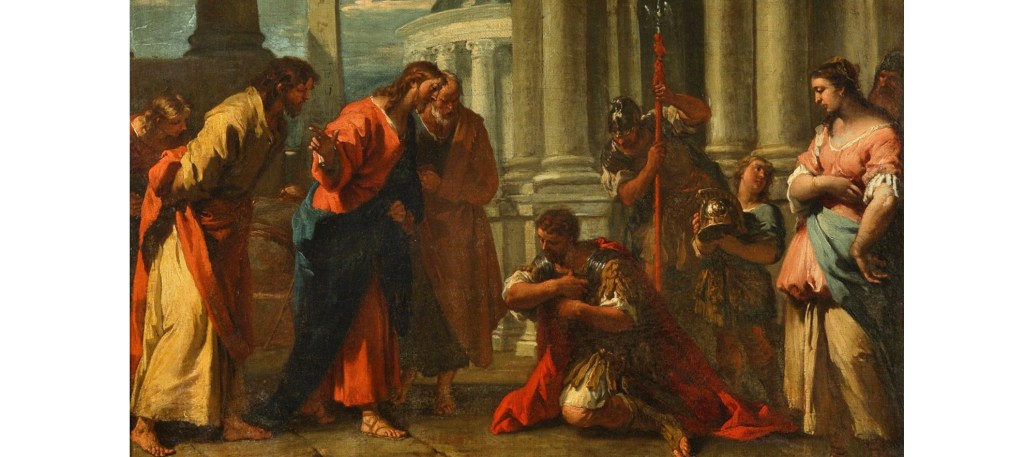
I would imagine that those around Jesus and the centurion were amazed as well. Here comes this commander of an occupying army of their land and he asks Jesus for this favor. Then if this is not unthinkable enough, he asks Jesus to heal a slave, and with his word from afar. Jesus recognizes the faith of this man and said, “You may go; as you have believed, let it be done for you” (Mt 8:13). The slave was healed. Jesus, in this generous gift of healing, showed that he came, yes, to the Jews, but also to the Gentiles and the slaves as well.

God chose the people of Israel not for themselves alone, but that they would be a light to all peoples. As Isaiah said, all nations shall stream toward mount Zion and “from Zion shall go forth instruction, and the word of the LORD from Jerusalem” (see Isaiah 2:1-5). Jesus echoes Isaiah’s prophetic words as is recorded in today’s Gospel: “Amen, I say to you, in no one in Israel have I found such faith. I say to you, many will come from the east and the west, and will recline with Abraham, Isaac, and Jacob at the banquet in the Kingdom of heaven” (Mt 8:11). The centurion’s act of faith is the beginning movement, like a drop of water that is the beginning of a majestic waterfall.

The first point we can learn from the centurion is that he was aware that his slave was in need. A slave held no dignity, value, or worth, and yet, he was not invisible to the centurion. Nor was the centurion indifferent to his suffering and pain. Are we aware of those in our midst who are in need? Let us resist the temptation to walk around, over, or by others and be willing to come close as Jesus did time and again.

Second, like the centurion, let us embrace humility and acknowledge our own sinfulness, and when we do that, we are better able to see the needs of others. None of us are perfect. No one person is above any other and all of us fall short of the glory of God. We all have gifts as well as shortcomings. We need each other because we complement one another and we are stronger together than apart.

Third, we cannot stand on our own. The centurion recognized his limitations. He acknowledged that he needed help. He needed Jesus. As do we. We cannot accomplish our salvation on our own merit or will power. We need a savior. Apart from Jesus, who we prepare to encounter this Advent season, we can do nothing, but with Jesus all things are possible.

Jesus is the Truth and the Fulfillment that we seek. He has sent out a universal invitation of communion, to Israel first and then to those from east and west, north and south, Jew and Gentile, slave and free, male and female. The Roman centurion modeled our response to Jesus’ presence when he recognized and acknowledged his own unworthiness before Jesus. He was also aware of and sought healing for his slave. The centurion had faith and hope that Jesus could and would provide healing with just his word.

May we follow his example this Advent as we take time to examine our conscience, have the humility to confess our sins, to acknowledge that we need help from Jesus and others. May we be willing to seek forgiveness and be willing to forgive. May we be willing to resist the temptation of fearing that we are unable and unworthy, close ourselves off, and be indifferent to the plight our own needs and needs of others, but instead, seek Jesus for help for ourselves and others.

Jesus was amazed with the faith of the centurion, is he amazed with our’s? We have so much to offer one another when we are willing to work together instead of apart from or against one another. May we who have received the forgiveness, healing, and grace of Jesus and felt the embrace of his love, reach out to provide hope to those of our family and friends, as well as those Jesus is calling us to draw closer to, those we may have kept at arm’s length.

——————————————————————-

Painting: A quiet moment in between Masses Sunday, God coming close. “Lord, I am not worthy that you should enter under my roof, but only say the word and my soul shall be healed.”

Link for the Mass readings for Monday, December 1, 2025

“You may go; as you have believed let it be done for you.”

The centurion said in reply, “Lord, I am not worthy to have you enter under my roof; only say the word and my servant will be healed” (Mt 8:8).

After Jesus finishes his Sermon on the Mount, he comes down from the mountain. In the opening of chapter eight, we see two hearts open to God, a leper (who is not included in today’s reading but you can see his encounter with Jesus by reading Mt. 8:1-4.) and a centurion. The centurion may or may not have been a Roman but he certainly was a Gentile. He, a member of an occupying army, was aware of the animosity many Jews felt toward him. Yet he, like the leper, approached Jesus.

Jesus saw in the leper, not revulsion, and in the centurion, not an enemy, but first and foremost, human beings in need, two persons with faith and belief. Reading on we see that Jesus also heals the mother-in-law of Peter and many who are possessed. Jesus reached out to them with a simple touch of his hand, with his healing words and in so doing brought to each of them the healing they sought. Jesus shows us that the kingdom of his Father is open to all who have faith and believe.

Jesus said to the centurion, “You may go; as you have believed let it be done for you” (Mt. 8:13). Do we have the same belief as the leper, the centurion, and Peter’s mother-in-law? Each of them believed in Jesus and experienced healing.

We are all wounded by sin and also in need of experiencing physical, psychological, and/or spiritual healing.  Jesus is just waiting for us to ask, and to open our hearts and minds to him, so that we too may be healed and transformed by his forgiveness, love, and mercy. We, like the centurion and Peter, can approach Jesus on behalf of others who are also in need of healing. Let us resist the temptation to judge anyone as unworthy to receive the grace, love, and mercy of Jesus but be willing to see others in need and bring Jesus to them.

As God brings people into our lives, let us receive them as Jesus did: as fellow human beings, first and foremost, created in his image and likeness. May we be healed from any revulsion, prejudice, or temptation to define others with labels and instead be willing to allow Jesus to reach out through us to share his healing word or extend his healing touch to one another. Let us believe in Jesus, be healed and help to heal others!


Painting: Sebastiano Ricci, “Christ and Centurion”, 16th century, Italy

Link for the Mass readings for Saturday, June 28, 2025

When we confess our sin, trust in Jesus, and are willing to serve each other, we take a closer step to peace.

“Amen, I say to you, in no one in Israel have I found such faith” (Mt 8:10).

The one to whom Jesus was referring to was the Roman centurion who approached Jesus seeking healing for his servant. I imagine that Jesus was not only amazed by the man’s humility, in recognizing his sinfulness and that he believed that Jesus could heal from a distance with simply his word, but also that he was aware of the need and suffering of his servant and willingness to do something about it. This Roman centurion, part of the occupying power in Israel, clearly embodied the teachings of Jesus! It is from the centurion’s words that we get the words that we speak before receiving Jesus in the Eucharist during each Mass: “Lord, I am not worthy that you should enter under my roof, but only say the word and I shall be healed.”

God chose the people of Israel not for themselves alone, but that they would be a light to all peoples. As Isaiah said, all nations shall stream toward mount Zion and “from Zion shall go forth instruction, and the word of the LORD from Jerusalem” (see Isaiah 2:1-5). Jesus echoes Isaiah’s prophetic words as is recorded in today’s Gospel: “Amen, I say to you, in no one in Israel have I found such faith. I say to you, many will come from the east and the west, and will recline with Abraham, Isaac, and Jacob at the banquet in the Kingdom of heaven” (Mt 8:11). The centurion’s act of faith is one of this beginning movements of faith in Jesus that, like a few drops of water, become the beginning of a majestic waterfall.

The first point we can learn from the centurion is that he was aware that his servant was in need. A slave held no dignity, and yet, he was not invisible to the centurion. Nor was the centurion indifferent to his suffering and pain. We also need to be aware of those in our midst who are in need. We need to resist the temptation to walk around, over, or by others and be willing to embrace them in their need.

Second, like the centurion, we need to embrace humility and acknowledge our own sinfulness, and when we do so, we are better able to see the needs of others. None of us are perfect. No one person is above any other. We all have gifts as well as shortcomings. We need each other because we complement one another and we are stronger together than apart.

Third, we cannot stand on our own. The centurion knew his strengths, the authority he possessed, while at the same time he recognized his limitations. He acknowledged that he needed help. He needed Jesus. As do we. We cannot accomplish our salvation on our own merit or will power. We need a savior, for apart from Jesus, who we prepare to encounter this Advent season, we can do nothing, but with Jesus all things are possible.

Jesus is the Truth that we seek. He has sent out a universal invitation of communion for all, to Israel first and then to those from east and west, north and south. The Roman centurion modeled our response to Jesus’ presence when he recognized his own sinfulness and acknowledged it before Jesus. He was also aware of and sought healing for his servant. The centurion had faith and hope that Jesus could and would provide healing with just his word.

May we follow his example this Advent as we take time to examine our conscience, have the humility to confess our sins, to acknowledge that we need help from Jesus and others. May we be willing to seek forgiveness and be willing to forgive. May we resist the temptation to embrace fear and close ourselves off from and be indifferent to the plight and needs of others.

We have so much to offer one another when we are willing to work together instead of stand apart from or against one another. May we who have received the forgiveness and grace of Jesus and felt the embrace of his love, work to beat our “swords into plowshares
and [our] spears into pruning hooks”. We can use our words to destroy or to empower and give hope. Choosing to return hate with love, and to say the good things people need to hear, we can promote a ripple of peace that can contribute to making Isaiah’s words a bit more real: “One nation shall not raise the sword against another, nor shall they train for war again” (Isaiah 2:4). Wouldn’t it be nice if we could take a few steps closer to this reality this Advent?

——————————————————————-

Painting: Sebastiano Ricci – Christ Heals the Centurion’s Servant, 1726-1729

Link for the Mass readings for Monday, December 2, 2019

Healing happens when we are willing to see each other as human beings.

Our account from Luke today represents a wonderful picture of collaboration and harmony. The centurion, a Gentile – non-Jew, heard that Jesus was near and appealed to Jewish elders to seek out Jesus to invite him to his home to heal his slave. As Jesus was on the way, the centurion apparently had a change of heart, concerned about his sinfulness and did not want to trouble Jesus. He sent his friends to Jesus with the request to heal his slave with his word. Jesus was amazed: “I tell you, not even in Israel have I found such faith” (Lk 7:9). The slave was then healed.

Aside from the fact that no one seemed to have a problem with slavery, certainly not uncommon in the Ancient Near East, everyone involved, the centurion, his friends, Jewish elders, and Jesus, were all working together to make this healing possible. The centurion actually showed concern, not indifference for his slave. Gentiles and Jews, occupier and occupied, collaborated with one another, and Jesus did not hesitate to answer the request of the centurion, a representative of the Roman occupying army.

This Gospel scene is certainly worth meditating upon.

The centurion was aware, and he sought help for his servant who was ill and in need of healing. The interesting point is that he sought help from those he was in a position to oppress. He went to those of a different race and religious belief. This Gentile centurion asked help from the elders of the Jews. The elders recognized the need of one of their oppressors and reached out to Jesus for help. Everyone in this account did not hesitate to play their part to help a servant.

Are we willing to see, hear, speak up, and seek help for those in need around us, no matter who they may be? Can we resist apathy, indifference, and prejudice, and instead, keep our ears, eyes, and hearts open to the vulnerable among us? Are we willing to see each other as people created in the image and likeness of God? Will we treat those we encounter with dignity and respect and be willing to collaborate and work together for the good of those like us, as well as those who are different, in little ways with great love today as Jesus did, one person at a time.

When we do so, we are at our best. We are the hands and feet of the Body of Christ.

—————————————————————————————–

Photo: May we reflect the light of Jesus in our corner of the world as we resist the temptation to feed division and dehumanization and seek instead to promote healing and reconciliation, grounded in God’s love for the dignity of each human person.

Link for the Mass readings for Monday, September 16, 2024