To be a disciple of Jesus we need to follow the way of the cross.

Jesus summoned the crowd with his disciples and said to them, “Whoever wishes to come after me must deny himself, take up his cross, and follow me” (Mk 8:34).

Our life is not about us, and about what we can accumulate. It is not about achieving and placing our security in power, fame, wealth, and pleasure. Nor are we here on this earth to merely exist, to just get by, and live in survival mode. We exist to be loved by God, to love others as we have been loved, and to live life to the fullest.

The challenge is, are we willing to truly deny ourselves, take up the cross of Jesus, and follow him? The followers of Jesus hearing him say that was quite visceral as many of them had witnessed a crucifixion personally. It is a humiliating, degrading, and horrifically painful death. And yet, Jesus is saying openly that this is a requirement to following him as a disciple.

We may be removed from the, in the face quality of a crucifixion, but we can still recoil at the invitation to renunciation. To accept this cost of discipleship, it is helpful to recall Jesus’ words to Peter in yesterday’s account when Jesus convicted Peter for rebuking Jesus saying that he was to suffer, be rejected by the elders, and killed. Jesus rebuked Peter because he was “not thinking as God does but as human beings do” (Mk 8:33).

We take up our cross and follow Jesus when we are ready and willing to renounce any thought, word, or deed, person, place, or thing that we have place before God; when we are willing to put Jesus first in our lives whether or not we will be ridiculed, persecuted, or killed. This willingness to be Jesus’ disciple comes slowly with each, “yes”, as we see with Peter himself. He and the other Apostles, especially in the Gospel of Mark stumble time and again. Just like the blind man who Jesus just healed, it took a second healing for him to see (cf. Mark 8:22-26). To truly see as God sees will take time with us as well.

Peter affirmed who Jesus was, the Messiah, the Son of God, in one breath with the insight of God, taking a step ahead, and yet, in the next breath, he could not accept that Jesus would be a suffering Messiah and die, taking a few steps back. Peter would also deny him publicly to a slave girl (cf. Mark 14:66-72). Many times Peter would refuse to take up his cross, but he continued to “repent and believe in the Gospel” (Mark 1:15).

Jesus calls us to follow him. We do so one decision at a time. Like Peter, we will sometimes, think as humans do, while at other times, we will think as God does. We will say, “yes” more times than not when we are willing to allow our minds and hearts to be transformed by God’s love. As disciples, we are to follow the way that leads to the cross, which means letting go of our attachments, disordered affections, and idols, and as Jesus and Mary did, say “yes” each time to the invitation to follow our Father’s will. We will sink less when we keep our eyes on Jesus (Matthew 14:22-33) and remain faithful more when we follow Mary’s direction to do whatever he tells us (John 2:5).


Picture: Crucifix in the sanctuary of St. Ignatius of Loyola, ordination day.

Link for the Mass readings for Friday, February 21, 2025

Jesus took up his cross and invites us to do the same.

I can visualize the opening scene of today’s Gospel in my mind’s eye. Jesus striding along with a gathering of people walking, talking, and moving about, and then he just stops and turns. Those closest to Jesus pull up to a stop with him, others continue right past, while at the same time others bump into and trip over those who had stopped before them. The subtle hum of random conversation then slowly comes to a halt, a stillness ripples through the crowd, and then there is silence. The dust begins to settle. Those closest have their eyes locked on his, while those further back are craning their necks, moving left and right to get a better look, while still others are cupping their ears to catch the sound of Jesus’ voice.

These crowds most likely consisted of some disciples, while the greater majority were those on the periphery gathering because of curiosity, intrigue, and maybe even wonder. Jesus then begins to speak, “If anyone comes to me without hating his father and mother, wife or children, brothers and sisters, and even his own life,…” and then, “Whoever does not carry his own cross and come after me…” and then he finishes with  “In the same way, everyone of you who does not renounce all his possessions cannot be my disciple” (cf. Lk 14:25-33).

Those who may be hearing these words second hand, as they were further away from the point of direct hearing, may not believe that the message was transmitted to them correctly. These words cut to the quick, just as surely as when Jesus shared about eating his flesh and drinking his blood, and when he told another follower, who wanted to bury his father to let the dead bury their dead. Luke does not say, but I am sure that many of those gathered around him were just as shocked and began to walk away.

The familial bond for ancient peoples was strong. Though the invitation of salvation that Jesus offers is for all to be saved, he is not going to dumb down or sugar coat his message just to get numbers. Jesus presents, time and again, that the way to live a life of fullness and wholeness, to restore that which has been lost, is to put God first in our lives. God must be the primary focus, the primary relationship in our life, nothing else can have priority of place before him. When we do so, everyone and all other things will fall into their proper place.

Do we want to be an onlooker, just someone looking at Jesus from a distance, or a disciple, willing to be his servant sent forth to share the Gospel and invite others into relationship with him? Are we attached to any possessions, false substitutes, even members of our family, such that we place them before our relationship with God? Idols are anything that we put before God and will distract and divert us from the very flow of his life force that fuels our existence. If we are willing to walk the path of discipleship, we must be willing to surrender our will to God, place him first in our lives, take up our cross, and be open to being transformed by his love.

Jesus is the interpretive key that opens our understanding. All that which is material and finite in our lives find meaning in relation to him. Only when we are able to let go of the attachments to the things of this world will we then truly begin to be free. St. Francis embodied this in a radical way. One of his foundational prayers, which he sometimes would pray for hours was, “My God and my all!” And that is the life he lived and which Jesus invites us to live.


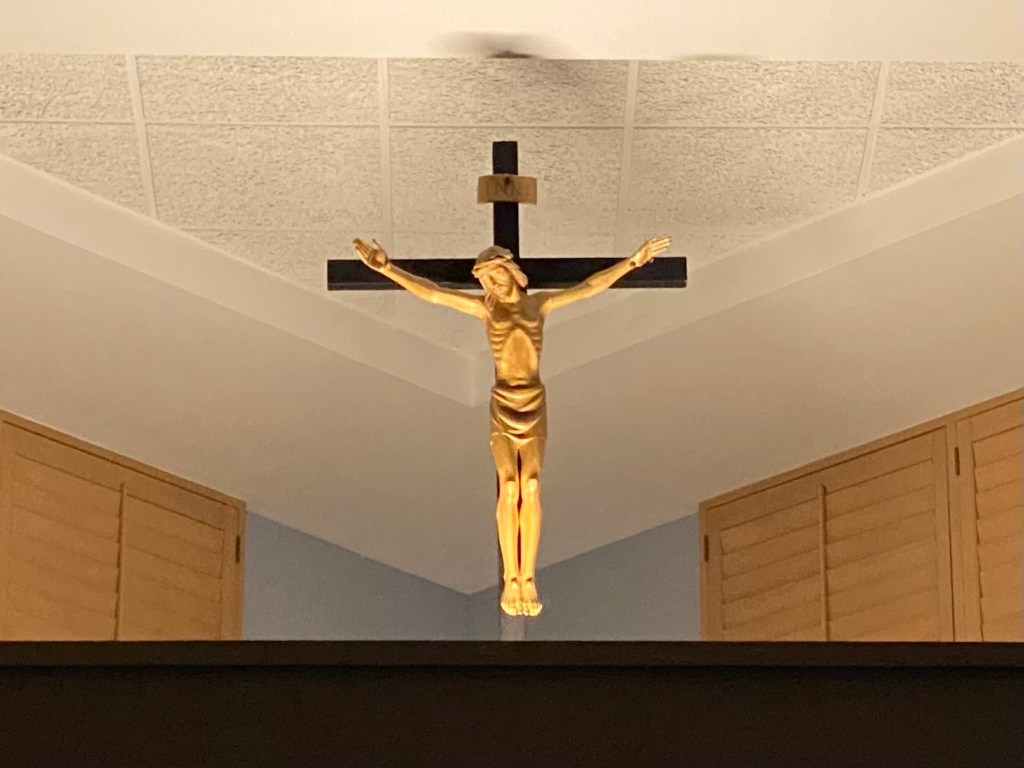
Photo: The crucifix hanging above our altar in our temporary place of worship in our hall, Holy Cross Catholic Church, Vero Beach, FL.

Link for the Mass readings for Wednesday, November 6, 2024

Behold Jesus on the Cross and be healed.

“In punishment the LORD sent among the people saraph serpents, which bit the people so that many of them died” (Numbers 21:6).

What kind of God would bring poisonous snakes upon his children? When Jesus taught his disciples about prayer didn’t he say, “Is there anyone among you… if a child asks for a fish, will give it a snake? If you then, who are evil, know how to give good gifts to your children, how much more will your Father in heaven give good things to those who ask him” (Mt 7:10).

Is God a loving Father or a harsh taskmaster?

He is a loving Father who not only wants his children to live but to live life to the full. God freed his people from slavery and was not only leading them to the promised land but also providing for and protecting them on the way. And yet, the people consistently grumbled and then rose up against Moses.

God chose to share with them a stark image of their choice of opposition to him by sending the serpents. The imagery of the serpent would have come to mind quickly to the people. For it was the serpent who tempted Eve and Adam and led them to their Fall. As St. Ephrem the Syrian (306-373 AD) wrote: “The serpent struck Adam in paradise and killed him. [It also struck] Israel in the camp and annihilated them” (Word on Fire Bible, p. 643).

We as Christians interpret the serpent in Genesis as Satan, which in Hebrew means adversary or opposer. Those of the people who rose up against God opposed him as Satan did. God revealed to them who they were serving in their rebellion and also showed them that if they rejected God and his love, protection, and provision, what the consequences to that choice would look like. Apart from God they will die. Trusting in and following God, even when the desert held no promise, they will live. “This particular punishment is another way of insisting that negativity necessarily follows from rebellion against God’s will” (Barron, p. 641).

When the people saw their sin in opposing God, they correctly repented. Moses again interceded for them, and God provided the healing antidote. He guided Moses to place a bronze image of a poisonous serpent on a pole. All who then looked upon it, were cured. In seeing clearly what had led to their poisoning, they could renounce it and receive God’s mercy, forgiveness, and healing. “Somehow, seeing sin for what it is serves to disempower the hold it has upon us” (Barron, p 641).

Jesus, the divine Son of God becomes one with us in our humanity to reveal to us the path to participate in his divinity. He shows to us our own rebelliousness, pride, and sins that separate us from God. Jesus has not come to condemn us for our sin but to save us, to free us from our slavery to sin. Jesus took the sin of the world upon himself as he was lifted up on the Cross. As he shared with Nicodemus, “just as Moses lifted up the serpent in the wilderness, so must the Son of Man be lifted up, that whoever believes in him may have eternal life” (Jn 3:14-15).

This is why we celebrate the feast of the Exaltation of the Holy Cross this day each year. What was a wicked sign of oppression and horrific suffering has now become a sign for our salvation. As we look upon the crucifix, we are reminded of the suffering that Jesus bore. Jesus took upon himself “all the dysfunction of the fallen human race” (Barron, p. 642).

When we look upon Jesus hanging on the cross, we see death but also the path to eternal life when we are willing to renounce, repent, atone for, and seek forgiveness for our sins. For on that Cross is where Jesus died for each and every one of us, and in so doing conquered the sin and death brought into the world by Adam and opened up for us the door to eternal life through his resurrection.


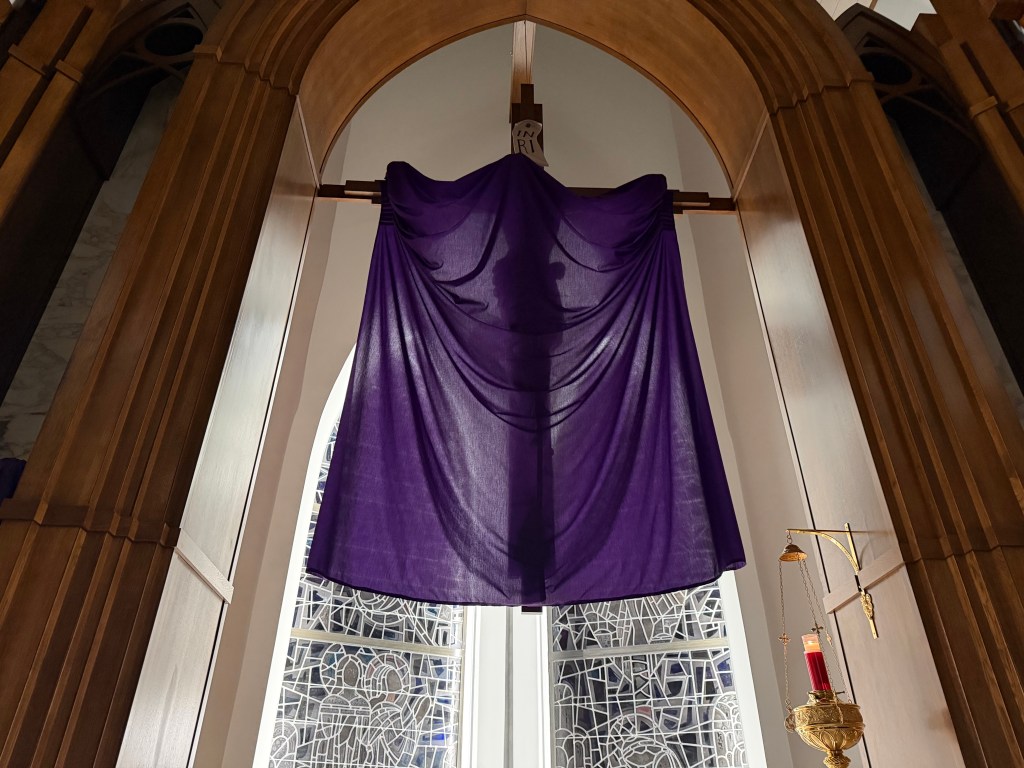
Photo: St Mary Chapel, St, Vincent de Paul Regional Seminary, Boyton Beach, FL.

Link for the Mass readings for Saturday, September 14, 2024

Word On Fire Bible: The Pentateuch. Elk Grove Village, IL: Word on Fire, 2023.

The crucifix and Good Friday, a reminder of Jesus’ love for us.

Jesus was betrayed, arrested, falsely accused, tried, scourged, and beaten. Jesus carried his cross, was crucified, and with his words, “It is finished” (Jn 19:30), Jesus died. The gift of a crucifix is that it is an icon of the moment of the death of Jesus. Having a crucifix is not a morbid fascination with death, nor a rejection of his resurrection. The crucifix is not a magic talisman, but a sacramental, that helps us to remember the reality of what the Son of God, who became one with us in the fullness of our humanity. Jesus embraced all of it, all the way even unto his death, giving his life for us that we might have the opportunity to be born again, to be one with him, to be deified, and live with him forever. Without the crucifixion, there would have been no resurrection.

On this Good Friday, let us spend time in venerating Jesus on the Cross, meditating before a crucifix, before this expression of the most intimate act of Love ever expressed in human history. This icon expresses the wonderful bestowal of the grace of God upon humanity. We are reminded that we have a God who has experienced and understands betrayal, loss, suffering, pain, anguish, and even death. Jesus is relevant to our lives because he meets us in our chaos and suffering.

In making time to be still and looking upon the cross upon which he died, seeing his body slumped and lifeless, we can call to mind the times we have been betrayed, the struggles, trials, pains, sorrows, and losses that we have or are enduring right now. We can also recall those times we have betrayed and hurt others with our actions or inactions, as well as caused pain and suffering. With each conflict or experience of injustice, we can be comforted in knowing that Jesus understands because he has experienced them all.

Making time to gaze upon the crucifix in times of fear, anxiety, temptation, or indecision, and also when we are in need of forgiveness, can give us the strength and courage to endure or go through what lies before us. Jesus with his arms outstretched represents for us his eternal welcome, that he loves us more than we can ever mess up, that he does not define us by our sins or worst mistakes, and that he loves us more than we can ever imagine.

When we resist running from our trials, our suffering, and our pain, and instead face them, we will find that Jesus is waiting for us with his arms outstretched and wide open, just as he did on the Cross. Jesus meets us in the depths of the whirlwind of our deepest hurts, struggles, and confusion, as well as when and where we need him most. He may not have an answer or we may not be able to hear it in the midst of our suffering, but he is present.

I did not experience Jesus’ death in person. I did experience my wife, JoAnn’s, death, and as she lost more weight, it was like witnessing a crucifixion. I remember one afternoon when the sun shone through the window, I looked up and saw the side of her face which appeared to be only skin and bone. Even though emaciated, she never lost her beauty or her grace. JoAnn radiated love: for me, for our children, and for any who helped to care for her in her final days. JoAnn’s love, the consistent presence of the Holy Spirit that kept me focused on her and her needs instead of myself, and Jesus holding each of us up were seeds of love that were planted within me that have begun to sprout.

This is my fifth Good Friday without JoAnn. This will also be the first time in even more years that I haven’t led the Stations of the Cross on Good Friday at my home parish of St. Peter. One thing is guaranteed in our life as human beings and that is change. Nothing remains the same. Change faced with Jesus though gives us meaning and a purpose, not right away always, but when we continue to turn to him there is healing and new beginnings.

This is why we venerate Jesus on the cross today, this is why today is Good Friday, because what appeared to be the end wasn’t. Today we remember the love of the Father who sent his only Son to give his life for each and every one of us. My heart closed the day JoAnn died as may have happened for Jesus’ disciples and Mary whose heart was pierced. That is the pain we all carry into our Holy Saturdays. Yet looking at the crucifix now, we know this represents the act of love that made the Resurrection possible. We are not to deny our grief, suffering, and pain, but through our Good Fridays bring our anguish to the open arms of Jesus on the cross. The cross is the doorway to our healing, redemption, and our salvation. The crucifix is a sign not of loss but of victory for in the words of St. Irenaeus, “Jesus opened up heaven for us in the humanity he assumed!”

——————————————————————–

Photo: Crucifix at entry of Our Lady of Florida Spiritual Center, North Palm Beach, FL.

Link for the Mass readings for Good Friday, March 29, 2024