death

With Jesus we can live more fully now and better prepare for eternity to come.
“Heaven and earth will pass away, but my words will not pass away” (Lk 21:33).
Jesus is emphasizing here the soundness of his parable of the fig tree and its allusion to the fall of Jerusalem which would happen within this generation or forty years. The fall of Jerusalem would indeed come in 70 AD. The great temple in Jerusalem would come down and this time not be rebuilt.
All that exists and that we know will pass away eventually because all things are finite, they are limited and material. The readings of this week repeat the same theme that we are not to place our hope and trust ultimately in the things of this world. The longer we live, the more we will experience loss, even the death of those closest to us. I remember my maternal grandfather share with me when he was around ninety years old that most of the people he grew up with were no longer alive.
All that which is physical and finite will pass away, but the words of Jesus will not pass away. Jesus’ words are life. He is God, the second Person of the Holy Trinity. He is the Logos, the Word, the very reality of God. Hearing his word is not enough though. Once we hear his word, we are to then mediate, pray with, and ponder his words, put his words into action and practice them in our lives. In doing so, Jesus becomes one with us in our humanity and we, one with him in his divinity. In God’s time, we will begin to bear fruit. We will become like the fig trees when their buds burst open.
Momento Mori is the Latin phrase that means, remember you will die. Accepting the reality of death and contemplating on our own deaths is not a morbid exercise when we enter this pondering with the end goal in mind that we will be one day be with God for all eternity. Also, those who contemplate their deaths more regularly live their lives more fully now. When we practice our awareness of death, we better appreciate our and the lives of others more because we come to see the fragile nature of our human condition.
Contemplating our death from time to time, also helps us to determine who and what is important to us. Dr. Leo Buscaglia, a professor at USC, while he was still alive had assigned his students an invitation to imagine that they had one week to live. They were to come up with a list of what they would want to do for that week and with whom they would want to spend it. After they turned in their assignments, Dr. Buscaglia then returned the papers and said, “Why not live this way now? Why do you have to wait until you are dying to start living your life more fully?”
Jesus invites us to resist the temptation to avoid uncomfortable situations as well as to resist clinging to wonderful experiences once they are gone. This healthy indifference helps us to experience the present gift of the moment where we will experience God and hear his guidance more clearly. Jesus helps us to live in this way because he lives in the eternal present. We are going to die someday, putting off until another day may be too late, so let us start living now.
Jesus, please help us to acknowledge that not only are we going to die, but that we need to die each day, and be free of curving in upon ourselves. Help us to open ourselves up to your promise of eternal life. Help us to discern the path you would have us to walk, guide us through our challenges and trials, and help us to bloom where we have been planted. When we listen to, meditate and pray upon, and put your words into practice, we will live more fully and experience your peace, joy, and love more deeply.
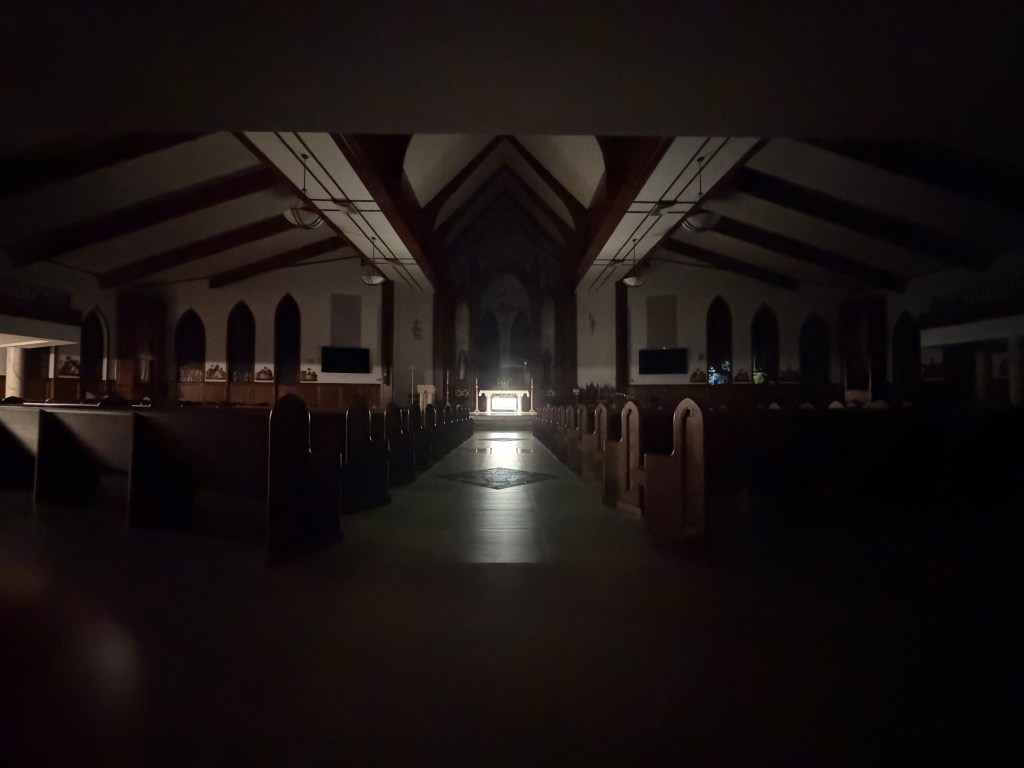
Photo: Slowing down to God’s pace helps us to hear and follow his direction, for his words will never pass away.
Jesus leads us through death into life.
Jesus said to them, “The Son of Man is to be handed over to men, and they will kill him, and he will be raised on the third day.” And they were overwhelmed with grief (Mt 17:22-23).
This is the second time in the Gospel of Matthew that Jesus shares with his disciples that he will die soon. They are overwhelmed with grief because their focus is on the first part of Jesus’ statement that he will be handed over to death. They do not understand or yet comprehend the second part about how he will be raised on the third day. How could they? There was no point of reference for them. Jesus did bring three people back to life during his ministry, but Jesus would not be merely resuscitated as they were and just die again. Jesus would resurrect and conquer death.
For us, we can read today’s Gospel about the impending death of Jesus and gloss over it a bit too easily. Because we celebrate Easter each year, we celebrate that Jesus has risen. Yet, do we really take in what this means? Does the fact of the Resurrection, the reality that Jesus has conquered death and become the firstborn of the new creation really have relevance in our lives?
The life, death, and Resurrection of Jesus matters! The missing piece for those for whom this statement doesn’t register any relevance may be that they do not want to think about death all that much. To be honest, none of us really want to come face to face with our own mortality, and most of us don’t until we or a loved one is forced to.
Beginning the summer after my freshman year of college, I began working the second shift in a nursing home as a CNA. It was the first time that I experienced death up close through the care of the residents I worked with. They were not merely patients but became family. What happened when I was present when some of them died was surprising. I was blessed with an experience of peace.
I learned from these moments of grace, revisited with my own wife, JoAnn’s death, and in this past year as a priest walking with about forty families from anointing to funeral masses, is to not take life for granted. Life is fragile and when we are able to contemplate and face the impending reality of our own deaths as well as those we love, we have an opportunity to live our lives more fully as well as appreciate a bit more those still with us! And when we experience this practice with the One who conquered death, life and our purpose takes on an even deeper meaning.
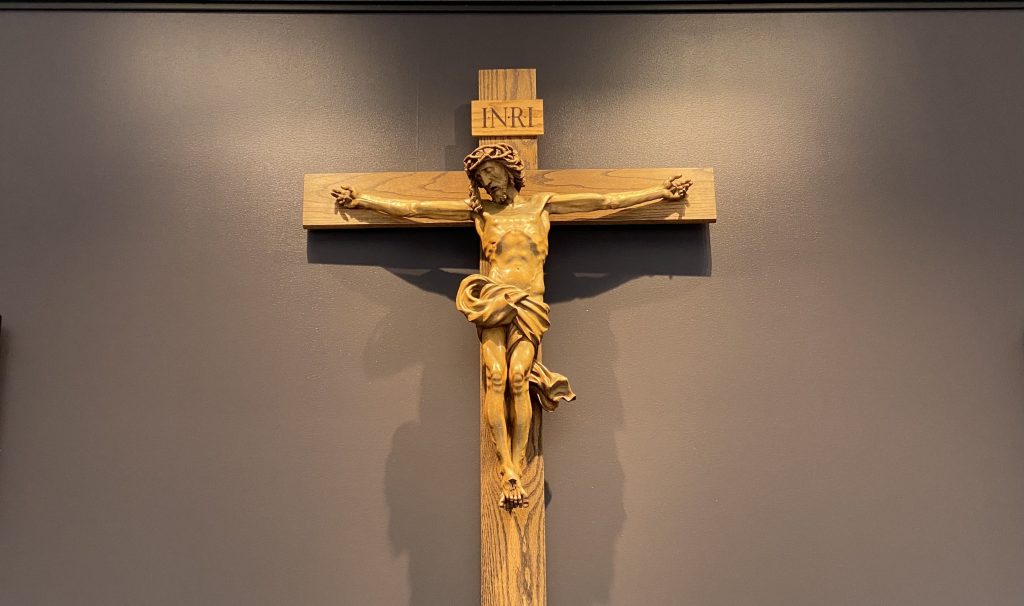
Jesus understands each of our struggles and tribulations, our sins and our failings, as well as our deepest hopes and dreams. Jesus also knows about our deepest fear of death, for he, as a human being, experienced it too in the Garden of Gethsemane. The gift of the crucifix, the sacramental object of Jesus on the Cross, is a reminder of the reality of death while at the same time that death does not have the final answer, Jesus, fully human and fully divine, does.
Photo: Crucifix outside the dining hall at University of St. Mary of the Lake.
Ponder death this Holy Saturday, so that we may better appreciate life.
“So they laid Jesus there because of the Jewish preparation day; for the tomb was close by” (John 19:42).
“They” is a reference to Joseph of Arimathea and Nicodemus. Joseph appealed to Pontius Pilate seeking to receive his body for burial. The common Roman practice would be to leave the dead bodies of those who died on their crosses to be picked at and eaten by animals. This display further emphasized that if one decided to go against the Roman leadership, this would also happen to them. Joseph and Nicodemus were able to give him a proper resting place in an unused tomb near the place where he died. Up to this point, these disciples in secret now have come forward publicly to show their alliance with Jesus.
The place of Jesus’ burial, though at first glance was opportune because it was close to Golgotha, has deeper significance as does all of Scripture. For Jesus was buried in a tomb in a garden (see John 19:41). The image of Jesus being buried in a garden echoes the idea of Adam being cast out of the garden he was first created in. The image of Jesus as the new Adam, being buried in a new tomb, is not the end of the story but only the beginning.
This moment of Holy Saturday was the in between time of the death of Jesus until his resurrection. Death appeared to have the final word but as we know, Jesus experienced death, just as he was laid in the tomb, but he conquered death and rise again. The reality of this fact we will celebrate beginning tomorrow night as we celebrate the Easter Vigil and then Easter Sunday when Jesus indeed did conquer death and become the first born of the new creation!
May we give ourselves some time this Holy Saturday to be simple, to be still, to ponder the mystery of this moment in Jesus’ life as he experienced death and slept in that state of death, alone in a tomb. May this pondering of Jesus’ death help us to also reflect upon our own death. Doing so is not a morbid practice, but instead helps us to appreciate the gift of life that God has given us. Pondering our mortality helps us to acknowledge that our time is limited and that we are only passing through this life.
All of us will die. That is the truth. Facing and pondering that truth will help us to decide more intentionally how we want to live our lives, now and in the life to come. Instead of being governed by reactive thoughts, words, and actions, we can come to a place of peace and stillness, breathing, resting, receiving, and abiding in God’s love. From that place of experiencing and resting in God’s love, we can open our hearts and minds to the guidance of the Holy Spirit.
Through following the lead of the Holy Spirit, we are granted a path that will lead us to heal, be forgiven, and be restored to the original glory, to be transformed into the image and likeness of God that was intended from the beginning of creation. Jesus has opened up to us the possibility of returning to the new garden by undoing the sin of Adam that cast us out in the first place. Jesus’ obedience to and love of the Father we are invited to participate and share in. Are we willing to take his hand and follow him to where he will lead? This question as well as a few of the other points above are good to ponder this Holy Saturday.
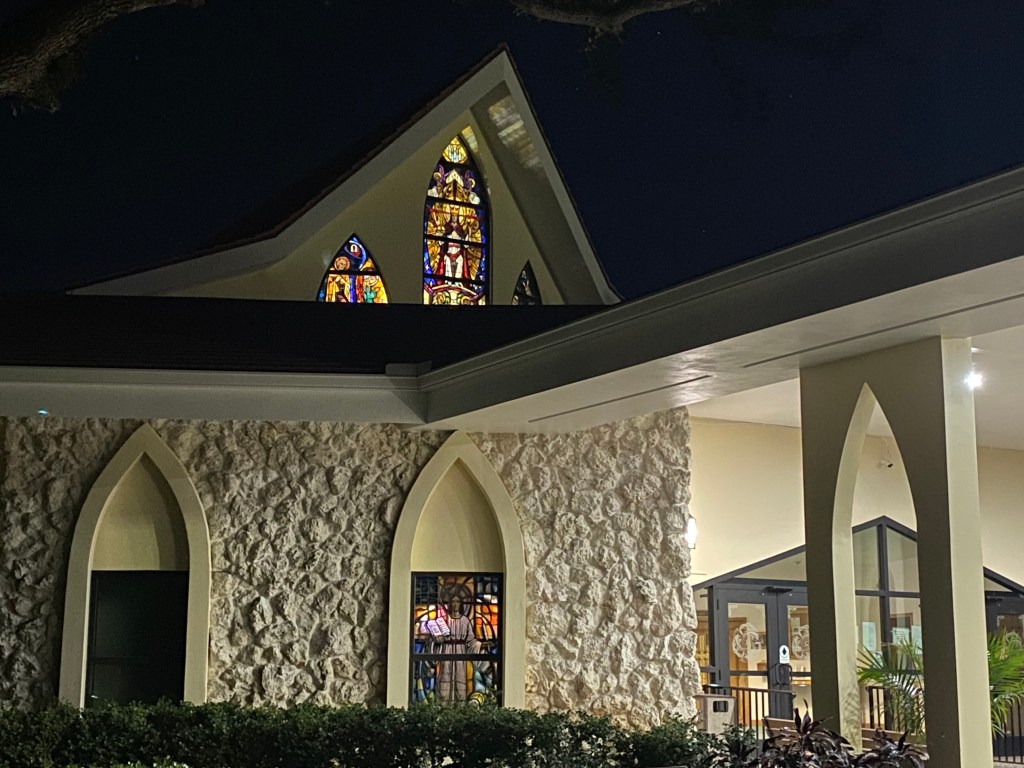
Photo: Even in the darkness of Holy Saturday, even in our darkest moments, the light of Jesus is present.
Link to the Mass readings for Good Friday to ponder on Holy Saturday

When we remember we will die, we will live better now.
“Heaven and earth will pass away, but my words will not pass away” (Lk 21:33).
All that exists and that we know will pass away eventually because all things are finite, they are limited and material. The readings of this week repeat the same theme that we are not to place our hope and trust ultimately in the things of this world. The longer we live, the more we will experience loss, even the death of those closest to us. I remember my maternal grandfather share with me when he was around ninety years old that most of the people he grew up with were no longer alive.
All that which is physical and finite will pass away, but the words of Jesus will not pass away. Jesus’ words are life. He is God, the second Person of the Holy Trinity. He is the Logos, the Word, the very reality of God. Hearing his word is not enough though. Once we hear his word, we are to then mediate and ponder his words, put his words into action and practice them in our lives. In doing so, Jesus becomes one with us in our humanity and we, one with him in his divinity. In God’s time, we will begin to bear fruit. We will become like the fig trees when their buds burst open.
Momento Mori is the Latin phrase that means, remember you will die. Accepting the reality of death and contemplating on our own deaths is not a morbid exercise when we enter this pondering with the end goal in mind that we will be one day be with God for all eternity. Also, those who contemplate their deaths more regularly live their lives more fully now. When we keep the our awareness of death available to us, we take our life and the lives of others for granted less because we come to see the fragile nature of our human condition. We also come to realize that we do not know the time or hour when others or we ourselves will die.
Contemplating our death from time to time, also helps us to determine who and what is important to us. Dr. Leo Buscaglia, a professor at USC, while he was still alive had assigned his students an invitation to imagine that they had one week to live. They were to come up with a list of what they would want to do for that week and with whom they would want to spend it with. After they turned in their assignments, Dr. Buscaglia then returned the papers and said, “Why not live this way now? Why do you have to wait until you are dying to start living your life more fully?”
Jesus invites us to resist the temptation to avoid uncomfortable situations as well as to resist clinging to wonderful experiences once they are gone. This healthy indifference helps us to experience the present gift of the moment where we will experience God and hear his guidance more clearly. Jesus helps us to live in this way because he lives in the eternal present. We are going to die someday, putting off until another day may be too late, so let us start living now.
Jesus, please help us to remember that we are going to die so that we may better appreciate and experience each moment. Help us to discern the path you would have us to walk, guide us through the challenges and trials that will arise, and to bloom where we have been planted. Help us to recognize that we will have less regrets when we listen to, meditate upon, and put the words of Jesus into practice, so that we may live now and experience your peace, joy, and love.
Photo: Sometimes knowing the time we have left can be a blessing. Enjoying our final two months together with JoAnn, July 4th weekend, 2019. Swan boat ride on Echo Lake in, LA.
Link for the Mass readings for Friday, November 29, 2024

The horizon we gaze upon has an effect on the life we live now.
The term horizon is often defined as where the earth and sky meet. This is actually an apparent horizon or sensible horizon because we see an apparent plane based on our observation point. If we are able to broaden our viewpoint and look beyond the present location we are standing at on the earth, say from the space shuttle, we could then experience a rational or celestial horizon: where the great circle of the celestial sphere whose plane passes through the center of the earth is parallel to the celestial horizon of a given position. Journeying deeper into space we could discuss event horizons, the boundaries marking the limits of black holes.
Before delving any deeper and getting lost in space, let’s return to earth and today’s Gospel where Jesus stated: “Pay attention to what I am telling you. The Son of Man is to be handed over to men” (Lk 9:44). What Jesus offers to us in this statement is the horizon of the cross, the place where heaven and earth meet, where the physical and the spiritual, where the finite and infinite meet.
Many of Jesus’ followers were and are still confounded by the cross. As Paul wrote to the Church at Corinth: “For Jews demand signs and Greeks look for wisdom, but we proclaim Christ crucified, a stumbling block to Jews and foolishness to Gentiles, but to those who are called, Jews and Greeks alike, Christ the power of God and the wisdom of God” (1 Cor 22-23).
Paul echoes what Jesus was talking about – his imminent fate and our ultimate horizon – death. None of us will be able to avoid the final result of our mortality. Jesus taught both through his words and in his death that to be truly free we need to be willing to lose our life to gain it. We have to face and walk through our deepest fears to grow. Our life is not lived until we give it away.
The more willing we are to face the reality of our own death, the less likely we are to take the time we have for granted, and the better we can live our lives here and now. During our final four months together, JoAnn and I experienced God’s grace because we faced the reality that her time was near, we embraced the gift of the time we had together, and through the prayers of so many, we experienced the infinite presence of the love of God in our midst.
There is so much we can experience and enjoy, but if we only limit ourselves to that which we can experience with our physical senses alone and attempt to deny our own mortality, we limit ourselves and distort the sacredness of life. What makes us fully human, alive, and fulfilled is an embrace of both the physical and the spiritual, of both reason and faith, seeking the horizon where the finite and infinite meet, where earth and heaven come together.
This union happens most perfectly in Jesus Christ, who is fully human and fully divine. Jesus helps us to experience the beauty of God’s creation and our relationships. This happens best when we are willing to enter with him into, instead of resist, the natural rhythm of life and death. We come to appreciate the truth of how fragile our lives really are.
This is not a truth to run from but to embrace. And as we do, we will be less apt to take each other for granted and instead better appreciate one another. We will also be able to slow down and rest more in the moments that God offers in which we can experience foretastes of heaven now. In doing so, we will better prepare ourselves for that time when Jesus will lead us into our own death so that we may rise with him and experience a new and infinite horizon.
Photo: Rosary walk and pause, Riomar Beach, Vero Beach, FL.
 Spiritual Stepping Stones