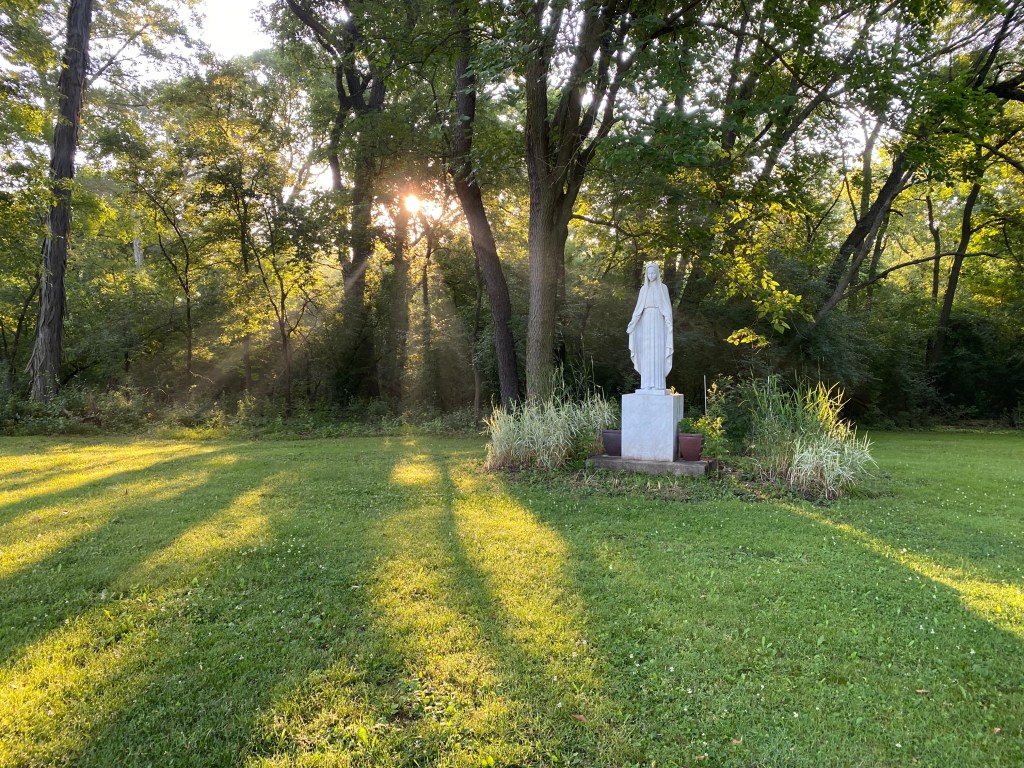
Let us turn over our anxiety to and receive from Jesus his peace.

“Martha, Martha, you are anxious and worried about many things. There is need of only one thing. Mary has chosen the better part and it will not be taken from her” (Lk 10:41-42).

My wife, JoAnn, used to have more than a few spirited discussions on this Gospel passage each time that it arose because at first reading it appears that Jesus does not show any empathy or regard for Martha’s gift of hospitality nor for all the work she is doing. All the men are sitting around listening to Jesus with Mary doing the same, and who is left to do all the work? Martha.

It is not only deacon’s wives who carry extra weight and burdens in support on the home front to allow their husbands the time to serve, (While JoAnn was still alive, the time it took me to write these daily posts was less time I spent with JoAnn or less time to devote to the needs of our home) but many wives who are full-time homemakers, run in-home businesses or carry a job outside the home, as well as caring for the children, overseeing the bills, the day to day grind, find themselves at times, rightly so, underappreciated, undervalued, and not respected for all they do.

Husbands can do a better job of being present, more patient, respectful, and attentive to their wives and be more of an equal partner on the journey. All of us, female or male, could also be better served when we follow this pattern of attention and priority: For those married as well as single put God first, then family, work, and our unique vocation.

With all the above as a prelude, I do not believe that Jesus was disregarding Martha. Especially in the Gospel of Luke, there are many instances in which Jesus empowers women so far beyond the cultural reality of his time. We read this as we do any biblical account from our twenty-first-century mindset. Contextually, the men sitting at the teacher’s feet in a different room, the women cooking, and most times eating separately were commonplace for those in the ancient near east of the first century AD. Mary was the only person out of step with the times.

Jesus said that Martha was worried about many things. Mary could have been one of those worries, and not so much that Mary wasn’t helping in the kitchen, but because she was breaking the social norm of sitting with the men. When Martha calls Jesus to redirect Mary, she probably expects him to support her plea. Yet, Jesus acknowledges that “Mary has chosen the better part” of sitting and having her primary focus be on him. I can visualize Martha being taken aback at first, but then slowly feeling the muscles in her face relax as the lightbulb went on, she chooses to let go of her anxiety, take her apron off, throw it to the side, and sit down next to Mary.

There is biblical evidence that beyond the Twelve, Martha, Mary, and Lazarus, were Jesus’ friends. When Jesus came four days after the death of Lazarus, as soon as Martha heard Jesus was outside, she, not Mary, came immediately out to Jesus, and in that exchange, it was Martha who made the claim that Jesus was the Messiah, the Son of God (cf Jn 11:27). Would she have had this insight, the same as Peter, if she was still holding a grudge?

Our modern reaction and push back to this Martha and Mary account in Luke may not so much be a reflection on Jesus but how poorly men have treated women over the generations and how poorly women continue to be treated even today. No matter their ages, young, old, and everywhere in between, women are human beings created in the image and likeness of God. No one has the right to abuse, demean, disparage, devalue, or exploit any woman. Women are to be appreciated, heard, respected, cherished, and valued.

God has given each of us gifts and ways to participate in his Father’s plan. May we seek to be still and rest in Jesus’ presence as Mary, and hopefully Martha, did. In this way, our anxiety can begin to reside as we experience feeling safe and we will come to know and experience his love. Doing so will help us to better know Jesus, his voice, and his teaching, know and follow his will, love others as he loves us, and live our lives respecting, encouraging, and supporting one another with the gifts and guidance that God has given us.


Photo: One of the ways that I sit at Jesus’ feet and experience his peace, Rosary walks on our campus here at Holy Cross, Vero Beach. Praying for the west coast of Florida and all in the path of Milton.

Link for the Mass readings for Tuesday, October 8, 2024

Our burdens will be easier when we allow Jesus to help us carry our load.

Jesus said: “Come to me, all you who labor and are burdened, and I will give you rest” (Mt 11:28).

Scripture scholar, Fr. Daniel J. Harrington, SJ, stated that in this passage Jesus’ invitation was given to those who are not yet his disciples, those Jews who do not yet believe in him and the way that he is proposing. Jesus is calling them from the heavy burdens laid upon them by the scribes and Pharisees and inviting them to accept his burden that is lighter (cf. Harrington, 167). We can read this in Matthew 4:3: “They tie up heavy burdens [hard to carry] and lay them on people’s shoulders, but they will not lift a finger to move them.”

Jesus’ charge leveled against the Pharisees comes from those who have experienced the laws without the assistance and support to follow them. The demands of Jesus are even more challenging than those of the Pharisees, Sadducees, or the scribes! I shared yesterday one of the six antitheses, here is another: “You have heard that it was said… whoever kills will be liable to judgment. But I say to you, whoever is angry with his brother will be liable to the judgment, and whoever says to his brother, ‘Raqa,’ will be answerable to the Sanhedrin, and whoever says, ‘You fool,’ will be liable to fiery Gehenna” (Mt5:21-22). Jesus is equating calling someone Raqa – an airhead or calling someone a fool akin to murder. Our words can destroy or empower! We need to choose our words wisely.

The difference between Jesus and many of the religious leaders of his time is that Jesus, the Son of God in the fullness of his divinity, was willing to enter into the chaos of our humanity. He experiences and suffers along with us. He invites us to yoke ourselves to himself. This will lighten the load that we carry. Many impose burdens on us, and we can impose burdens on others. We also impose them on ourselves and turn away from the invitation of Jesus’ help.

A handful of injuries I have suffered through the years were because I attempted to lift or carry something beyond my strength, instead of seeking assistance from another. I would think, “I can do it, I don’t want to bother anyone.” That is just the physical; there are also the mental and emotional burdens of anxiety, doubt, pride, fear, and worry that we burden ourselves with. This is not Jesus’ way.

Jesus offers us a path to follow that leads us to experience joy, peace, and tranquility in this life and fulfillment and union with God in the next. No matter what pain, suffering, trial, and/or challenge we are facing right now, we do not have to go through it alone. We just need to remember to reach out our hand to Jesus and when we do, what we will find is his hand already extended ready to grasp ours. Many times, the offering comes from those who are close to us, who are more than willing to help.

In aligning ourselves with God’s will, life isn’t necessarily going to be easier, but he will give us the strength and peace of mind not only to endure but to experience a peace that surpasses all understanding while doing so. Let us take our first step together today, hand in hand with Jesus, and so find rest in knowing that we are not alone!

Also, may we be kind to those in our midst with our words, actions, and faces. Among those who may be abrupt or rude, resist the temptation of reacting and instead be present and understanding; for we are not aware of the burdens others are carrying. Offer instead a simple smile as a start, instead of an instant reaction returned in kind, a posture of patience and understanding, which can make a heavy load just a little lighter.
—————————————

Photo: Restful end of the day with Rosary walk.

Harrington, S.J. Daniel J. The Gospel of Matthew. Vol. 1 of Sacra Pagina, edited by Daniel J. Harrington, S.J. Collegeville, MN: Liturgical Press, 2007.

Link for the Mass readings for Thursday, July 18, 2024

Our lives are “measured by love.”

A key focal point of the last supper narrative in the Gospel of John is Jesus washing the feet of his disciples. Washing feet was a custom in the ancient Near East because either people walked barefoot or wore sandals. In either event, people’s feet became quite sore and dirty getting from here to there. Washing of the feet was a hospitable way to welcome guests into one’s home, though this action was the most menial of tasks and often performed by the lowest of slaves or servants.

After washing his disciples’ feet and sitting down, Jesus said to them, “Do you realize what I have done for you? You call me ‘teacher’ and ‘master,’ and rightly so, for indeed I am. If I, therefore, the master and teacher, have washed your feet, you ought to wash one another’s feet” (Jn 13:13-14). Jesus is sharing with those who will carry on his message and ministry that they are not to feel so high and mighty in their being called to follow him. The Apostles, those who are sent by Jesus, are to look at their ministry as seeking how best to serve others, not seeking to be served themselves.

In many parishes, this evening at the Mass of the Lord’s Supper, some members of the parish will have a foot washed by the priest or priests, following the model set by Jesus. This would remind all of us, as members of the Church that we are all an integral part of the Body of Christ and we are at our best when we are willing to serve, support, and lift one another up. This is true when all is well and good in addition to when conflict and challenges arise in the messiness of our daily lives.

Pope Francis, in his homily given on April 5, 2020 highlighted this same point: “Dear brothers and sisters, what can we do in comparison with God, who served us even to the point of being betrayed and abandoned? We can refuse to betray him for whom we were created, and not abandon what really matters in our lives. We were put in this world to love him and our neighbors. Everything else passes away, only this remains. The tragedy we are experiencing summons us to take seriously the things that are serious, and not to be caught up in those that matter less; to rediscover that life is of no use if not used to serve others. For life is measured by love.”

We best exemplify Jesus’ washing of the feet when we resist the allure and temptation of pride. Our life is not about us. We are not the center of the universe. We need to walk away from the table that offers a buffet of false substitutes for God. Nor are we to curve in upon ourselves and get down on ourselves when we realize our shortcomings and sins because then the focus is still on ourselves.

Let us instead seek to be aware, attentive, discern wisely and even when we fall, be thankful, repent, and begin again. Jesus has not nor will he ever abandon us, and he never tires of loving, forgiving, and serving us. We, as were the apostles, are called to and will be measured by our willingness to wash each other’s feet: to love, to forgive, and to serve one another.

————————————————————

Photo: Painting of Jesus hanging in the monastery here at Our Lady of Florida Spiritual Center, North Palm Beach, FL.

Link for the Mass readings for Holy Thursday, Evening Mass of the Lord’s Supper, March 28, 2024

“Awake my soul, awake lyre and harp, I will awake the dawn.”

Rising very early before dawn, he left and went off to a deserted place, where he prayed” (Mk 1:35). This was a common practice of pious Jews at the time. The intent was to spend time away from the everyday hustle and bustle, to be still, to better be able to connect with God. Jesus is making the effort and time to do the same, to go off to a place of quiet and stillness before the day’s activity begins, and to seek guidance from his Father as to how best to proceed in his ministry. When Simon Peter tracked Jesus down, Jesus shared the guidance he received to move on to the nearby villages to preach there also.

I have found this practice beneficial as well. In the early 90’s when I entered the Franciscans, I learned how to pray the Liturgy of the Hours. During my first week of participating in this practice, a verse resonated with me: “My heart is ready, O God, my heart is ready. I will sing, I will sing your praise. Awake my soul, awake lyre and harp, I will awake the dawn” (cf. Psalm 57). Even though my body and mind groan in protest, there is a feeling and experience of peace, renewal, and empowerment with making the time to “awake the dawn.”

I have been blessed to do so over the past eighteen years or so. Having the privilege and opportunity to teach for eight and a half years at Rosarian Academy and then nine years at Cardinal Newman HS, I began each day in the chapel sitting quietly and praying the Office of Readings and Morning Prayer. For the past year and a half, I have been able to not only pray the Liturgy of the Hours but also participate in daily Mass with the clergy, religious, and my brother seminarians at St. Vincent de Paul Regional Seminary.

It is nice to begin the morning slowly with God, to be infused with his Word and to be in the presence of Jesus in the Eucharist, then to go forward into the day to share the joy of that morning’s encounter. I also introduced a “Holy Hour” into my day as well since coming to the seminary which has been an opportunity to grow even closer in intimacy with Jesus and experience moments of healing and growth.

How we go off to a deserted place will be different for each of us based on our station and responsibilities in life. There is much pulling at us to distract and divert us from making the time, but our lives will be transformed when we do. To commit to 10 to 20 minutes of quiet a day to start will mean we need to let go of something else. It may mean hitting the snooze button is no longer an option, maybe it is getting up 20 minutes before your spouse and kids, quiet time with morning coffee or breakfast, sitting quietly on the porch, at the kitchen table, or favorite quiet spot, quiet time in the car, maybe there is a gap in between classes, any time outside for a quiet walk or sitting by water is great. There are so many options.

There is something for me that is special about the stillness before the dawn, experiencing night giving way to the morning light, hearing the bird song, and yet, there are many ways, as there are many places and times that we can create for ourselves to show up with God and allow him to happen. I also enjoy ending the day with a quiet walk around our lake after supper. As we make time to experience stillness, we will also begin to notice God more often in our activities, interactions, and interruptions. Making time to go off to a deserted place is a wonderful gift that I pray you may give to yourself this week.


Photo: Waking the dawn during my 30-Day silent retreat this past July at Joseph and Mary Retreat House, Mundelein, Illinois.

Link for the Mass readings for Sunday, February 4, 2024