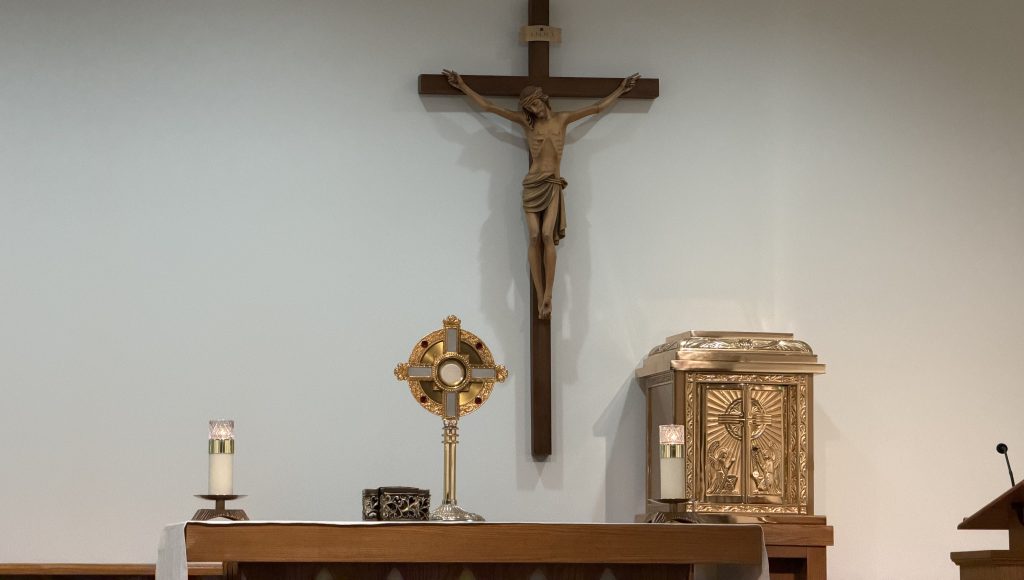
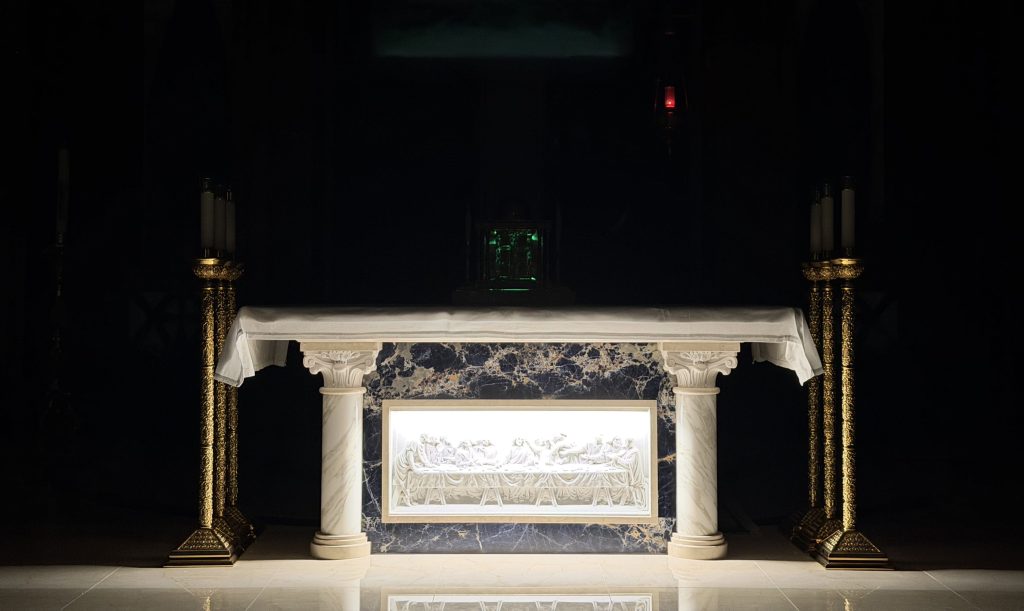
When we allow our heartbeat to align with the Sacred Heart we will experience his rest and peace.

“It was because the LORD loved you and because of his fidelity to the oath he had sworn your fathers, that he brought you out with his strong hand from the place of slavery, from the hand of pharaoh, King of Egypt” (Deuteronomy 7:8).

God hears the cry of the poor. He sends Moses to free his chosen people. Not because they are the best and brightest, the strongest or having the most potential. He is doing so because of his promise to Abraham, Isaac, and Jacob, the patriarchs. He is doing so because he loves his children, those enslaved, but also all of humanity and creation. The chosen people are chosen not so they can keep God all to themselves but so that they can reveal him to all peoples.

All that has been created has come to be out of the outpouring of God’s love. We and everything that is, exists because God willed and loved us into reality, to be loved and to love him and each other in return. 

God still comes close today, he still hears the cry of the poor. The poor are each of us in the depths of our souls crying out to our loving God and Father, just as St. Augustine in his introduction to his Confessions identified: “You have made us for yourself, O Lord, and our hearts are restless, until they rest in you.” We all thirst and starve for his love and communion. The pharaohs today are not just those who overtly oppress others, though there are still those who do, but more subtle are the fallen aspects of each one of our egos that enslave our authentic and true selves. 

God has sent another Moses to free us: “In this way the love of God was revealed to us: God sent his only Son into the world so that we might have life through him” (I John 4:9).

Jesus comes close, he shines the light of love into our darkness, our sins, our traumas, our fears. He gently invites us to come into the light of his love, to be embraced, forgiven, and restored as the beloved children that we already are, but to often forget.

Each day and during moments of the day, it is helpful for us to remember that we are the beloved daughter or son of the creator of all that exists. He made and formed each of us as an expression of his love. There has never nor will there ever be again someone like you. You are loved as you are right now as you are and you need do nothing to prove that. All we need to do is receive the love God offers to us. 

Listen quietly for the beating of the Sacred Heart of Jesus and allow your heart to align in rhythm with his heart, such that Heart speaks to heart. Receiving the love of the Father through Jesus is the key to our freedom. No self-help program or three-point strategic plan needed (counseling does have its place and time). Just a simple, “Yes” to your loving God and Father, as Mary said, “May it be done to me according to your word.” As Jesus said, “Not my will but yours.” A simple slowing down and returning throughout the day and each day to an opening of your heart to the Sacred Heart of Jesus. 

Aligning ourselves to the pace and rhythm of the Sacred Heart of Jesus helps us to experience his rest, which is deeper than physical. The rest that Jesus promises is the rest that our soul has always longed for. It is in that simple rest that we can experience the safety and stability of his love, a release from stress, strain, and pain, and deep, slow breathing that leads to peace, that peace that surpasses all understanding. Rest yes, but not for just ourselves. We are to “bring the peace of the risen Lord to our world, with the freedom born of the knowledge that we have been loved, chosen and sent by the Father” (Pope Leo XIV).


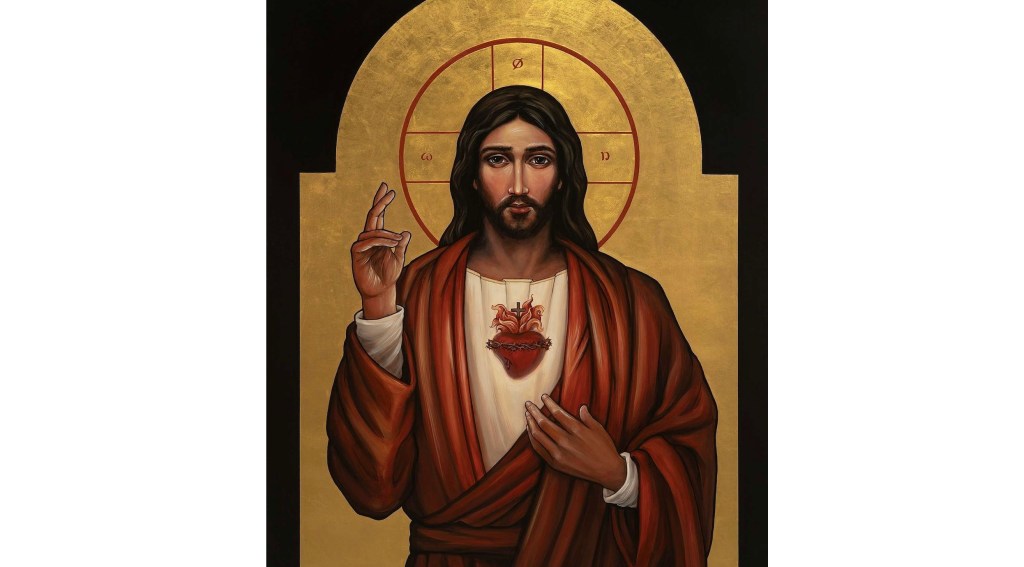
Painting: The Sacred Heart of Jesus accessed from Trinity Catholic College

Pope Leo XIV Solemnity of the Sacred Heart Homily, June 27, 2025

Link for the Mass readings for Friday, June 12, 2026

Blessed is the one who hears and ponders the word of God and puts it into practice.

Curtis Mitch and Edward Sri, in their commentary on Matthew, offer three key insights into how to understand the beatitudes. Contextually, Jesus does not make up the genre of beatitudes himself. The Greek, makarios, can be interpreted to mean happy and “denotes blessedness or happiness not in the sense of an emotional state but in terms of being in a fortunate situation… In the Jewish tradition, beatitudes either commended those who take a certain path of life or promised future consolation to those in affliction” (Mitch and Sri, 88). 

The Hebrew Scriptures provide examples that Joseph and Mary would have read or shared from memory to Jesus, and he would have prayed with himself. “Forty-five beatitudes are found in the Old Testament, most in the Psalms and Wisdom literature, where they commend a certain quality, condition or situation. For example, the blessed are those who delight in God’s law (Ps 1-2), who take refuge in the law (Ps 2:12)… and trust in him (Ps 84:12).” (Mitch and Sri, 89).

Who is blessed to Jesus? Not even his own mother because she is his mother, but blessed is the one who hears and ponders the word of God and puts it into practice (cf. Luke 11:28). Jesus presents to his followers a path of how they are going to live a particular way of life. He is setting a road map that will guide them through the trials and tribulations that will come in doing so, and even when challenges arise, Jesus promises that his Father will provide consolation. Those who put the beatitudes into practice and live as his disciples will experience happiness and fulfillment. 

Mitch and Sri also show that “Jesus’ beatitudes represent a reversal of values, turning the world’s standards for happiness upside down” (Mitch and Sri, 88). Mature disciples of Jesus will come to experience consolation no matter the external storms that arise. Even in times of desolation, they will remain persistent and on course, so to come out on the other side stronger for having trusted that Jesus is with them even when they did not feel his presence. 

Jesus does not commend those who wage war as blessed, but instead: “Blessed are the peacemakers, for they will be called the children of God” (Mt. 5:9). Jesus does not promote the lives of the rich and famous, but instead: “Blessed are the poor in spirit, for theirs is the kingdom of heaven” (Mt. 5:3). Jesus does not affirm those who thirst for power, pleasure, wealth, and fame, but instead: “Blessed are they who hunger and thirst for righteousness, for they will be satisfied” (Mt. 5:6).

These are just a few of the eight beatitudes Jesus presented. A good practice is to review each of the eight beatitudes that Jesus presents in the beginning of his Sermon on the Mount. Which one(s) strike a nerve. Stop there and meditate with Jesus leading us. Where is he helping us to see a way where we can release an attachment so to better follow more faithfully?

Jesus invited his disciples to sit at his feet as the “new Moses”. He came up the mountain like Moses who came up to receive the law. Jesus did not come to receive the law, he came to “teach it” (Mitch and Sri, 87). As he begins his Sermon on the Mount with the Beatitudes, the other wonderful thing we will realize about the beatitudes is that he was not just sharing head knowledge but practical ways to inherit the kingdom of Heaven, to grow in intimacy with his Father and share in the love of the Holy Spirit. All practices that he himself lived through and through.

The Beatitudes, like the Ten Commandments, are boundaries that define us as the children and inheritors of God’s will and blessing. They help us to uncover that which seeks to lead us astray, to isolation, and to our death, and instead identify how to stay focused on that which leads us to eternal life. The most important thing we can do every day is to pray, and the enemy knows that, so he will seek with all his means to distract, divert, and dissuade us from doing so or to keep our prayer and practices merely at the functional level. 

Jesus offers us his love that we might trust him to allow his light to shine in our hearts and minds and the places we would rather no one would see. Even those places that we may feel unlovable, because even there, Jesus will love us when we let him in. He seeks to reveal our sin and failures, not to condemn and shame us, but to help us to see what is enslaving and isolating us and that which keeps us from greater intimacy with his Father. The light and love of Jesus help us to see what our lives are like without God and what they are like with him.

As our consciences become better formed through following Jesus’ teaching, such as the Beatitudes, as we allow him access to our wounds and sins, as we are loved by Jesus even there, we will be purified by the loving fire of the Holy Spirit, and we will then be blessed with a clean heart and see God. See our Loving God and Father who has made us to be happy, fulfilled, and at rest; a rest that we will find when we breathe, receive, rest, and abide in Him.


Photo: Quiet time praying Evening Prayer after the Saturday Vigil Mass at St Helen Catholic Church in Vero Beach.

Mitch, Curtis. The Gospel of Matthew. Grand Rapids, MI: Baker Academic, 2010.

Link for the Mass readings for Monday, June 8, 2026

Jesus has sent us the Holy Spirit to lead us to experience rest and peace grounded in his love.

What is common to all of us is that we experience some expression of loneliness to varying degrees, sometimes consciously but mostly unconsciously. We are social beings, we want to belong, to be part of, and this is why we are communal. We may do, say, or turn a blind eye to behaviors that go against our conscience just to be accepted, acknowledged, and/or noticed. This behavior further feeds our loneliness, because though we may be “accepted”, we become more alienated from our true self. We are not accepted for who we are but who we portray ourselves to be.

At the core of our being, what we all seek is to be loved, and to love in return. We strive from the moment of our conception not only to exist but to actualize the fullness of who God is calling us to be. Through our time of gestation, we are not potential human beings, we are human beings actualizing out potential. A difference between me typing this now and when I was in my mother’s womb is that before my birth, I was smaller and more vulnerable.

We as human beings are a living, craving hunger and desire to be in communion with God and one another from the moment of our conception until our natural death and continuing on into eternity. This is true to the believer and the atheist alike. Until we embrace this deepest of needs and desires, we will be restless, anxious, and unfulfilled. We can feel isolated and alone, even in the midst of a hundred people or daily likes on social media. St. Augustine in the introduction to his autobiography said it best: “You have made us for yourself, O Lord, and our hearts are restless until they rest in thee.”

God has made us for himself and constantly invites us to be in a relationship with him and with each other because he is the foundation and source of our being. Sin is the turning away from that invitation, a curving, or caving in upon oneself away from God and others. It is also the unwillingness to bother or to care, to reach out toward another in need. For what we do to the least of our brothers and sisters, we do to Jesus. We are not just to be pro-birth though, we as Catholics are to be pro-life, and we are invited to promote a consistent ethic of life.

Jesus became human in his Incarnation. He too, as we did, developed in the womb of Mary to show the importance of the dignity of the person and that our dignity is grounded in our relationship with God our Father, meaning we are all brothers and sisters. We are his beloved daughters and sons, just by who we are not by what we do. Jesus was not a plan B, but he was always the primary plan. In the fullness of time, when God so willed, he sent his Son to become one with us in our humanity so that we can become one with him in his divinity. 

Jesus is the face, hands, and body of God. He came that we might see and experience God. Jesus experienced all we experience except for sin because he never, in any thought, word, or deed, rejected or said no to his Father. His whole life was a, “Yes” to the will of God. Jesus is the bridge, the way to love and be loved, authentically.

In today’s Gospel, Jesus continues preparing his disciples for the reality that he will be returning to the Father. Though he will ascend to the Father, he will not his apostles nor has he left us alone. He has and will continue to be with us for all ages. This is so because as the Son of God made man, in his Ascension, he returned to the Father not just in his divinity as the Son, but also in his humanity. God created all of humanity and his creation as interconnected, and because of that, we all experience this transcendent act of the Ascension when Jesus returned to the Father in his glorified, human body.

Jesus shared with his disciples: “When the Advocate comes whom I will send you from the Father, the Spirit of truth who proceeds from the Father, he will testify to me. And you also testify, because you have been with me from the beginning”(Jn 15:26-27). Jesus is talking about the Holy Spirit, the third person of the Trinity, the infinite Love experienced and shared between the Father and the Son. We become sharers in this divine love and communion of the Holy Trinity through our participation in the life of Jesus.

As we experience the love of the Holy Spirit, develop a relationship with him, we begin to feel alive, we begin to heal and to feel whole, because we have experienced the love we have been made for. We have experienced being loved for who we are and as we are. We no longer have to say, do, or accept those actions that we don’t agree with or that go against our conscience, to belong. St. John Henry Cardinal Newman has stated that our conscience is the “Aboriginal Vicar of Christ”. Jesus dwells within us, to guide and lead us, to help us to develop a well-formed conscience. He encourages us to also say, “Yes” to his Father as he has and continues to do.

We share in the trinitarian love when we grow our relationship and participate in the life of Jesus. This great gift of grace will continue to grow as we testify to this love and share it with others. The greatest gift of God, the love that he gives us, expands as we receive and give his love away. The more we give, the more we will receive. That does not mean fixing others or their problems. We are called to be present, to accompany, and journey with others, meeting them as Jesus met others and meets us, as and where we are. We are to laugh with, cry along, encourage, empower, and support, but above all to be present, to allow the love of the Holy Spirit to happen through us.

Jesus has not left us as orphans. Jesus cares, even if we believe or feel like he is not listening. His return to the Father through his Ascension has given us a greater and more intimate access to the Holy Spirit. By trusting in his love, we will begin to heal from and free ourselves from the tendrils of doubt, fear, and anxiety.

We are not alone. We will heal, and expand when we say, “Yes”, to God’s will and allow ourselves to be drawn in by the tender chords of his love to grow in our relationship with him. Allowing ourselves to experience and receive more of God’s love, helps us to slow down more so that we will better listen, be more aware of and present to our needs and the needs of each other. Once identified, we can choose with the guidance of the Holy Spirit how best to proceed.

As we strive to actualize and become truer to ourselves, and who God us has created us to be, and then rest there, we will experience that peace that surpasses all understanding and develop relationships with others based on authenticity and integrity, regardless of external pressures and internal stirrings. To know we are loved and to love in return, which is what we all seek, is an unbreakable foundation. A foundation upon which we can find the rest we have been created for, in God, in ourselves, and we can just be.

——————————————————————————–

Photo: Come Holy Spirit, fill the hearts of the faithful and kindle in us the fire of your love!!!

Link for the Mass readings for Monday, May 11, 2026

When we trust and have faith in Jesus, we will experience his help in times of trouble.

Our days are so full of activities, conflicts, health issues, technological stimulation, 24/7 news cycles, social media interaction, challenges, polarization, as well as good and healthy activities, pursuits, interactions, recreation, and engagements which can all contribute to our emotional, physical, psychological, and spiritual weariness. If we do not have the proper foundation and orientation, we can feel stretched, hollowed out, and/or fatigued at best. One day can seem to blend into another, and another, and another. The image of being on a hamster wheel or an unending treadmill can fall afresh in our mind’s eye when we actually do take a minute to breathe. Anxiety, worry, stress, fear, prescriptions, and addictions all appear to be on the rise and swirling out of control.
Is there an answer to this hyper pace or are we doomed to just keep going until the wheels fall off? The opening verse in today’s reading provides an antidote when we are feeling any or all of the above. As well as a bell going off if we are riding along at this pace unaware the lug nuts are even loosening!
Jesus said to his disciples: “Do not let your hearts be troubled. You have faith in God; have faith also in me” (Jn 14:1).
Jesus spoke specifically to his disciples after he had talked to him about leaving them. He was going back to the Father through the way of the cross. No matter what challenges we are experiencing, what is knocking on the door of our minds as we are reading these words, we are invited to breathe, identify them, seek the discernment of the Holy Spirit and renounce any thoughts that are not of his will, allow any emotions to be experienced and released, and seek clarification on any issues that we need to discern. We can trust Jesus with helping us to discern how best to deal with the external challenges as well as the internal, menacing thoughts. Putting God first does not mean that the externals to our life will immediately take an abrupt turn for the better, nor does it mean that we will feel a peace within from our mental maelstroms.
What establishing a foundational relationship with Jesus does mean is that we will have support and divine assistance. We will come to know and experience that we are not alone in our struggles. The disciples found this out when in the midst of a sudden sea squall. Their boat was taking on water as the waves grew higher such that they were terrified and so, called to a sleeping Jesus. Jesus awoke and with a word, he calmed the sea (cf. Mk 4:35-41).
Jesus may or may not calm the sea of our trials and tribulations, but what he will do is be present with us through our storms in life and we can trust in him that he will guide us through. As we grow more confident in our trust in Jesus, as we feel safer that he has our back, we will be assured that no matter who or what comes at us, he will be there by our side to assist us. We will experience a peace that surpasses all understanding and calm within ourselves. The ultimate assurance that Jesus provides is that when we surrender our life to him, we belong to him, we are not alone nor orphaned. He gave his life for us, to redeem and save us so that we can be assured of our home for eternity. “I will come back again and take you to myself, so that where I am you also may be” (John 14:3).
Jesus has not so much saved us from our sin as he has saved us for eternity. Jesus promises that he will come back for us at the hour of our death. He is preparing a place for us in the heavenly kingdom. We do not have to just wait for him to come back though. By growing in our relationship with him now, we enter into and participate in his life and so experience his relationship with his Father and experience the love of the Holy Spirit. Jesus grants us a participation in the life of the Trinity. Even though these moments of grace are fleeting, they are very powerful and consoling and last.
If we are struggling at any level and are seeking to build our trust and faith in Jesus, it is important to proceed patiently. God works slowly and this goes against the instant gratification culture we are swimming in. God is building a foundation in us which is meant to last not only for the moment, or even this life alone, but to lead us into the next. When we make time to sit at the feet of  Jesus, slow down and breathe, ask for his help, seek his discernment about where we can make changes in our life, he will lead us. We just need to trust him and be willing to follow his lead.
This time does not need to be lengthy, three to five minutes a day to start can do wonders. On the surface level, by stopping for five minutes to pray and breathe more deeply and consciously, we get off the wheel, we step out of survival and reaction mode, so that we can then make more intentional and insightful decisions, and we can come to see that we truly have options, but more importantly, we begin to develop a relationship and intimacy with Jesus so to begin to recognize his voice in our stillness and in our activity. When we show up, God will happen. When we show up, breathe a few deep breaths, allow the shoulders to come out of our ears, we can begin to experience God’s love as well. Once slowing down, then there are some practices that can help us to grow in our relationship with God.
The Liturgy of the Hours, and the daily readings of the Mass, meditating, praying, and contemplating the word of God have been foundational for me and my transformation, healing, and growth. Over my two years at the seminary, I was also introduced to practicing a holy hour of prayer, often before the Blessed Sacrament daily. Each of these practices have become foundational and non-negotiable anchors in my day. My schedule has gotten even busier in my second year of priesthood, and St. Francis de Sales wise words remind me, “It is important to set aside thirty minutes a day to pray, and if busy, one hour.” Seems counter intuitive. But if we hold firm to the half or full hour, other activities of the day must go. Then we discern what not have been there in the first place.
Having set times to stop to meditate and pray throughout the day has been helpful, especially on those days when my schedule is full to overflowing. Author Wanda E. Brunstetter, wrote, “If you are too busy to pray, you are busier than God wants you to be.” There is a lot of truth in her statement. I have had busy days, weeks and months, where I have wondered if taking the time to pray and meditate was really the most sensible choice. Time and again doing so has made an incredible difference and has now been helping me better reevaluate what I schedule into each day. 
The Rosary is another great way to get into God’s word by meditating on the mysteries of the life of Jesus and Mary. If you are not able to pray the whole Rosary in one sitting, start with one decade a day. Read for a few minutes from the Bible once in the morning and then return to meditate on the same verse or verses that touch or challenge you throughout the day. You can also read the daily Mass readings and place your self in the scene and allow the account to open up before you as if were actually there – your own version of the Chosen.
A wonderful invitation given by St. Teresa of Avila is when we are reading and feel the sense to close our eyes and just be still, to do so. Each of these practices offer us a few of the many ways to stop the madness, to slow down, simplify, and connect with the power, the love, and the grace that Jesus yearns to share with us such that no matter the external or internal upheaval, we may experience his peace, that peace that surpasses all understanding (cf. Philippians 4:7).
—————————————————–
Photo: Tuesday afternoons with Jesus, refreshing and renewing time!
Link for the Mass readings for Friday, May 1, 2026

May we allow ourselves to rest and be cared for by Jesus our shepherd.

I am not sure how many people reading this reflection are shepherds, live on a farm, or raise sheep. Many of us are most likely removed from the daily life and commitment of a shepherd. With such ignorance as our starting point, we can fall prey to a false romanticism of the life of a shepherd as a reaction to the fast pace and hustle and bustle of modern urban and suburban life. The commitment and demands of shepherds during Jesus’ time were demanding and all-consuming, with little acknowledgment or recognition. In fact, many shepherds were looked down upon, and groveling at the bottom of the social class of ancient Palestine. Yet Jesus compared himself to being a shepherd.
Just scratching the surface of the social context of shepherds could help to shed light on John’s Gospel today where Jesus paints an image of himself as a shepherd who when he calls his sheep they hear and recognize his voice so they follow him. the sheep hear his voice, “the shepherd calls his own sheep by name” (Jn 10:3).
Jesus is not just a shepherd, but the good shepherd. Good shepherds lived among their sheep, watched over them, cared for them, helped to birth and raise them, as well as was willing to protect them with his life from predators and thieves. Though we may not be fond of being compared to sheep, Jesus does the same for us. He watches, cares for, protects, nourishes us with his own Body and Blood, and has given his life for us. Jesus calls us by name. Imagine that. Really, ponder all the billions of human beings that have, exist now, and will ever exist, and Jesus knows each one of us by name. Are we willing to listen and come to him.
We can get in trouble when we stray from his protective care and wander away. Yet, just as a sheep baas and bleats, so the Good Shepherd is always close to hear when we call. Each one of us is precious and important to him. We just need to remember that truth and reach out to him daily and more importantly stay close to him. Yet, no matter how far we may find ourselves astray, he will come to us and will carry us back home on his shoulders.
I invite you to spend some quiet time with Jesus, the Good Shepherd, today. With the humility and simplicity of a lamb, allow yourself to rest your head on his lap, surrender to him all your cares, doubts, anxieties, and fears. Allow your self to feel the comforting weight of his hand and so be healed by confessing any sins that are weighing you down. Let him impart some healing balm on past hurts left unforgiven, and let him bind up any recent wounds. At some point in your contemplation, also let soak in the ultimate gift this shepherd gave: his life for each one of us that we might have life in him. A life not merely to exist or survive, but a life of joy, fulfillment, and wholeness.
————————————————-
Photo: Some quiet time resting with my Lord and my Shepherd.
Link for the Mass readings for Sunday, April 26, 2026

Discerning or feeling stressed about a decision, maybe time for a nap.

Who do we want to be? It is so easy to get caught up in being busy, taking care of children, the home, school assignments, work, as well as a myriad of other activities that each of us, experiencing our unique vocational state in life, can add to the list. These can all be good things, but we can lose ourselves in our business and responsibilities as well as how we define ourselves, such that we slip into a state of survival mode or merely existing. One day can move into one week, into one month, into one year, and then we wake up one morning and wonder where the last ten years have gone!

We can fall into the trap of being defined by what we do instead of who we are and who God is calling us to be. We may have heard or be told at some point in our lives, “Don’t just sit there, do something.” God has another way of presenting us this statement: “Don’t just do something, sit there, and let me do something in you.” God has a plan for each one of us with the end result being eternal communion with him in heaven. Living a life of holiness and becoming saints is who God seeks each of us to be. We need to remind ourselves of this from time to time, by assessing where we are now and if we are listening to the guidance of God.

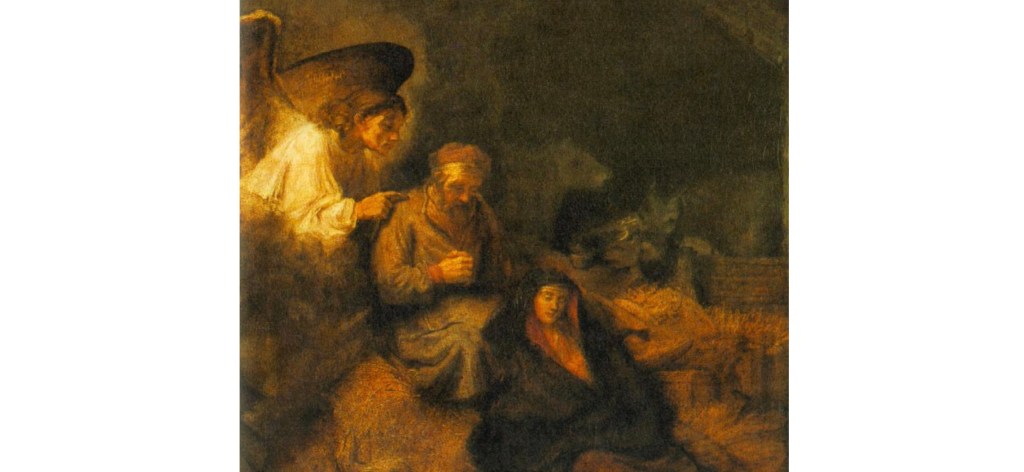
Our Gospel account from Matthew today gives us an opportunity to see holiness in action. Joseph has become aware that Mary, his betrothed, is with child and he is not the Father. Pass the Pepto Bismol please… Joseph, “a righteous man” follows the law, but is “unwilling to expose her to shame, decided to divorce her quietly” (Mt 1:19). Joseph’s life of righteousness pulls him to follow the law, yet he shows that discernment in matters of the dignity of the person is just as important. Joseph not only was unwilling to make Mary into a public spectacle but was also unwilling to allow the possibility of her to be stoned to death.

Joseph pondered the idea of divorcing her quietly. Before he made his final decision, Joseph slept on the matter, which is often a good course of action when weighing heavy issues or dealing with stressful conflict. How many times do we rush into decisions only to regret them later? Joseph receives God’s direction through the angel of the Lord in a dream.

When Joseph awoke in the morning, he did not dig in his heels feeling that he knew best, that he knew better than Gabriel, and return to his original decision. Joseph did not let fear or anxiety about the possible scenarios that were running through his mind regarding what others may say or think sway him, nor did the possible and real difficulties he could envision deter him.

Joseph trusted God. With confidence and assurance of who he was and what God called him to do, Joseph acted on the guidance he had received without hesitation.

St. Joseph is a model for us. When faced with decisions to make, we need to remember who we are, whose we are, and who we are called to be. We are children of God, and that means we belong to God who loves and cares for us. He has a plan and each thought, decision and action we follow through on is a step in diverting from or fulfilling that plan.

There are many elements in good discernment, gathering information, ponder the reasonable options, praying and seeking God’s guidance, slowing down to breathe and think, seeking guidance from a trusted family member or friend, reading, praying, meditating with the Bible, his creation, being open to Godincidents, or a good nap or early to bed. Joseph followed some of the above and had the humility to listen to God’s messenger and he granted him not only the guidance he sought but the support to fulfill the commission he received. God will do the same as we discern his direction too.

St. Joseph, pray for us!

——————————————————————–

Painting: Closeup of Rembrandt’s “Dream of St. Joseph”

Link for the Mass readings for Thursday, March 19, 2026

Making time each day for a breath and a look up, we can reset with Jesus, experience his peace and rest.

Look at me, serve me, I want, are attitudes and dispositions that tempt us. Fame, honor, power, prestige may be another way of making the same point, which is that we often have a hyper-focus on self and self-promotion. Social media offers more of a platform to fuel this temptation. If we think this is something new with the advent of modern technology, we can look at today’s Gospel of Matthew to see that we have been operating from this posture for a very long time.

Jesus, for the third time, was attempting to prepare his disciples for his passion. He said: “Behold, we are going up to Jerusalem, and the Son of Man will be handed over to the chief priests and the scribes, and they will condemn him to death and hand him over to the Gentiles to be mocked and scourged and crucified, and he will be raised on the third day” (Mt 20:18-19).

The response of the mother of James and John (the two brothers make the request themselves in the Gospel of Mark) is actually not that surprising if we spend any time with people. She disregards what Jesus just mentioned about his imminent death and requests that when Jesus assumes his seat of power that her two sons will be number one and number two. The other disciples were quite indignant, and I can imagine what followed was not a pretty sight.

This is a good teachable moment. When we are preoccupied with what we want to say or are thinking about, we do not hear what someone right before us is sharing with us. The mother of James and John appeared not to hear what Jesus had just shared. She is believing that Jesus is the Messiah and that he is going to claim his throne, and wants to be sure that her boys, who have given their life to his cause will be taken cares of. She just missed the point that the throne of Jesus will be the cross. The apostles aren’t any better. They don’t correct her misperception of Jesus’ messiahship, they instead start jockeying for the position that she proposed James and John filled.

Jesus doesn’t condemn the mother’s request, he directs the brothers to the truth of the request and in so doing, brings the point back to where he had started. Jesus heard the mother, James and John, and the other apostles. His response answers the question, returns to the point he is making, and offers them a participation in his passion. To give them a place at his right and left “is for those for whom it has been prepared for by my Father” (Mt 20:23). This statement addresses them all by letting them know that the preeminent place in his kingdom, whoever is to be first, is the one who serves his brother and sister. This message is for all of us.

Jesus encourages us this Lent to take the focus off ourselves and get out of our heads. To let go of I, me, and mine. Even when we let go a little, we will feel more peace. Just a few intentional breaths help so much. We can also experience quieter moments when we get outside, look up, and see the expanse of the sky (Even in the cold of the north!). We’re no longer thinking about ourselves but touching the gift of our eternal nature and call to be one with God. Instead of feeling contraction, we can experience a restful release and sense of expansion.

When we allow ourselves to breathe, we can then let go of stress and the strain and the energy we expend following the distractions, diversions, and temptations that keep us on a treadmill pace. A few breaths can also help us to stop and choose to spend a few moments with Jesus. He will then, as he did today with the apostles, redirect any ways in which our mindset is not aligned with his Father’s will. We can then place God’s priorities for our life first, properly order our own, and/or let go of any that are not of his will.

When we are able to breathe, receive, and abide in God’s love, we experience real rest, discern and make decisions from his guidance, and begin to experience more change and transformation, healing and renewal. We will begin to bear the fruit of the spirit: “love, joy, peace, patience, kindness, generosity, faithfulness, gentleness, self-control” (Galatians 5:22-23). When we let go of the desire to be first or best, to sit at the right or left of Jesus, we will rest in being who we are, God’s beloved daughters and sons. Identifying as such, we will experience more of God’s love, let go of the need to be served, experience more balance, be moved to serve and share the love we have received.

——————————————————————————

Photo: Looking up and outward, and breathing deep, experiencing the love of God. May you also do and experience the same!

Link for the Mass readings for March 4, 2024

A fast from the busy can help us to decompress and reset.

In the Gospel of Matthew, we read today about the account of Jesus comparing himself to a bridegroom: “The days will come when the bridegroom is taken away from them, and then they will fast” (Mt 9:15). In a sense, the bridegroom has been taken from us, in another sense, he is closer to us now than he was when he was with his disciples and walked the earth. The fullness of his reign though will not be consummated until Jesus comes again, but while we wait, when we are willing to set aside other distractions and be still, we can hear and experience of the beating of his Sacred Heart.

We need food for our survival, but we don’t need as much as we think we do! Fasting from food is not the only focus of our Lenten fast. The discipline of fasting provides an opportunity to keep our passions in check. By resisting the impulse of instant gratification, we are able to better discern between apparent goods and the actual Good in our lives. When we are able to navigate through the maze of distractions, diversions, temptations, and allurements on a physical level, we can begin to go deeper into the spiritual reality to begin to expose some of the demons that we feed, such as “distrust, apathy, and resignation”.

Pope Francis mentioned that these three demons “deaden and paralyze the soul of a believing people.” He continued by stating that: “Lent is the ideal time to unmask these and other temptations, to allow our hearts to beat once more in tune with the vibrant heart of Jesus.”

When we are willing to discipline our impulsiveness, to slow down, to take time to recollect even with a few deep breaths, we can begin to see more clearly God’s will for our lives. We can then be more open to God’s invitation to grow in relationship with him and each other. We can better assume the posture of John the Apostle by resting our head on the chest of Jesus (cf John 13:25), such that our hearts will beat in the same rhythm as his Sacred Heart.

This is the gift of contemplation drives us to service. This is the same rhythm that beat in the prophet Isaiah who reminds us in today’s first reading what true fasting is all about:  “releasing those bound unjustly, untying the thongs of the yoke; Setting free the oppressed, breaking every yoke; Sharing your bread with the hungry, sheltering the oppressed and the homeless; Clothing the naked when you see them, and not turning your back on your own” (Isaiah 58:6-7).

————————————————————————

Photo: Stillness, quiet moments, while experiencing the wonder of God’s creation helps us to experience, can help us to slow down and allow our heart to beat with he rhythm of Jesus’ sacred heart.

Link for Pope Francis homily:

Pope Francis offers a “worksheet” for Lent: Check it out!

Link for the Mass readings for Friday, February 20, 2026

Come away and rest awhile with Jesus.

After hearing the accounts and success of the apostle’s missionary trip, Jesus invited them to step away from the crowds “to a deserted place [to] rest awhile” (Mk 6:31). Jesus is showing the apostles the importance of balance. There are times to work and serve as well as times to recharge, to reconnect, spend some quiet and reflective time with him. Jesus is our model, our guide and teacher, but he is at the same time more than that. Jesus is the source and sustenance of who we are as a living craving, hunger, and desire to be one with God and each another. As the deer longs to refresh itself from the waters of a running stream, we long to be nourished by the living water, Jesus, and this is true for the atheist as well as the mystic alike. This is true for each and every one of us, whether we are aware of this reality or not.

Our thirst for communion can be stifled because it is so easy to be caught up in our day to day schedule, life’s demands, and operating from survival mode. Even when all is good and we are serving well, as we see with the apostles return, there is a need for rest.  There is so much that needs to be done, and at the same time, there are so many distractions and diversions that vie for our energy and attention.

In today’s Gospel, the intent of Jesus is to escape with his apostles for some rest and renewal, to decompress with them, and hear about their experiences of ministry. They get in a boat to do just that, yet the crowd that they thought they had left behind arrived on the other side before they did! This is a sign that the preaching, exorcisms, and healing work the apostles participated in was already bearing fruit. Just as people were flocking to Jesus, so word was getting out about his disciples! “When Jesus disembarked and saw the vast crowd, his heart was moved with pity for them, for they were like sheep without a shepherd; and he began to teach them many things” (Mk 6:34).

So much for being able to “rest away for awhile”! Or maybe the boat ride across was that moment of rest. The moment to take a breath and reconnect with Jesus. As Jesus and the apostles were coming closer to shore, they could have diverted their course to avoid them. Instead, Jesus, was moved with pity or compassion and taught them. A key for a more balanced life is to spend time daily with Jesus to know his will and follow his lead.

This is an important discipline and practice that we all need to attend to. As St. Francis de Sales taught: “Every one of us needs half an hour of prayer a day, except when we are busy — then we need an hour.” When I first began as a priest here at Holy Cross, I was having trouble fitting in my daily holy hour before the blessed sacrament. The light bulb went on when my spiritual director said to me, “You know what you are doing?”

I asked, “What?”

He said, “You are negotiating with a non-negotiable.”

He then said maybe you can do a half hour a day. Before he even finished the thought, I felt Jesus tell me that I needed to be faithful to that time alone with him each day. Without his grace and guidance and renewing in him, I would not be able to do what he requires me to do as his priest. I have been blessed by making time each evening to go away to the church and rest awhile with him.

When we intentionally put God first and make the time each day to spend with him, often there is a serendipitous alignment that we experience in our day, that we did not think possible at the outset. This often happens when we consciously make time for stillness, for meditation and prayer, even and especially, during the moment when we may feel we just don’t have the time.

As you ease into Saturday, my invitation is to give yourself a fifteen minute retreat. Read these words from Jesus slowly and reflectively: “Come away by yourselves to a deserted place and rest awhile” (Mark 6:31). Find a quiet place where you feel comfortable, take a few deep, slow breaths, close your eyes, then step into and sit in the boat with Jesus and his disciples.

Breathe some more, feel the breeze of the Sea of Galilee, feel the warmth of the sun on your face, and experience the rhythm of the boat on the water. Does Jesus remain silent and rest with you? Does he begin to teach, and if so, what does he share? Do any questions arise and if so what do you ask, and what is his answer? Allow yourself to be still, just you and Jesus for the time you have set aside. When the boat comes to shore, go forth into the day renewed and blessed by Jesus with a heart and mind able to be moved with compassion to follow God’s will in how best to serve him through those he brings you today and into the coming week.

—————————————————————-

Photo: Heading in to spend some quiet time away with Jesus.

Link for the Mass readings for Saturday, February 7, 2025

“I will give you rest.”

Verses that we read, such as: “Come to me, all you who labor and are burdened, and I will give you rest” (Mt 11:28) really hit the spot, they arrive at the right time. I am sure that if you are reading these words you may also welcome Jesus’ invitation. Yet what is the labor and burden that we need to rest from? Teachers, administrators and students, of which I was a part for decades are coming into crunch time now as the end of the quarter or term is so much closer. Those in other occupations also work long hours, and sometimes, two or three jobs, just to get by.

Many also who oversee and care for their home, others with children, elder parents, family members, and dealing with family issues that can be enormous, especially at this time of year. Add to the above Christmas preparations: decorating, putting up lights, shopping, buying presents, cooking, baking, writing and mailing Christmas cards can also add to feeling weighed down.

Unfortunately, there are way too many who are not so much burdened by work but the lack of access to gainful or meaningful employment. They are burdened with keeping the bills paid and a roof over their heads as the temperatures fall. Some have no home or family, they are burdened with getting from day to day, seeking ways to get food, clean clothes, a place to wash and relieve themselves. Christmas cards are a distant thought. Many others are burdened and living in fear that they or their family member or members may be deported.

Speaking of fear, how many of us are burdened by fear, anxiety, stress, and strain from a myriad of swirling reasons? Concerns about our family, community, country, and the world are a burden that can also weigh heavily. Advent and Christmas, even when life is more stable, are still times in which many buttons can be pressed and many stressors can be triggered. What is the adage that is offered when family and friends gather? Resist talking about politics, religion, and… we all can add a few others.

If you are feeling weary and worn as we draw close to the midway point of this Advent Season, it is a good opportunity to make some time to just stop and take a slow, deliberate breath. Notice your shoulders coming out of your ears. Embrace the invitation of Jesus and rest in him. Allow the burdens to come to mind, then visualize yourself giving them to Jesus, open yourself to his guidance, ask for his help for the day to day challenges, and seek who may be best able to assist you in any particular situation. Slowing down may help us to become more aware of any sins that we feel burdened by. This is a good time to rest and trust in the forgiveness of Jesus and confess to him in the Sacrament of Reconciliation. Jesus will forgive you and bring you a lightness and fresh start!

Our God “does not faint or grow weary, and his knowledge is beyond scrutiny. He gives strength to the fainting; for the weak he makes vigor abound” (Isaiah 40:28-29). We do not have to deal with anything alone. We have help and support. My friend, Pastor Jerry Scott, taught me years ago a life lesson which I still return to, more often now as I begin my sixth decade. When a person is chopping down a tree, exerting a lot of energy and effort, but finding the results insufficient, he or she needs to realize that they need to step back, take a breath, and sharpen their ax. With a little rest, renewal, and a sharpened blade, the job can be accomplished sooner.

Let’s figuratively do the same daily with each of our endeavors. Let’s resist just putting our heads down and plowing through with blinders on and instead take some time to stop and assess from time to time what we need, where we need help, and yoke ourselves to Jesus for his guidance and strength. Sometimes, making time to breathe and plan, we can use our time more efficiently.

When we choose to intentionally breathe more, we can react less. We can bring our challenges to Jesus and he will help us to carry the burden, as we follow his will, we can work smarter instead of harder. In developing a pattern and place of trust and hope in him, seeking his guidance and direction this Advent, we will renew our strength and soar as with eagle’s wings; we will run and not grow weary, we walk and not grow faint (cf. Isaiah 40:31)!


Photo: Spending time outside, taking some breaths, and trusting in God, can do wonders.

Link for the Mass readings for Wednesday, December 10, 2025