
The love of Jesus can help us in our times of conflict.

The question raised by “the chief priests and the elders of the people” regarding what authority Jesus was teaching was not an uncommon question. Rabbis and teachers often began their presentations by sharing with their listeners who was their teacher. It would be comparable today to say what university we received our degree from.

There is also a bit of edginess in their question as well because Jesus has not only consistently been challenging their authority but he had also just purged the temple by driving out the sellers and money changers (see Mt. 21:12-17).

Although Jesus’ authority came directly from God, Jesus did not fall for their trap, wanting him to say just that. Then they could accuse him of blasphemy or force him to say his authority did not come from God and show him to be a fraud. Jesus did not give them the satisfaction. Instead of answering their question, Jesus asked one of his own. “Where was John’s baptism from? Was it of heavenly or of human origin” (Mt: 21:24)?

The answer given by these priests and elders showed further their unwillingness to accept who Jesus was. They were the shepherds of the people of Israel, yet they would not speak the truth. They were like reeds swaying in the wind (see Mt. 11:7). Unlike John the Baptist who stood on the truth and spoke truth to power, these chief priests and elders offered an answer that was calculated and weighed out by taking a quick opinion poll among themselves. Their answer was a lukewarm, “We do not know.” 

In answering this way, their authority as leaders was diminished. For if they were the religious guardians and guides, why could they not answer the simple question regarding the origin of John’s baptism? Jesus was not deflecting the question. He was prefacing his response. For if they recognized that John’s baptism originated from God, then why would they refuse to believe Jesus? They knew the answer, they were not willing to give it.

How about us? Are we like reeds swaying in the wind? Do we weigh our answers solely on a perceived response or do we speak the truth as the Holy Spirit leads us? We want to be liked, respected, to belong and to fit in, to be affirmed and accepted, which is healthy and natural, but at what cost? Sometimes we feel uncomfortable speaking what we believe because we fear another’s reactions. This is even more challenging these days because a simple response can affect a harsh reaction.

To live out our baptismal call as prophets, there will be times that we need to resist the perceived and real pressures we feel, resist our own insecurities, lean into conflicts, trust in God, seek his guidance, and speak the words the Holy Spirit gives.

As we do so, we need to remember to speak from a place of understanding and love. It is better to engage in a dialogue, not just mutually imposed monologues. A good reminder is to follow the lead of Jesus and ask more questions rather than offer ultimatums and pronouncements. Our goal in any encounter is not to impress or prove we are right and the other wrong, but to express what we believe and allow others to do the same. We can grow from one another when we are willing to listen and dialogue even when we disagree.

Sometimes God invites us to be silent and sometimes to speak boldly with passion. The key is to prayerfully pause, then choose to speak or to be silent. It is possible to move away from the extremes of talking past or shouting over one another and avoiding talking altogether. This happens when we listen first, breathe, pray, pause, and respect each other.

Jesus, please forgive us for giving into automatic reactions, not speaking as you have led, and disrespecting others. Help us in each encounter to breathe, to have ears to hear your guidance, to be understanding and respectful. Give us the courage and words to speak with charity and help us to know when to be silent and to listen. Above all, help us to love.

———————————-

Photo: Quiet times alone with God help us to experience peace that we can carry with us in times of conflict and disagreement.

Link for the Mass readings for Monday, December 15, 2025

We love well when we are willing to dialogue well.

“This is my commandment: love one another as I love you” (Jn 15:12).

God created us from the abundance and outpouring of his trinitarian love to be loved, and to love him in return. The love that Jesus is talking about is unconditional and not just relegated to those closest to us, although, hopefully, in our families and friendships is where we first experienced being loved and learned to love in return.

The love that Jesus commands that we are to participate in as his followers, is a going out from, a giving of ourselves to, and a willingness to sacrifice for one another. We are not to seek in return, but are to empty and give ourselves away. The return we get is from experiencing the infinite wellspring and source of the Holy Spirit that rises up within us. The more we hold back, the less we receive, the more we give, the more we experience. We are to resist withdrawing our love and assuming a selfish posture that leads to us becoming more like a stagnant pool. Instead, we are to remain open so as to allow the living stream of God’s infinite love to flow through us.

The love Jesus commands cannot be done on the fly. Love is accepting the interruption and choosing to be present. Love means stopping, setting aside our agendas, and accompanying another. Love is also not coercion and manipulation, it is accepting another as they are and where they are. Love is sharing the journey of life together. St Thomas Aquinas has written it best: Love is to will the good of the other as other. This is more than mere emotion, feeling, or sentiment but actually wanting the best for someone else and rejoicing in their becoming fully alive. Nor does this mean that we become doormats or enablers of dysfunctional or abusive behavior. We hold people accountable – for to love is also to be clear about respecting our’s and another’s dignity.

This practice of love is also not exclusive but universal. Yes, we are to love those in our family, community, place of worship, tribe, political party, and nation, while at the same time we must be willing to go out from our comfort zones and protected bubbles to risk opening ourselves up to those who we feel are different, those who do not see the world as we see it, and even those we consider our enemies. This does not mean we have to agree or even like someone else. Jesus commands us to love, to respect the dignity of the person as our starting point. This is the love he offers us and calls us to do the same.

A dialogue grounded in love is a wonderful way to grow in relationship. Speaking and listening with a heart and mind open to the love of God is also a good way to participate in the divine communion of love that is shared between the Father, and the Son, and the Holy Spirit. Authentic communication happens when we state clearly our beliefs, our thoughts, and dreams, and also allow others to do the same. Even though we may differ in our points of view, we can still grow together in love for one another.

When we talk at and over one another, demean, belittle, and/or are condescending, we dehumanize each other. Pope Leo has invited us to be “a Church that builds bridges and encourages dialogue, a Church ever open to welcoming”.  We welcome and build such bridges of such dialogue when we are willing to resist staying at a distance and are more willing to come close, to love, and respect one another. From that starting point we are better able to encounter the person and free ourselves from prejudicial caricatures and labels that hopefully will dissolve through our interaction and respectfully engaging with one another.

Instead of keeping each other at arm’s length, when we are willing to love as Jesus loves us, we will better be able to listen with patience and understanding. We will learn to embrace and grow from one another. From a place of mutual, loving dialogue, we can recognize and remember again who we are, beloved daughters and sons of God our Father, friends, brothers and sisters together on this journey we call life.

—————————————————————-

Photo: Making some time to be in quiet conversation with Jesus, to receive his love and love him in return. Giving ourselves time to experience loving dialogue with Jesus helps us to better enter into loving dialogue with each other.

Pope Leo XIV quote from his May 8 Ubi et Orbi message

Link for the Mass readings for Thursday, May 22, 2025

Let us seek to inform and not convince.

Jesus affirms who he is and whose he is in today’s Gospel of John. Despite those who do not believe that he is the Messiah, Jesus again makes his point very clear: “I did not come on my own, but the one who sent me, whom you do not know, is true. I know him, because I am from him, and he sent me” (Jn 7:28-29). Jesus is the Son of God made man and he belongs to the One who sent him, God the Father.

As Jesus was challenged in his time, he continues to be challenged today. That level of challenge has increased even to the degree that his human existence is even dismissed in some circles as a mere legend. Even as a historical figure, some speculate that Jesus did not walk the roads of Galilee and Judea as recorded in today’s Gospel. This need not be a reason for alarm. Though it is a reason to know our Tradition, the deposit of faith that has been preserved and passed on from Jesus to his Apostles and disciples, and to those early Church Fathers and Mothers named and unnamed, and passed on up to us to this day in an unbroken apostolic succession. We need to know the Bible, how to read and receive the sacred word, to understand its context, and schedule a daily time to encounter the Word proclaimed in worship as well as privately in reading, study, meditation, prayer, and contemplation.

It is important to know what we believe, who we believe in, and whose we belong to. In this way when we are challenged, we do not need to stoop into a defensive crouch, but instead listen to the person’s points, their critiques, and ask questions of what they believe and why they believe what they believe. We can defend our position while at the same time being open to understanding where our questioners are coming from. We can then respond with the truth, just as Jesus did, with an open mind and heart of surrender to allow the Holy Spirit to be present through us.

When we are anxious, defensive, argumentative, seeking to be right, or fearing to be wrong, we limit what Jesus can do through us. God is not about numbers and quotas, he is about building relationships, one person at a time. It is more important to build relationships than to win arguments. We can learn much from St. Bernadette of Soubirous who when challenged time and again regarding the validity of her experiences and encounters with Mary responded, “My job is to inform, not convince.”

Lent is a good time to learn, grow, and to continue to develop our relationship with Jesus, as we continue our journey of faith, to share what we have received in a spirit of charity and dialogue with those we interact. We are all on this journey of seeking the True, the Good, and the Beautiful together. It is important to respect and love those who have differing perspectives outside of and even within the Church, be open to the reality that we can learn from each other, and allow God to guide each of us through our common challenges and step by faithful step grow closer to God and one another.

————————————————————————–

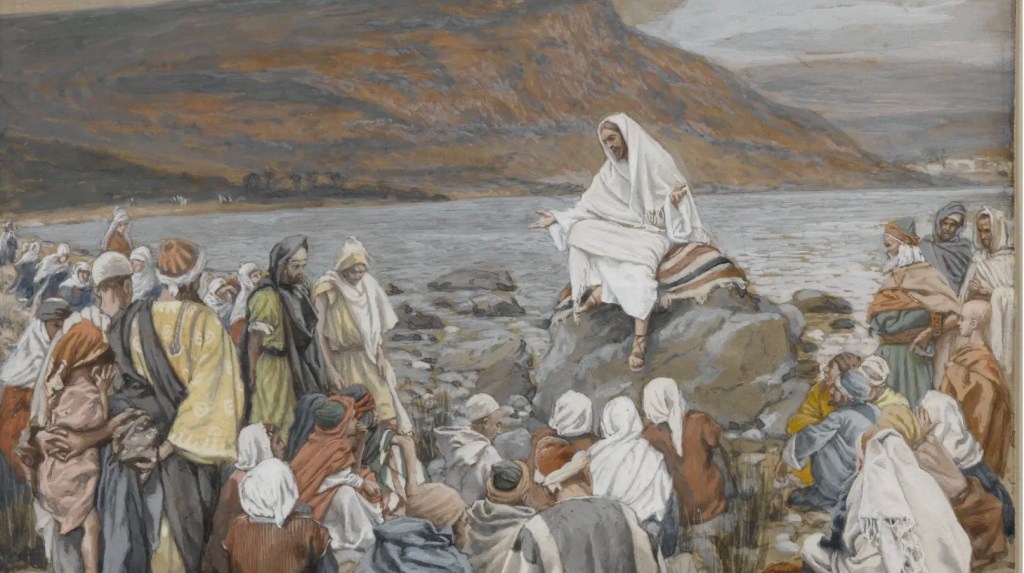
Photo: James Tissot Nantes – “Jesus Teaches the People by the Sea.” The Father sent Jesus to heal, teach, and do what he was sent him to do and Jesus did. As we come to know Jesus, his Father, and the love of the Holy Spirit, we are to do the same.

Link for the Mass readings for Friday, April 4, 2025