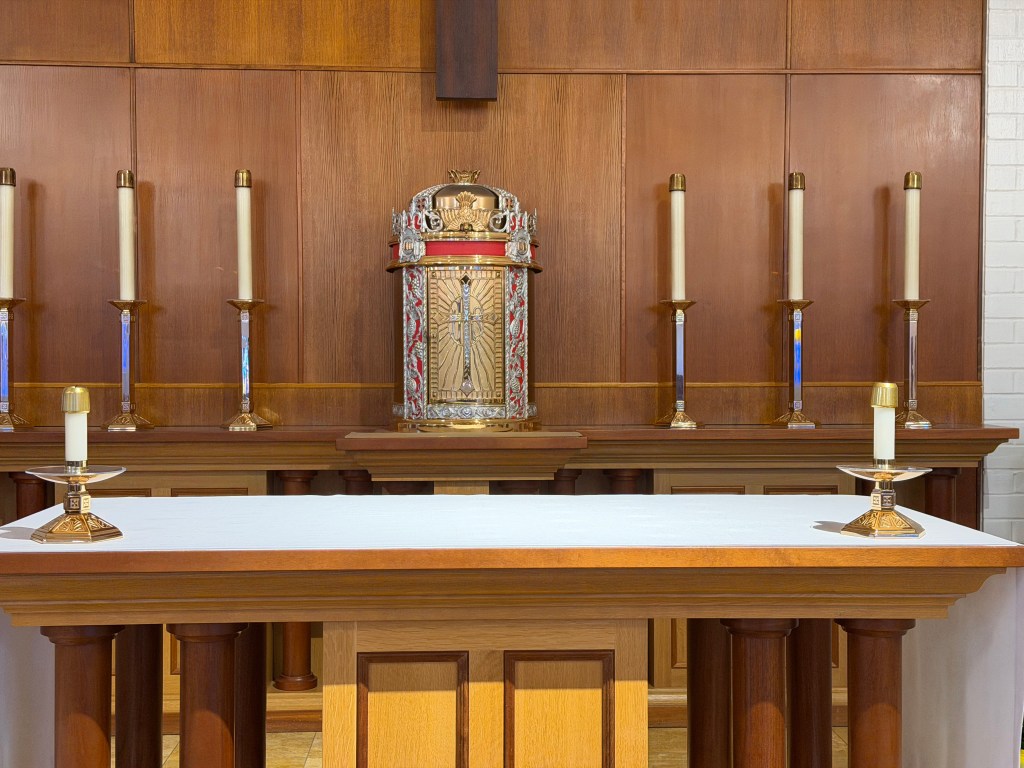
Do we have the faith to be still?

“Why are you terrified? Do you not yet have faith” (Mark 4:40)?

Jesus asked this question of his apostles after he quieted the wind and the waves. These were seasoned fisherman, so for them this must have been quite the storm. They even thought that they were not going to survive it as the waves not only tossed their boat but it also began to take on more and more water. Then looking at Jesus, they turned to thinking that he was indifferent to their need, he didn’t care that they were perishing. Jesus cared. He slept because he trusted in his Father to take care of them.

The faith of Jesus in his Father was rock solid. The visceral threat of death did not shake his faith as it did his closest followers. This is the first time that they appeal to him as teacher. They are growing in their understanding of him, but they are not yet at the point of comprehending that he is the Son of God, who could even command the seas and to obeyed.

Jesus called his apostles and brought them into his inner circle so they could not only experience his teaching, healings, and exorcisms but also to get to know him as the Son of God. As with any relationships, this takes time, and their faith, their trust in him in all circumstances was still growing. But as we read yesterday, faith as small as a mustard seed, will bring large results. This would come to pass with the apostles as well in time.

We too may find ourselves in times of trouble. Our anxieties, fears, and insecurities are a good barometer of our faith in Jesus. Our emotions are human and good as they alert us to a real or perceived threats. The challenge is to discern the real from the perceived and to determine when the threat has passed and resist the temptation to play an unending loop in our minds that keep us stressed.

Where our emotions can present a problem is when we believe in, place our faith in, identify ourselves by them, react from and stay in the endless loop. We need to resist suppressing or feeding our emotions but instead, stop, breath, stretch and identify them. From a place of feeling safer, we can then address the immediate trigger. Trusting in Jesus in the face of our trials is also good step.

The apostles judged that he didn’t care instead of wonder how he could be sleeping through all this? Would he have brought them out into the deep to let them perish? Jesus quieted the their storm and he will help us to calm the real as well as the perceived storms in our lives. He can guide and empower us to sit with our emotions, get to the source of them, identify the deeper root causes, as well as if they are perceived or real, and then work through the them and the situation.

The apostles, did the right thing. They tried everything they could do to correct their dire circumstances, they judged incorrectly that Jesus didn’t care, but they still turned to him for help. We will be better off when we too continue to turn to Jesus in every situation. Our faith and trust in him will grow. We will heal, mature, and grow through the storms in our lives.

Easier said than done? Yes, for both our real and imagined storms. As we place our trust in Jesus, persevere, claim our authority in his name to renounce any attacks of the enemy, all things are possible!


Photo: As the clouds gather, the light still shines through. Taken on the way to celebrate a funeral Mass this morning. We need not fear death, for even it does not have the final say, Jesus does.

Link for the Mass readings for Saturday, January 31, 2026

Let us repent, rise from the darkness and walk into the light of Jesus.

“The people who sit in darkness have see a great light” (Matthew 4:16).

Matthew is quoting the prophet Isaiah and the darkness he is referring to was the fall of Zebulun and Naphtali, the first two of the ten tribes of Israel that were conquered by the Assyrians in around 722 BC. The other eight tribes of Israel would also fall. The two tribes of Judah remained for a time, but then in 587 BC, Jerusalem, the capital city, along with the Temple, were also destroyed. The last two of the original twelve tribes of Israel were also conquered. The promise of an everlasting kingdom from David’s line appeared to be lost.

Not so. A great light would come, the Messiah, one greater than Moses would be sent by God to unite again the twelve tribes of Israel. The Kingdom of David would be re-established, this time – forever. A glimmer of hope arose in 538 BC when Cyrus the Great conquered Babylon and freed Judah and sent them back to rebuild Jerusalem and the Temple. Cyrus was a liberator, but not the promised Messiah.

What Matthew did not share in this part of his Gospel was the next promise that Isaiah made: “For a child is born to us, a son is given to us; upon his shoulder dominion rests. They name him Wonder-Counselor, God-Hero, Father-Forever, Prince of Peace” (Isaiah 9:5).

As Christians we believe this child promised to become the Prince of Peace, is Jesus the Christ, the Son of the living God. In the gospel today, Matthew records the beginning of his public ministry which began with the arrest of John the Baptist. Jesus has come from the northern region, Galilee to be baptized by John. Now with his arrest, the political climate in Jerusalem seems a bit too hot. Jesus “withdrew to Galilee… in the region of Zebulun and Naphtali” (Mt. 4:12-15).

Wait a minute – Zebulun and Naphtali? Yep. Jesus is going back to the beginning where the fall of the ten tribes of Israel first began. Makes sense since he came to restore and re-establish and re-unify the twelve tribes of Israel. He did not only come to restore but to establish the new Israel. That is what we see in the next verses in which Jesus calls Simon, Andrew, James and John, the first of the, wait for it – twelve apostles.

Just as the twelve tribes of Israel began with the twelve sons of Jacob/Israel, the new Jerusalem will begin with the twelve apostles. By our baptism, we are heirs and members of the new Israel, the Body of Christ. Yet, we don’t have to look far to see the seeds of disunity and division still festers like a plague. Just as David unified the twelve tribes, for them only to be divided after one generation, we too suffer division and polarization in our nation, church, families, and friends.

Paul experience this in one the church’s he founded in Corinth. In our second reading, he appeals to them: “I urge you, brothers and sisters, in the name of our Lord Jesus Christ, that all of you agree in what you say, and that there be no divisions among you, but that you be united in the same mind and in the same purpose” (I Corinthians 1:10). We are to be united in the love of Christ. Jesus is the light that shines in our darkness of division.

We can easily fall into despair with the disunity and polarization, we can feel like people sitting in darkness and overshadowed by death on every side. Yet, we are not overcome. Jesus is the fulfillment of Isaiah’s prophecy. And his antidote to the darkness? “Repent, for the kingdom of heaven is at hand” (Mt 4:17).

Jesus’ message is as simple as it is clear. Jesus is the kingdom of heaven that is at hand and he is continuing to establish the new Israel that will be fulfilled in the heavenly kingdom. He is present among us revealing with his gentle light another way, one of harmony and peace. When we allow ourselves to breathe, receive, rest, and abide in the love of Jesus, when we become less so Jesus can become more, we experience his love, consolation, and joy. If we are not, there may be something we need to repent from, reject, something to heal from, and/or something to let go of.

The light of Jesus will guide us through our darkness and when we follow, will lead to our healing, forgiveness, and freedom. We can retreat further into the shadows and feed anxiety, doubt, or fear. We can also choose to repent, leave the darkness, and come into the light. Each thought, word, and action contributes to fostering the present darkness or to the light that will overcome it. Hopefully, with each choice, we trust more in Jesus.

——————————————-

Photo: When we are willing to see, Jesus shines in our darkness.

Link for the Mass readings for Sunday, January 25, 2026


As Jesus called and sent the Apostles, he calls and will send us.

“Jesus summoned the Twelve and gave them power and authority” (Lk 9:1).

Just as Jesus summoned the Twelve, he does so with us and empowers us for mission in his name. The mission of the Church in each generation is to continue to ministry of Jesus and the Apostles. The expression of our service is unique to each of us. We might resist exploring or entering into a deeper commitment of our faith though because we might feel anxious or afraid that God may call us to do something that we would never want to do, or that we couldn’t conceive of being capable of. There also may be some trepidation even when we are clear of the direction God wants us to move in which may arise from our hesitancy to change and move out from our comfort zone. Ultimately, God wants for us what we want for ourselves deep down. We may not even know what that is, but God does.

God knows what will give us and with whom we will experience meaning, fulfillment, and joy in our lives. The challenge for us is to come to know this for ourselves as well. The work of discipleship begins by accepting the invitation of God to walk with him and trust that he knows what he is doing and where he is leading! No matter our age, we are never too young or too old to begin or recommit to the journey along the path of discipleship. One good practice is to reflect on our dreams and desires, bring them to God in prayer, and imagine ourselves embracing what we desire.

When I first joined the Franciscans to study for the priesthood in the early ’90s, I imagined from time to time my ordination day, especially in our second year as we were thinking about taking temporary vows. When I did so, a puzzling result consistently arose. I did not experience any excitement or joy. So, a year and a half into formation, I decided to take a leave of absence. I had asked to take off a year, but the minimum time for a leave of absence was two.

Though I balked at first about the two-year time frame required, I came to see the wisdom of my formation director. I would have come back after a year. About a year and a half after I left, I then realized that my vocational path was leading me to the Sacrament of Matrimony and not Holy Orders. Eighteen months after I came to that realization, I met JoAnn. As our relationship grew and we began to talk about marriage, whenever I envisioned our wedding day, I felt excitement and joy. Each year that we had together built on the one before. We grew closer to God and each other right up until the day of her death.

God led me to the Franciscans in my mid-twenties, he then led me out, and then to JoAnn. Almost three years after JoAnn’s death, he led me to seminary to be formed as a diocesan priest. Periodically when I imagined my ordination day, even though the schedule was more intense this time around, unlike during my novitiate year with the Franciscans, this time I felt excited. A year and almost two months after being ordained a priest, it is still more amazing than I could have ever imagined!

God loves us more than we can ever imagine, he has a plan for each and every one of us, and he knows what will fulfill us. When we ponder our dreams and desires, and as we investigate, research, explore potential opportunities and continue to pray and discern each step, we will come to see that as we align ourselves with God’s will that makes all the difference. We are not alone in this process, and we have a God who can see the full picture, where we see only a small part.

There will be fits and starts, missteps and slips, doubts as well as confirmations, and desolations as well as consolations. The key through it all, is to remain faithful, to continue to trust in Jesus who called us. He will continue to accompany us along the way. As he did with the Apostles, he will give us the resources and strength we need, and he will send the Holy Spirit to empower and transform our lives.

The process of discerning God’s will for our lives is not just for ourselves alone. Jesus is preparing us for mission. Making time to be silent, to meditate and pray with God, coming to know better his will and to put into practice his teachings, we will be transformed daily by the gift of God’s love. Continuing to breathe, receive, rest, and abide in his love, we will better know how best to serve God in others!


Photo: We too are called like St. Peter and St. Paul.

For Mass readings see bible.usccb.org and click on the link for Wednesday’s readings.

The beatitudes lead us away from the false promises of this world to experience real joy!

Blessed are you when people hate you, and when they exclude and insult you, and denounce your name as evil on account of the Son of Man” (Lk 6:22).

The Beatitudes are contrary to much of what too many of us are tempted by when seek our satisfaction, security, and fulfillment. Much of us are lured in some form or fashion, by power, fame, wealth, pleasure, and celebrity. What is more, how many of us who proclaim to be people of faith resist Jesus’ teachings because of self-centered reasons? We hold on to things that keep us from God, that really do not make us happy.

In today’s Gospel account from Luke, Jesus began to teach his disciples on a deeper level. He had just chosen the twelve by name and that number would not have slipped by them. Their thoughts were more than likely moving closer to the realization that Jesus was the Messiah, the promised heir of David. Would he be gathering them together to restore the twelve tribes of Israel and overthrow the occupying power of Rome? Yes, but not in the way they were thinking.

Jesus’ presentation was not about taking up military or physical armaments, but spiritual ones of attaining the  kingdom through four blessings and dashing the common hope with four woes. Jesus’ message is a universal message, an invitation to and for all who have ears to hear as well as hearts and minds open to receive. Jesus spoke not only to his twelve newly hand picked followers as wells as those from “Judea and Jerusalem” but also those from the “coastal region of Tyre and Sidon” (Luke 6:17). That Jesus did not dismiss but was teaching those from Tyre and Sidon would not have been missed either. They were from Gentile territory.

Jesus’ teachings challenged all present and they challenge us today to evaluate where we are placing our trust and security. If we are placing our trust in the things of this world, the four woes section is for us, for that which is finite and material are fleeting and passing. By placing our trust in Jesus, his Father and the love shared between them, the Holy Spirit, the beatitudes will lead us to experience joy.

Being poor, hungry, in mourning, hated, excluded, insulted and denounced as evil will bring us happiness? Yes. Because each of them counter the typical substitutes that we can be tempted by and place before our relationship with God. Each of the beatitudes that Jesus offers are invitations to experience true joy. We just need to be willing to relinquish putting self first and seeking pursuits apart from God’s will.

When we rely more on God and less on material things, even relationships, when we depend more on God alone, our relationships and our pursuits will be more properly ordered. With God first, we will experience order and peace and… what is so fleeting to so many who seek both in the things of the world, we will experience real rest. If we are serious about being Jesus’ disciple, then a good place to start is learning and living the beatitudes. This is no easy task but when we look at each one and begin to detach from the attachments they allude to, “we will rejoice and leap for joy” (Lk 6:23)!

Joy because we will then have the inner freedom to experience the good things that God gives and less ensnared by them. We will be fueled not by the advancement or aggrandizement of self, but by emptying our ego, we will have room to receive the love of Jesus, the source of our joy, which wells up from within and never runs dry! Jesus is the kingdom of Heaven that is at hand and he will lead us, if we are willing to follow, to the ultimate desire and deepest craving and hunger of our being, to be in communion with God and one another.

———————————–

Photo: EnJOYing another beautiful sunset painted on God’s canvas of creation Sunday evening. May you experience a taste of the joy God is seeking to bring you today!

Link for the Mass readings for Wednesday, September 10, 2025

“Come and you will see.”

After hearing John the Baptist point out Jesus as the Lamb of God, Andrew and another disciple of John seem to understand the meaning of what John means. The two follow Jesus as he walks by them. Jesus senses they are behind him. He stops, faces them, and asks, “What are you looking for?”

Their response to the question, “Rabbi” (which translated means Teacher) “where are you staying?” (Jn 1:38), is odd. Unless we understand that, in fact, the two disciples of John did not grasp the full relevance of John calling Jesus the Lamb of God after all. They related to Jesus, from the context of what they knew, their default position. They were approaching his as a rabbi, a teacher. Most rabbis of the time would have a place where they would gather their disciples and teach them. Another thought is that they did not want to come right out and say, “Jesus, are you the Messiah?”, there was some doubt, so they went with addressing him as rabbi.

Jesus said: “Come and you will see” (Jn 1:39). Andrew and the disciple then spent the day with Jesus and that made all the difference. If Andrew had any doubt before, it was now gone. We do not know what he experienced with Jesus in their time together, but the first thing that Andrew does is go and tell Simon, his brother, that he had found the Messiah, the Anointed, the Christ! There was no hesitation. He wanted to share what he had seen and experienced. Most likely as we hear time and again in the Gospels, Andrew witnessed some or all of these examples: the blind saw, the deaf heard, the lame walked, the possessed were exorcised, sins were forgiven, and Jesus taught with authority.

May we place ourselves in this scene of the Gospel today and follow the finger of John the Baptist who points over to this man walking ahead of us at a pretty good clip. As we turn to follow, the brightness of the morning sun catches our eyes. We squint, look down, and lose him for a moment, but take a few steps to keep pace. We hear the crunch of the stone and sand under our sandals and as we look up again to see how far ahead of us Jesus is, and then we notice he is standing still only a few feet away. He is smiling, his eyes are inviting as is his question: “What are you looking for” (Jn 1:38).

Stay with the scene. How do you answer, and what happens next? Allow your imagination and senses to come alive. Place your self in this moment with Jesus. Be aware of any emotions or thoughts that arise. This is not just a mind game. Jesus experienced this scene himself in full and living color. He was there, and when we meditate on Scripture, we pray with the words we read, and ask the Holy Spirit to guide us, we can enter into the memory of Jesus. If we are willing to come and see, as Andrew and the other disciple were, Jesus will lead us as well. Allow yourself some time with Jesus today as Andrew did and let God happen.

————————————————————————————-

Photo: Let us be willing to follow Jesus, the way, the truth, and the life. Photo accessed online from housemixblog.com

Link for the Mass readings for Saturday, January 4, 2024