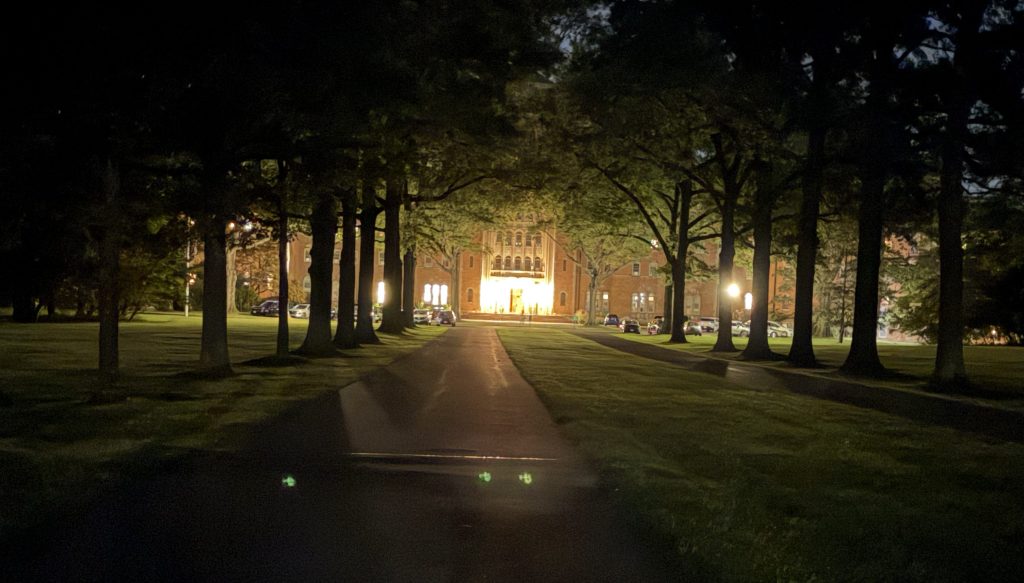
May we trust in the guidance of the Holy Spirit when he is inviting us to embrace change.

“To what shall I compare the people of this generation? What are they like? They are like children who sit In the marketplace and call to one another, ‘We played the flute for you, but you did not dance. We sang a dirge, but you did not weep'” (Lk 7:31-32).

Jesus convicted those who held a narrow view of who was a true follower of God by sharing the image of a flute being played and no one was dancing, thus in times of joy, there was no celebration. When the funeral dirge was sung, they did not weep, they did not mourn. Jesus then tied the analogy to his present condition regarding those who did not accept the ascetical practices of fasting and the call to repentance from John the Baptist, nor did they accept the inclusive and festive table fellowship of Jesus.

In our own time, we have encountered those that are not pleased beyond their own narrow focus and who suffer from a hypersensitive, tunnel vision. Anything that hints at even a slight variation of change sends tremors of discontent. If we are honest, we all have some resistance to change, but if we are to authentically live the Gospel, St. John Henry Cardinal Newman’s quote is an apt barometer: “To live is to change and to be perfect is to have changed often.”

My wife, JoAnn, embraced change much more easily than I. She consistently helped me, even when I didn’t feel it was helpful in the moment, to resist getting too comfortable. She did so again in “changing her address” seven years ago already to a heavenly zip code. Working through the reality of her death, the adventure of two years of seminary, and adjusting to the blessings of completing now two years as a priest, have continued to present opportunities to embrace change.

It would have been easier to seek an early retirement and live a quieter life, which was what I thought was the prudent move at the time, but God had another plan. When most my age are thinking of or beginning an early retirement, I instead trusted in the Father’s guidance and embraced the invitation to change again and embark on a new adventure. Though not easy, I am very happy that I did.

I have enjoyed very much my time serving at Holy Cross. I have been blessed by a wonderful community. I have learned a lot and continue to adjust. And before I could get too settled, Bishop Manuel has invited me to be the director of vocations, seminarians and our new discernment house, while remaining here as parochial vicar. Change continues!

The Church, at her best, is a balance between the rock, solid foundation of our core beliefs, such as is outlined in the Nicene Creed, which provides stability, assuredness, and identity. While at the same time, she is open to the life-giving inspiration of each nudge from the Holy Spirit. When we in each generation follow the lead of the Holy Spirit the Gospel will continue to be relevant.

As we remain grounded in what we believe, it is important that, at the same time, we allow ourselves to be flexible and allow the Holy Spirit to lead us. In this way, we can avoid molding the Church into our image, and instead be conformed and transformed into the image and likeness of Jesus, who is the embodiment of Love, the Trinitarian communion of which we profess in the Creed.

We can live a life of joy when we resist the temptation to hold on too tightly. Nothing and no one in this world lasts because all is finite. When it is time to mourn, let us weep, and if we do so well, when it is time to embrace life we can do so with the fullness of joy and we can dance and live again. What lasts, even eternally, as St. Paul wrote, is love. God is love and God created us out of an abundance of his love. When we are willing to surrender our wills to the Father, our hearts and minds to the Son, and allow our souls to be led by the Holy Spirit, we will better embrace change and live a life of inner freedom and joy!


Photo: Rosary walk at the Seminary of the Immaculate Conception. Here for a week for the NCDVD, National Conference for Diocesan Vocation Directors. Learning a lot! Recommitting to the priority of prayer.

Link for the Mass readings for Wednesday, September 16, 2026

Do we have the faith to be still?

“Why are you terrified? Do you not yet have faith” (Mark 4:40)?

Jesus asked this question of his apostles after he quieted the wind and the waves. These were seasoned fisherman, so for them this must have been quite the storm. They even thought that they were not going to survive it as the waves not only tossed their boat but it also began to take on more and more water. Then looking at Jesus, they turned to thinking that he was indifferent to their need, he didn’t care that they were perishing. Jesus cared. He slept because he trusted in his Father to take care of them.

The faith of Jesus in his Father was rock solid. The visceral threat of death did not shake his faith as it did his closest followers. This is the first time that they appeal to him as teacher. They are growing in their understanding of him, but they are not yet at the point of comprehending that he is the Son of God, who could even command the seas and to obeyed.

Jesus called his apostles and brought them into his inner circle so they could not only experience his teaching, healings, and exorcisms but also to get to know him as the Son of God. As with any relationships, this takes time, and their faith, their trust in him in all circumstances was still growing. But as we read yesterday, faith as small as a mustard seed, will bring large results. This would come to pass with the apostles as well in time.

We too may find ourselves in times of trouble. Our anxieties, fears, and insecurities are a good barometer of our faith in Jesus. Our emotions are human and good as they alert us to a real or perceived threats. The challenge is to discern the real from the perceived and to determine when the threat has passed and resist the temptation to play an unending loop in our minds that keep us stressed.

Where our emotions can present a problem is when we believe in, place our faith in, identify ourselves by them, react from and stay in the endless loop. We need to resist suppressing or feeding our emotions but instead, stop, breath, stretch and identify them. From a place of feeling safer, we can then address the immediate trigger. Trusting in Jesus in the face of our trials is also good step.

The apostles judged that he didn’t care instead of wonder how he could be sleeping through all this? Would he have brought them out into the deep to let them perish? Jesus quieted the their storm and he will help us to calm the real as well as the perceived storms in our lives. He can guide and empower us to sit with our emotions, get to the source of them, identify the deeper root causes, as well as if they are perceived or real, and then work through the them and the situation.

The apostles, did the right thing. They tried everything they could do to correct their dire circumstances, they judged incorrectly that Jesus didn’t care, but they still turned to him for help. We will be better off when we too continue to turn to Jesus in every situation. Our faith and trust in him will grow. We will heal, mature, and grow through the storms in our lives.

Easier said than done? Yes, for both our real and imagined storms. As we place our trust in Jesus, persevere, claim our authority in his name to renounce any attacks of the enemy, all things are possible!


Photo: As the clouds gather, the light still shines through. Taken on the way to celebrate a funeral Mass this morning. We need not fear death, for even it does not have the final say, Jesus does.

Link for the Mass readings for Saturday, January 31, 2026

God brings about the growth of his creation, us included.

Two parables are presented by Jesus today in the Gospel of Mark. Both are presenting what the kingdom of God is like. The first presents a man who sows seeds, and the second is a mustard seed that is planted. In both cases, the seeds germinate, sprout, go through the process of growth, and become mature plants. The kingdom of God is like these plants in that God works through the smallest of and many times, unnoticed beginnings. Also, God’s timing is not our timing. In our rapid-paced world of instant access, we would do well to slow down.

God not only begins small, and on his own timetable, but he often works beyond the realm of our awareness. This is evident in the first parable offered by Jesus: “This is how it is with the Kingdom of God; it is as if a man were to scatter seed on the land and would sleep and rise night and day and the seed would sprout and grow, he knows not how” (Mk 4:26-27). This is not to say that God has set everything in motion and is indifferent or despondent to his creation. Quite the opposite.

God has a plan. He has been and continues to be intimately engaged in guiding his creation and in each of our lives as well. He revealed this truth to Jeremiah: “Before I formed you in the womb I knew you, before you were born I dedicated you” (Jeremiah 1:5). God is present, invites us to be in relationship, and once we accept, seeks for our relationship to grow. Like the farmer in the first parable, “I have planted seeds but don’t see anything happening.” But slowly, a sprout emerges, a stalk rises, and a bud forms. We too may make an attempt at prayer and feel nothing is happening. If we intentionally make time to be with God, something is happening.

God has no need for us, and yet he has loved us into existence for our good. He invites us to know him and to participate in the spreading of his kingdom. Just think of someone who you have, for the longest time, wanted to meet. If the opportunity arose to spend time with that person, how excited would you be? How much more so if they also did not want to just meet but spend more time with you, with the intention of forming a relationship! We have the opportunity to do so with the Creator of all that exists, and not just today, or tomorrow, but for all of eternity.

God has created us to know, love, and to serve him. He invites us to be in communion with him, and to participate in his work of salvation history in simple and subtle ways. Are we aware of his invitation, are we willing to watch and pray? Are we willing to place ourselves in a posture to receive his word as well as his silence? Just as an acorn that is sown matures and grows over time into the mightiest of oaks, so may our relationship with our Loving God and Father also grow and mature that we become one with him in this life and into the next for eternity.


Photo: May we mature and flourish like these cabbage palms that even withstood the tornados of Milton.

Link for the Mass readings for Friday, January 30, 2025

Just as seeds sown grow into wonderful trees, so does God’s kingdom grow through us.

Two parables are presented by Jesus today in the Gospel of Mark. Both are presenting what the kingdom of God is like. The first presents a man who sows seeds, and the second is a mustard seed that is planted. In both cases, the seeds germinate, sprout, and go through the process of growth, and becoming mature plants. The kingdom of God is like these plants in that God works through the smallest of and many times, unnoticed beginnings. Also, God’s timing is not our timing. In our rapid-paced world of instant access, we would do well to slow down.

God not only begins small, and on his own timetable, but he is often working beyond the realm of our awareness. This is evident in the first parable offered by Jesus: “This is how it is with the Kingdom of God; it is as if a man were to scatter seed on the land and would sleep and rise night and day and the seed would sprout and grow, he knows not how” (Mk 4:26-27). This is not to say that God has set everything in motion and is indifferent or despondent to his creation. Quite the opposite. God has a plan and has been and continues to be intimately engaged in guiding his creation and in each of our lives as well. He revealed this truth to Jeremiah: “Before I formed you in the womb I knew you, before you were born I dedicated you” (Jeremiah 1:5). God is present to us, invites us to be in relationship, and seeks our relationship to grow, whether we know it or not. As we get to know him, he quietly invites us to participate in his plan.

The beauty is that even though God has no need for us, he invites us to know him and to participate in the spreading of his kingdom. Just think of someone who you have, for the longest time, wanted to meet. If the opportunity arose to spend time with that person, how excited would you be? How much more then if they also did not want to just meet you but to grow in a relationship with you! We have the opportunity to do so with the Creator of all that exists, and not just today, or tomorrow, but for all of eternity.

God has created us to know, love, and to serve him. He invites us to be in communion with him, and to participate in his work of salvation history in simple and subtle ways. Are we aware of his invitation, are we willing to watch and pray? Are we willing to place ourselves in a posture so better to receive his word as well as his silence? Just as an acorn that is sown matures and grows over time into the mightiest of oak trees, so may our relationship with our Loving God and Father also grow and mature that we become one with him in this life and into the next for eternity.


Photo: Some of the oaks here on our campus of Holy Cross Catholic Church before the storm.

Link for the Mass readings for Friday, January 31, 2025