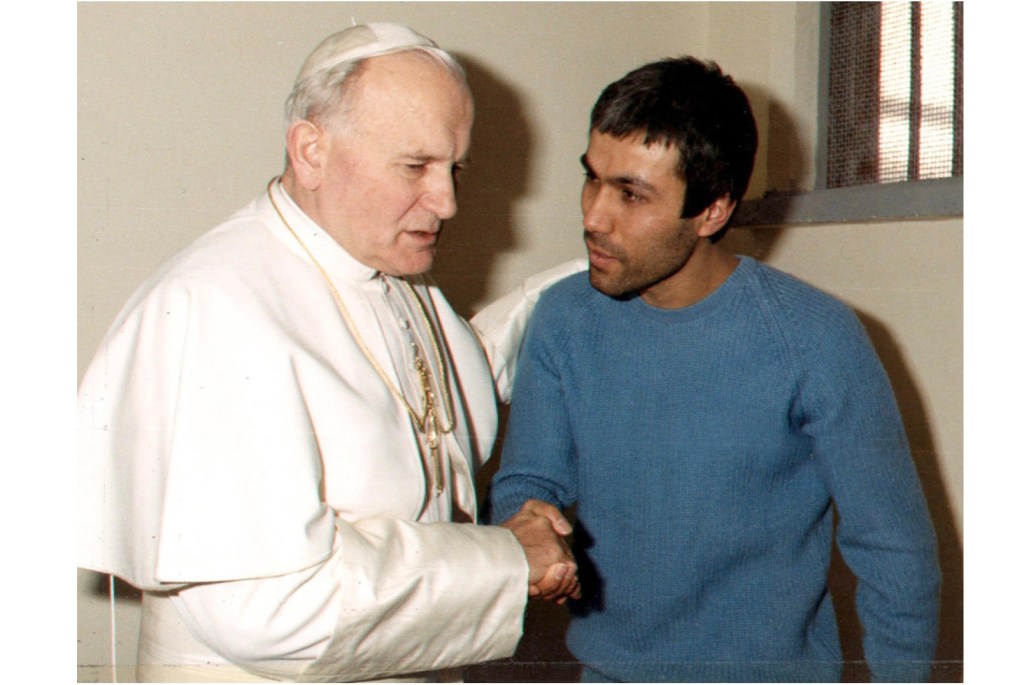
“Love your enemies and pray for those who persecute you.”

The sixth antithesis may be the most challenging of them all. “You have heard that it was said, You shall love your neighbor and hate your enemy. But I say to you, love your enemies and pray for those who persecute you, that you may be children of your heavenly Father” (Mt 5:43-45). The parable of the Good Samaritan provides a nice parallel to this verse. It can be found in Luke 10:25-37. For in that parable, Jesus shows our enemy and our neighbor to be one and the same.

A good examination of conscience would be to read the above verse, ponder who would come up for us as an enemy, and then read the Parable of the Good Samaritan. Whenever the word Samaritan comes up, we drop the word Samaritan and insert the person or persons who came up for us. When we have finished this exercise, then, may we pray for the person or persons defined by us as our enemy, for if we only love those who love us, what makes us any different than anyone else? If we are to be disciples of Jesus, if we are to be children of our heavenly Father, we are not only to love those who love us, but we are to also love our enemies. We are to love those for whom there is little chance of being loved in return.

Jesus offers us the way to be able to accomplish this seemingly impossible feat: “So be perfect, just as your heavenly Father is perfect” (Mt 5:48). We are able to love our enemy as ourselves by being perfect. This is not much help unless we understand that the English word used here is translated from the Greek word telios, which means complete, whole, to reach one’s goal or purpose in life. As a Christian, our end goal, our purpose, our fundamental option, is to be in full communion with God our Father, who is Love. God the Father is not just loving, not just a lover, but Love. “God is love” (1 John 4:8).

God is love and so, “makes his sun rise on the bad and the good, and causes rain to fall on the just and the unjust” (Mt 5:45). We strive in our life to attain the end goal of being perfected by Jesus the Christ, when we, through an act of our will, allow ourselves to become transformed into becoming agents of his love. The most challenging of enemies is facing the enemy within. To love as God loves, we are to follow the words and actions of Jesus and the prophets.

Each day we are given a choice. We can choose to feed our fears, seek revenge, dig in our heels, embrace our egos, react in kind to negativity, and/or remain indifferent to the suffering around us and in our world. We can refuse to love our enemies, withdraw our love, and so reap what we sow and contribute to the condition of separation, polarization, violence, and dehumanization that plagues our communities, nation, and world.

Or, we can choose instead to resist giving in to all of the above and instead allow ourselves to be perfected by Jesus, brought into alignment with his Father’s will, and collaborate with the love of the Holy Spirit so to be agents and models of love, mercy, forgiveness, and justice in our realm of influence. By loving our enemies, we will help to diffuse the power of hate.

We can only be perfected and transformed by the love of Jesus when we spend time with him in meditation and prayer. We are called to receive his teachings, to resist hearing and letting them go in one ear and out the other, and instead read them again a second, third, and fourth time to allow the light of the Holy Spirit to convict us. Where do we fall short or resist putting into practice the teachings of the Sermon on the Mount? Answering honestly will help us to receive more of the love of God and the strength to put these seemingly impossible commands into practice in our lives with those real people we engage with every day.

—————————————————————-

Photo: Pope St. John Paul II modeled for us this antithesis when he met, prayed with, and forgave Mehmet Ali Agca at Rebibbia prison on December 27, 1983, for shooting and attempting to kill him on May 13, 1981. (CNS photo/L’Osservatore Romano accessed from catholic sun.org)

Link for the Mass readings for Tuesday, June 17, 2025

“Let he who is without sin cast the first stone.”

In today’s Gospel account from John, many people gathered around Jesus in the temple area and were sitting and listening to him, when a horrific display of human wickedness breaks in as, “the scribes and the Pharisees brought a woman who had been caught in adultery and made her stand in the middle” (Jn 8:3).

This act of depravity is worse if we spend any time thinking about this verse. This was a calculated plan hatched by the scribes and Pharisees. They had been watching this woman for the opportune time to break in and catch her, using their own words of accusation, in “the very act of committing adultery” (Jn 8:4). If this group was this calculated and malicious, they would not have probably even given her the opportunity to put her clothes on, but grabbed her and brought her to the temple area.

The shame that this woman must have had to endure as she was dragged openly and publicly through the streets was made worse because this crowd brought her to the temple area. The temple was where people came to give sacrifice to atone for their sins and to worship God. What was worse was that the dehumanization of this woman most likely had nothing to do with bringing her to repentance, but had all to do with demeaning her for their own twisted ends to trap Jesus.

The Pharisees and scribes hatched this plot just to trap Jesus in what they believed was a fool proof way to bring charges against him. If Jesus did not follow the law of Moses and condemn her to be stoned, he could be charged for speaking out against the Mosaic law. If he did condemn her, he then could be charged by Roman law. Only the Roman authorities could institute the death of a person.

Jesus bent down and began to write on the ground with his finger (Jn 8:6). With this action, Jesus could have been buying some time to think over his response. He could have just been showing an attitude of indifference toward the charges presented. The truth is, we also do not know what Jesus wrote in the dirt that day. St. Jerome proposed that he was writing the sins of those gathered around him as they were waiting for his judgment. Another interesting speculation is that Jesus was again showing his foundation in the prophetic tradition.

Jesus could have been quoting the prophet Jeremiah: “O LORD… all who forsake you shall be put to shame; those who turn away from you shall be written in the earth, for they have forsaken the LORD, the fountain of living water” (Jeremiah 17:13, RSV). Jesus had just shared a few verses earlier that anyone who believed in him : “Out of his heart shall flow rivers of living water” (John 7:37, RSV). Those who came to trap Jesus could have found themselves getting caught in the trap instead and receiving God’s judgement for their forsaking God present before them in His Son (Pitre).

Whatever Jesus wrote had an effect unless the pregnant pause before Jesus spoke: “Let the one among you who is without sin be the first to throw a stone at her” (Jn 8:7) and when he returned to writing allowing for another pregnant pause allowed for his words to sink in. One by one, starting with the elders, the accusers, and even those who had gathered to listen to Jesus that morning, all walked away.

Jesus stood a second time only to find the woman standing before him. This is the first time he addressed her: “Has no one condemned you?” She replied with three simple words, “No one, sir.” And Jesus replied, “Neither do I condemn you.” Jesus did not seek to inflict any more shame on this woman and forgave her. Nor did he dismiss the sin. In Jewish law, there needed to be two witnesses to condemn someone of a capital crime. There was no witness left to do so. Jesus chose not to condemn her but also stated clearly, “Go, and from now on do not sin any more” (Jn 8:8-11)

Jesus and the woman looked eye to eye in the temple area, a stone’s throw away from the Mercy Seat of God. Jesus met this woman surrounded in her sin, shame, and anguish with mercy and forgiveness. He cleansed the temple precincts of the hypocrisy of the Pharisees and scribes who had darkened the area that day and his forgiveness purified her from the stain of her sin. This was no cheap grace. Jesus did convict the woman of her sin, but did so in a way that respected her dignity, unlike those who hauled her out publicly to humiliate her for their own malicious purposes. Jesus convicted her in private, once everyone had gone.

In forgiving her with love and mercy, I can imagine, that she, who had been dragged through the streets, not only experiencing the humiliation, but fearing that her death was imminent, then walked away from her encounter with Jesus crying not just with tears of relief, but with tears of joy. Could the words of Isaiah have come to her mind then, “Remember not the events of the past, the things of long ago consider not; see I am doing something new” (Isaiah 43: 18-19). This woman having drunk from the “stream of living water” walked away born again, a new creature, transformed by the purifying love of God.

This account embodies the gift of the Sacrament of Reconciliation. We all sin and fall short of the glory of God. We bring our sins, contrition, fears, and are to be met with the loving mercy and forgiveness of Jesus in the priest. Not so that we can then just go out to do whatever we want to again, but to go and sin no more. To not only be forgiven, but to also receive the grace to help us to resist temptation, to heal, and through participating in the life in Jesus, walk with him along the way to restore the glory we lost.

————————————————————–

Painting: May we experience and share the same mercy and forgiveness.

Dr. Brant Pitre, Catholic Productions

Link for the Mass readings for Sunday, April 6, 2025