Jesus wants to heal and save us. Do we want to be?

Has there ever been a time when you were picked last for the team, whether on the playground, P.E., or gym class? I remember being on both sides, being picked last, and picking others to join and having to pick someone last. I preferred being chosen last much more than having to be in the situation to choose a classmate last, and it was often an agonizing situation. In our Gospel reading today, Jesus comes upon a man who has experienced even worse.

He has been in need of healing for thirty-eight years. Apparently, there was a limited time to get into the waters of the pool of Bethesda to experience the healing properties that it afforded, for each time the water stirred, while the man moved to get closer to and enter the water, “someone else gets down there before” him. This is worse than getting picked last, as he doesn’t in a sense even make the team!

But with Jesus, the last shall become first. Key ingredients are belief, faith, and a willingness to be healed. Jesus does not impose, even in the case of healing, Jesus invites. He asks the sick man, “Do you want to be well?” The man is stuck in the limitations of someone getting him to the pool. That is all the affirmation Jesus needs. The man is willing if there is someone to help. Jesus commands him to rise, pick up his mat and walk. The man is no longer the one picked over, the one ignored, the one unseen. In his encounter with Jesus, he is healed by Jesus’ word.

Jesus meets us in our need as well as the man at the Pool of Bethesda. He meets us where we are, no matter our station in life. He does not leave us on the outside looking in, he does not leave us wondering if we are loved or if we belong. He does not only come to encounter us but if we are willing, to empower us to be about the mission given to us by his Father. Jesus gives meaning and purpose to our lives. Jesus has come to save us. Each and every one of us is a gift from God and has been graced with something to contribute to others, something unique to help make the kingdom of God a reality.

Give yourself a moment of silence and stillness, without and within. Settle into a place with no or little distractions, breathe in deep and exhale a few times, then close your eyes. See yourself as you are in your present seated position, breathing, experiencing your shoulders relaxing, and just being still. Then notice Jesus. He is walking toward you as he did with the man at the Pool of Bethesda. Does Jesus remain standing, does he sit beside you, or kneel before you? As he assumes whatever posture, allow your thoughts to reflect on what you need. As you are pondering, does Jesus ask you a question? What does he ask or what does he say?

Jesus is present, right here and right now, for you. There are no boundaries, no limitations, only those you impose on yourself. Share with Jesus your need. You are no longer misunderstood, left out, or picked last. Jesus is present. Embrace this moment of time together, of knowing that you are loved, heard, and that you belong in the kingdom of God.

————————————————————————-

Painting: Some quiet time of prayer in between studying, St. Vincent de Paul Regional Seminary, Boynton Beach, FL.

Link for the Mass readings for Tuesday, March 12, 2024

Forgiveness is possible. We just need to be willing to ask Jesus to help us.

Forgiveness is a wonderful gift of grace and mercy. If we asked many people if they would like to receive forgiveness most would say yes. The number would most likely be less if we were to ask them how many would be willing to forgive others. If we were asked to forgive someone seven times, that number would shrink significantly, and if we were invited to forgive someone seventy-seven times, is there any among us who would say yes, any among us willing to consider doing so?

Why is forgiveness so hard for most of us? I do say most because there are those who have an openness to being forgiving. One reason could be that we have few role models. I would imagine those that are more forgiving have not only experienced positive role models but have received forgiveness themselves.

How often do we seek forgiveness from others when we have done something wrong, inappropriate, or made a mistake? We often seek to explain first, make excuses, justify, or ignore our behavior altogether. When we resist being humble, confronting our offenses, and do not seek reconciliation, we do not experience the healing balm of forgiveness. We are then less likely to be willing to offer forgiveness and more likely to hold a grudge or to seek revenge.

Yet, even if we receive the gifts of mercy and forgiveness, as the servant did in today’s parable (Mt 18:21-35), we may still choose to be unforgiving toward others. We may resist forgiveness because we have already created patterns of distancing ourselves, making someone else as other, somehow justifying the hurt and pain we feel. We think that by holding a grudge or offering another the cold shoulder, we are giving them just what they deserve.

Unfortunately, patterns of not seeking forgiveness, not willing to forgive others, allowing ourselves to bear grudges, to distance ourselves, or project negative feelings on others to cover up our own inadequacies, not only perpetuate a climate of isolation and divisiveness, but continues to multiply mistrust and further distance. When allowed to left unchecked leads to violence in too many forms.

Even in a case when someone has truly wronged us in some way, Jesus is guiding us to forgive, to make an attempt to understand why someone might act in such a way, and to shift the momentum away from the perpetual cycle of hurt and to seek to bring about healing and reconciliation.

Jesus is clear that if we are not willing to forgive, we will not be forgiven. This is true because when we are unwilling to forgive, we cut ourselves off from the love of God. We choose the hurt and pain inflicted upon us over the healing balm that God offers. The Sacrament of Reconciliation is a gift of healing, and a pattern of regular confession helps us to receive the healing and forgiveness of our loving God and Father. As we develop a regular practice of examining our conscience, experiencing contrition – true sorrow for our sins, confess, and are willing to complete our acts of penance, we are absolved and forgiven from our sins, and we will experience healing.

Forgiveness does not mean we condone another’s inappropriate actions. It means we choose to no longer participate in the cycle of hurt. Even when we feel forgiveness is impossible, are we willing? That is all Jesus requires. We forgive in the beginning when we are willing to ask Jesus to forgive through us until we can learn to forgive ourselves, like Doha Sabah Abdallah.

Doha lost her son during the bombing of her city in 2014. Doha shared her story with Pope Francis while he visited Iraq back in 2021. She said: “By imitating him [Jesus] in our sufferings, we testify that love is stronger than everything,”

Pope Francis shared how touched he was by Doha’s story of forgiveness. On his plane trip back home, Pope Francis said, “I forgive. This is a word we have lost. We know how to insult big time. We know how to condemn in a big way… But to forgive, to forgive one’s enemies. This is the pure Gospel. This hit me in Qaraqosh.”

Let us take up the mantle that Jesus holds out to us today and this Lent, seek forgiveness, be healed, and willing to forgive.

————————————————————————-

Photo: Statue of St. Vincent de Paul our patron saint. St. Vincent de Paul Regional Seminary, Boynton Beach, FL

Link for the Mass readings for Tuesday, March 5, 2024

In stillness, there can be the beginning of healing.

There is something greater here. Something greater than the wisdom of Solomon and something greater than the preaching of Jonah. Following the way of Jesus is a faith we are called to live daily. Following Jesus is not a part-time vocation. We all have a unique gift in the dignity we have been conceived and born with. We have a unique way to express and live out our dignity as well. Unfortunately, what happens with most of us is that we are tempted, misdirected, distracted, and diverted as to what God would have us do and as a result we are often unplugged from the very source of our existence.

As Jesus taught, often in his parables, the kingdom of Heaven on earth starts small, like a mustard seed, like yeast, and develops slowly when nurtured. Lent is a good time to slow down, step back, take a retreat even while in the midst of our everyday activities. We just need to insert some dedicated time to God each day so as to better be able to acknowledge his presence in our activities.

If you are feeling a bit restless, on edge, or out of sync, I invite you to make some time to be still and breathe, this can be while in the shower, during breakfast, a morning walk, taking a sip of coffee or tea, during the car ride to and from work, or school. During this time ask God for some guidance. We can ask him to help us see those areas that we need to repent from and let go of, those thoughts, words, and actions that keep us distracted, redirected, and unsettled because we aren’t being truly who we are and who God is calling us to be. We can then confess to him and receive his forgiveness and reconciliation.

God invites us to come to the silence to also be able to sit in and experience the tensions, wounds, and traumas waiting for us there. Many of us would say a quick, “No, thank you,” to that invitation because who wants to experience those unresolved issues, hurts, and/or pain. We may even believe in the lie that if we open up those areas that we will be completely undone. Yet, it is only through experiencing the pain that we will experience the healing. Also, we will come to realize that the initial hurt is not as bad as the effects of it being left unresolved and the energy expended to keep it at bay is exhausting.

Jesus is present and waiting, to receive us and lead us through. He is inviting us to experience his acceptance and love as we are, to feel safe, to let go and be honest. With humility in seeking the help of and trusting in Jesus, we begin with simple steps that will lead us on the path to our freedom.

Jesus said in today’s Gospel that, “There is something greater here.” Christianity is not a secret sect. We are called to share the joy, the forgiveness, healing, and reconciliation we experience from God with others, even with, as Jonah found out, our enemies. We are to look for opportunities to offer a smile, an encouraging word, to reach out to someone we have been meaning to connect with for a while, in person or far away, and/or someone that we may sense just needs a listening ear. We can also react less by asking for God’s patience to be more understanding with those who may get under our skin or stretch us out of our comfort zones.

Lent can be a joyful time when we enter into the season with the intent to deepen our walk with the One who is wiser than Solomon and preached repentance and reconciliation. With our hearts and minds turned back and open to God, Lent will not so much be a drudgery to endure, but a joyful embrace of the opportunity for experiencing healing from those areas we have kept buried for far too long. Lent is a season that we are invited to change our minds such that we are more open to dialogue, forgiveness, healing, sharing the joy, reconciliation, and contributing to building up the kingdom of God one healing at a time!

———————————————————-

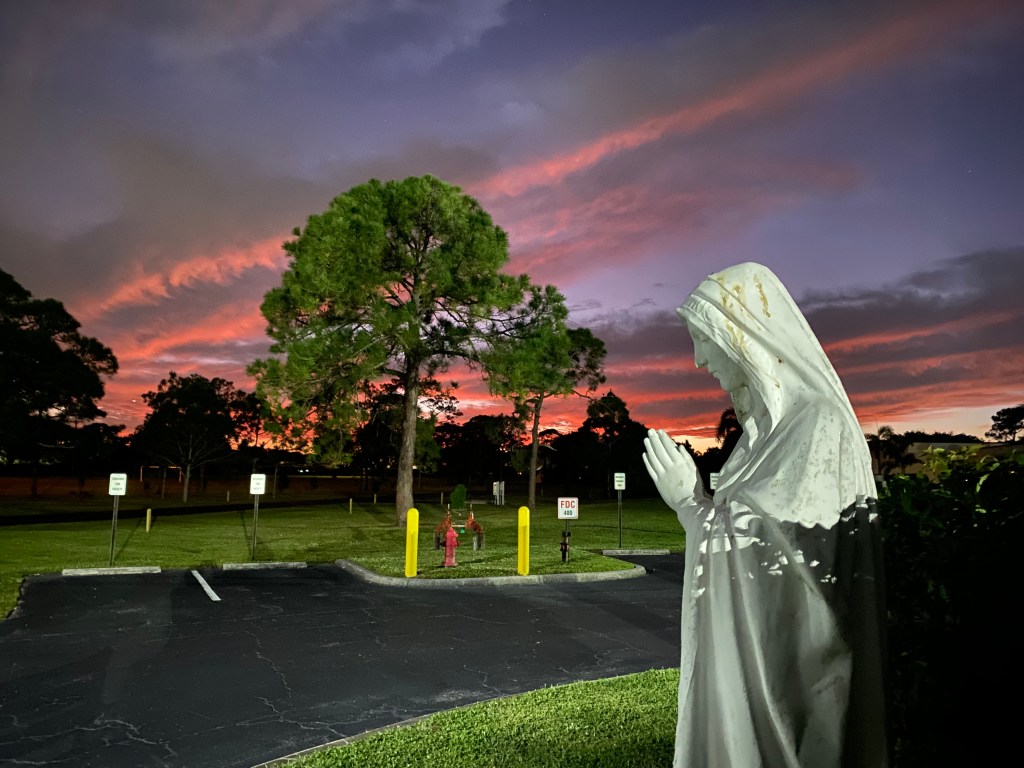
Photo: Some quiet time with Mary – St. Vincent De Paul Regional Seminary, Boynton Beach, FL.

Link for the Mass readings for Wednesday, February, 21, 2024

The Divine Physician is inviting us to experience forgiveness, healing, and his love.

Think about how good we feel after coming to be on the other side of healing from a bad cold or the flu, recovering from a twisted ankle, a broken collar bone, or other health conditions. We experience a feeling of wholeness that was missing during the midst of our suffering where we may have pondered a time or two whether we would ever get better.

The same can be said for estranged relationships. The distance of separation can be agonizing, an inner gut-wrenching experience that gnaws away at us. We wonder if there can ever be a coming back together. Then when reconciliation, forgiveness, and amending of the brokenness of relationships does happen, we can experience such a relief, lightness and joy, that we never imagined possible while in the midst of the gut wrenching angst, conflict, and separation.

Sin separates us from one another, and unchecked sin can build and multiply like cancerous cells. The Pharisees and the scribes questioned why Jesus was eating with tax collectors and sinners, and Jesus replied: “Those who are healthy do not need a physician, but the sick do. I have not come to call the righteous to repentance but sinners” (Lk 5:32).

Jesus is truly a light in the darkness. For Levi and his friends, who just settled for the path they were on, thinking and feeling, this is the best it was going to get, were given a choice, an invitation, a new way. A great celebration of fellowship ensued in Levi’s home because these men and women, who had been outcasts, who were separated from the greater community were forgiven, welcomed, and embraced. They were loved by Jesus as they were. They did not have to change first for Jesus to call Levi and gather with them.

They were welcomed into the kingdom and reign of God. Their ticket to reconciliation and healing was accepting the invitation of Jesus, to receive and experience his love and welcome. Levi and the other sinners did not run from the light of Jesus, but were willing to recognize their need for healing, were willing to repent, to turn away from their prior ways of life and so were reborn!

They were divinized because of their willingness to participate in the life of Jesus. Levi would continue to follow Jesus such that it was no longer he who lived, but Christ who lived in him (cf. Galatians 2:20)!

Jesus invites us each day, as he invited Levi in today’s Gospel, to follow him. We are given the same invitation and opportunity for healing and for discipleship. Will we resist rationalizing and justifying our sinful thoughts, actions, and habits, welcome the light of Jesus that reveals our venial and mortal sins, and admit that we are in need of healing, and repent so as to be forgiven and released from all the energy we have expended in protecting and hiding from ourselves and our God who loves us more than we can ever mess up?

Quietly spending time daily, especially in the evening and recalling our day, by asking Jesus to reveal to us those ways in which we have not lived according to his will is a wonderful practice. Those sins we call to mind we can confess on the spot and Jesus will forgive us. As we recognize recurring actions or more serious sins, we will need a more direct human encounter by embracing the Sacrament of Reconciliation. Reconciliation is a gift of mercy and healing where we can experience firsthand the healing grace of Jesus.

Jesus loves us as we are. Yet holding on to our sin, keeps us at a distance from experiencing the greater breadth and depth of his love. We only need to be willing to be contrite, to embrace sorrow for the harm we have inflicted with our personal sins and go to the Divine Physician in our time of prayer and/or Reconciliation. Once absolved, the heavy weight is lifted, and we are healed. We are then better able to engage in penance to atone for our sins committed, better able to forgive others as we have been forgiven, and to love as we have been loved!

——————————————————————–

Photo: Rosary walk over Thanksgiving break, St. Peter Catholic Church, Jupiter, FL.

Link for the Mass readings for Saturday, February 17, 2024

When we are willing to allow Jesus to come close and touch us we too are healed.

Moved with pity, he stretched out his hand, touched him, and said to him, “I do will it. Be made clean” (Mk 1:41). Jesus felt compassion when he heard the plea of the leper. He went out from himself and did the unthinkable in his time and place and touched the leper. Jesus saw not a leper, not someone unclean, not someone to stay away from, but a brother. Jesus met the person before him and in an act of love gave him what he had not experienced in who knows how long, human touch. In so doing, he brought this man back to life. Being a leper meant his was isolated from family, friends, and worship. Now healed he could return from his exile.

When is the last time we have been moved with pity, with compassion, to suffer with and feel the pain of another? In so many ways, we too are like the leper, starving for love and affection. Even if we are not aware or willing to admit it. Too many of us are living a life of isolation and aloneness to different degrees, even among our families and friends. We are starving to be heard, to be acknowledged, to be touched, to be loved in healthy ways. It is no wonder why anxiety disorders, addictions, and unhealthy practices in many forms are on the rise.

Jesus knows and has experienced the loneliness we all feel in our hearts. He feels our distance and hunger. He seeks to draw close to us as he did with the man with leprosy who called out to him. The Son of God entered our human condition and encounters us to experience the fullness of our brokenness, lead us to experience what we want to keep distant from within ourselves, bring us to healing so we can see the promise of the fullness of who we really are and called to be. Jesus encountered people, he did not see them as others. He seeks to encounter us, each and everyone of us, personally and uniquely. He seeks to draw close, to touch, and to heal us.

He does so in a most intimate and powerful way in the Eucharist where we are able to receive and consume him. He becomes organically a part of us and we a part of him.

So transformed by our encounter, may we follow the lead of Jesus and make an effort today and each day to see each other as brothers and sisters loved by Jesus as much as he loves us. No matter who we come across may we not avert our eyes but be drawn into another’s gaze and offer at the least a smile. In that simple act, we acknowledge to that person that they do exist. As social beings, we long to be touched, and it is good that we can do so again, after coming out of the different periods of Covid that we have experienced.

We can draw close even in our hyper-sexualized culture by being models of building chaste relationships, offering expressions of healthy touch, establishing, and respecting healthy boundaries. We can draw close by resisting the temptation to talk at or over one another, seeking to fix one each other, and instead listen, understand, and hear another share their pain and be willing to accompany each other through our struggles, as well as share in our joys. We can seek to forgive and be forgiven.

We can only do so in a healthy way when we allow God to draw close to us and develop our relationship with him. Through the experience his healing touch and the love of the Holy Spirit we can heal from our wounds and so heal our present relationships and build new, and healthy ones. By taking the risk of drawing close as Jesus did and continues to do, we can begin to encounter one another, really see each other, heal, and build up the wounded Body of Christ in our midst.


Photo: Rosary walk, St. Vincent De Paul Regional Seminary, Boynton Beach, FL. Contemplating heaven and earth.

Link for the Mass readings for Sunday, February 11, 2024

Jesus invites us to listen.

Those who witnessed Jesus healing the man who was deaf with a speech impediment grasped something more than just the healing when they stated: “He has done all things well. He makes the deaf hear and the mute speak” (Mk 7:37). With these words, they were acknowledging the deliverance of Israel by the Lord, promised by the prophet Isaiah, when he mentioned how, “the eyes of the blind will be opened, the ears of the deaf will be cleared” (Isaiah 35:5).

The beauty of this healing may be missed by us in the modern age because of the graphic nature of the details used by Mark. Jesus places his fingers in the man’s ears, spits into his own hands, and then touches the man’s tongue. Jesus is mixing his own saliva with this man in need of healing. We don’t even share drinks from the same bottle anymore as we used to do when we were kids! And with what we have dealt with regarding Covid, this imagery can seem incomprehensible!

Yet, what Jesus is showing is the intimacy of communion that he offers. He gave the very essence of his own being that it would be mingled with this man. This physical teaching is an image or icon, of how the Son of God, in no way diminishing the fullness of his divinity, entered into the very real corporality of our humanity. He became one with us so that we can become one with him. This was true then and it is still true for us today!

We all suffer physical, emotional, psychological, and spiritual trials. But we also suffer from not being able to hear God’s word, and so are mute in speaking his word. Jesus, even if he does not provide a healing or an immediate solution to a trial, is present in our lives. We are invited to consciously resist the temptation of avoiding our own suffering, pain, or challenges and instead are invited to embrace and enter into them. We are not expected to do this alone, but to bring our need for healing to Jesus. In this way, we are aligning our suffering with his on the Cross. When we choose to offer up our pain and suffering on behalf of another, we participate in Jesus’ redemptive suffering. Others can experience relief and healing from our sacrifice in participation with Jesus.

This act of the will gives meaning to our suffering such that we do not endure what we are going through in vain. May we face, head-on, that which rises before us, actualizing the guidance of Jesus as well as the advances of modern medicine, science, and psychology, embracing a posture that engages both faith and reason. Our approach will be best if we are more mindful and balanced with our discernment. Just masking struggles without dealing with the root causes will only prolong and possibly worsen the condition.

Jesus invites us to step away with him and hear his healing word: “Ephphatha!” so that we too can be healed from our deafness to the needs of those around us and be open. Be open to receive his love so that we can be more present to and love one another. Jesus also wants to heal others through us. With ears more open to the voice of his Father, we become more aware of the needs of others. We can let go of our needs, our ego, and be present. One of the best gifts of healing we can offer is to really listen to and hear someone. People will experience a lot less anxiety and suffering when they feel that they have been heard and this is also one of the best ways that we can show another that we care and love them.

——————————————————————————————-

Picture: Evening Rosary walk last Fall. Time in silence helps us to listen. St. Vincent de Paul Regional Seminary, Boynton Beach, FL.

Link for the Mass reading for Friday, February 9, 2024

Model of courage and faith

In today’s encounter between Jesus and the Syrophoenician woman, we can observe again the crossing of societal norms by both the woman and Jesus. She, very much like the woman who had been hemorrhaging for twelve years, was desperate and approached Jesus. She was willing to not only risk breaking the social taboo of speaking with Jesus, but she was also willing to do so by walking into the home where Jesus was staying and fall at his feet.

Jesus’ response to her begging sounded more like he was possessed himself rather than the healer she sought out: “Let the children be fed first. For it is not right to take the food of the children and throw it to the dogs” (Mk 7:27). This woman was not fazed by Jesus calling her a dog, she wasn’t leaving without receiving healing for her daughter, even if that meant she was putting her life in danger. Her retort, “Lord, even the dogs under the table eat the children’s scraps”, emphasized this point. It was also the key that opened the door for the disciples and us to witness a consistent pattern with Jesus.

We saw the same situation with the woman who was experiencing the hemorrhage (cf. Mk 5:25-34). Both women had the faith and courage to approach Jesus and both received the healings they sought and were affirmed by Jesus. The outcome of this encounter was also like the one Jesus had with another gentile, the Roman centurion, who said that he was not worthy for Jesus to enter under his roof (cf. Matthew 8:8). In both accounts, Jesus healed solely by his word from afar. What is important to Jesus is not whether they are male or female, Jew or Gentile. What matters if the person’s faith! Do they trust in him or not?

Do we have the courage, faith, and trust in Jesus as shown by the Syrophoenician woman in today’s Gospel? When we let nothing hinder us from drawing closer to Jesus, including relinquishing the reigns of being our own masters, acknowledging that God is God and we are not, believing that Jesus is truly the Son of God, that he is still present and active in our lives, and we have no reason to be anxious or afraid, miracles still do happen! Jesus said that if we have faith, even the size of the mustard seed, we can move mountains (cf. Mt 17:20).

We don’t need a lot of faith, a mustard seed is tiny. Just that little amount of trust in Jesus is enough for God to happen! Remember the feeding of the five thousand with just a loaf of bread and a few fish! When we believe with childlike trust that Jesus will provide, he will. It may not be as immediate as with the Syrophoenician woman or it may. What is important is that we can mature and grow in our faith such that we know Jesus, trust that he loves us, wants the best for us, and that he will always be there for us. It is also important to renounce any of the mind noise that may arise to counter these truths.

No matter what we might be dealing with today, let us be inspired by the Syrophoenician woman, and bring our petitions or intentions to him. Bring any anxieties, fears, trials, and/or tribulations to him, lay our burdens at his feet, and take his hand. With Jesus all things are possible. Jesus has not nor will he ever abandon us. He cares for and loves us. Jesus the Christ, the Son of the living God is our Savior and Redeemer, is present, is the kingdom of God at hand, and will see us through step by faithful step.


Photo: Icon of Syrophoenician Woman by Br. Robert Lentz, OFM

Link for the Mass reading for Thursday, February 8, 2024

Are we willing to come close as Jesus does for us?

“Whatever villages or towns or countryside he entered, they laid the sick in the marketplaces and begged him that they might touch only the tassel on his cloak; and as many as touched it were healed” (Mk 6:56).

The people of Jesus’ time were in need of healing, hungry to draw closer to God, often searching, wandering, and wounded, like sheep without at shepherd. This is just as true for us today. Though Jesus is not as visible to us as he was to those in the land of Gennesaret, he is just as present if not closer. We who receive Jesus in his Word proclaimed and through his Body and Blood, in the sacraments, prayer, healing, mercy, and grace are sent forth to bring Jesus to others.

We are not to go home as if nothing of any significance just happened in our gathering as the Mystical Body of Christ at Mass. Jesus does not send us to walk around with an air of superiority over others, to judge and condemn people, to refuse to help those in need because we feel they deserve the condition they are in, that they are “illegal” (people may do illegal actions but no person is illegal), that they chose their lifestyle, that they are lazy and just need to pull themselves up by their own bootstraps. Jesus was and is not indifferent to the plight of others. Jesus met people and continues to meet us where we are and as we are, and then he leads us with his “gentle chords of love” (cf. Hosea 11:4) to the truth of who his Father has created us to be.

Pope Francis was asked in an interview by Fr. Antonio Spadaro, S.J., in 2013, “What does the church need most at this historic moment?” And Pope Francis answered, “that the thing the church needs most today is the ability to heal wounds and to warm the hearts of the faithful; it needs nearness, proximity. I see the church as a field hospital after battle.” We need to be “near”, in the same “proximity”, to bear Christ to one another: “The church sometimes has locked itself up in small things, in small-minded rules. The most important thing is the first proclamation: Jesus Christ has saved you. And the ministers of the church must be ministers of mercy above all.”

Jesus, please help us to be present and willing to come near. Lead us to experience your love, mercy, forgiveness, and like you, be willing to enter into the chaos of one another. Help us to resist the temptation to keep others at a distance and refuse to be indifferent to the needs of those you bring to us in their time of need. May we too, in the words of Pope Francis, go out to “heal the wounds and to warm the hearts of the faithful” by being willing to accompany others in their sorrows, anxiety, trials, and tribulations.

People are really hurting all around us. Help us to let go of the need to fix them or fix their problems. Jesus, help us to be present, to listen, to hear, understand, and be open to allow the Holy Spirit to speak through us at the appropriate time, so that, in the end, we do not prevent people from encountering you, but become a means for them to encounter you, the divine physician, and be healed.

—————————————————————————————————————

Photo: Are we willing to grow together like these three trees? Rosary walk, St. Vincent De Paul Regional Seminary, Boynton Beach, FL.

Spadaro, S.J., Antonio. “A Big Heart Open to God: An interview with Pope Francis”. America Magazine. September 30, 2013 Issue: https://www.americamagazine.org/faith/2013/09/30/big-heart-open-god-interview-pope-francis

Link for Mass readings for Monday, February 5, 2024

Confession – Intimate and healing encounter with Jesus.

“So they went off and preached repentance” (Mark 6:12).

They, being the Twelve Apostles, preached repentance. There is a pattern. John the Baptist called people to a baptism of repentance. The first words of Jesus’ public ministry were, “This is the time of fulfillment. The kingdom of heaven is at hand. Repent and believe in the Gospel” (Mark 1:15). And now in today’s Gospel, the Twelve are going off two by two preaching repentance.

What does repentance have to do with us almost two thousand years later? What repentance had to do then. We all have in the deepest part of us a yearning to belong, to be part of, to be loved. We want to be seen, heard, and understood. We want our lives to have meaning, fulfillment, and a sense of worth and dignity. This deepest longing has been placed in us to be filled by God and as we receive and abide in God’s love, we are better able to encounter and share his love with each other.

The problem is that since the Fall, we all fall short of the glory of God. The good news is that we have not been totally corrupted. We are still good. Even though we have intentionally and consciously chosen to turn away from God and seek to feed our deepest longings with something or someone other than God. We can change. We can come to realize that who and whatever we place before the Father separates us from a deeper and more intimate communion with him.

We can realize that when we sin, we turn away from God, isolate ourselves from God, and feel the loneliness of that choice. This worsens when we decide that we don’t need God, that we are self-sufficient, and can take care of ourselves. Our hunger grows and is unsatisfied by the finite ways we try to fill our infinite hunger. The answer then is to slow down, be still, and listen to the invitation of God that he constantly offers and then to decide to repent, to turn back to him, to change our heart and mind.

What we see in the path blazed by John the Baptist, Jesus, and then his Apostles are the seeds of the Sacrament of Confession which Jesus will institute with the Twelve in the upper room after his Resurrection. Jesus has experienced the loneliness of the separation that we all feel in our sinful state. Only he felt it much more intimately and profoundly as he received the full assault of the weight of all our sin on the Cross. And what did Jesus do when he met the same Twelve who betrayed him? He forgave them and called them to forgive others in his name.

Jesus instituted the Sacrament of Confession to help provide the healing we need to repent and to turn back to the Father. He gave this gift to the Apostles who then passed it on to their followers, and who then successively passed this gift on through each generation of priests to our present day. Confession is a grace, a bridge that leads back to the Father that keeps on giving for those who come to receive this miracle of healing. “Confession is the personal gift of redemption, always unique, to each person, just as each person can accept and apply it” (Confession, Adrienne von Speyr, p. 93).

God the Father loves us more than we can imagine, and he wants us to experience his love. Confession is one of the most intimate ways we can experience his love. We are only as sick as our secrets. In Confession, we can bring forth the deepest and darkest of what we have done and what we have failed to do. We don’t need to buy into the lie that we will be abandoned if anyone knew. Instead, Jesus, who was abandoned, does not abandon us. Jesus forgives, loves, heals, frees, and restores us so that we can experience what we have been created for, to be loved by God and to love him and each other in return.


Photo: Rosary walk St. Vincent De Paul Regional Seminary, Boynton Beach, FL.

Link for the Mass readings for Thursday, February 1, 2024

Have courage, have faith, trust in Jesus.

“Jesus, aware at once that power had gone out from him, turned around in the crowd and asked, ‘Who has touched my clothes'” (Mk 5:30)? The woman could have slipped away, she could have stood still and said nothing. Had anyone seen her touch his clothes. Jesus’ disciples were bewildered that Jesus even asked such a question with so many pressing about him. No matter, the woman approached with “fear and trembling” and told him the truth.

In coming forward and telling the truth, this woman was showing tremendous courage. She had just broken a serious, social taboo. She touched Jesus in public as a woman and having been hemorrhaging for twelve years, would have been considered ritually unclean. Her touch would have rendered Jesus unclean. The opposite happened. Both Jesus and the woman knew she was healed the moment she touched his garment. Jesus did not admonish her but publicly recognized her faith.

All the while as this scene transpired, Jairus must have been in agony, knowing how close his daughter was to death, and Jesus actually, stopped and took precious time to even engage with this woman. Finally, they were about to resume their journey when the terrible news came that his daughter had passed away. What might have flashed through his mind in that moment? The time Jesus took to talk with her, could that have made the difference?

Other details surely crossed his mind. As a synagogue official he would have known the taboos she crossed as a woman who was the lowest of low. She would have also been frail and pallid from her condition, at death’s door herself, yet she had mustered such courage and faith. As these and other thoughts raced through his mind, Jesus said to the man, “Do not be afraid, just have faith” (Mk 5:36).

Jairus had just experienced a powerful expression of just such faith with this woman, probably someone until this very moment who he would have shown disdain for. Maybe just maybe, if he could muster the same faith as her, Jesus could bring his daughter back to life. Could his and the woman’s eyes met at that moment? Could a light have then shone in the darkness of his despair? Jesus would heal his daughter, by taking her hand and commanding her to rise and walk.

How many of us have been or have known someone who has experienced the anguish Jairus, whose daughter was near death, was going through, or the woman who had been suffering for twelve years with hemorrhages and receiving no help and all but lost hope? How many of us know of such healings that still happen today? How many of us have though experienced the opposite? Where we experienced no healing, we wondered where Jesus was, and why did he allow this to happen, or did not step in to help?

The best we can do in times of trial and dire need is to summon the courage of the woman suffering from hemorrhages and trust in Jesus. He may or may not bring the outcome we seek. But I assure you that he is present with us through our pain and suffering, whether we feel his presence or not. Sometimes he allows the unthinkable to happen, of which we cannot even comprehend at the time, to bring about a greater good. Often, we are not able to see that until a later date when we are able to look back.

Remember also, that even death does not have the final say. Jesus does because he has conquered death. Jesus and we who participate in his life are victorious. Healings do still happen. Ultimately, faith is placing our trust in our God and Father who loves us, who is present with us no matter what, and carries us in our darkest hour. He sent his Son to walk with us and encourage us as he did with Jairus: “Do not be afraid, just have faith” (Mk 5:36). Let us place our hand in his, face what is before us, and be on our way together.


Photo: The light of Jesus shines even when the sun doesn’t. Rosary walk as storm clouds gathered a few weeks ago, St. Vincent De Paul Regional Seminary, Boynton Beach, FL.

Link for the Mass readings for Tuesday, January 30, 2024