Just as the sun will rise, we know Jesus will be there for us no matter what.

Jesus continues to present the imagery of the shepherd in today’s Gospel reading from John. He offers the assurance of security and protection that is to be found for those that are in his fold when he says, “No one can take them out of my hand. My Father, who has given them to me, is greater than all, and no one can take them out of the Father’s hand. The Father and I are one” (Jn 10:28-30). How does one enter the fold of the Good Shepherd? All who hear his voice and follow him will be known by him and so be a part of his flock.

Yet, there are those who hear his voice and do not recognize the Shepherd. They do not follow him and so are not known by him, although he seeks them out. They may know about the Shepherd, have heard of him, but do not know him. Their hearts and minds are closed. They do not believe in his miracles, his exorcisms, his teachings, and the question of those opposing him in today’s reading is, “If you are the Messiah, tell us plainly” (Jn 10:24). Jesus did just that by saying that he and the Father are one. The response to the forthright comment of Jesus is that those who are closed to his answer pick up rocks to throw at him (see Jn 10:31).

Jesus offers the gift of relationship with him and his Father, to experience the love shared between them, the Holy Spirit. This offer is without condition. Jesus is open about who he is, who we are, and who we can become in participation with him. Those who say no to his invitation do so for their own reasons; a demand for proof, a listing of the terms and conditions that need to be met first, assurances sought for, and/or excuses offered, diversions, distractions, temptations… Just as Jesus invites us to freely come to him, he will only come so far as we are willing to receive him. He does not conform to us or to our will.  Jesus does not need us, yet he loves us by willing our ultimate good.

Even we who have said yes, only go so far. We hedge our bets, dip our toes into the water, and maybe go in ankle-deep, but not too many of us are willing to relinquish control, let go, and surrender fully all at once. Jesus offers, eternal life, true, but also a life of meaning and fulfillment now. A perfect life? No. There will continue to be challenges, conflicts, mistakes, and misfires as well as Jesus’ voice continuing to call us to follow him to go into deeper waters, to seek freedom and healing from our anxieties, fears, and weaknesses. He urges us to face conflicts, to be disciplined in resisting temptations, and to continue to surrender and trust him.

Through all our experiences, the ups and downs, the only assurance is that we are not alone. No matter what we may face today or tomorrow, just as we know the sun will rise, we can be trust that Jesus will never let us go and no one can take us out of his hand. Each step of the journey we take, we can be confident that Jesus, our Good Shepherd, will be there to guide and protect us.

——————

Photo: Looking up while praying my holy hour during Holy Week at Our Lady of Florida Spiritual Center, North Palm Beach, FL.

Link for the Mass readings for Tuesday, April 23, 2024

Jesus is with us, even when we fall.

“Everything that the Father gives me will come to me, and I will not reject anyone who comes to me, because I came down from heaven not to do my own will but the will of the one who sent me” (Jn 6:37-38). Jesus does not reject us, he accepts us as we are, first and foremost. Jesus has come to do his Father’s will which is to lead us all to salvation, to be redeemed and restored to the proper order of freedom from our enslavement to sin. This is why Jesus met Cleopas and the other disciple on the road to Emmaus. They were walking the wrong way! Jesus did not tell them that, he just opened the Scriptures for them, so that they could see that he was who he claimed to be and then revealed himself to them in the breaking of the bread. Once they had a deeper encounter with him, they determined on their own to turn back, and even though evening approached they went back to tell the Apostles the Good News of their experience.

It was through sharing a meal with them that they recognized him. How many meals had they shared together before his death? A close reading of Sacred Scripture shows how important table fellowship is for Jesus and his followers before his death and after his Resurrection. True, Jesus eating with his disciples after his Resurrection shows that he is no ghost, he is human, but also that he is reestablishing the cornerstone of his ministry, table fellowship.

Here the basic needs of sustenance are met, for the body, and in also in sharing his time and conversation with anyone willing to eat with him, no matter their level of ritual purity, touches the deepest hunger within each of us, which is to belong, to be accepted as we are, for who we are. The majority of the crowd that Jesus is speaking to has continued to come to him because he fed them with only a few loaves and some fish. In the miraculous multiplication, Jesus is providing for their bodily nourishment, but also preparing them for the deeper spiritual nourishment of the body and soul to come in the next verses as he goes deeper into his Bread of Life discourse.

Jesus loves us, he wills the best for us. Many resist this claim for different reasons. It could be the callouses, scars, growing cynicism resulting from wounds inflicted by others as well as from those within the Church. Each of us could have experienced the same and have also been let down by those we have looked up to and trusted. If we are involved in a relationship long enough, we will experience disappointment or worse. This is because sooner or later, when we allow ourselves to get close enough, the masks will come down and who we truly are, the fullness of our wounds and our gifts will come to the fore. Conflicts will arise because we are finite beings. We are still a work in progress. Conflict is not a bad thing. It is healthy when we are willing to work together to resolve the conflict together.

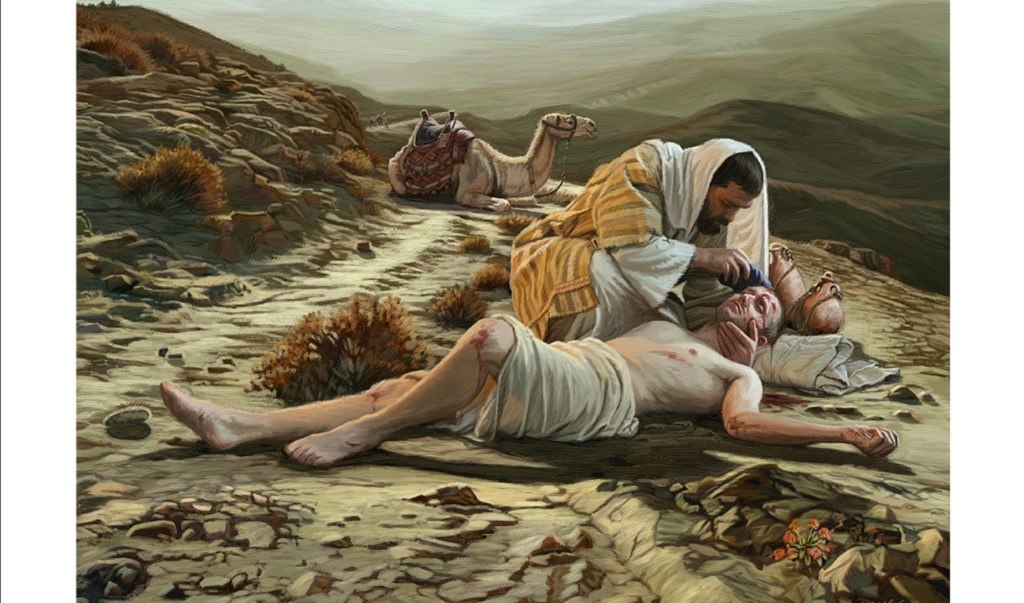
None of us are perfect. We are all on a journey. On our own, not only will we consistently fall short of our goal, we will often be headed in the wrong direction. That is why we need a savior. Jesus, fully divine as Son, came down from heaven and became human to meet us in our humanity. He is there for us when we fall down face-first into the mud. He is willing to be there with us, to look us in the eye, and smile.

Even if we are not able to look past the predicament, can we resist Jesus? His eyes looking at us and his smile that lets us know we can get through this together. His hand offered to us that we can grasp and feeling the strength of his grasp, then rise together and stand again. That is how Jesus shows his mercy and love for us. He enters our chaos and meets us in the muck and grime of our mistakes, brokenness, and sin. He loves us there, and when we are ready to accept his offer of love, he invites us to get up, and begin to walk again toward the fullness of who we are called by his Father to be.

As our relationship grows and deepens with Jesus and as our trust renews, we begin to believe that we belong. We begin to heal and realize that we are a part of something greater than ourselves and then, with wobbly steps, we begin to offer attempts of the same mercy, forgiveness, and unconditional love with others. This is the path of discipleship. This is the road we are on, together. This is not a hundred-yard dash but a long and winding road. Let us be willing to persist, to be led, to love, to be there for, and accompany one another each step of the way. And especially may we have the willingness to help each other when we fall.

———————————————————————————

Photo: Living Stations of the Cross in the streets of the Bronx, me, as Jesus, falling a third time – around 1991.

Link for the Mass readings for Wednesday, April 17, 2024

Our healing begins when we are willing to receive the embrace of Jesus.

A ghost is a disembodied spirit or an apparition. Jesus is no ghost, though when he appears to his disciples they believe him to be just that. Jesus then tells them: “Look at my hands and my feet, that it is I myself. Touch me and see, because a ghost does not have flesh and bones as you can see I have” (Lk 24:39). He also then requested from them something to eat, and Jesus received and ate the baked fish he was given.

Jesus, in showing the wounds on his hands and feet and in eating of the fish, revealed to his disciples that his resurrection is a bodily one. Jesus was not a disembodied spirit. Nor was he a mere apparition or hallucination. Jesus, was not resuscitated, just to die again. Jesus has conquered death and is risen from the dead. Jesus then proceeded, as he had done with Cleopas and the other disciple on the road to Emmaus, to share with those present how he is the fulfillment of the Law and the Prophets by opening the scriptures for them.

Jesus not only revealed himself as having risen from the dead and shared that he was the fulfillment of the Law and the Prophets, he embodied forgiveness. Though the disciples had betrayed him, and carried the weight of shame upon their shoulders for their lack of courage, the first words Jesus spoke were not words of condemnation but forgiveness: “Peace be with you” (Lk 24:36). In the showing of his wounds, the disciples were certainly reminded of what Jesus had gone through, his suffering and crucifixion. Could those wounds have also mirrored their own betrayal of him, their internal wounds, as well their own need for healing and repentance? Jesus did not bring up any of their past failures. He instead offered them peace.

All of us have been wounded in some way and have experienced trauma brought on by the myriad ways we have been exposed to the fallen nature of humanity. Jesus invites us to stop running from the fear of facing our hurts and the roots of our suffering and to instead kneel before him. He offers us his hands held out to us. May we gaze upon and ponder his wounds still present from the nails and come to a deeper appreciation of the suffering he endured for us.

Jesus invites us next to look up into his face, the face of the one who conquered death and rose again. Resist turning away from the smile that radiates his unconditional love. May we allow ourselves to lose ourselves in the eyes of his acceptance, that offer each and every one of us the realization that Jesus loves us in this moment just as we are.

Then listen, receive, and abide in the words he speaks, “Peace be with you.” In those words of invitation, may all our fears, anxieties, and hurts melt away. May we die to our pride and arise, allowing ourselves to be embraced by Jesus, embraced by his love, so to receive and abide in his love which is the foretaste of eternity. In the arms of Jesus, let our healing begin.


Pencil drawing: Kathryn J. Brown, 1982, hanging on my seminary room wall. Spend some time to rest in Jesus’ embrace this Lord’s Day.

Link for the Mass readings for the third Sunday of Easter, April 14, 2024

The sun is setting on Lent as we begin Holy Week.

A core group within the leadership of Israel has decided. They will not deny themselves their power, prestige, and their place. They will not take up their cross and follow Jesus, the way, the truth, and the life. They will not allow the teaching and momentum of the growing number of those following Jesus to continue unchecked. As Passover drew nearer, thousands of people were coming up to Jerusalem to purify themselves for the great feast.

This meant the Romans would have many more centurions in place to keep the peace. The division and commotion that Jesus was causing could cause conflict and unrest and then swift and violent retribution from the Roman presence. The Sanhedrin, the Jewish High Council, followed the lead of the high priest, Caiaphas, who said, “You know nothing, nor do you consider that it is better for you that one man should die instead of the people, so that the whole nation may not perish” (Jn 11:49-50). With these words, they began to plan how to put to death the carpenter of Nazareth.

With the words of Caiaphas, the sun began to set on the life of Jesus. These words affect us even today as they usher in the sunset of our Lenten observance. The gift of our liturgical readings allows us to relive the story of our faith. Lent has given us a time to reflect and to meditate upon who Jesus is. Is he just a carpenter, another teacher, a holy man from the past, or is he each of these, but someone so much more. Is he the Son of God who became one with us in his humanity so that we can become one with him in his divinity?

Do we see his teachings and life as a threat as did the Sanhedrin? Do we like our life the way it is, such that we do not want Jesus to come into our home and start turning over the tables and disrupting our order and comfort? Or do the Gospels cut us to the heart and inspire us to shake off our complacency, our indifference, our cynicism, our comfort, our routine.

Jesus evades the centurions, because his hour is not yet, but when his Father willed it, Jesus was willing to give his life, not just in an abstract way, but very personally: for each and every one of us. Does that mean anything? Jesus gave everything for us. Does this truth spark a desire to acknowledge our sins, to repent, and to begin anew? Are we willing to open our hearts and minds to his love that transforms, are we willing to spend some time in quiet and allow Jesus to speak in the silence of our hearts, are we willing to be encouraged to fast, to pray, meditate, and to be moved with compassion to help those in need?

As Holy Week begins with the Vigil Mass for Passion Sunday may we meditate on the words of Caiaphas, “consider that it is better for you that one man should die instead of the people, so that the whole nation may not perish” (Jn 11:49-50). Caiaphas did not know that what he proclaimed would be so true, that the One, Jesus, would die, not only so the nation would not perish, but that all humanity could be saved.

Jesus died for each and every one of us that we might have life and have it to the full. As the sun sets this Saturday evening, may it not be just another rotation of the earth on its axis, but an opportunity to commit once again to die to our false selves, our egos, our self-centered postures, to be forgiven, and healed, and take up our cross and follow Jesus into Holy Week.
———
Photo: From Rosary walk last fall, SVDP Regional Seminary, Boynton Beach, FL

Link for the Mass readings for Saturday, March 23, 2022

Jesus wants to heal and save us. Do we want to be?

Has there ever been a time when you were picked last for the team, whether on the playground, P.E., or gym class? I remember being on both sides, being picked last, and picking others to join and having to pick someone last. I preferred being chosen last much more than having to be in the situation to choose a classmate last, and it was often an agonizing situation. In our Gospel reading today, Jesus comes upon a man who has experienced even worse.

He has been in need of healing for thirty-eight years. Apparently, there was a limited time to get into the waters of the pool of Bethesda to experience the healing properties that it afforded, for each time the water stirred, while the man moved to get closer to and enter the water, “someone else gets down there before” him. This is worse than getting picked last, as he doesn’t in a sense even make the team!

But with Jesus, the last shall become first. Key ingredients are belief, faith, and a willingness to be healed. Jesus does not impose, even in the case of healing, Jesus invites. He asks the sick man, “Do you want to be well?” The man is stuck in the limitations of someone getting him to the pool. That is all the affirmation Jesus needs. The man is willing if there is someone to help. Jesus commands him to rise, pick up his mat and walk. The man is no longer the one picked over, the one ignored, the one unseen. In his encounter with Jesus, he is healed by Jesus’ word.

Jesus meets us in our need as well as the man at the Pool of Bethesda. He meets us where we are, no matter our station in life. He does not leave us on the outside looking in, he does not leave us wondering if we are loved or if we belong. He does not only come to encounter us but if we are willing, to empower us to be about the mission given to us by his Father. Jesus gives meaning and purpose to our lives. Jesus has come to save us. Each and every one of us is a gift from God and has been graced with something to contribute to others, something unique to help make the kingdom of God a reality.

Give yourself a moment of silence and stillness, without and within. Settle into a place with no or little distractions, breathe in deep and exhale a few times, then close your eyes. See yourself as you are in your present seated position, breathing, experiencing your shoulders relaxing, and just being still. Then notice Jesus. He is walking toward you as he did with the man at the Pool of Bethesda. Does Jesus remain standing, does he sit beside you, or kneel before you? As he assumes whatever posture, allow your thoughts to reflect on what you need. As you are pondering, does Jesus ask you a question? What does he ask or what does he say?

Jesus is present, right here and right now, for you. There are no boundaries, no limitations, only those you impose on yourself. Share with Jesus your need. You are no longer misunderstood, left out, or picked last. Jesus is present. Embrace this moment of time together, of knowing that you are loved, heard, and that you belong in the kingdom of God.

————————————————————————-

Painting: Some quiet time of prayer in between studying, St. Vincent de Paul Regional Seminary, Boynton Beach, FL.

Link for the Mass readings for Tuesday, March 12, 2024

Forgiveness is possible. We just need to be willing to ask Jesus to help us.

Forgiveness is a wonderful gift of grace and mercy. If we asked many people if they would like to receive forgiveness most would say yes. The number would most likely be less if we were to ask them how many would be willing to forgive others. If we were asked to forgive someone seven times, that number would shrink significantly, and if we were invited to forgive someone seventy-seven times, is there any among us who would say yes, any among us willing to consider doing so?

Why is forgiveness so hard for most of us? I do say most because there are those who have an openness to being forgiving. One reason could be that we have few role models. I would imagine those that are more forgiving have not only experienced positive role models but have received forgiveness themselves.

How often do we seek forgiveness from others when we have done something wrong, inappropriate, or made a mistake? We often seek to explain first, make excuses, justify, or ignore our behavior altogether. When we resist being humble, confronting our offenses, and do not seek reconciliation, we do not experience the healing balm of forgiveness. We are then less likely to be willing to offer forgiveness and more likely to hold a grudge or to seek revenge.

Yet, even if we receive the gifts of mercy and forgiveness, as the servant did in today’s parable (Mt 18:21-35), we may still choose to be unforgiving toward others. We may resist forgiveness because we have already created patterns of distancing ourselves, making someone else as other, somehow justifying the hurt and pain we feel. We think that by holding a grudge or offering another the cold shoulder, we are giving them just what they deserve.

Unfortunately, patterns of not seeking forgiveness, not willing to forgive others, allowing ourselves to bear grudges, to distance ourselves, or project negative feelings on others to cover up our own inadequacies, not only perpetuate a climate of isolation and divisiveness, but continues to multiply mistrust and further distance. When allowed to left unchecked leads to violence in too many forms.

Even in a case when someone has truly wronged us in some way, Jesus is guiding us to forgive, to make an attempt to understand why someone might act in such a way, and to shift the momentum away from the perpetual cycle of hurt and to seek to bring about healing and reconciliation.

Jesus is clear that if we are not willing to forgive, we will not be forgiven. This is true because when we are unwilling to forgive, we cut ourselves off from the love of God. We choose the hurt and pain inflicted upon us over the healing balm that God offers. The Sacrament of Reconciliation is a gift of healing, and a pattern of regular confession helps us to receive the healing and forgiveness of our loving God and Father. As we develop a regular practice of examining our conscience, experiencing contrition – true sorrow for our sins, confess, and are willing to complete our acts of penance, we are absolved and forgiven from our sins, and we will experience healing.

Forgiveness does not mean we condone another’s inappropriate actions. It means we choose to no longer participate in the cycle of hurt. Even when we feel forgiveness is impossible, are we willing? That is all Jesus requires. We forgive in the beginning when we are willing to ask Jesus to forgive through us until we can learn to forgive ourselves, like Doha Sabah Abdallah.

Doha lost her son during the bombing of her city in 2014. Doha shared her story with Pope Francis while he visited Iraq back in 2021. She said: “By imitating him [Jesus] in our sufferings, we testify that love is stronger than everything,”

Pope Francis shared how touched he was by Doha’s story of forgiveness. On his plane trip back home, Pope Francis said, “I forgive. This is a word we have lost. We know how to insult big time. We know how to condemn in a big way… But to forgive, to forgive one’s enemies. This is the pure Gospel. This hit me in Qaraqosh.”

Let us take up the mantle that Jesus holds out to us today and this Lent, seek forgiveness, be healed, and willing to forgive.

————————————————————————-

Photo: Statue of St. Vincent de Paul our patron saint. St. Vincent de Paul Regional Seminary, Boynton Beach, FL

Link for the Mass readings for Tuesday, March 5, 2024

In stillness, there can be the beginning of healing.

There is something greater here. Something greater than the wisdom of Solomon and something greater than the preaching of Jonah. Following the way of Jesus is a faith we are called to live daily. Following Jesus is not a part-time vocation. We all have a unique gift in the dignity we have been conceived and born with. We have a unique way to express and live out our dignity as well. Unfortunately, what happens with most of us is that we are tempted, misdirected, distracted, and diverted as to what God would have us do and as a result we are often unplugged from the very source of our existence.

As Jesus taught, often in his parables, the kingdom of Heaven on earth starts small, like a mustard seed, like yeast, and develops slowly when nurtured. Lent is a good time to slow down, step back, take a retreat even while in the midst of our everyday activities. We just need to insert some dedicated time to God each day so as to better be able to acknowledge his presence in our activities.

If you are feeling a bit restless, on edge, or out of sync, I invite you to make some time to be still and breathe, this can be while in the shower, during breakfast, a morning walk, taking a sip of coffee or tea, during the car ride to and from work, or school. During this time ask God for some guidance. We can ask him to help us see those areas that we need to repent from and let go of, those thoughts, words, and actions that keep us distracted, redirected, and unsettled because we aren’t being truly who we are and who God is calling us to be. We can then confess to him and receive his forgiveness and reconciliation.

God invites us to come to the silence to also be able to sit in and experience the tensions, wounds, and traumas waiting for us there. Many of us would say a quick, “No, thank you,” to that invitation because who wants to experience those unresolved issues, hurts, and/or pain. We may even believe in the lie that if we open up those areas that we will be completely undone. Yet, it is only through experiencing the pain that we will experience the healing. Also, we will come to realize that the initial hurt is not as bad as the effects of it being left unresolved and the energy expended to keep it at bay is exhausting.

Jesus is present and waiting, to receive us and lead us through. He is inviting us to experience his acceptance and love as we are, to feel safe, to let go and be honest. With humility in seeking the help of and trusting in Jesus, we begin with simple steps that will lead us on the path to our freedom.

Jesus said in today’s Gospel that, “There is something greater here.” Christianity is not a secret sect. We are called to share the joy, the forgiveness, healing, and reconciliation we experience from God with others, even with, as Jonah found out, our enemies. We are to look for opportunities to offer a smile, an encouraging word, to reach out to someone we have been meaning to connect with for a while, in person or far away, and/or someone that we may sense just needs a listening ear. We can also react less by asking for God’s patience to be more understanding with those who may get under our skin or stretch us out of our comfort zones.

Lent can be a joyful time when we enter into the season with the intent to deepen our walk with the One who is wiser than Solomon and preached repentance and reconciliation. With our hearts and minds turned back and open to God, Lent will not so much be a drudgery to endure, but a joyful embrace of the opportunity for experiencing healing from those areas we have kept buried for far too long. Lent is a season that we are invited to change our minds such that we are more open to dialogue, forgiveness, healing, sharing the joy, reconciliation, and contributing to building up the kingdom of God one healing at a time!

———————————————————-

Photo: Some quiet time with Mary – St. Vincent De Paul Regional Seminary, Boynton Beach, FL.

Link for the Mass readings for Wednesday, February, 21, 2024

The Divine Physician is inviting us to experience forgiveness, healing, and his love.

Think about how good we feel after coming to be on the other side of healing from a bad cold or the flu, recovering from a twisted ankle, a broken collar bone, or other health conditions. We experience a feeling of wholeness that was missing during the midst of our suffering where we may have pondered a time or two whether we would ever get better.

The same can be said for estranged relationships. The distance of separation can be agonizing, an inner gut-wrenching experience that gnaws away at us. We wonder if there can ever be a coming back together. Then when reconciliation, forgiveness, and amending of the brokenness of relationships does happen, we can experience such a relief, lightness and joy, that we never imagined possible while in the midst of the gut wrenching angst, conflict, and separation.

Sin separates us from one another, and unchecked sin can build and multiply like cancerous cells. The Pharisees and the scribes questioned why Jesus was eating with tax collectors and sinners, and Jesus replied: “Those who are healthy do not need a physician, but the sick do. I have not come to call the righteous to repentance but sinners” (Lk 5:32).

Jesus is truly a light in the darkness. For Levi and his friends, who just settled for the path they were on, thinking and feeling, this is the best it was going to get, were given a choice, an invitation, a new way. A great celebration of fellowship ensued in Levi’s home because these men and women, who had been outcasts, who were separated from the greater community were forgiven, welcomed, and embraced. They were loved by Jesus as they were. They did not have to change first for Jesus to call Levi and gather with them.

They were welcomed into the kingdom and reign of God. Their ticket to reconciliation and healing was accepting the invitation of Jesus, to receive and experience his love and welcome. Levi and the other sinners did not run from the light of Jesus, but were willing to recognize their need for healing, were willing to repent, to turn away from their prior ways of life and so were reborn!

They were divinized because of their willingness to participate in the life of Jesus. Levi would continue to follow Jesus such that it was no longer he who lived, but Christ who lived in him (cf. Galatians 2:20)!

Jesus invites us each day, as he invited Levi in today’s Gospel, to follow him. We are given the same invitation and opportunity for healing and for discipleship. Will we resist rationalizing and justifying our sinful thoughts, actions, and habits, welcome the light of Jesus that reveals our venial and mortal sins, and admit that we are in need of healing, and repent so as to be forgiven and released from all the energy we have expended in protecting and hiding from ourselves and our God who loves us more than we can ever mess up?

Quietly spending time daily, especially in the evening and recalling our day, by asking Jesus to reveal to us those ways in which we have not lived according to his will is a wonderful practice. Those sins we call to mind we can confess on the spot and Jesus will forgive us. As we recognize recurring actions or more serious sins, we will need a more direct human encounter by embracing the Sacrament of Reconciliation. Reconciliation is a gift of mercy and healing where we can experience firsthand the healing grace of Jesus.

Jesus loves us as we are. Yet holding on to our sin, keeps us at a distance from experiencing the greater breadth and depth of his love. We only need to be willing to be contrite, to embrace sorrow for the harm we have inflicted with our personal sins and go to the Divine Physician in our time of prayer and/or Reconciliation. Once absolved, the heavy weight is lifted, and we are healed. We are then better able to engage in penance to atone for our sins committed, better able to forgive others as we have been forgiven, and to love as we have been loved!

——————————————————————–

Photo: Rosary walk over Thanksgiving break, St. Peter Catholic Church, Jupiter, FL.

Link for the Mass readings for Saturday, February 17, 2024

When we are willing to allow Jesus to come close and touch us we too are healed.

Moved with pity, he stretched out his hand, touched him, and said to him, “I do will it. Be made clean” (Mk 1:41). Jesus felt compassion when he heard the plea of the leper. He went out from himself and did the unthinkable in his time and place and touched the leper. Jesus saw not a leper, not someone unclean, not someone to stay away from, but a brother. Jesus met the person before him and in an act of love gave him what he had not experienced in who knows how long, human touch. In so doing, he brought this man back to life. Being a leper meant his was isolated from family, friends, and worship. Now healed he could return from his exile.

When is the last time we have been moved with pity, with compassion, to suffer with and feel the pain of another? In so many ways, we too are like the leper, starving for love and affection. Even if we are not aware or willing to admit it. Too many of us are living a life of isolation and aloneness to different degrees, even among our families and friends. We are starving to be heard, to be acknowledged, to be touched, to be loved in healthy ways. It is no wonder why anxiety disorders, addictions, and unhealthy practices in many forms are on the rise.

Jesus knows and has experienced the loneliness we all feel in our hearts. He feels our distance and hunger. He seeks to draw close to us as he did with the man with leprosy who called out to him. The Son of God entered our human condition and encounters us to experience the fullness of our brokenness, lead us to experience what we want to keep distant from within ourselves, bring us to healing so we can see the promise of the fullness of who we really are and called to be. Jesus encountered people, he did not see them as others. He seeks to encounter us, each and everyone of us, personally and uniquely. He seeks to draw close, to touch, and to heal us.

He does so in a most intimate and powerful way in the Eucharist where we are able to receive and consume him. He becomes organically a part of us and we a part of him.

So transformed by our encounter, may we follow the lead of Jesus and make an effort today and each day to see each other as brothers and sisters loved by Jesus as much as he loves us. No matter who we come across may we not avert our eyes but be drawn into another’s gaze and offer at the least a smile. In that simple act, we acknowledge to that person that they do exist. As social beings, we long to be touched, and it is good that we can do so again, after coming out of the different periods of Covid that we have experienced.

We can draw close even in our hyper-sexualized culture by being models of building chaste relationships, offering expressions of healthy touch, establishing, and respecting healthy boundaries. We can draw close by resisting the temptation to talk at or over one another, seeking to fix one each other, and instead listen, understand, and hear another share their pain and be willing to accompany each other through our struggles, as well as share in our joys. We can seek to forgive and be forgiven.

We can only do so in a healthy way when we allow God to draw close to us and develop our relationship with him. Through the experience his healing touch and the love of the Holy Spirit we can heal from our wounds and so heal our present relationships and build new, and healthy ones. By taking the risk of drawing close as Jesus did and continues to do, we can begin to encounter one another, really see each other, heal, and build up the wounded Body of Christ in our midst.


Photo: Rosary walk, St. Vincent De Paul Regional Seminary, Boynton Beach, FL. Contemplating heaven and earth.

Link for the Mass readings for Sunday, February 11, 2024

Jesus invites us to listen.

Those who witnessed Jesus healing the man who was deaf with a speech impediment grasped something more than just the healing when they stated: “He has done all things well. He makes the deaf hear and the mute speak” (Mk 7:37). With these words, they were acknowledging the deliverance of Israel by the Lord, promised by the prophet Isaiah, when he mentioned how, “the eyes of the blind will be opened, the ears of the deaf will be cleared” (Isaiah 35:5).

The beauty of this healing may be missed by us in the modern age because of the graphic nature of the details used by Mark. Jesus places his fingers in the man’s ears, spits into his own hands, and then touches the man’s tongue. Jesus is mixing his own saliva with this man in need of healing. We don’t even share drinks from the same bottle anymore as we used to do when we were kids! And with what we have dealt with regarding Covid, this imagery can seem incomprehensible!

Yet, what Jesus is showing is the intimacy of communion that he offers. He gave the very essence of his own being that it would be mingled with this man. This physical teaching is an image or icon, of how the Son of God, in no way diminishing the fullness of his divinity, entered into the very real corporality of our humanity. He became one with us so that we can become one with him. This was true then and it is still true for us today!

We all suffer physical, emotional, psychological, and spiritual trials. But we also suffer from not being able to hear God’s word, and so are mute in speaking his word. Jesus, even if he does not provide a healing or an immediate solution to a trial, is present in our lives. We are invited to consciously resist the temptation of avoiding our own suffering, pain, or challenges and instead are invited to embrace and enter into them. We are not expected to do this alone, but to bring our need for healing to Jesus. In this way, we are aligning our suffering with his on the Cross. When we choose to offer up our pain and suffering on behalf of another, we participate in Jesus’ redemptive suffering. Others can experience relief and healing from our sacrifice in participation with Jesus.

This act of the will gives meaning to our suffering such that we do not endure what we are going through in vain. May we face, head-on, that which rises before us, actualizing the guidance of Jesus as well as the advances of modern medicine, science, and psychology, embracing a posture that engages both faith and reason. Our approach will be best if we are more mindful and balanced with our discernment. Just masking struggles without dealing with the root causes will only prolong and possibly worsen the condition.

Jesus invites us to step away with him and hear his healing word: “Ephphatha!” so that we too can be healed from our deafness to the needs of those around us and be open. Be open to receive his love so that we can be more present to and love one another. Jesus also wants to heal others through us. With ears more open to the voice of his Father, we become more aware of the needs of others. We can let go of our needs, our ego, and be present. One of the best gifts of healing we can offer is to really listen to and hear someone. People will experience a lot less anxiety and suffering when they feel that they have been heard and this is also one of the best ways that we can show another that we care and love them.

——————————————————————————————-

Picture: Evening Rosary walk last Fall. Time in silence helps us to listen. St. Vincent de Paul Regional Seminary, Boynton Beach, FL.

Link for the Mass reading for Friday, February 9, 2024