
It is lawful to do good rather than evil, to save life rather than destroy it.

In today’s Gospel scene, Jesus enters the synagogue and sees a man with a withered hand. The eyes of the Pharisees are on him to see if, yet again, Jesus will heal on the Sabbath. Jesus is clear in his mind what he is going to do. Before doing so, he calls the man up and asks the Pharisees, “Is it lawful to do good on the sabbath rather than to do evil, to save life rather than to destroy it” (Mk 3:4)?

Jesus here is giving them a no-brainer of a question. Of course, one is to do good rather than evil on the Sabbath, to save life rather than destroy it! Yet, the Pharisees remain silent!!! Jesus expresses anger and grief. Jesus is meeting the Pharisees on the ground of Scripture that they are using against him and giving them an opportunity to soften their hearts. 1 Maccabees 2:41 records the account of the Maccabeans deciding to take up arms on the Sabbath to defend themselves against attack. With this in mind, Jesus may be appealing to those Pharisees that were challenging him to choose to see the healing of this man as a greater good. Unfortunately, “their hardness of heart” shows they were not appreciative of the scriptural assistance.

At the peak of this fifth conflict in Mark, before we continue, may we stop and imagine ourselves present in the synagogue. Witness Jesus looking at the Pharisees and the Pharisees looking back at him. Have you ever been present when tensions were very high and there was dead silence? Imagine what was going through the mind of the guy standing in between them with the withered hand?!!!

The anger rising in Jesus may have had to do with the unwillingness of the Pharisees to show any compassion at all for this man. That they would hold so tightly to their self-righteous stance and refuse to even have a discussion about the matter. Not even to say in effect, “Yes, Jesus of course, it is lawful to do good, to save a life but what you are doing is unorthodox.” No. They refuse to dialogue. Their faces are set like flint, they dig in their heels. Even though Jesus is inviting them to take just a step to consider another alternative, they instead harden their hearts. In their silence, they are choosing evil over good, choosing to destroy life rather than save it. Pride has reared its grotesque head.

Jesus breaks the silence as he says to the man, “Stretch out your hand.”

The man is healed, but instead of rejoicing, and sharing the good news as Andrew did with his brother Simon, the Pharisees leave immediately to find the Herodians and begin to plot to not only undo Jesus but “to put him to death.” Think about the massive irony! They who would refuse to see a man healed on the Sabbath, did not hesitate to plan someone’s death on the Sabbath.

We have witnessed in today’s Gospel the poison of pride. We have witnessed the mercy of God presented and rejected. As is stated in the Catechism of the Catholic Church: “There are no limits to the mercy of God, but anyone who deliberately refuses to accept his mercy by repenting, rejects the forgiveness of his sins and the salvation offered by the Holy Spirit” (1864). That is what Jesus is angry about. Not only do the Pharisees resist any move in the slightest direction toward compassion, or their own repentance, they further separate themselves from the love of God. They start with a principle of defending the law, and walk out seething with a premeditated intent to kill Jesus, and on the Sabbath!

With each choice of putting self over another, pride grows. Its appetite is insatiable. Pride is known as the mother of all sins because of its disordered focus on self at the expense of all others and all else. The deadliest component of which is in direct opposition to God and separation from the very life force of our existence. Choosing to be prideful, we foster attitudes of vanity, arrogance, and a disordered self-reliance. We can think the center of universe revolves around us, and that is not only untrue, it is unhealthy.

If there are places where we see any tendrils of pride, amen! Slash them, repent, and ask Jesus to give us the antidotes to pride, humility and obedience to God. Choosing these virtues frees us from the isolating grip of pride so we may experience the healing communion of Jesus. May we reject evil and choose the good, reject pride and choose love, reject death and choose life, resist the temptation to withdraw or scowl and instead offer a smile, a hand of welcome, and/or a listening ear.

———————————————————————-

Photo: Jesus, thank you for your light and love that reveals our sin, so we can repent, confess, heal, and be forgiven and free and who you created us to be.

Catholic Church. “Article 8: Sin,” in the Catechism of the Catholic Church, 2nd ed. Vatican: Libreria Editrice Vaticana, 2012.
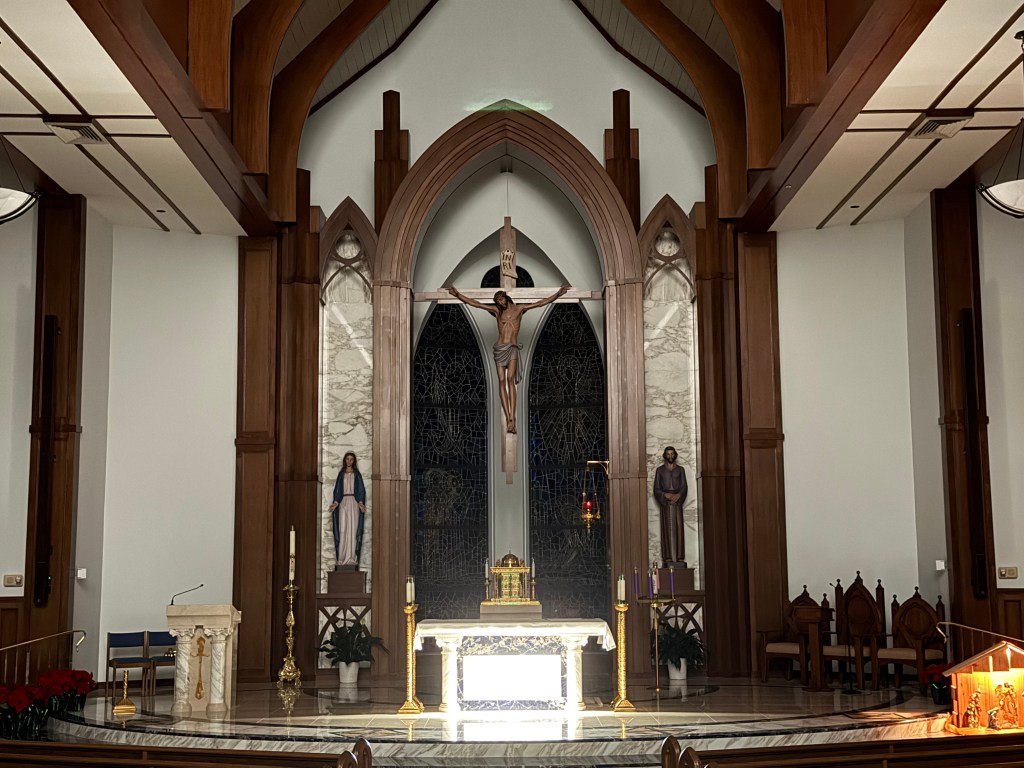

Link for the Mass readings for Wednesday, January 21, 2025

Jesus, Mary, and Joseph, please help us to follow the will of God as you did.

Joseph heard the news that Mary, his betrothed, was with child. In ancient Judaism, a betrothal was the first stage of marriage in which the couple exchanged their consent before at least two witnesses. They were considered to be legally married and yet the woman would still live in her home for up to a year. The second stage happened when the bride moved into the groom’s home and they consummated the marriage.

In Matthew sharing the information that Joseph and Mary were betrothed, indicated that the child was not biologically Joseph’s. Matthew does disclose the thoughts or emotions of Joseph about what he felt when he found out this news. Whatever inner turmoil he had, he chose not to bring Mary’s case to a public hearing, he did not want expose Mary to any shame. He was not going to make a public spectacle of Mary, but instead decided to “divorce her quietly.” Before he made his final decision though, Joseph made an excellent choice regarding the discernment of serious matters. He slept on the idea before acting.

During Joseph’s sleep, the angel of the Lord delivered a message. “Joseph, son of David, do not be afraid to take Mary your wife into your home. For it is through the Holy Spirit that this child has been conceived in her. She will bear a son and you are to name him Jesus, because he will save his people from their sins” (Mt 1:20-21). When Joseph awoke, he was obedient to the angel of the Lord. Joseph was willing to change his mind and took his wife into his home (Mt 1:24).

We may hear this so many times, we may miss the power of Joseph’s choice. He could have felt anger that the child was not his own and that Mary was unfaithful, which is what most of us go to when we read this account. There is another interpretation of the “reverential fear view,” which “was held by Sts. Thomas Aquinas, Bernard, Basil, and Ephraim. In this view, Mary told Joseph about her conceiving by the Holy Spirit and he responds with religious awe over the mystery of what God is working in Mary” (Curtis and Sri, 44). Joseph, like many of the prophets when encountering the work of God concretely do not feel worthy to follow through on what is being asked of him.

We don’t know what was going through Joseph’s mind before the angel, but we do know that he as did Mary once he was clear of God’s will trusted in God’s will, and “that has made all the difference” to quote Robert Frost’s poem, “The Road Not Taken.” Because of Mary and Joseph’s, “yes”, to God and to family, the Son of God became man and opened up heaven for us in the humanity he assumed.

God often works in the same way when dealing with us. What may appear to be absurd, unimaginable, or downright impossible, is indeed possible when we align our will with God’s will. This is the week of Joy in Advent.

The source of joy does not come from external experiences but from an encounter with and acceptance of God’s invitation. Joy is an experience of communion with the love of God. This has been given to us in greater measure because Jesus became one with us, and so upon his ascension into heaven, we too can experience the loving communion he experiences with his Father. We can also experience the love of the Holy Spirit in our encounter with family and friends, this exchange of giving and receiving of ourselves in conversation, shared experiences, and in resolving challenges and conflicts together.

Mary and Joseph both received incredible news, that neither of them fully comprehended. They could have easily responded in a different way. They could have given into very real fears. Instead, they trusted in and obeyed God, they chose family, and because they did, we can rejoice not just during this week but we can rejoice always! The same God who sought out Mary and Joseph has a plan for us as well.

Mary and Joseph followed God’s lead and were willing to allow their unborn child, Jesus, to come to full term. Because they were willing to risk public ridicule and worse, Jesus entered into our human condition. There may be a difficult situation we are dealing with, we may feel like we are on our own, and that there is no way out, and/or no help on the horizon. God will make a way when there appears to be no way, and reveal it to us through his Son. We may not understand either, but like Mary and Joseph, let us trust in God, one another.

Jesus, Mary, and Joseph, please intercede on our behalf this Advent Season such that we will resist the temptation of taking each of our family members for granted, and instead give others the benefit of the doubt, appreciate and be thankful for one another. Help us to react less and breathe deeply more. Help us to be more understanding, patient, and willing to forgive, such that even though we have experienced past hurts, conflicts, disagreements, and different points of view, we may ultimately experience time and again the joy of being there for one another, through thick and thin.


Photo: Blessed to spend time with the Holy Family each evening for my holy hour.

Link for the Mass readings for Thursday, December 18, 2025

The Holy Spirit is the new wine that will grow within us if we are willing to change.

God is not a tyrant. God is not checking his list and checking it twice to see who’s naughty or nice. God is not teeing up the football to pull it up at the last second as we are running up to kick it. God does not ask us to walk onto a rug and pull it out from under us.

Anything that God requires of us, asks of us, and the boundaries he establishes for us are done out of love for us. God wills our good and wants the best for us. God knows what will make each and every one of us in our own unique way fulfilled, to have meaning, joy, and experience freedom, love, and wholeness in our lives. God has a purpose for our lives that aligns with his will for the unity of all of humanity and creation.

It is from this context that we can understand our readings and the Bible as well. Saul is being corrected by Samuel because he was not obedient to God’s command. You cannot be partially obedient, as Saul was attempting to justify when he said that he obeyed the LORD and fulfilled the mission. Samuel showed that Saul had not done so (See I Samuel 50:8-23).

In the Gospel, Jesus gives the imagery of changing the old wine skins to new ones otherwise the old ones will burst as the wine ferments and expands. Newer and flexible skins are necessary (Mark 2:18-22). The new wine we are to receive is the life of the Holy Spirit within us, that can only breath and expand when we are willing to be flexible, to change and to grow. We can only change and grow when we are obedient to God.

Unfortunately, when many of us hear the words change, obedience, or discipline, we cringe or constrict. Yet, even in the natural, material world, there are many examples of the positive effects of a willingness to change, establish boundaries, order, discipline, and obedience. Resistance happens when we are operating under a false belief or apparent good that distorts our freedom. Freedom is not doing what we want, when we want, how and whenever we want. Those are examples of a freedom of indifference that leads us down the path of attachment, addiction, and slavery to sin.

God today is inviting us to experience a freedom for excellence. To have the freedom to play any instrument fluently, we need to be obedient to the teacher, discipline ourselves to practice, and be open to correction. Partial obedience, not being diligent with our times of practice, resisting guidance and correction, will limit our freedom to play. This is true in so many other areas of the arts, sports, occupation, relationships, family, and our spiritual life.

I still have the same guitar my father gave me when I was about seven. I still can’t play any music because I was not willing to discipline myself to play it and so I do not have the freedom to play any music. I have been obedient and put in the time and energy, discipline and sacrifice necessary to be ordained a deacon and blessed to have been serving as a deacon for these past ten years.

The bottom line is, do we trust the one who is guiding us? In this case, do we trust God that he has our best interest in mind? If we do, then we will be more likely to be obedient to his will, trust in his guidance, make the sacrifices necessary, and follow where he is leading us. That is what Jesus and Mary did, what the saints did, and what we can do, one step, one yes at a time. Easy? No. With his Son, Mary, the saints, still doing and willing to help us, as well as each other accompanying and supporting us, possible? Yes.


Photo: Rosary walk last night, St. Vincent de Paul Regional Seminary, Boynton Beach, FL.

Link for the Mass readings for Monday, January 15, 2024