
May we, like Anna, speak about how our encounter with Jesus has changed our lives.

We have no evidence of what the encounter with the baby Jesus meant for Anna, Simeon, the Magi, or the shepherds. What most likely happened was that they all did as Anna did, she “spoke about the child to all who were awaiting the redemption of Jerusalem” (Luke 2:38). Since they followed God’s invitation to come and see the baby in their own unique ways, even though their part in God’s theodrama was no longer recorded in the Bible, their lives were most likely not ever the same again as they continued to share the good news they experienced.

The account continued for Joseph, Mary, and Jesus who, “returned to Galilee, to their own town of Nazareth. The child grew and became strong, filled with wisdom; and the favor of God was upon him” (Lk 2:39-40). No ticker-tape parade, no giving the key to the city, and no gala ball awaited the Holy Family when they returned to Nazareth. They went on to live very simple lives preparing for the appointed hour.

The Advent and Christmas accounts of these past few weeks have revealed a wonderful tapestry of men and women accepting God’s invitation. In their own small and unique ways they have collaborated with God who works through the everyday events of people’s lives, more often than not unseen. We would do well to ponder and follow their examples. St. Mother Teresa learned from her namesake, the Little Flower, St. Therese of Lisieux, to do just that, not get caught up seeking to do great things, but to do little things with great love.

As the Christmas Season continues, let us do the same as life has already or has begun to shift; families and friends have come and gone or are readying to go, vacation days are coming to an end. Let us resist the temptation to get lost again in the busyness of life. Let us appreciate the gift we have been given, to meditate, ponder, and think a bit more about the accounts of Jesus and the supporting cast around him. What do these stories mean for each of us? Life can be hard and can change in an instant because it is fragile. Let us not take our family and friends for granted. May we take a deep breath and renew our commitment to God and each other.

As the Holy Family begins their journey to Nazareth and their simple life, as we begin to return to our regular daily routines, may we be a little more aware and open to the quiet and gentle ways of how God is working in our lives. May we commit to supporting and caring for one another, be a little more aware and reach out to those in need, express our need for help and allow others to assist us. As we do so, we will start to recognize the simplicity of divinity operating within the midst of our human interactions. The Holy Spirit is inviting us to be transformed in this new year, to watch, pray, and cooperate, so that he may kindle in us the fire of his love so that it may spread to others and renew the face of the earth.
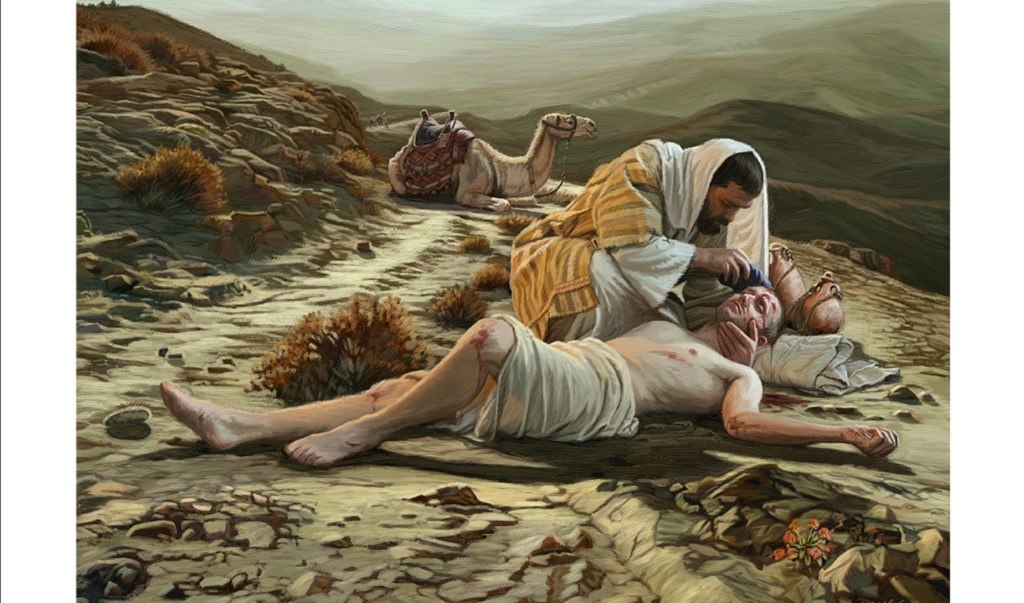

Photo: “Holding the Redemption of Israel.”

Link for the Mass readings for Tuesday, December 30, 2025

Are we willing to do likewise, and show mercy as the Good Samaritan did?

It is interesting that the Pharisees, the Sadducees, the Herodians, and here in today’s Gospel account, a scholar of the law, instead of genuinely seeking to learn the truth from Jesus, they all “test” Jesus. They seek to prove him wrong, trip him up, or attempt to present him in a compromising light.

The scholar indeed knows the law well. He knows the foundation of the law which Jesus himself calls the greatest commandment in Mark and Matthew. In combining Deuteronomy 6:5 and Leviticus 19:18, the scholar answers his own question that one can “inherit eternal life” by loving “the Lord, your God, with all your heart, with all your being, with all your strength, and with all your mind, and your neighbor as yourself” (Luke 10:27).

Jesus commends his answer and acknowledges his understanding. Jesus then shares an important point to any law or teaching: “Do this and you will live” (Luke 10:28). It is not enough to know, we must put what we know into practice. Otherwise, there is no fruit. What we “know” will atrophy, it will whither away and die if we do nothing with what we have learned.

Not only does the scholar miss the point, he continues on his course to press Jesus further, seeking to “justify himself” by asking who is his neighbor. Jesus without missing a beat, sings the song of the Good Samaritan. In it Jesus presents who ought to be the heroes, the priest and the Levite, two law abiding Jews. Each know the law but each are unwilling to take the risk of breaking the law of ritual impurity by touching a dying man. Or they do not want to risk their own safety and refuse to fulfill the deepest root of the law, loving their neighbor as themselves. So they walk on. Jesus does not give the reason for their refusal to help.

The one who is willing to come close, the one who fulfills the letter of the law is not a scholar, a Pharisee, one of the high council, or even a common Jewish man or woman, but a Samaritan. Samaritans were considered enemies for different reasons. They were not pure-bloods. They were of the northern tribes of Israel and many of the Jews that survived the Assyrian occupation intermarried with the Gentiles. They also worshipped, not on Mount Zion, Jerusalem, but on Mount Gerizim. Sprinkling in some violent interactions and you have a recipe ripe for division and distrust.

Yet, it is this Samaritan who lives out the fullness of the law of God by loving his neighbor who is in need. He not only comes close to check on him, he provides aide, brings him to an inn where he can rest, heal, and all on his dime. Did the scholar go and do likewise? We do not know. Just as when the rich young man walked away sad after Jesus invited him to sell all he had and follow him, we don’t know if he ever came back. Are we willing to treat each other with mercy as did the Good Samaritan?

We can know the Catechism inside and out, know the Bible chapter and verse, we can attend daily Mass, but it does not mean that much if we do not allow what we have learned to shape and soften our hearts and our minds such that we come to know Jesus, his Father and the love shared between them, the Holy Spirit. Our faith is about experiencing God’s love and loving one another as he loves us.

To grow in our relationship and experience of God’s presence we need to slow down, slip away from the fast pace and the instant gratification mill. What we receive in our time of reading, studying, meditation, prayer, and worship, we need to ponder and sit with, put into practice, and share with one another as God leads. “God works in depth, in the slow time of trust” (Pope Leo XIV).

We are not perfect. We all fall short of the glory of God. The enemy seeks to distract, divert, trip, beat us down, and leave us for dead, just as we read about the man on the Jericho road. The good news is that in our times of desperation, when we find ourselves down and almost out, the Good Samaritan is Jesus. He is not only willing to come close, if we are willing to allow him, he will lift us up, restore us to health, save, redeem, and give us new life.

As Jesus does for us, let us go and do likewise for each other.


Painting: “The Good Samaritan” by Dan Burr

Link for the Mass readings for Monday, October 6, 2025