“No. He will be called John.”

Zechariah had not spoken since the time he encountered the angel Gabriel. Gabriel shared with Zechariah that his wife Elizabeth, though barren and past childbearing age, would give birth to a son and his name would be called John. The time for the fulfillment of Gabriel’s prediction had now come to pass, Elizabeth gave birth, and with friends and relatives gathered around on the eighth day for his circumcision and naming. Elizabeth announced that her son will be named John. Those with her balked, “There is no one among your relatives who has this name” (Lk 1:61).

There may also be some hesitancy because John, or יוֹחָנָן, Yôḥanan in Hebrew, means one who is graced by God. Who did Elizabeth think she was naming her son by this sacred name? They then appealed to Zechariah. He supported his wife by writing on a tablet that “John is his name.” Zechariah confirmed Elizabeth’s words and: “Immediately his mouth was opened, his tongue freed, and he spoke blessing God” (Lk 1:63-64).

Filled with the Holy Spirit, Zechariah spoke what we call today the Benedictus or Canticle of Zechariah, the beginning lines of which read: “Blessed be the Lord, the God of Israel; for he has come to his people and set them free. He has raised up for us a mighty Savior, born of the house of his servant David” (Lk 1:68-69).

Zechariah did not proclaim that John was the Messiah. As Christians, we believe that Micah prophesied that John was to be the herald of the Messiah. He prepared the way for the coming of the Lord. The Benedictus, like the Magnificat, is a song of great promise. This is why the Church proclaims that they are to be prayed every day in the recitation of the Book of Christian Prayer or the Liturgy of the Hours. We are living in the time of its fulfillment.

The year 2025 A.D. does not stand for after the death of Jesus, it stands for anno domini, in the year of our Lord. We live in the in between times of Jesus’ first coming as we prepare for his next coming. We live in great joy because we can prepare to receive Jesus everyday. This is why St. Paul wrote to the Philippians, we are “to rejoice always.” No matter the external circumstances or internal angst, our Lord Jesus the Christ, the Son of the living God is at hand. Jesus has come to forgive, heal, accompany and deliver, give us guidance and strength. Jesus has come to save us!

In the midst of continuing violence, war, polarization, endless forms and acts of dehumanization, fear, and growing anxiety, we will celebrate again this Thursday. We will celebrate Christmas, the reality that the Son of God agreed to draw close to us. To become human, to die, and conquer death so that he can be with us and lead us into eternity. John helped to prepare the way to receive Jesus by calling people to repentance. May we seek his intercession as we prepare well in these final days of Advent so to better remember and celebrate again the reason for the season. Our Savior has come. Sin, suffering, and death no longer have the final answer. Jesus does.

May we heed the call of John and Jesus to repent so that we may be freed from our entanglements with sin, receive God’s forgiveness, and so better experience his grace and love. May we let go of anything that separates us from our relationship with God and resist the temptation to curve in upon ourselves which leads us to death. Let us turn away from our pride and the false promise of self sufficiency and instead depend upon and place our trust in Jesus who offers us eternal life. Each and every day, with the courage of John, let us prepare the way of the Lord and “give people knowledge of salvation” that Jesus is at hand so that God may “guide our feet into the way of peace.”


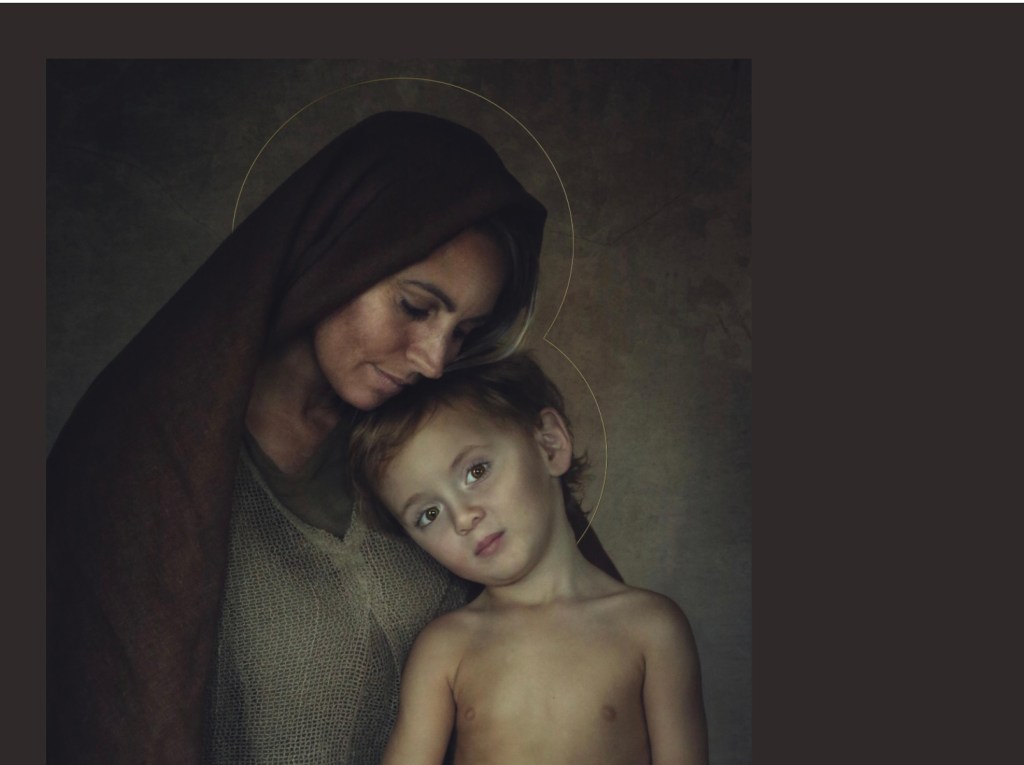
Photo: St. Elizabeth and John the Baptist by Krysten Brown, The Saints Project

Link for the Mass readings for Tuesday, December 23, 2025

Joseph and Mary trusted, followed the will of God, and gave us our Savior.

Joseph had an interesting twenty-four hour period. First, he learned that his betrothed, Mary, was “with child”. Betrothal in ancient Judaism was not what we think of today as being engaged. Betrothal is the first step in the marriage process in which the man and wife give consent to marry before at least two witnesses. The wife remains with her family while the husband builds a home for them. Once the time for the second stage of the marriage arrives, they will celebrate for about a week and then at the end, there is a procession of the husband and wife and all present that leads to their home. The couple enters their new home and consummate the marriage.

The key point is that even in the first stage of the marriage, the betrothal period, the couple is considered to be married and have formed a covenantal bond. If on the night of marriage it was uncovered that the woman was not a virgin or that she had conceived a child with another man, the punishment could be as severe as stoning. Although, by the time of the Roman occupation, it was not allowed for the Jews to enact capital punishment. This is why the Jewish leadership brought Jesus to Pilate to get permission for his crucifixion and why the crucifixion was enacted by the Roman centurions.

Providing this context may help us better understand that when Joseph hears the news from Mary that she is pregnant, and knowing that he was not the biological father he decided, to “divorce her quietly.” This could have been because he did not believe Mary, that she conceived this child through the power of the Holy Spirit. He also could have believed Mary, recognizing this was a miracle, but did not feel himself worthy to take on this roll. Either way or if there was some other thoughts swirling in his brain, before being able to act on his decision, the angel Gabriel had a few things to say.

“Joseph, son of David, do not be afraid to take Mary your wife into your home” (Mt. 1:20). Gabriel confirmed Mary’s story and was asking Joseph to fulfill his vow to Mary and to commence with completing the second stage of their marriage. Gabriel also called Joseph, “Son of David.”

These words reveal that the royal line of David did not die out at the destruction of the Temple in 587 BC at the hands of the Babylonians. Joseph was an heir to the throne of David. Gabriel continued, “You will name him Jesus” (Mt. 1:21). In calling Joseph to name Jesus, even though he was not his biological father, meant that he was asking him to adopt him legally and that meant he was just as much his son as if by blood. Meaning that Jesus would be part of the royal lineage and an heir to the throne as Joseph was.

The end of Gabriel’s message was the most powerful. Jesus or Yeshua in Aramaic, means God or the LORD saves, and this son of Joseph and Mary was not just to be the long awaited Messiah, he is: “Emmanuel, which means ‘God with us'” (Mt. 1:23) and he be the savior of the children of God, he would save them from their sins. If Joseph did not know how to respond to Mary’s version of her account, what about now? Joseph followed Gabriel’s opening line and was not afraid. Joseph fulfilled his word, trusted in God, fulfilled the second stage of marriage, and was willing, ready and able to provide and protect his young family from the challenges that were about to unfold.

Both Joseph and Mary awaited the coming of the Messiah just as so many of their kinsmen, yet neither could believe the part they were asked to play in being the parents of the Son of God. Yet, once they were clear of the plan that God had for them they faithfully assumed their responsibility. Because of Joseph and Mary’s faith and trust in God, their ascent to follow the will of God, the second person of the Trinity, the Son of God, took on flesh and became man in the virgin womb of Mary.

As Jesus would later speak during his public ministry, “Blessed are those who hear the word of God, and observe it” (see Luke 11:28). Joseph and Mary did just that and continued to do so with each thought word and deed going forward. They are models for us and Jesus their Son is more than a model, but the one who saves us, gives us the strength, guidance, and hope when we may feel weak, lost, or experiencing sorrow.

There are so many anonymous people within and without of the Church who are just like Mary and Joseph. They quietly and diligently go about their daily lives as pencils in God’s hands. They are not only open to hearing but also following the guidance of the Word of God. They ascent to the truth and follow through with their actions. They may not have even be aware of the profound effect that their choices have had on others.

Throughout the Bible, God calls those who are not necessarily worthy, but humble and willing to play their part in salvation history. Each one of us is invited to participate as well. If our heart aches about a particular issue and we may wonder why God does not intercede and correct a certain situation, he may be convicting our conscience, moving our hearts to compassion. The injustice that tugs at our heartstrings could be an invitation from the Holy Spirit to be the hands and feet of Jesus to help to make right what has gone wrong.

Mary and Joseph waited with great expectation for the Messiah, never in their wildest dreams would they have imagined that they would play a central role in his birth. Never would they have dreamed that he would be more than the Messiah, he would be “Emmanuel, God with us.” Jesus remained fully divine while he became fully human. If it were not for the care, guidance, and support of Mary and Joseph, things would have gone badly for Jesus and for us all.

May we allow our hearts and minds to be conformed to the movement of the love of Holy Spirit as did Mary and Joseph. Jesus, Mary, Joseph, and the saints have paved the way of salvation history for us to follow. We are invited to walk on, even if with baby steps in the beginning, and play our part by daily allowing each thought, word, and action to be filtered by the Holy Spirit so that we can engage in small acts of great love with each choice we make.

—————————————-

Painting: “All is Calm” by Gabriel Heaton from havenlight.com

Link for the Mass readings for Sunday, December 21, 2025

We begin another Advent to watch and pray for Jesus’ coming.

As the earth turned again one more time on its axis last night, and the shadows began to fall, night slowly crept over each part of our planet. Our sacred text, our sacred word, is not only written in the Bible, but the finger of God has traced his word across all of the earth, the galaxy, the universe, the whole of the created order. God continues to write and sing us his love song. The ground, foundation, and source of creation and our very being is the outpouring of the Trinitarian Love expressed between God the Father, God the Son, and God the Holy Spirit.

As the sun appeared to us to set, and night gently made its way across our minuscule earth in this part of the Milky Way last night, the vigil began and so also began the new liturgical year and we now find ourselves in the season of Advent. We heard or will hear again today the words of Jesus urging us to: “Stay awake” (Mt 24:42).

Paul in the second reading also sounds the alarm, for, “it is the hour now for you to awake from sleep” (Romans 13:11). Traditionally, the readings of the first two weeks of Advent focus on our watching for the second coming of Jesus. We are to watch and pray, to step away from the triggers of reacting. This Advent we are invited to slow down, observe how the daily cycle of day to night and night to day repeats itself. In doing so, we can enter into that daily rhythm of breathing, watching, and praying so that we can be more aware and more alert for the signs of his coming, like a watchman standing guard over the city. Then instead of reacting, we can choose to act according to God’s will.

During Advent, we also prepare in the final two weeks to remember again the first humble coming of Jesus, the Incarnation, in which the infinite Son of God took on flesh at his miraculous conception in the womb of Mary and became man. Fully God and fully man, Jesus experienced our human condition in the most vulnerable of settings. We are a people of memory, though we often forget, that is why we hear the story again of the simple birth of our savior, who many rejected even then, saying there was no room for him in the inn. Do we make room for Jesus to come to be present in our daily lives?

The third way we prepare for the coming of Jesus during Advent, is in our everyday experiences. We who have much in the way of material comfort need to remember, how God heard the cry of the poor and saved his people by sending Moses to free them from their bondage in Egypt. He sent judges and prophets to guide his people, and he sent his Son to be born in poverty, to free us from our bondage to anyone and anything that is not from him, anything that will lead us astray.

“God, in Christ, has come to set right a world gone wrong” (Grunow, 174). We have been made for God and nothing with fill our deepest desire to be in relationship with him. There is so much that attempts to lead us away from God. We can and do try to fill our deepest longings by grasping for anything but God and find ourselves dissatisfied time and again. We can’t save ourselves. The greatest willpower, discipline, and persistence is not enough. We need God, we need a savior. Let us remember this Advent who we are, whose we are, and who we are called to be. As we prepare for Jesus’ second coming and prepare to remember and celebrate his birth, may we also remember to set aside some time to enter into the rhythm of creation, to allow our hearts to beat in time with Jesus’ Sacred Heart.

We have been created by Love to love. As gently as the night gave way to the morning rays of the sun this morning, may we live and move more gently upon this earth. May our thoughts, words, and actions be filtered through the holy hepa filter of the Holy Spirit. So that we filter out that which is not, and accept that which is, of God. As we prepare well, we will not need to know the time or the hour, because we will know our Savior and so will be ready. Let us then awake, watch, and pray.

————————————————————–

Photo: Ready or not, Sunday Vigil here at Holy Cross, Advent has begun!

The Word on Fire Bible: The Gospels. Park Ridge, Illinois: Word on Fire, 2020.

Link for the Mass readings for Sunday, November 30, 2025

Jesus is willing to save the one.

“What man among you having a hundred sheep and losing one of them would not leave the ninety-nine in the desert and go after the lost one until he finds it” (Lk 15:4)?

At first hearing, how many of those present hearing the parable, or us today reading it, would answer yes? To most of us it would not make sense to leave the ninety-nine to go and search for the one that was lost.

What this parable represents is the love that God has for each and everyone of us. He knows us better than we know ourselves. God loves us with an everlasting love and is continually reaching out to us because he is the foundation and source of who we are. He wills our good and wants the best for us, even when we may not see the truth. This parable also represents a microcosm of the public ministry of Jesus.

Jesus met people one on one, person to person. He encountered the blind, the lame, the leper, the Syrophoenician woman, the woman at the well, the woman accused of adultery, the daughter of Jairus, the widow’s son, and Lazarus. Jesus not only healed these people and so many others who were considered to be on the outside looking in, he restored their dignity as human beings. Jesus loved each of them as a unique person.

In crafting this parable of the good shepherd seeking the lost sheep, Jesus may be echoing, Isaiah. He prophesied that because the leadership of his time was not bringing back the stray nor seeking out the lost, God would “appoint one shepherd over them, to pasture them” (See Ezekiel 34:23). Jesus sought out and continues to seek out the lost, no matter how far we have strayed, or messed up, Jesus loves comes for us.

He opens his arms and invites us into his loving embrace so that we may feel and experience the beating of his Sacred Heart. As we enter into that sacred rhythm, all our anxiety, fears, and pain begin to fade away and we begin to heal. We begin to experience our dignity as we experience being loved for who we are, not defined by our worst sins nor by what we do.

We just need to be willing to be found and allow him to lift us up on his shoulders and carry us back into the fold. As we do so and as we continue to experience his love, we will come to believe and say, as did St Paul,“Who can separate us from the love of Christ? Trial, or distress, or persecution, or hunger, or nakedness, or danger, or the sword?… Yet in all this we are more than conquerors because of him who has loved us” (cf. Romans 8:35-37).

Once we slow down enough to place our head on the chest of and experience the beating of the Sacred Heart of Jesus, renew in the rhythm of it, we will experience his peace and rest. We too are to love with the same radical love of the Shepherd who left the ninety-nine to rescue the one, who just happens to be us if we are willing to be rescued.

—————————————————–

Photo: Stain glass window at Cathedral of Our Lady of the Angels, Los Angeles, CA

Link for the Mass readings for Friday, June 27, 2025, Solemnity of the Sacred Heart of Jesus

“I will not reject anyone who comes to me.”

“Everything that the Father gives me will come to me, and I will not reject anyone who comes to me, because I came down from heaven not to do my own will but the will of the one who sent me” (Jn 6:37-38).

Jesus does not reject us when we seek him out and when we come to him. He accepts us because he knows that we come because we have on some level listened to his Father and allowed our hearts and minds to be moved by his love. Jesus has come to do his Father’s will which is to lead us all to salvation, to be redeemed and restored to the proper order of freedom from our enslavement to sin. Even when we turn away, are diverted by distractions, misled by our sin, or misunderstandings, Jesus will seek us out. In the depths of our souls, we all seek the love of God that we have been created for.

This is why Jesus met Cleopas and the other disciple on the road to Emmaus. Even though they were walking the wrong way, Jesus did not tell them that. He came upon them, walked among them, and opened up the Scriptures to them. In doing so, the fire that had been dimmed by the despair of Jesus’ death, was rekindled in Jesus’ breaking open the word for them, in sharing salvation history for them, such that when Jesus moved to continue on, they invited him to stay with them. Then, in the breaking of the bread, they recognized Jesus who they thought they lost. They experienced in their presence and were nourished by “the bread of life” (John 6:35).

It was through sharing a meal with them that they recognized him. How many meals had they shared together before his death? A close reading of Sacred Scripture shows how important table fellowship is for Jesus and his followers before his death and after his Resurrection. True, Jesus eating with his disciples after his Resurrection shows that he is no ghost, he is human, but also he is reestablishing the cornerstone of his ministry, table fellowship.

Not only are the basic needs of sustenance met, but also in sharing his time and conversation with anyone willing to eat with him, no matter their level of ritual purity, they were touched at the deepest hunger within their hearts, which is to belong, to be accepted for who we are. The majority of the crowd that Jesus spoke to has continued to come to him because he fed them with only a few loaves and some fish. In the miraculous multiplication, Jesus provided for their bodily nourishment, but also was also inviting them to experience the deeper spiritual nourishment of the soul which can only be nourished by his Body and Blood.

Jesus loves us, he wills the best for us. Many resist this truth for different reasons. It could be the callouses, scars, and growing cynicism as a result of wounds inflicted by others, those who did not fulfill expectations, betrayal. Each of us could have experience the same and have also been let down by those we have looked up to and trusted. If we are involved in a relationship long enough, we will experience disappointment or worse. This is because sooner or later, when we draw close the masks will come down and who we truly are, the fullness of our wounds and our gifts will come to the fore. Conflicts will arise because we are finite and imperfect, human beings. We are still a work in progress.

None of us are perfect. We are all on a journey. On our own, we will consistently fall short of our goal. That is why we need a savior. We need someone that we can trust that will be there for us when we are let down and when we fall down face-first into the mud. Someone who, when that happens, will lay down in the mud with us, look us in the eye, and smile.

Even if we are not able to look past the predicament, or smile in return, we might just be able to catch his eyes looking at us and then we will see him offer us his hand. We can then rise together, and stand again. That is how Jesus shows his mercy and love for us. He enters into our chaos and meets us in the midst of the muck and mire of our mistakes, wounds, and sins. He loves us there, and when we are ready to accept his offer of love, he invites us to get up, and begin to walk again.

As our relationship grows and deepens and as our trust strengthens, we begin to believe that we belong and have dignity. We begin to heal and realize that we are a part of something greater than ourselves. Then with wobbly steps, begin to offer attempts of the same mercy, forgiveness, and unconditional love to others that we have received. This is the path of discipleship. This is the road we are on, together. This is not a hundred-yard dash but a long and winding road. Let us be willing to: persist, be led, love, be there for, and accompany one another as we take the hand of Jesus and allow him to lead us on the Way. Jesus will not reject any of us who walk with him. May we help others as Jesus helps us when we fall to rise up and begin again.

———————————————————————————

Painting: Figure of Christ by Heinrich Hofmann

Link for the Mass readings for Wednesday, May 7, 2025

Would we choose to remain paralyzed or be healed?

In a time when word of mouth is the way to get news out, the momentum still moved quickly. Jesus has preached with authority and moved people with his words, he has healed people and exorcised unclean spirits. So when it was known that Jesus was in the vicinity, in his present home of Caparnaum, people came. Jesus came not to abolish the law but to fulfill it. That meant that he did not water down the message of God, but raised the standards even higher than they had been before under the leadership and legacy of Moses. Unlike some of the Pharisees though, Jesus did not just add heavy burdens to leave the people to carry on their own, Jesus accompanied those he challenged, he carried the weight of their sin, all the way to Calvary.

If Jesus had a business card to hand out as people gathered around him, it may have had written on it his first words recorded by Mark in his Gospel: “This is the time of fulfillment. The kingdom of God is at hand. Repent, and believe in the gospel” (Mk 1:15). The time of fulfillment is indeed at hand in the presence of the Son of God made flesh. The entrance to that kingdom is measured by a willingness to turn away from sin and turn back to God. Those who are open to the love of God, willing to be shaped and transformed by his love, who are in touch with their hunger and yearning to be one with the Father, recognizing that there is more to life than the false promises, apparent goods, and even the finite goods of this world, are drawn to Jesus.

When Jesus returned to Capernaum after some days, it became known that he was at home. Many gathered together so that there was no longer room for them, not even around the door, and he preached the word to them (Mk 2:1-2).

It is clear that there is a movement afoot in just these first two chapters of Mark. Another key verse from Mark is the very first line of his Gospel: “The beginning of the gospel of Jesus Christ [the Son of God]” (Mk 1:1). This is an amazing line, unless we read the words only, missing its proper contextual background. Those reading or hearing these words in the first and early second century would have grasped Mark’s intent immediately. There are two words in that verse that would have leapt off the pages or the lips of the reader; gospel and Christ.

The geopolitical powerhouse lording over Israel at the time of the life of Jesus was Rome. The house of Caesar was its head. Augustus Caesar was emperor at the time of the birth of Jesus. Tiberius Caesar reigned during most of the adolescence and adult life of Jesus. The term gospel, euangelion in Greek, meant good news. This gospel was spread throughout the Roman empire by messengers especially on two occasions, at the behest of the emperor; on his birthday and after great military victories. Christ, or Christos in Greek, meant the anointed one. The only ones who were anointed were emperors, kings, and priests.

Mark was making a very clear point with this opening verse, the proclamation of the good news: Jesus is the Christ, the anointed one, not Caesar. It is not Kaiser Kyrios, Casaer is Lord, but Iēsous Kyrios, Jesus is Lord! This verse is treasonous in the face of Caesar and a subversive rallying cry for the followers of Jesus then and today. Yet Mark was not calling for a military coup, or a power play, but transformation from within.

In his gospel account, Mark revealed that the first opposition to rise up against Jesus was not by the Roman occupiers. It came from the scribes of his own people. Instead of being amazed that Jesus had forgiven the man’s sins and was about to heal him of his paralysis, they seek to label him as a blasphemer. Imagine what the man felt who was just about to be healed before the interruption? Thanks to his friends, he was able to overcome the obstacles of getting to Peter’s house in the first place and then through the roof when no one would let them pass, and yet, would he get so close only to be denied by the scribes? Before these doubts could take hold, Jesus spoke: “I say to you rise, pick up your mat and go home” (Mark 2:11).

Jesus freed this man from his paralysis. Unfortunately, the scribes remained paralyzed. How about us? Do we believe that Jesus is a blasphemer or Iēsous Kyrios! May we come to see and to believe that Jesus is the Christ, the Son of the living God, our healer, and Lord. He will free us and heal us when we are willing to surrender our ego and allow ourselves to be transformed from the darkness of revenge, hatred, pride, and division, and instead be conformed to his Body, and like the man’s friends, uphold the dignity of our brothers and sisters through our acts of mercy, love, caring, and unity.

________________________________________
Photo: “Truly this man is the Son of God” (Mark 15:39)! Processional cross, sanctuary of St. Vincent de Paul Chapel, SVDP Regional Seminary, Boynton Beach, FL.

Link for the Mass readings for January, 17, 2025

“Behold the Lamb of God.” He who was born and died for us.

John the Baptist saw Jesus coming toward him and said, “Behold, the Lamb of God, who takes away the sin of the world” (Jn 1:29).

The only one who can take away sins is God. The unblemished lamb is the animal that is sacrificed at the Passover meal, commemorating when the angel of death passed over the Hebrews whose doorposts were marked with the blood of the lamb. The next day they were freed from their slavery under pharaoh, and the exodus event began culminating in their passing through the Red Sea to freedom.

The Son of God became human to become the Lamb of God. He experienced laughter, pain, suffering, love, tears, and all of our human condition even temptation, but he did not sin. The Son of God became human so that what he assumed in his human condition, he could redeem. As the Lamb of God, Jesus approached John for baptism, he took upon himself the sin of the world and submitted his divinity to his human condition and was willing to be baptized for repentance not because he sinned, but so that he could take upon the sin of the world upon himself. This act was also a foreshadowing of his crucifixion on the cross.

The Incarnation, the Son becoming fully human while remaining fully divine, was the premiere act of mercy, in that Jesus entered the chaos and woundedness of our lives. His allowing himself to die on the cross the greatest expression of his love. The same love that he shares with his Father, his receiving and returning all that he received to the Father and holding nothing back, we can see him doing so visibly when we look upon a crucifix. He was born and died, he gave everything, including his life for each and every one of us.

Alone we cannot be redeemed, we cannot be fully healed or restored to who we have been created to be. We need a savior. Jesus is, while at the same time, more than a model to follow or a teacher to guide us, he became one with us in our humanity to lead us up out of our brokenness and sin. In saying yes to his invitation, we can say with Paul, “yet I live, no longer I, but Christ lives in me; insofar as I now live in the flesh, I live by faith in the Son of God who has loved me and given himself up for me” (Galatians 2:20). This is the gift we have received again this Christmas, a reminder that when enter into a relationship with Jesus, he grants us the grace to access and share in the divine power of the Love experienced between God the Father, God the Son, and God the Holy Spirit.

Jesus holds his hand out to each one of us today. May we receive his hand in our own, and as our fingers touch his palm may we feel the wound there, embrace the remembrance of the nail that pierced his flesh, the pain that he endured, so we could have this very moment with him. Even in our brokenness, anxiety, confusion, fear, and sin, may we resist pulling away. May we feel the warmth of his hand grip ours. Let our gaze be drawn up to see his face, his smile, his forgiveness, and experience his infinite love for us.

I am blessed at each Mass as I hold up the consecrated host to be able to say, “Behold, the Lamb of God, behold him who takes away the sin of the world.” May we see, believe, and receive the Body and Blood of Christ. Amen.

———————————————————-

Photo: Christmas Morning Mass, Holy Cross Catholic Church, Vero Beach, FL.

Link for the Mass readings for Friday, January 3, 2025

Jesus is with us, even when we fall.

“Everything that the Father gives me will come to me, and I will not reject anyone who comes to me, because I came down from heaven not to do my own will but the will of the one who sent me” (Jn 6:37-38). Jesus does not reject us, he accepts us as we are, first and foremost. Jesus has come to do his Father’s will which is to lead us all to salvation, to be redeemed and restored to the proper order of freedom from our enslavement to sin. This is why Jesus met Cleopas and the other disciple on the road to Emmaus. They were walking the wrong way! Jesus did not tell them that, he just opened the Scriptures for them, so that they could see that he was who he claimed to be and then revealed himself to them in the breaking of the bread. Once they had a deeper encounter with him, they determined on their own to turn back, and even though evening approached they went back to tell the Apostles the Good News of their experience.

It was through sharing a meal with them that they recognized him. How many meals had they shared together before his death? A close reading of Sacred Scripture shows how important table fellowship is for Jesus and his followers before his death and after his Resurrection. True, Jesus eating with his disciples after his Resurrection shows that he is no ghost, he is human, but also that he is reestablishing the cornerstone of his ministry, table fellowship.

Here the basic needs of sustenance are met, for the body, and in also in sharing his time and conversation with anyone willing to eat with him, no matter their level of ritual purity, touches the deepest hunger within each of us, which is to belong, to be accepted as we are, for who we are. The majority of the crowd that Jesus is speaking to has continued to come to him because he fed them with only a few loaves and some fish. In the miraculous multiplication, Jesus is providing for their bodily nourishment, but also preparing them for the deeper spiritual nourishment of the body and soul to come in the next verses as he goes deeper into his Bread of Life discourse.

Jesus loves us, he wills the best for us. Many resist this claim for different reasons. It could be the callouses, scars, growing cynicism resulting from wounds inflicted by others as well as from those within the Church. Each of us could have experienced the same and have also been let down by those we have looked up to and trusted. If we are involved in a relationship long enough, we will experience disappointment or worse. This is because sooner or later, when we allow ourselves to get close enough, the masks will come down and who we truly are, the fullness of our wounds and our gifts will come to the fore. Conflicts will arise because we are finite beings. We are still a work in progress. Conflict is not a bad thing. It is healthy when we are willing to work together to resolve the conflict together.

None of us are perfect. We are all on a journey. On our own, not only will we consistently fall short of our goal, we will often be headed in the wrong direction. That is why we need a savior. Jesus, fully divine as Son, came down from heaven and became human to meet us in our humanity. He is there for us when we fall down face-first into the mud. He is willing to be there with us, to look us in the eye, and smile.

Even if we are not able to look past the predicament, can we resist Jesus? His eyes looking at us and his smile that lets us know we can get through this together. His hand offered to us that we can grasp and feeling the strength of his grasp, then rise together and stand again. That is how Jesus shows his mercy and love for us. He enters our chaos and meets us in the muck and grime of our mistakes, brokenness, and sin. He loves us there, and when we are ready to accept his offer of love, he invites us to get up, and begin to walk again toward the fullness of who we are called by his Father to be.

As our relationship grows and deepens with Jesus and as our trust renews, we begin to believe that we belong. We begin to heal and realize that we are a part of something greater than ourselves and then, with wobbly steps, we begin to offer attempts of the same mercy, forgiveness, and unconditional love with others. This is the path of discipleship. This is the road we are on, together. This is not a hundred-yard dash but a long and winding road. Let us be willing to persist, to be led, to love, to be there for, and accompany one another each step of the way. And especially may we have the willingness to help each other when we fall.

———————————————————————————

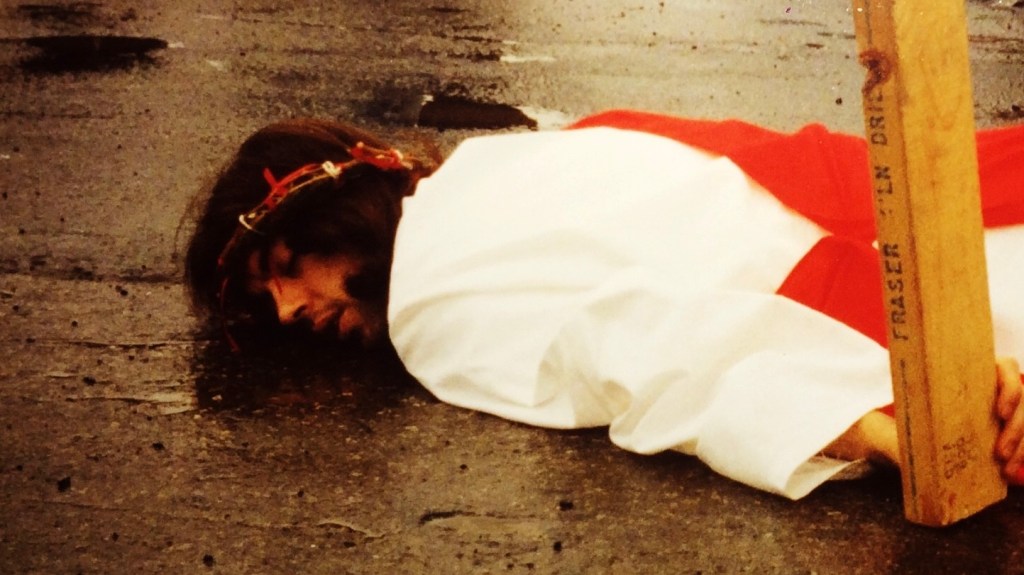
Photo: Living Stations of the Cross in the streets of the Bronx, me, as Jesus, falling a third time – around 1991.

Link for the Mass readings for Wednesday, April 17, 2024

Jesus took our sin upon himself to forgive and free us.

It is interesting to note that in today’s Gospel reading from John, Jesus spoke to those who “believed in him” (Jn 8:31). But the more he talked, the less they seemed to understand who he was: “If you remain in my word, you will truly be my disciples, and you will know the truth, and the truth will set you free.” His listeners balked at the word, “free”, asserting that because they were ancestors of Abraham they have never been enslaved by anybody.

In the United States of America, freedom is also highly valued. Many of us would probably react very much in the same way. We may have different ways of expressing why we feel that we are free, but we would certainly assert that we are not enslaved to anybody or anything.

Jesus’ words ring just as true then as they do today: “Amen, amen, I say to you, everyone who commits sin is a slave of sin.” Jesus shined his light on the truth that many of us do not see, which is our enslavement to sin. If we truly seek to be free, then we need to acknowledge this point. What many of us claim to be freedom, doing whatever we want to do, when we want to and how we want to do it, is not true freedom. We cannot even hear the clanking of the chains or feel the weight of the shackles chaffing at our skin as we raise and shake our fists to assert our freedom of indifference!

Our response to Jesus’ statement: “who commits sin is a slave of sin” ought not to be one of hiding, denying, rationalizing, attacking, or fleeing. It is better to embrace the truth that Jesus is placing before us. In this way, we allow his light to expose the darkness in our hearts where sin speaks, and we realize that we have said yes. Becoming aware of our fault for those things we have done and have failed to do is the first step in becoming truly free. Recognizing with St. Paul that we do what we don’t want to do and do what we don’t want to do, is another step.

When Pope Francis was asked in an interview, “Who is Jorge Mario Bergoglio?” he answered, “I am a sinner, but I trust in the infinite mercy and patience of our Lord Jesus Christ, and I accept in a spirit of penance.” We are all sinners because we all in some form or fashion place idols before God. When we think our life is about us first and foremost and ignore or rationalize our sin then we are enslaved, such that it chokes and threatens to undo us. Then we experience its debilitating effects and succumb or attempt to free ourselves, yet the process becomes likened to a Chinese finger trap. The more we pull to escape, the tighter the grasp.

This is not a negative or defeatist attitude, quite the contrary. We are children of God, created in his image and likeness. We have just forgotten who and whose we are. When we call out our sin in truth, we can be freed from it. Jesus became human, and took our sin upon himself to free us from death and sin.

We become free from our sins by acknowledging that we are sinners. This does mean we are awful people. We are good. It just means that we have fallen for an apparent good instead of the true Good that God wants for us. We also cannot ultimately be freed by our efforts alone. We need to work in collaboration with the mercy of Jesus. We need a savior. Jesus accepts us as sinners, as we are. He loves us as we are and wants the best for us.

We do not have to be perfect or have our house for him to come to be present with us, for he is already waiting for us. We do not need to be worthy, we just need to be willing to open the door when he knocks and invite him into the chaos of our lives so he can forgive and heal us with his grace, love, and mercy. “So if the Son frees you, then you will truly be free.” 

——————————————————————

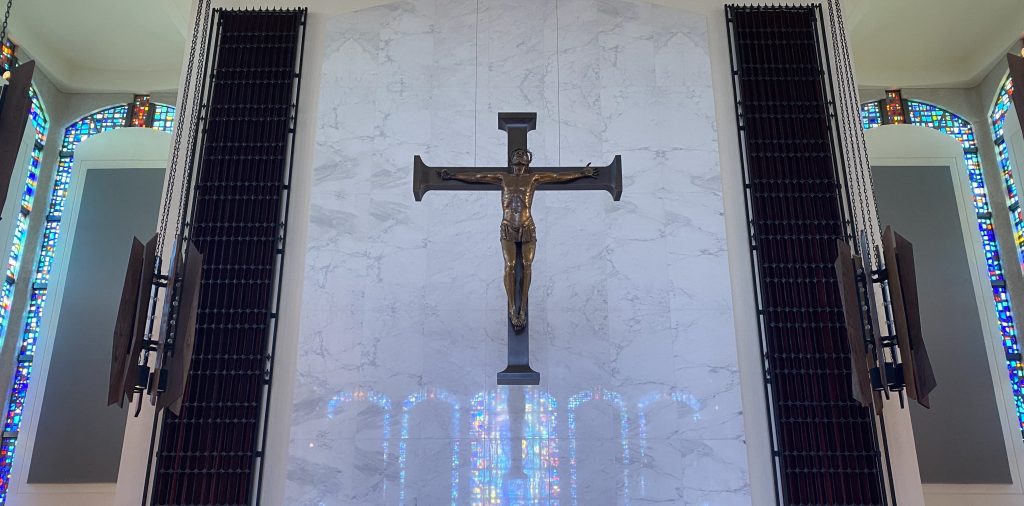
Photo: Crucifix in the sanctuary of SVDP chapel, SVDP Regional Seminary, Boynton Beach, FL.

Link for the interview with Pope Francis from America Magazine, September 30, 2013

Link for the Mass readings for Wednesday, March 20, 2024