service
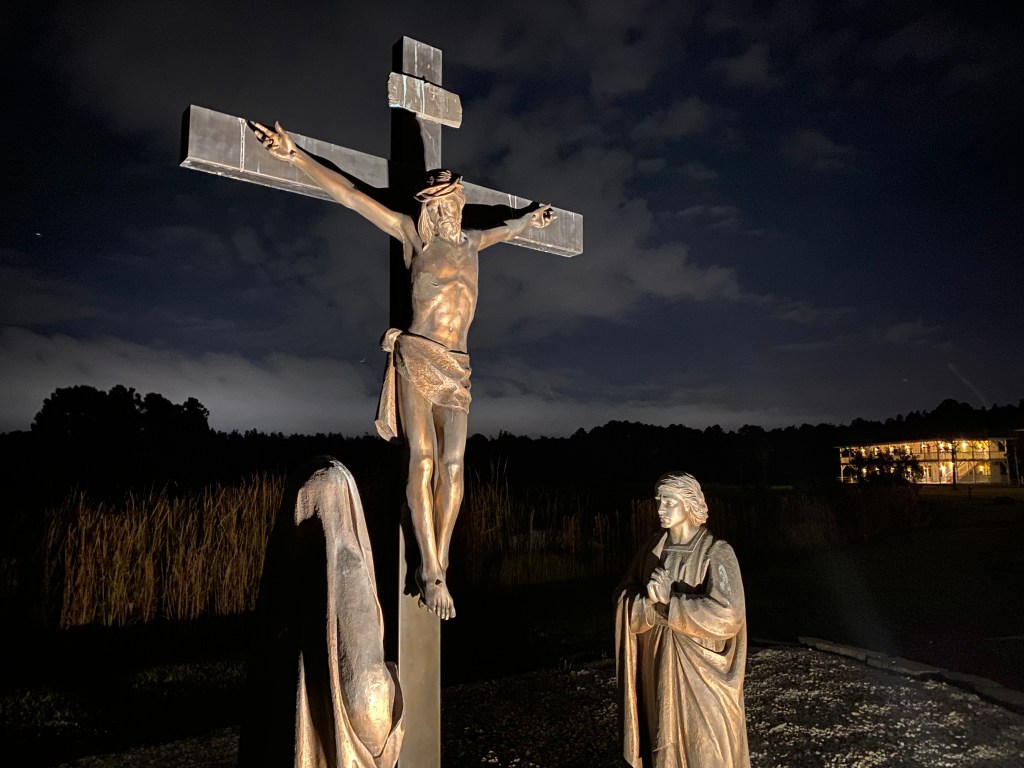
Not God, “What will you to do for us?” but instead, “What are we to do for you?”
For the Son of Man did not come to be served but to serve and to give his life as a ransom for many (Mk 10:45).
As fully God and fully man, Jesus taught and modeled for his disciples a contrarian view of how to live in our world. He rejected the pursuit of worldly honor, power, pleasure, and wealth during his earthly ministry. Jesus redirected any attention drawn to himself to his Father. He epitomized the exact opposite of the cult of personality by emphasizing that what is most important is developing a relationship with God and following his will by serving the needs of others, even to the point of suffering and dying to open up access to heaven for us.
On our own, we cannot achieve this freedom of service. James and John showed that they did not understand Jesus’ call to service. Instead, they were looking for seats of honor and power. Though they had experienced, studied, and were mentored by Jesus, it was not until experiencing his crucifixion, resurrection, and ascension, and in remaining true and faithful despite their own failures, that they came to a place of transformation through their openness to the indwelling of the Holy Spirit. They came to understand that Jesus called them to serve and not be served. They then fulfilled what Jesus first saw when he called them to leave their boats and follow him.
This is true for us as well. Jesus sees not just our impulsiveness, pride, and selfishness, our wounds, and our sins, but who God has called us to be from the beginning and still is yet to be actualized. Jesus calls us to a way of life that embraces loving and serving as he loved and served, yet in the unique way and charism that our loving God and Father has planted in us. He has sent the Holy Spirit to guide, empower, and to transform us by his love, so to draw us deeper into the Mystery of God.
May we be willing to be led, as James and John were, away from our attitude of: “Teacher, we want you to do for us whatever we ask of you.”, which is never a good question to ask the Son of God because in so doing we are feeding our E.G.O. We are Edging God Out of the picture and placing ourselves front and center. Instead let us open our heart and mind as Jesus did and embrace the inner disposition of a servant that asks, “God, what do you want me to do for you? How do you want me to serve? Not my will, but your will be done.”
——
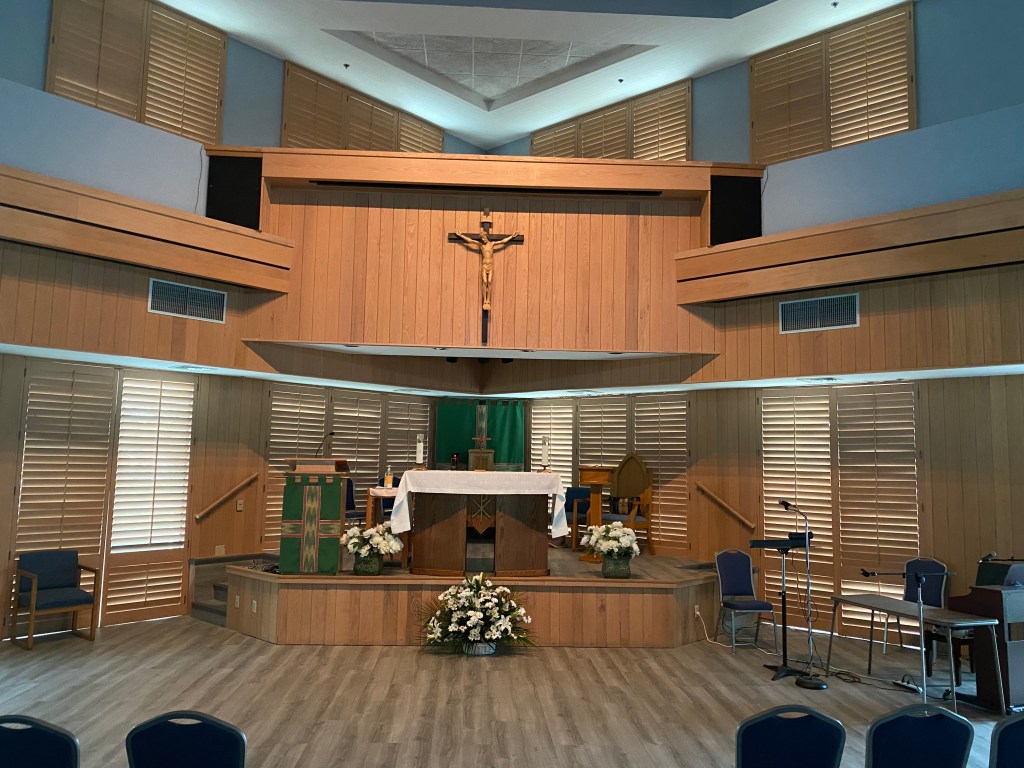
Photo: A time of quiet and thanksgiving looking at our new but temporary sanctuary in our parish hall. I was blessed to be able to greet and celebrate Masses this weekend together again with my Holy Cross family. We are beginning again and seeking God’s will on how to best move forward.
Link for the Mass readings for Sunday, October 20, 2024

“Whoever humbles himself like this child is the greatest in the Kingdom of heaven.” – Jesus
“Whoever humbles himself like this child is the greatest in the Kingdom of heaven. And whoever receives one child such as this in my name receives me” (Mt 18:4-5).
Children during the time of Jesus were seen if at all, to have little worth. They were vulnerable, had little if any status in society. They were often nothings, nobodies, and completely dependent on their parents for survival. Jesus invites a child to come to him, identifying himself with the child, as a response to the disciples’ question as to who would be considered the greatest in the Kingdom of heaven.
Jesus taught his disciples, and us today that we need to be completely dependent on God our Father, just as a small child is totally dependent on his or her parents. What leads us to greatness in the Kingdom of heaven is our turning away from the temptation to curve in upon ourselves, resisting the urge to feed our ego, place ourselves first, and as St Thomas Aquinas taught, resisting the cultural lures and substitutes for God: power, pleasure, honor, and wealth.
We are also to reject the image of the Übermensch, the super man, popularized by Friedrich Nietzsche, the 19th century German philosopher. Nietzsche wrote that God was dead and promoted the idea that humanity needed to create a world that would create new values based on the power of their will alone. Supermen and women striving for complete autonomy and self-sufficiency. Jesus teaches the exact opposite. We need to place our complete dependency and trust in God and rely on him for everything.
Participating in the reign of God is not one of lordship over another. Instead we are to assume the humility to accompany, walk along with, and serve each other along our journey in this life. Jesus embodied this reality. He as the Son of God entered into our human condition. He did not grasp at his divinity but instead surrendered it to his humanity. While remaining fully divine, he became human when through the power of the Holy Spirit was conceived in the womb of Mary, developed through his period of gestation, and was born into our world. As an infant and child, he was completely dependent on Mary, Joseph, and God his Father.
As Jesus continued to grow as a young child, he experienced the fullness of the human condition. He laughed, he cried, he got sick, he was tempted, he felt pain, he experienced heartache and joy. Throughout his life, and especially during his public ministry, he experienced human suffering up close and personal. He understood the suffering of his neighbor and experienced his own human and finite limitations. He loved and wept as we saw in his encounters with Lazarus, Martha, and Mary.
Jesus invites us to relate to God as our Father often in the Gospels, in the best sense of that intimacy of dependence. St Thérèse of Lisieux got this. “Jesus has chosen to show me the only way which leads to the Divine Furnace of love; it is the way of childlike self-surrender, the way of a child who sleeps, afraid of nothing, in its father’s arms.” Accepting Thérèse’s image is an acknowledgment that we are dependent on God and others, that we are not self-sufficient, that we are not capable of living radically independent lives, nor are we supposed to. God created us to be loved and to love, to be in community, to care for, empower, and support one another.
Our guardian angels, whose memorial we celebrate today, are at the ready awaiting our call. When we have the humility to ask for their help, we will realize that we are not alone. When we experience some supernatural support, from God, his angels and saints, we might just be willing to seek help from and support each other. We can offer a shoulder to lean on, a smile, a hug, a voice that speaks for the voiceless, a soul open to pray with and for others, an ear to hear, and we can embody the courage to serve and stand up for the dignity of others.
St Mother Teresa was willing to come close and pick up that first dying man in the street. She did not ask his religion, was not concerned if he was of a different race or nationality, was not afraid to risk illness or injury by attending to him. She knelt down and was present to him in his time of dire need. We are at our best when we follow Jesus, St. Thérèse and St Mother Teresa, the saints, and our guardian angels, place our dependency and complete trust in God’s hands and accompany each other by doing little things with great love.
Photo: To be loved and love in return is why we are here at this time.
Mass readings for Wednesday, October 2, 2024
Any willingness to share, Jesus will multiply.
As Christians we are called to be disciples of Jesus, to learn his teachings, and follow his ways. We are also called to be apostles in that we are to go out, proclaim, and share that he is who he said he is, and how he has affected our lives. Often when we are reminded of this message though, we may feel inadequate. We may question what it is that we can even possibly offer to help build up the kingdom of God. We may feel we have nothing to share, nothing to give, nothing to say, or that what the Lord asks of us, we do not know how to accomplish.
The disciples express similar feelings today for the latter point. Jesus shows concern for the thousands who had just listened to him for three days and are readying to depart. He is concerned that they are hungry and that some may collapse on their way home. The disciples look about bewildered as to how they could possibly feed the vast crowd. Then Jesus asked, “How many loaves do you have” (Mk 8:5)? They responded that they had seven loaves and two fish. Jesus would go on to feed, not only the whole multitude gathered, but when all ate their fill, seven baskets of bread fragments were left over.
We may not know how to take active steps to live our faith out in our daily lives, we may not even be aware of how to begin. On the other hand, we may have actually been engaged in service, but have started to coast, gotten complacent. If we are not moving ahead in the spiritual life, we are moving behind.
Each day is a new opportunity to begin again, and a good way to do so is to place ourselves in the presence of Jesus. We can sit before a statue, a picture, or an icon of him, we can look out a window, sit on a porch, or go outside. Any place that we can just be still and close our eyes will work. Then take some deep breaths, be silent and return to today’s Gospel account. The need of the people that were with Jesus for three days was hunger. As you reflect, what is your need? What needs might there be in your family, friends, neighbors, colleagues, or classmates? What needs in your community?
As you ponder these questions, resist any temptation to self-censor. Allow any need or needs to arise. Once you identify a concern, listen to the same words Jesus asked, “What do you have, what can you offer?”
You may not have an immediate answer. Stay with the question for a period of time, take it with you throughout the day if need be. Resist looking for the big response, a grand plan. Ask yourself what you can offer, no matter how small. Your willingness to share and to help, Jesus can multiply and bring about amazing results.
The disciples only gave seven loaves and two fish, which seemed insignificant to feed the thousands, and yet, Jesus multiplied that meager amount to feed all present with seven baskets left over. Jesus provides, Jesus works through us. The question we need to answer is not are we worthy, wise, or strong enough? The question we need to answer is, “Are we willing?”
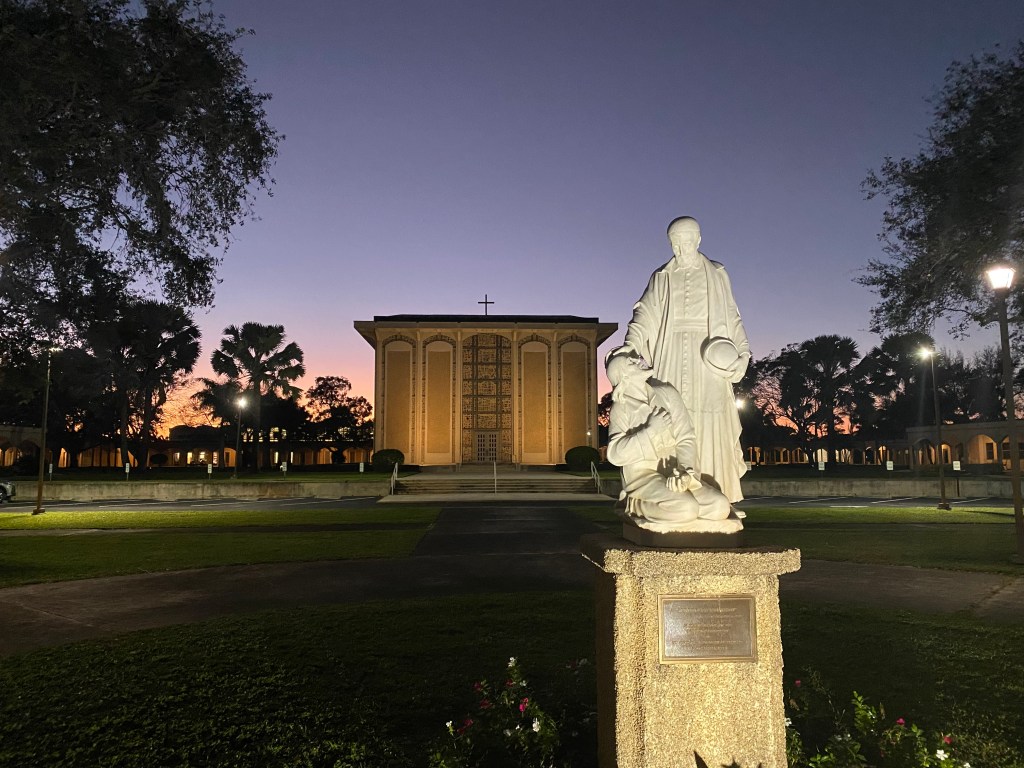
Photo: St. Vincent De Paul, our patron saint at the seminary, was willing to help and Jesus touched many through him. Entry to St. Vincent De Paul Regional Seminary, Boynton Beach, FL.
 Spiritual Stepping Stones