service
Having beheld and received Jesus, may we go forth to serve him in one another.
Jesus appeared to the Eleven and said to them: “Go into the whole world and proclaim the Gospel to every creature” (Mk 16:15). Jesus is once again claiming who he is: Kyrios – Lord. The word, gospel, comes from the Greek word, euangelion, meaning good news, but the one who proclaimed “good news” during the time of Jesus was the emperor. Caesar would send his emissaries to announce such good news as a great victory or his birthday. What Mark conveys in the very first line and here at the ending of his Gospel, is that Jesus is Lord! Not Kaiser Kyrios, Caesar is Lord, but Jesus Kyrios, Jesus is Lord!!!
We receive Jesus our Lord in an intimate way in the Eucharist. We receive his Body and Blood. We are loved and transformed by him each time we receive him by consuming him as we have been reviewing these past few days with Jesus’ Bread of Life discourse. When we are dismissed from Mass, one of the dismissal lines is, “Go and announce the Gospel of the Lord.” This is to echo the command of Jesus for all of us to proclaim the Gospel in our everyday experiences and encounters.
We proclaim the Gospel first and foremost by believing that Jesus is the Christ, the Son of God, our Savior and Lord. He has risen! He has risen indeed! He is the firstborn of the new creation. This is something to get excited about, something to fill us with joy. We are not to be a Grumpy Gus People, but an Alleluia People!!! Once we remind ourselves what we believe, who we believe in, who we are, and whose we belong to, then we are better prepared to engage with others.
The most powerful witness we can offer is when we seek opportunities to act, speak about and engage others with respect, caring, and joy. When we catch the eye of another offer a smile. We can also say hello, a nod of our head, or offer a wave, fist bump, high five, or a hug. We also need to be aware of other’s boundaries and respect their space at the same time. If someone is not open, we need to respect their posture, and meet them where they are.
Reaching out to others to acknowledge their dignity and value is the simplest, yet most profound way to spread the Gospel, which really means to share the love of Jesus by willing their good. We are to accept and accompany others as Jesus does with the purpose of building relationships. We are more inviting when we are willing to be patient, gracious, and willing to listen and hear in our interactions with each person we meet and in doing so we may begin to understand each other a little better.
Remember God gave us two ears and one mouth for a reason because it is better to listen first and speak second. As we encounter others, we are to also remember the common courtesy of saying please, thank you, and I forgive you, whether in a store, restaurant, bank, convenience store, on the sidewalk, in traffic, or online. It is just as important to engage in a similar fashion with those of our family, friends, and those closest to us.
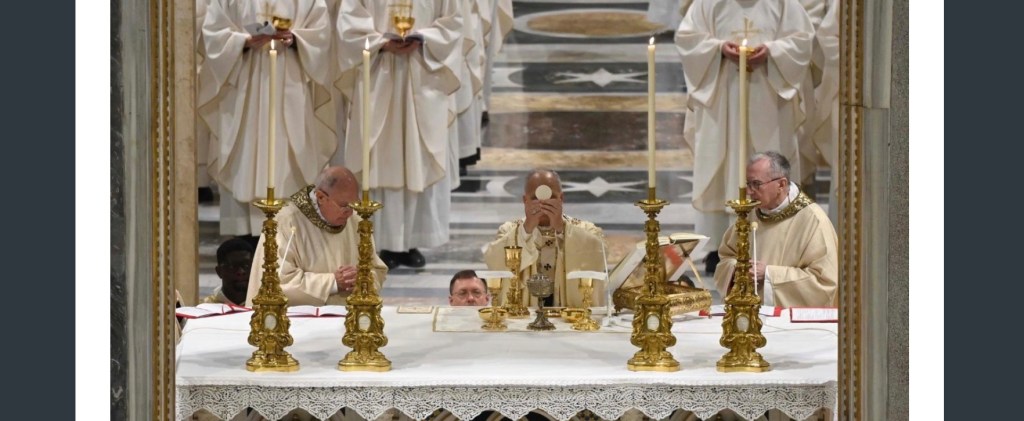
Especially now, with our country and the world on edge and more anxious than ever, believing in Jesus, embracing his love, and putting into practice small actions with great love we can make a difference. As Pope Leo said in his homily on Holy Thursday: “Christ offers us the example of self-giving, service and love. We need his example to learn how to love, not because we are incapable of it, but precisely to teach ourselves and one another what true love is. Learning to act like Jesus — the living sign that God has placed within the history of the world — is the work of a lifetime.”
Photo: Pope Leo XIV celebrating Mass Holy Thursday Evening (@Vatican Media)
Link for the Mass readings for Saturday, April 25, 2026
Almsgiving helps us to tap into the source of God’s love and service.
The Parable of the Rich Man and Lazarus (Luke 16:19-31) is well worth the read. Jesus challenges us through parables such as these. For the people of his time, those who had wealth and status in society did so, it was believed for the most part, because they were blessed by God. And likewise, those who were poor, were so because of God’s punishment. When the rich man and the beggar, Lazarus, die, I am sure Jesus paused to allow his listeners to imagine what would happen to these two men and to give their presumptions some time to ferment. Many would not have predicted what happened next.
Lazarus was taken up “by angels to the bosom of Abraham” (Lk 16:22). The rich man found himself suffering from the torment of flames, such that he was parched, begging just for a drop of water from Lazarus (cf. Lk 16:23-24). Abraham, the model of faith and father of Judaism, was not sitting with the rich man, who must have always been seated at the highest places in his day. Now that seat, at the bosom of Abraham, was offered to Lazarus. There was no hope at this moment for the rich man to cross over because of the wide chasm that separated them. An ironic subtlety was afoot as well in Jesus’ telling of the parable to the Pharisees. Lazarus the poor beggar is named, whereas, the rich man is not. Some biblical scholars, based on the context of this exchange with Jesus and the Pharisees, believe that Jesus was alluding to the rich man to be Herod Antipas and indirectly calling out the Pharisees for their close association with Herod, especially regarding the death of John the Baptist.
This state of suffering and separation for this rich man because of the uncrossable chasm, is a revelation of the life he lived prior to his death. He walked over or by Lazarus day after day not giving him even a second look. Lazarus would have been grateful even for the mere scraps that fell from the rich man’s table, just as the rich man now sought just a drop of water from the finger of Lazarus. The rich man committed the root offense from which sprouts much of our sin; he failed to bother, to care, to love his brother, to will his good. He failed to come close to Lazarus who was in need.
Jesus’ parable of the Rich Man and Lazarus, echoes very closely Matthew 25:40, “whatever you did for one of the least brothers of mine, you did for me.” How we treat each other matters. Failing to care, to reach out to those in need around us is sinful. We, probably like those who first heard this parable, experience time and again, a wicked mind storm that swirls with reasons, rationalizations, and justifications as to why we do not reach out to help. The majority, if any, are not valid. We are invited to give and to love joyfully from a natural, not a hesitant disposition, to provide aid and support.
Almsgiving is one of the three pillars of Lent and the practice helps us to heal our relationship with others. The first step is to be aware of those who are in need. This can be in our own home! Second, when we see someone in need and we feel the wind and the waves of our mind surging with reasons of why not to help, it is important to take a breath and call on Jesus. In that moment of pause, may we allow our eyes to adjust so that we can see the person before us as a human being, as a brother or sister with dignity, value, and worth.
What we are to seek in each moment of encounter is the guidance of Jesus and our willingness to allow him to work through us. May we be willing to be present and allow the Holy Spirit to happen in whatever form or act of kindness we are directed. We can do this best when we are daily entering into God’s word and allowing the Old and New Testament readings, especially these Lenten readings, to shape and transform us. When we trust “in the Lord”, we will be “like a tree planted beside the waters” (Jeremiah 17:7-8).
Almsgiving is the sharing of this spring flowing from the love of Jesus and helps us to grow in compassion and generosity. This flow will never run dry as long as we seek to be nourished by God’s word and his laws that teach us how to love one another. If not sure where to begin, we can pause and listen to Mary and do the same as she directed the servants at the wedding feast to: “Do whatever he tells you” (John 2:5).
——————————————————————-
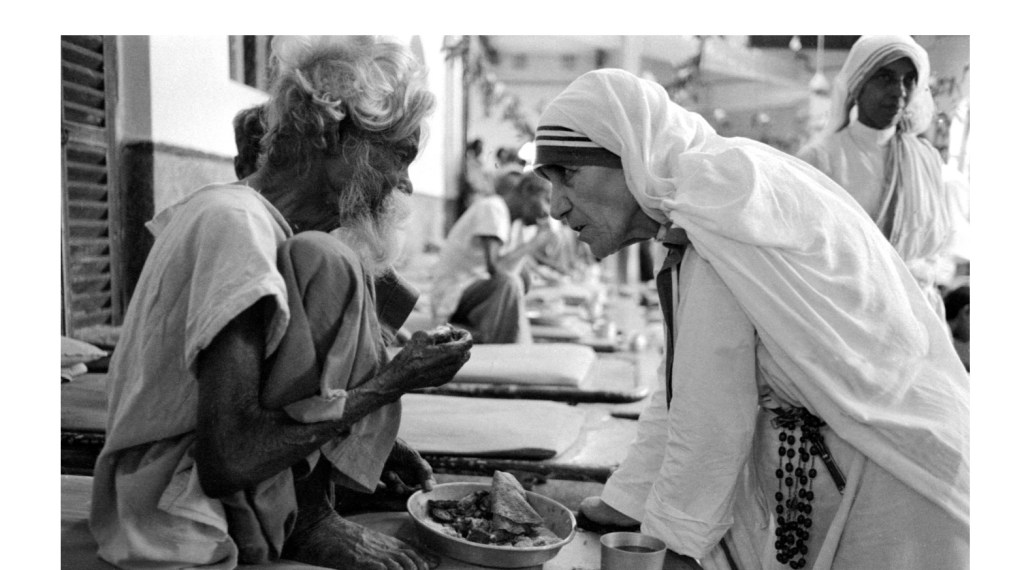
Photo credit: When St. Mother Teresa picked up the first man dying in the street she began to put into action her call within a call to serve the poorest of the poor. How and who is God calling us to serve?
Jesus offers us his light to shine in and through us to be shared.
“Is a lamp brought in to be placed under a bushel basket or under a bed, and not to be placed on a lampstand? (Mark 4:21).
God blesses us by giving his Son to us. He has done great things for us and he is the source of our joy! We do not earn nor is there anything that we can do to gain God’s grace. Our God and Father loves us unconditionally and always without hesitation and calls us to deeper and more intimate communion. But we can lose this gift of invitation to relationship, either by refusing what has been offered, or once accepting and receiving, not doing anything with the gift. If we are people of faith in name only, but not followed by action, we are concealing the light we have been given.
Prayer is the lifting of our hearts and minds to God, to spend time with him and in truly doing so, our lives as with any relationship, is changed. If we are not moving forward in the spiritual life, we are moving backwards. If we do not exercise our faith and allow that to happen over longer periods, we will receive signs of spiritual atrophy. To not even acknowledge the presence of God in our lives, the free gift of his invitation to be in a relationship with him, we will experience limitations and frustrations.
For whether we believe in God or not, we hunger to be in communion with him and one another, so we will be looking for other apparent avenues of happiness that will fall short of fulfilling us. If we do accept that there is a God, yet don’t participate in worship, fellowship, service, meditation and prayer, we are little but not much better off. I can believe that my truck will get me to where I want to go, but if I do not put the key in the ignition, turn on the engine, and shift it into drive, and press the gas peddle, I will remain stationary.
We are called daily to spend time reading, meditating and praying with the words of the Bible, putting into practice what we receive, and serving God as he leads. These spiritual non-negotiables happen more consistently when we schedule them first before any other activities, while being true to our station in life. A parent with an infant will have different demands than a monk or nun. What we do or do not do, does not earn God’s love. God loves us no matter what. The difference is that when we are consistently engaged in spending time with God, following his will, and putting into practice what he is guiding us to do, we experience his love and peace more because we experience him more.
We will then be more like Mary and the saints who reflected the light of Jesus. Privatizing our faith as well as getting into another’s face stifles the light of Jesus. We are called to follow the lead of the Holy Spirit, to be present, caring, understanding, supportive, convicting, and empowering, as we accompany one another in our realm of influence. The relationships we build are those that God brings into our lives.
Jesus has given his life for us, he continues to be present to and through us to others. May we be open to being conformed today and each day by his love. We are better able to do so by resisting and renouncing the temptations, diversions, and distractions that seek to lead us away from God. God sent Jesus to enter the chaos of our lives. May we allow him in to shine his light in our lives so we can identify and purge anything not of him, so that then we may begin to radiate the presence of Christ’s light in simple and concrete ways that allow God to happen through us in each encounter.
Photo: More of Jesus’ light will shine through us the more we are still enough to receive it.
“The fruit of love is service.”
He shouted, “Jesus, Son of David, have pity on me!” The people walking in front rebuked him, telling him to be silent, but he kept calling out all the more, “Son of David, have pity on me” (Lk 18:38-39)!
The difference between the blind man who shouted to Jesus and the people walking in front of Jesus was that the man knew he was blind. Those preventing access to Jesus were not aware of their spiritual blindness. Luke does not say why the people were preventing access to Jesus, just as Jesus in his parable of the Good Samaritan did not say why the priest or the Levite did not help the man dying on the road to Jericho.
Why would the people prevent the man from having access to Jesus? Especially since he was asking for pity or mercy. One practical reason could be time. They were on the way to Jericho, their mind was set to get there, and stay on the schedule they would. Another could be that the man was a beggar. He was not seen to have dignity and worth, so they attempted to quiet him so he could go back to being invisible. The Jericho road was a dangerous road, maybe this was just a setup, a way to lure Jesus into an ambush.
Ultimately, we do not know why they attempted to prevent the man access. The more important question is how often do we prevent others from accessing Jesus? We do not have the time, they are other, we may not see their dignity and worth as human beings, and/or we are afraid, so we keep others at arm’s length. Could it be we are just indifferent to the suffering of others?
Jesus responded differently to the call of the beggar in today’s Gospel account. He stopped and had the blind man brought to him. He made the time, saw him as a fellow brother with dignity and worth, and he took the risk to reach out to someone in need, and healed him. As Pope Francis has said, “[Jesus] understands human sufferings, he has shown the face of God’s mercy, and he has bent down to heal body and soul. This is Jesus. This is his heart” (Francis 2014, opening page).
This is to be our response as well. Even if we do not understand the suffering of another, Jesus does. We are invited to stop, to be aware, to enter the chaos of another, and trust that Jesus will be present through us to provide mercy. Are we willing to resist indifference and fear and instead see each person we encounter, not as other, but as a fellow human being? We do this best by making the time and being present. Are we willing to ask Jesus to heal our blindness that we may be willing to see the dignity and worth of each person that we meet so that those we encounter see in us the face of God’s mercy? We will be more apt to do so the more we spend time being still, breathing, resting, receiving, and abiding in God’s love.
Photo: “The fruit of silence is prayer, the fruit of prayer is faith, the fruit of faith is love, the fruit of love is service, the fruit of service is peace” – St. Mother Teresa. When we put into practice the words of Mother who put into practice the way of Jesus, we will also have the eyes to see and serve Jesus in those around us.
We pray, love, and serve because we are loved by the One who is Love.
“[W]hen you hold a banquet, invite the poor, the crippled, the lame, the blind; blessed indeed will you be because of their inability to repay you” (Lk 14:13-14).
Jesus means what he says here, though I am not sure many of us are ready to live this Gospel out. If we are going to get to the point where we can, we must understand the deeper point that he is making. The words of Jesus above give us an example of what it means to love unconditionally. We are to resist the temptation of doing anything with the primary purpose of receiving thanks or praise. We are to instead reach out to those in need because they are in need seeking nothing in return. We embrace our dignity as human beings when we recognize the inherent dignity of another and serve them without hesitation, without holding anything back.
This is the root of what we mean when we say that we are believers in the God of Jesus Christ. God is a divine community of persons, Father, Son, and Holy Spirit. The Father gives all that he is to the Son perfectly, infinitely, holding nothing back. The Son receives all that he has been given perfectly, infinitely and returns, in like fashion, what he has received back to the Father, holding nothing back. The infinite love shared between the Father and the Son is the Holy Spirit.
The Son of God became incarnate, one with us in our humanity, and he also gave all of himself to us on the cross, holding nothing back. He conquered death, rose from the dead, ascended to the Father so that we now can participate in that same divine love given and received between Father, Son, and Holy Spirit. We do not give of our time, talent, and treasure, so that we will receive more of each. We give, we love, we will the good of each other, because we have been loved into existence and are continually loved more than we can ever imagine by God. We are to receive his love and love in return because that is who he created us to be.
The very fact that we exist, that we have life, is a gift, yet we are not meant to merely exist. Jesus teaches us that the height of our humanity is to allow him to love us and through us, love others unconditionally. When we look into the eye of each and every person we meet, we are to see a brother, sister, mother, father. With each smile, each embrace, each listening ear, each act of invitation to walk not ahead, not behind, but with another, and by simply being present, we reaffirm to each other that we have dignity. This is true because each and every one of us has been created in the image of God, who is Love.
——————————————————–
Photo: St. Martin de Porres lived out this gospel literally. From the Dominican monastery in Lima, Peru, he fed several hundred people a day, provided healing, financial support, and began a school for street children. St. Martin, pray for us that we also may be people of prayer and service.
Are we willing to be a pencil in God’s hand?
So should it be with you. When you have done all you have been commanded, say, ‘We are unprofitable servants; we have done what we were obliged to do’” (Lk 17:10).
This ending verse from today’s Gospel account from Luke flies in the face of the ideals of fame and honor that many in our culture believe we ought to be striving for. After all, everyone wants their fifteen minutes of fame, don’t they?
The point Jesus is making with his disciples is one of perspective. We need to constantly remember that God is the Creator and we are his created beings, God is God and we are not. Our life is completely dependent on him and whether we like the analogy or the reality that we are servants, that is not only how we were created, but what will, in the end, bring us the most meaning and fulfillment in our lives is serving God without hesitation.
This is no dictatorial or tyrannical power play by God through his crown prince Jesus. Jesus himself consistently served his Father and would do so in the fullness of giving himself on the Cross. This is best summarized by Paul in his Letter to the Philippians, when he echoes one of the most ancient Christian hymns: “Though he was in the form of God, Jesus did not deem equality with God something to be grasped. Rather he emptied himself and took the form of a slave, being born in the likeness of men.”
Jesus, the divine Son of God, entered into our human condition because he was serving the will of his Father. We are to do the same. God is the director of his epic drama and each of us has a part to play. Our faith grows as we empty ourselves from our own grasping nature of seeking control, of being in charge, and seeking to be the director of our own life.
One of the reasons many of us have trouble with this type of imagery and language is because we consistently see so much abuse of power for selfish gain. This is not God’s goal. God does not need us, he is fully self-sufficient without our worship or service. It is we who need him and through the opening of our mind and heart to his direction, by acting on every word that comes from him, we do not become diminished, we actually expand and become more!
We truly become ourselves, we are fully alive, and we will experience more peace, when we resist living in the past or anticipating the worst case scenarios about the future. A wonderful image that St. Mother Teresa used often that I find helpful is being a pencil in God’s hand. When we have faith in and trust God, we can rest in his loving guidance and act as he directs. This is the beating heart of our faith, to place ourselves in a posture to hear the will of God, and act upon it in our willingness to serve him without hesitation. In doing so, we lose our life, and in so doing we find joy because we become fully alive.
—————————————————
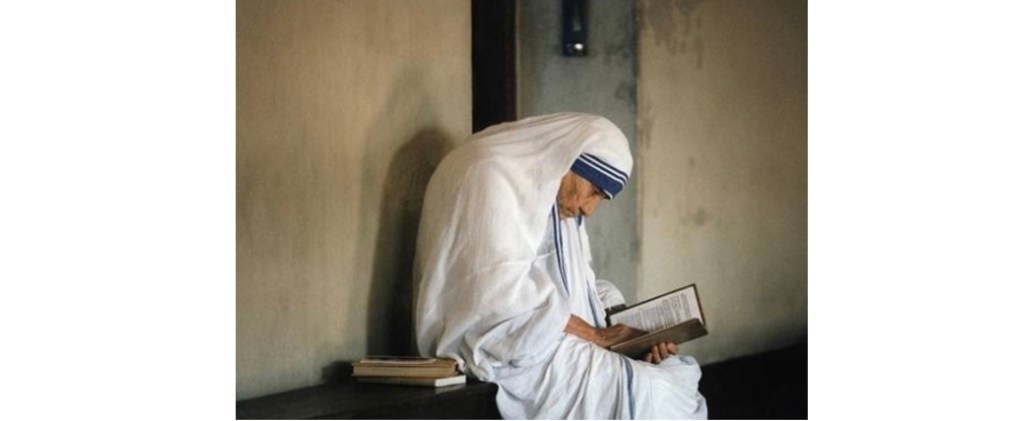
Photo: St. Mother Teresa could be a pencil in God’s hand because she gave herself to him in prayer and service daily.
Jesus continues to proclaim the Gospel today, and is inviting us to join him.
But he said to them, “To the other towns also I must proclaim the good news of the Kingdom of God, because for this purpose I have been sent” (Lk 4:43).
Jesus himself, the Son of God incarnate, fully divine and fully human, is the foretaste of heaven. His work of preaching, teaching, healing, and casting out demons, shows that the divine flow of the Father’s Love is infused into our fallen human condition. Jesus came to restore unity to that which had been divided and once he began his public ministry, he was ever on the go.
Through our Baptism, we have been conformed to and indelibly marked by Christ and for Christ. We are nourished by his Body and Blood in the Eucharist and we’re empowered through the laying on of hands by the bishop at our Confirmation. We have been divinized, grafted into the life of God through our participation in the life of Jesus the Christ. We too then are priests, prophets, and kings as we participate in his life. We also are, to preach and teach the same Gospel, to be his healing and comforting presence, to make Jesus present to those in our midst, and yes we too are called to cast out all demons, and to shine the light on negativity, dehumanization, and division in his name. As James teaches, we are to “submit [our]selves to God. Resist the devil, and he will flee” (James 4:7).
Jesus did not travel very far during his three and a half years of public ministry, yet his teachings have touched the corners of the world. That is because of those who have encountered him, said yes to his invitation, submitted to the will of his Father, and continued to spread his teachings and life in each generation. We too are called to experience “a resurrected new life”, just as the mother-in-law of Peter did. And what did she do once she was healed? Out of gratitude, she immediately rose and served him. She mirrored Jesus in her willingness to serve (cf. Gadenz, 107).
Moment by moment, in each circumstance, we are invited to surrender to the will of his Father, and follow the gentle guidance of the Holy Spirit. Each yes to the guidance of the Trinity is an embrace of the gift of the unique vocation we are called to put into practice. The time of fulfillment is now because Jesus is present in our midst, he is at hand. So let us repent and believe in the Gospel, (cf. Mk 1:15), and follow the lead of Jesus that we read about each day.
These are not just nice stories. They are invitations for transformation and participation. By reading, praying, and meditating with these scriptures, we deepen our relationship with Jesus and begin to experience the love of the Holy Spirit and we are given clearer sight about what to let go of that holds us back from a more intimate union with the Father. Each day is a new opportunity to learn from Jesus, follow his guidance, and be advocates of his love and healing in the unique expression he would have us share! Let us like, Peter’s mother-in-law, arise and serve.
Painting: The Exhortation to the Apostles by James Tissot
Gardens, Pablo T.. The Gospel of Luke. Grand Rapids, MI: Baker Academic, 2018.
Daily prayer with Jesus helps us to be better and more prudent stewards.
“Who, then, is the faithful and prudent servant, whom the master has put in charge of his household to distribute to them their food at the proper time” (Mt 24:45)?
Jesus is calling us to be that “faithful and prudent steward” and the household we are to serve is our own homes, churches, communities, states, countries, and world. For the world is our home and those we serve are our brothers and sisters. Jesus’ call is a universal call to solidarity. We are all invited to be united in this effort for and with one another because we are all created in the image of our loving God and Father.
God has created us, not as automatons or robots, or drone worker bees. He has created us as unique persons, one of a kind, distinct wonders that have never been nor ever will be again. Within our uniqueness, there is also the gift of diversity. We are not intended to be separate from one another, for God has created all of us to be interconnected, to be loved, and to love. What affects one, affects all.
Jesus clearly emphasizes this distinction in his parable, often called the Judgment of the Nations, when he stated: “Lord, when did we see you hungry and feed you, or thirsty and give you drink? When did we see you a stranger and welcome you, or naked and clothe you? When did we see you ill or in prison, and visit you?” And the king will say to them in reply, “Amen, I say to you, whatever you did for one of these least brothers of mine, you did for me” (Mt 25: 37-40).
Being faithful and prudent stewards means being aware of and willing to attend to the needs of the hungry, the thirsty, the stranger, the naked, those ill, and/or imprisoned. This is not an exhaustive list. We are to allow our hearts to be open to have compassion upon those for whom God calls us to serve. We begin this process with prayer, for prayer is the most important thing that we can do each day. We are to make the time to spend in silence to discern the will of God for each our thoughts, words, and actions.
Not all of us will be moved in the same way or for the same cause. We just need to remain open to the nudge of the Holy Spirit, trust his direction, and follow him regarding how and who best we can serve, no matter how small of a gesture. One thing that can limit us is if we are unwilling to admit to and confess our prejudices, insecurities, or biases, as well as toward whom we have been unaware or indifferent. When we have the humility to confess, God is ready to forgive, heal, and transform our hearts of stone into hearts of flesh.
As we are forgiven and begin to heal, as we experience the love and mercy of Jesus, we can draw strength from him, begin to see the dignity present in ourselves, and one another, begin to see each person we encounter as God sees them and begin to take steps to follow the lead of the Holy Spirit to love, to will each other’s good, in each thought, word, and deed.
Photo by Jay Mather, The Courier Journal, of St. Mother Teresa of Calcutta at Bellarmine College, Louisville, KY, June 22, 1982. “Until you can hear Jesus in the silence of your own heart, you will not be able to hear him saying, ‘I thirst’ in the hearts of the poor.” – St. Mother Teresa
“Whoever humbles himself will be exalted.”
“The greatest among you must be your servant. Whoever exalts himself will be humbled; but whoever humbles himself will be exalted” (Mt 23:11-12).
Jesus warns us to resist the sin of pride, and hubris, where we place ourselves as the focal point instead of God. This happens when we seek to be the center of the gravitational pull within our realm of influence. Through our subtle and not so subtle actions, we can embrace this temptation to live a life of, “Look at me, look at me!” Desiring to be affirmed is not a bad thing but that ought not to be our primary motivation for our actions. Ultimately, we will be better served when we seek our affirmation from God.
Choosing our own self-determination free of God’s guidance is the height of pride. God does not seek to limit us but to inspire us so that we may actualize the fullness of who he has created us to be. St Mother Teresa often guided her sisters not to seek to do great things but to do little things with great love. I came across a cassette tape of one of her talks during my freshman year of college. Her words started to plant a seed in my soul that urged me to look out beyond myself toward others.
Growing up with an introverted and shy nature, I spent much of my youth in my own world and spent more time with myself than others. The invitation to change that perspective would happen during my second semester of that same year. I took a psychology course and thought it would be interesting to work in a hospital. A close friend of mine, Steve, shared with me that his mother was a nurse in a nursing home in our hometown. That summer, when the semester ended, I applied for the job as a certified nursing assistant and was hired.
The first resident I assisted was named Margaret, age somewhere in her 90’s. She rolled passed me in her wheelchair and a particular odor followed. The aide I was training with caught my eye and I realized this would be my first solo attempt of service. I redirected and guided her to the toilet, which was in a small closet-sized area in between two adjoining bedrooms. It was a particularly hot day, and as I removed Margaret’s depends, I found quite the surprise. For the next fifteen minutes as I cleaned her up, I sweat, teared up, and repeatedly fought back the urge to gag, all the while Margaret – sang. Once finished and in a fresh nightgown, I helped her into her bed, tucked her in, and then Margaret said, “Give me a kiss lover.”
Others may have run for the door and never looked back. I stayed, and for the next four or five years, I experienced the wonderful gift of building relationships with the many residents and coworkers who drew me out of myself. What started out as a job became an extended family, and I served them with great joy.
God presents us with opportunities daily. We can choose to curve in upon ourselves or we can risk being present for and give of ourselves to others. Let us resist the urge to be led by anxiety or fear and instead pray for the courage to be open to the opportunities to extend the grace God offers us to serve in little ways with great love, one person, one encounter at a time. I pray that you may encounter your Margaret! For Margaret helped me to live what St Mother Teresa taught me: “Love only can become our light and joy in cheerful service of each other” (Teresa 2010, 355).
———————-
Photo: Let us serve one another with joy as St. Mother Teresa did.
Mother Teresa. Where There Is Love, There is God. Edited by Brian Kolodiejchuck, M.C. NY: Doubleday, 2010.