Jesus reacted to the criticism of not observing ritual washing prior to eating that was leveled at him from the Pharisees and scribes by recalling the tradition of the Prophets through the words of Isaiah: “This people honors me with their lips, but their hearts are far from me” (Mk 7:6). Jesus recognizes the context of these words as he uses them. Many of the Israelites of Isaiah’s time “lost an intimate contact with God, and serve him with an empty formalism devoid of authentic love… inherited rituals that are not rooted in interior conversion of heart” (Healy, 137).
Jesus is convicting the Pharisees and scribes of doing the same, following the law for the law’s sake which is an empty act. What is more important is encountering the living God, experiencing his love and forgiveness, developing a relationship, being transformed by him, and restoring what has been lost.
Isaiah, the prophet, the mouthpiece of God also invoked a promise. “For when his children see the work of my hands in his midst, they shall sanctify my name; they shall sanctify the Holy One of Jacob, be in awe of the God of Israel” (Isaiah 29:23). When the people again are willing to see God among them and recognize his presence, change their minds and hearts, they will again be invited to turn away from their idolatrous and selfish ways and again worship God.
In quoting this verse, those with eyes to see and ears to hear will reflect on the life, teachings, exorcisms, and healings, they will ascent to the truth, that Jesus is his Father’s hands in their midst.
Are we willing to see this truth as well? Each of us as human beings were created in God’s image and likeness, but through sin, lost that likeness. Jesus us come to reveal where we have turned away and lead us back, heal where we have been wounded, forgive us of our sins, and show us where, in our religious practices, we may be going through the motions, offering empty lip service, rather than growing in our relationship with him as a person.
We must be careful and vigilant that we resist substituting “religiosity for genuine obedience to God and his word. What is needed is a personal encounter with Jesus leading to a deep transformation of heart. When that occurs, religious practices come to life and serve their true practice” (Healy, 138). Jesus challenged the hyper scrupulosity and exactitude of the rules that had nothing to do with being humble servants of and growing in relationship with God.
Just laws and practices are enacted to help us to build up and empower through discipline and clear boundaries so that we can identify the false promises and lies of the enemy, the apparent goods the distract us. Their aim is to help keep us from being enslaved to our passions and sins and instead lead us to freedom for excellence, for fulfillment, and to experience a heart on fire with an ever-growing love that yearns for a relationship with God and each other, like a deer that longs for running streams.
As with any game we play, there are rules and regulations, there are referees and officials to keep order. When the rules enforced encroach on the flow of the game, such that they inhibit the freedom of play, the game is stunted. When there is no enforcement, the game quickly devolves into chaos. When the rules are consistent, they provide the structure and boundaries that limit abuse, allow for the game to flourish, and the players to experience the freedom to actualize their potential, and as such, the play becomes something beautiful for God.
The first time I saw people skate, at around seven years, I was enraptured. My father was working on a project at our local, ice rink. We had not gone there to skate, and yet, I refused to leave until he took me on the ice. It didn’t matter that the only skates that fit my feet were figure skates or that my first attempt was a dismal failure. What mattered was that I made it to the ice and the joy of that experience inspired me as I learned the rules of balance, how to stop, and what a toe kick was and was not for. Soon I had the freedom not only to skate but to join a hockey team. The freedom and joy I felt any time I skated or played hockey, I still carry with me.
We as the Church, are not to lead with the rules and moralizing, but instead, share our time, presence, the joy of our faith, and build opportunities of encounter and relationship. We empower and support one another as we enter into the play between our finite freedom and God’s infinite freedom. We have been created for and to seek a deep and intimate relationship with him that will lead us to a deeper transformation of our hearts and minds. With both open to God’s guidance, we can better identify and discern between the voice of the enemy and God. There is a unique balance between the rules and the freedom of play in ice skating as well as our relationship with God.
Loving someone does not mean allowing them to do whatever. Loving means willing their good, offering invitations, options, establishing boundaries, corrections, opportunities for growth, maturity, and authentic freedom. This is how God guides us with his love. We are going to make mistakes, I have made plenty. The key is learning from those mistakes, recognizing that we are on a journey together, and we are to learn from God and one another. The boundaries, practices, and rules that God teaches us through the Church provides a foundation to identify and renounce that which seeks to divide and isolate us. They allow us to grow in relationship with God, who invites us to be; joyful, human beings that are fully alive!
———————————————————————————
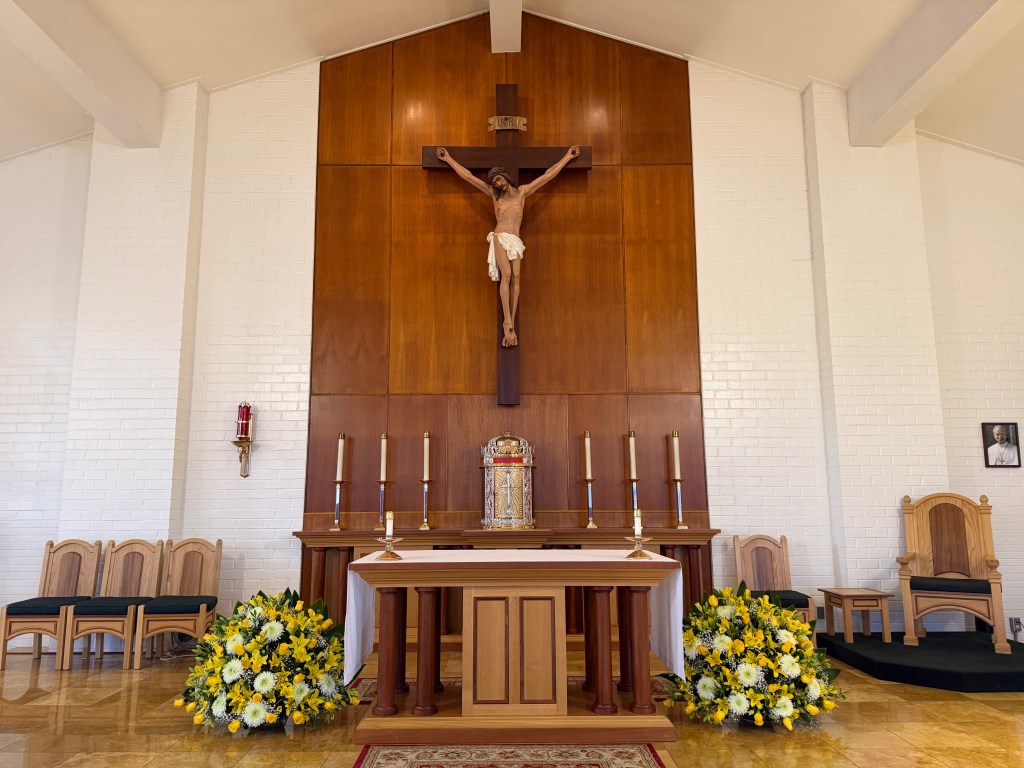
Photo: Be aware what brings you closer to experiencing God and his love for you and do that! Holy Hour at St. Gerard Majella Catholic Church this morning.
Healy, Mary. The Gospel of Mark. Grand Rapids, MI: Baker Academic, 2008.
 Spiritual Stepping Stones