Slow down, breath, stop, and trust in Jesus.

Our days are so full of activities, conflicts, health issues, technological stimulation, 24/7 news cycles, social media interaction, and the mix of our own personal unique daily challenges. If we do not have the proper foundation and orientation, we can feel stretched, hollow, and/or fatigued at best. One day can seem to blend into another, and another, and another. The image of being on a hamster wheel or an unending treadmill can fall afresh in our mind’s eye when we actually do take a minute to breathe. Anxiety, worry, stress, fear, prescriptions, and addictions all appear to be on the rise and swirling out of control.

Is there an answer to this hyper pace or are we doomed to just keep going until the wheels fall off? The opening verse in today’s reading provides an antidote when we are feeling any or all of the above.

Jesus said to his disciples: “Do not let your hearts be troubled. You have faith in God; have faith also in me” (Jn 14:1).

We are invited to place our trust in God through his Son, Jesus. By putting them first does not mean that the externals to our life will take an abrupt turn for the better, but what it does mean is that we will have support and divine assistance. It means that we are not alone in our struggles. The disciples found this out when in the midst of a sudden sea squall. Their boat was taking on water as the waves grew higher they were terrified and so, called to a sleeping Jesus. Jesus awoke and with a word, he calmed the sea (cf. Mk 4:35-41).

Jesus may or may not calm the sea of our trials and tribulations, but what he will do is be present with us through our storms in life and we can trust in him that he will guide us through. As we grow more confident in our trust in Jesus we will come to be assured that no matter who or what comes at us, he will be there to assist us. We will experience more peace and calm within ourselves. The ultimate assurance that Jesus provides is that when we surrender our life to him, we belong to him, we are not alone or orphaned. He gave his life for us, to redeem and save us so that we can be assured of our home for eternity.

If we are struggling at any level and are seeking to build our trust and faith in Jesus, we do need to realize that this takes time. We need to remember to daily ask Jesus for help, seek his discernment about where we can make changes in our life, and make periodic efforts to stop in our day to be still. This time does not need to be lengthy, three to five minutes to start can do wonders. On the surface level, by stopping for five minutes to pray and breathe more deeply and consciously, we get off the wheel, we step out of survival and reaction mode, so we can then make more intentional decisions, and we can come to see that we truly have options, but more importantly, we begin to develop a relationship and intimacy with Jesus so to begin to recognize his voice that is calling out to guide us.

Author Wanda E. Brunstetter, wrote, “If you are too busy to pray, you are busier than God wants you to be.” There is a lot of truth in her statement. I have had busy days, weeks, and months, where I have wondered if taking the time to pray and meditate was really the most sensible choice. Time and again it has been. At the beginning of these two years of seminary when my workload was larger than I anticipated, I barely prayed much for a few days and realized that was a mistake. Making time for consistent prayer each day became my priority and doing so has made a tremendous difference.

Daily Mass, praying with the Liturgy of the Hours, reading and meditating on passages of the Bible, reciting the Rosary are great tried and true practices from our tradition that I find helpful. If any seem too much, especially if you are just starting, begin with Night Prayer in the Liturgy of the Hours each night before bed, or a couple of verses each day from the Bible or one decade. One slowly and well said Our Father and some quiet time to listen or just a few minutes of breathing slowly and opening our heart to Jesus can be transformative.

Consistent moments of stopping and being still and intentionally lifting our hearts and minds to God each day is a tremendous gift to help our hearts to learn to rest and trust in Jesus. Each of these practices offer us a few of the many ways to stop the madness, to slow down, simplify, and connect with the power, the love, and the grace that Jesus yearns to share with us such that no matter the external or internal upheaval, and even if life is going pretty well, we will experience his peace and security which is what we all truly long for.

—————————————————–

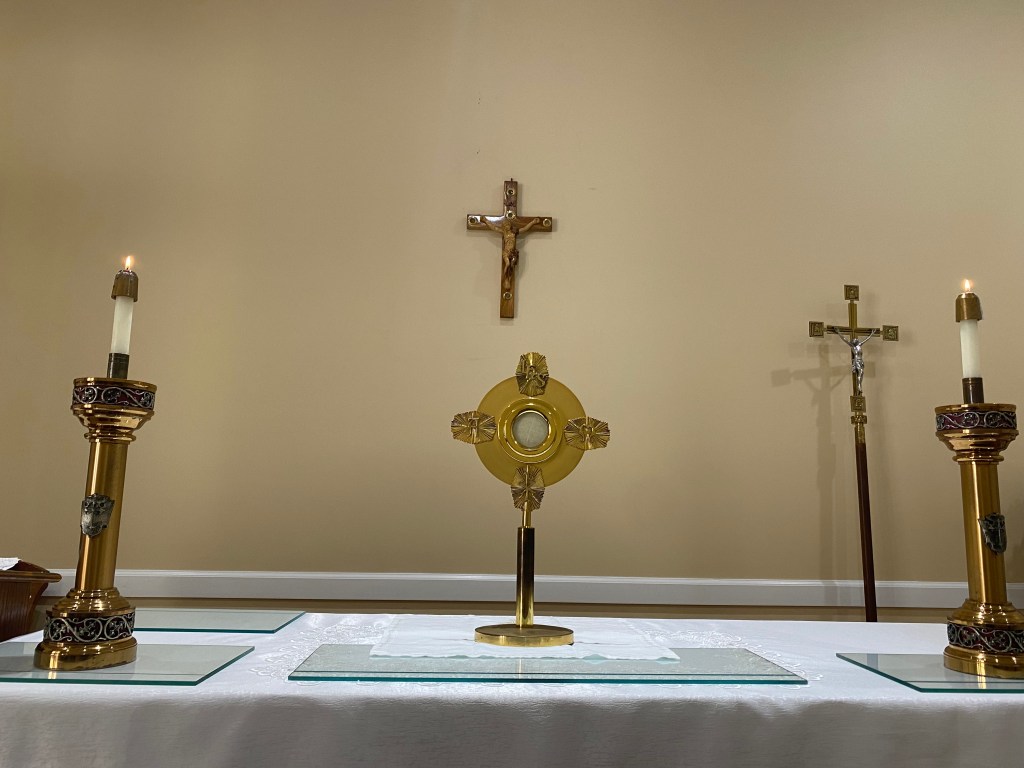
Photo: Quiet time before the Blessed Sacrament this past Tuesday while on silent retreat at Casa San Carlos, Delray Beach, FL. 

Link for the Mass readings for Friday, April 26, 2024


“Go, and announce the Gospel of the Lord.”

Jesus appeared to the Eleven and said to them: “Go into the whole world and proclaim the Gospel to every creature” (Mk 16:15). Jesus is once again claiming who he is: Kyrios – Lord. The word, gospel, comes from the Greek word, euangelion, meaning good news, but the one who proclaimed “good news” during the time of Jesus was the emperor. Caesar would send his emissaries to announce such good news as a great victory or his birthday. What Mark conveys in the very first line and here at the ending of his Gospel, is that Jesus is Lord! Not Kaiser Kyrios, Caesar is Lord, but Jesus Kyrios, Jesus is Lord!!!

We receive Jesus our Lord in an intimate way in the Eucharist. We receive his Body and Blood. We are loved and transformed by him each time we receive him and so when we are dismissed from Mass, one of the dismissal lines I use most often is, “Go and announce the Gospel of the Lord.” This is to echo the command of Jesus for all of us to proclaim the Gospel in our everyday experiences and encounters.

We proclaim the Gospel first and foremost by believing that Jesus is the Christ, the Son of God, our Savior and Lord. He has risen! He has risen indeed! He is the firstborn of the new creation. This is something to get excited about, something to fill us with joy. We are an Alleluia People, not a Grumpy Gus people. Once we remind ourselves what we believe, who we believe in, and whose we belong to, then we are better prepared to engage with others.

The most powerful witness we can offer is when we seek opportunities to act, speak about and engage others with respect, caring, and joy. When we catch the eye of another offer a smile. We can also say hello, a nod of our head, or offer a wave, fist bump, high five, or a hug. We also need to be aware of other’s boundaries and respect their space at the same time. If someone is not open, we need to respect their posture, and meet them where they are.

Reaching out to others to acknowledge their dignity and value is the simplest, yet most profound way to spread the Gospel, which really means to share the love of Jesus by willing their good. We are to accept and accompany others as Jesus does with the purpose of building relationships. We are more inviting when we are willing to be patient, gracious, and willing to listen and hear in our interactions with each person we meet and in doing so we may begin to understand each other a little better.

As we encounter others, we are to also remember the common courtesy of saying please, thank you, and I forgive you, whether in a store, restaurant, bank, convenience store, on the sidewalk, in traffic, or online. It is just as important to engage in a similar fashion with those of our family, friends, and those closest to us. Remember God gave us two ears and one mouth for a reason because it is better to listen first and speak second.

Especially now, with the world on edge and more anxious than ever, believing in Jesus, embracing his love and message, and putting into practice small actions with great love is a wonderful way to begin to “Go into the whole world and proclaim the Gospel to every creature” (Mk 16:15). I might add, “every creature” is in this statement. All of the above applies to all that God has created. We need to be better stewards and caretakers of each other as well as our planet.


Photo: Sanctuary at St. Edward Catholic Church, Palm Beach, FL.

Link for the Mass reading for Thursday, April 25, 2024

Walk not away from Jesus, ponder instead.

Even though Jesus had fed the five thousand and they were satisfied and there was plenty more where this gift of grace came from, even though they traveled by boat and followed him to Capernaum seeking a sign, the discourse regarding eating his Flesh and drinking his Blood was just too far of a stretch for the majority of the disciples to take. In fact: Many of the disciples of Jesus who were listening said, “This saying is hard; who can accept it” (Jn 6:60)?

All but the apostles walked away from Jesus at that point and returned to their former ways of life. They could not believe because they did not fully appreciate who Jesus was, the One from above, who was sent by the Father. They had not developed a deep enough relationship with him such that they could trust him and that what he had said was true, they could not believe that he was the One whom God had sent.

Jesus then said to the Twelve, “Do you also want to leave?” Simon Peter answered him, “Master, to whom shall we go? You have the words of eternal life. We have come to believe and are convinced that you are the Holy One of God” (Jn 6:67-69). Peter’s response is one of belief and trust. I am sure they reacted in the same way as the others gathered there, but they trusted Jesus enough that even though this teaching was hard, even inconceivable, he would make sense of it for them, just as he had done so many times before.

This is to be our response as well. When we find some of his teachings are hard to digest, we need to resist the temptation to walk away. Instead, may we follow Mary’s model of pondering, as she did when Gabriel shared that she would bear the Savior of the world. She did not fully comprehend what the message meant, but she trusted God and said yes. May we follow Peter, who may have also been dealing with mixed emotions and doubts, remained firm in his belief in Jesus because he trusted that Jesus was the “Holy One of God”. Peter had experienced that Jesus had known what he was saying and doing before, he would continue to trust him this time as well.

Jesus is a model to follow, yes, but he is so much more! Jesus does not give us more burdens to bear, but graces that build upon our nature that we are invited to receive. He did not want to die, but he was willing to say yes, to submit his human will to his Father because he trusted him and knew he would bring about a greater good. Jesus gave his life and in so doing he conquered death, transcending the time and space of our present dimension so to be present to us in the Sacrament of the Eucharist he gave us.

Jesus lives, he is the firstborn of the new creation, and he wants to not only lead us to eternal life, but impart his life in us today, in such an intimate way that we may consume him at each Mass, that we may be one with him in this life and for all eternity! May we with Peter come to believe and be convinced, that Jesus is the Holy One of God!

Amen. Amen.
I’m alive, I’m alive,
Because he lives.
Amen. Amen.
Let my song join the One that never ends.
Because he lives.
The verse from Matt Maher’s song, “Because He Lives (Amen)”.

—————————————————————

Photo: Taking some time to ponder and enjoying the company of a Blue Heron. St. Vincent de Paul Regional Seminary, Boynton Beach, FL.

Link for video: Because He Lives (Amen), Matt Maher, from cd: Saints and Sinners, 2015

Link for the Mass readings for Saturday, April 20, 2024

Jesus offers all as he gives his “Flesh for the life of the world.”

Those in the crowd who Jesus is speaking with are those who experienced his multiplication of the loaves and fish. Step by systematic and deliberate step, through chapter six of John and as read in this week’s Mass readings, Jesus is setting the stage for today’s insertion into his presentation.

Jesus begins slowly, but with each successive step, he is not willing to be tamed. He, as the One from above, the One who has seen and has been sent by the Father, is fully divine, as well as fully human. The Godman is speaking among those who have come to him. He has responded to the people’s request regarding how they were to “accomplish the works of God” and his response is that they are to believe in him, he who had been sent by God. They were to “work for food that endures for eternal life, which the Son of Man will give”. Jesus with the multiplication of the loaves and fish provided for those who were hungry in the moment. He is now describing how he will provide food that will endure for eternal life. Jesus shared that he is this food, the bread from heaven, that will give life to the world.

What Jesus has shared thus far and what he shares in today’s Gospel message has been given to him to say by his Father and is for everyone who is willing to accept his invitation: “I am the living bread that came down from heaven; whoever eats this bread will live forever; and the bread that I will give is my Flesh for the life of the world.”

We have an advantage, that those listening to Jesus, did not have. We just experienced Lent and we can certainly draw a line to how Jesus gave his very life, his Flesh, that was sacrificed and hung on the cross. Jesus died and experienced utter God forsakenness by giving his very life for the life the world.

But for those in the crowd who only the day before sought to unanimously make Jesus their Messiah by popular acclamation are growing a bit uncomfortable. This discourse is now starting to move into a more dramatic and concrete presentation with horrific implications. After an initial gasp or two, some murmuring of questions might have begun to arise:

“Did Jesus really just say he would give us his flesh?”

“Jesus is saying he is the bread from heaven, and the bread he is offering is his flesh?”

“Is Jesus saying what I think he is saying?”

Yes! The Son is saying exactly that because the Father has given all that he is, holding nothing back, emptying himself into the Son. The Son has received all that the Father is and returns himself, giving all that he is, holding nothing back, to the Father. This eternal giving and receiving, this eternal communion of Love shared between the Father and the Son is the Holy Spirit. Jesus is offering us a participation in this perichoresis, this divine dance of infinite communion, as he offers all that he is to his listeners then and to us, this day, to be consumed. He is holding nothing back in his offer. We are invited not only to receive all that Jesus is, we are also invited to give ourselves away in return. Stay tuned, more to come tomorrow…
—————————————-

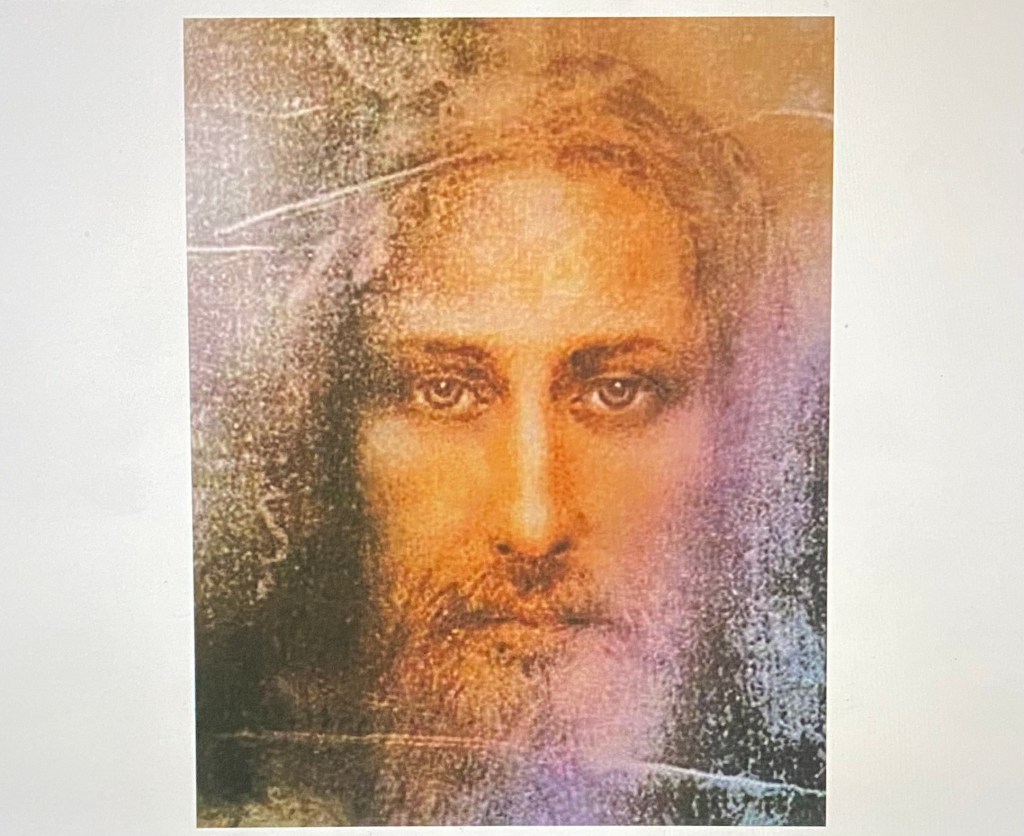
Photo: Closeup of the artistic rendition of the face of Jesus based on the Shroud of Turin.

Link for the Mass readings for Thursday, April 18, 2024

Jesus is with us, even when we fall.

“Everything that the Father gives me will come to me, and I will not reject anyone who comes to me, because I came down from heaven not to do my own will but the will of the one who sent me” (Jn 6:37-38). Jesus does not reject us, he accepts us as we are, first and foremost. Jesus has come to do his Father’s will which is to lead us all to salvation, to be redeemed and restored to the proper order of freedom from our enslavement to sin. This is why Jesus met Cleopas and the other disciple on the road to Emmaus. They were walking the wrong way! Jesus did not tell them that, he just opened the Scriptures for them, so that they could see that he was who he claimed to be and then revealed himself to them in the breaking of the bread. Once they had a deeper encounter with him, they determined on their own to turn back, and even though evening approached they went back to tell the Apostles the Good News of their experience.

It was through sharing a meal with them that they recognized him. How many meals had they shared together before his death? A close reading of Sacred Scripture shows how important table fellowship is for Jesus and his followers before his death and after his Resurrection. True, Jesus eating with his disciples after his Resurrection shows that he is no ghost, he is human, but also that he is reestablishing the cornerstone of his ministry, table fellowship.

Here the basic needs of sustenance are met, for the body, and in also in sharing his time and conversation with anyone willing to eat with him, no matter their level of ritual purity, touches the deepest hunger within each of us, which is to belong, to be accepted as we are, for who we are. The majority of the crowd that Jesus is speaking to has continued to come to him because he fed them with only a few loaves and some fish. In the miraculous multiplication, Jesus is providing for their bodily nourishment, but also preparing them for the deeper spiritual nourishment of the body and soul to come in the next verses as he goes deeper into his Bread of Life discourse.

Jesus loves us, he wills the best for us. Many resist this claim for different reasons. It could be the callouses, scars, growing cynicism resulting from wounds inflicted by others as well as from those within the Church. Each of us could have experienced the same and have also been let down by those we have looked up to and trusted. If we are involved in a relationship long enough, we will experience disappointment or worse. This is because sooner or later, when we allow ourselves to get close enough, the masks will come down and who we truly are, the fullness of our wounds and our gifts will come to the fore. Conflicts will arise because we are finite beings. We are still a work in progress. Conflict is not a bad thing. It is healthy when we are willing to work together to resolve the conflict together.

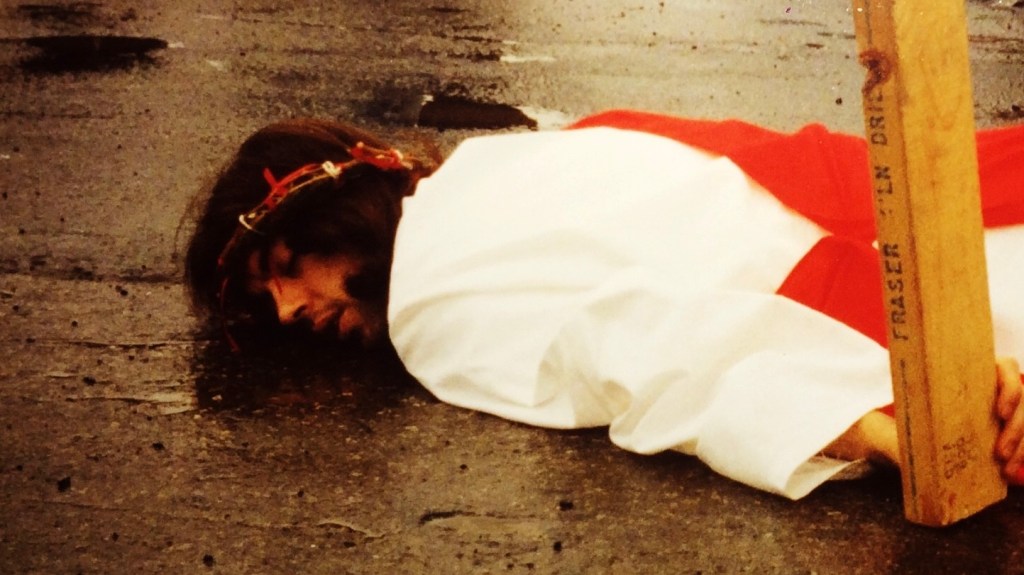
None of us are perfect. We are all on a journey. On our own, not only will we consistently fall short of our goal, we will often be headed in the wrong direction. That is why we need a savior. Jesus, fully divine as Son, came down from heaven and became human to meet us in our humanity. He is there for us when we fall down face-first into the mud. He is willing to be there with us, to look us in the eye, and smile.

Even if we are not able to look past the predicament, can we resist Jesus? His eyes looking at us and his smile that lets us know we can get through this together. His hand offered to us that we can grasp and feeling the strength of his grasp, then rise together and stand again. That is how Jesus shows his mercy and love for us. He enters our chaos and meets us in the muck and grime of our mistakes, brokenness, and sin. He loves us there, and when we are ready to accept his offer of love, he invites us to get up, and begin to walk again toward the fullness of who we are called by his Father to be.

As our relationship grows and deepens with Jesus and as our trust renews, we begin to believe that we belong. We begin to heal and realize that we are a part of something greater than ourselves and then, with wobbly steps, we begin to offer attempts of the same mercy, forgiveness, and unconditional love with others. This is the path of discipleship. This is the road we are on, together. This is not a hundred-yard dash but a long and winding road. Let us be willing to persist, to be led, to love, to be there for, and accompany one another each step of the way. And especially may we have the willingness to help each other when we fall.

———————————————————————————

Photo: Living Stations of the Cross in the streets of the Bronx, me, as Jesus, falling a third time – around 1991.

Link for the Mass readings for Wednesday, April 17, 2024

Believe in the One who God has sent, Jesus, the Bread of Life!

Yesterday and today’s Gospel readings from John are laying the groundwork for the discourse of Jesus to come. In yesterday’s account, Jesus shared with the people who gathered about him, those who had already received the miraculous multiplication of bread, that they were not to “work for food that perishes but for the food that endures for eternal life” and Jesus also shared that they were to “believe in the one [God] sent” (see Jn 6:27-29).

In today’s account, the people are asking for a sign, just as Moses gave to their ancestors in the desert. Jesus reminds them that his Father had given them the bread from heaven, and also added: “My Father gives you the true bread from heaven. For the bread of God is that which comes down from heaven and gives life to the world” (Jn 6:32-33). Certainly, this offer is appealing, and so the people not only want some of this bread also, they want an endless supply of it. Now Jesus moves from the subtle foundation he has been building to the substance of his point: “I am the bread of life; whoever comes to me will never hunger, and whoever believes in me will never thirst” (Jn 6:35).

Jesus encouraged his listeners to pursue the food that “endures for eternal life” to believe in the one his Father sent, then he shares how his Father gives them the true bread from heaven “for the bread of God is that which comes down from heaven and gives life to the world.” Jesus is the one his listeners are to build their relationship with, for he is the very presence of God in their midst. Jesus is the promise of eternal life. Jesus is the one sent by his Father to give life to the world. Jesus is the bread of life!

We are a living craving, hunger, and desire to be one with God and each other, and this is true for the atheist and the believer alike. That which God has created, he has created good, but the material and finite will not fulfill us. We, in short order, experience the limitations of the finite and seek something more. This is how we are wired, because ultimately, our deepest desire, that which we seek to fulfill us, is eternal. The One to satisfy this eternal hunger which we can never exhaust is the bread of life, Jesus Christ.

Do we believe this to be true? Do we believe that Jesus is the bread of life, that he is the source and sustenance, the very foundation of our being and existence? Are we tempted and diverted by other things and so miss receiving the Eucharist at Mass or is making time to go to Mass and receive the Eucharist our reason to miss other things?

If we have been caught up: in the business of life, in the mere existence or survival mode of the day-to-day, or stuck in our sin, addiction, brokenness, or disillusionment, if we feel like we are just running on empty, and/or if we have just taken this reality for granted, then let us “believe in the one who God sent”, commit or recommit ourselves and our very lives to the one who is our source and sustainer, and let us come to receive Jesus, the Bread of Life in the Mass, at least each Sunday.

——————————————————————-

Photo: Praying by the tabernacle in the chapel at Bethany Retreat Center, Lutz, FL during my priestly canonical retreat back in November.

Link for the Mass readings for Tuesday, April 16, 2024

Let us believe in the one whom God sent.

One of the best ways to celebrate the Easter Season is to continue to conform our lives to the one who gave his life for us that we may experience and be engaged in our life to the full. We can accomplish this better by putting into practice what we read in the Gospels as well as being open to encountering God in our daily experiences and one another.

Today’s Gospel reading continues after Jesus not only fed the 5,000 but also after he had walked across the Sea of Galilee and guided his disciples safely to the shore. When the crowd caught up to, found, and gathered around Jesus, he continued to teach them, guiding them to “not work for food that perishes but for the food that endures for eternal life, which the Son of Man will give you.” The people asked him what they could, “do to accomplish the works of God?” Jesus answered and said to them, “This is the work of God, that you believe in the one he sent” (cf: Jn 6:27-29).

The people asked Jesus what they were to do to accomplish the work of God, and he said to believe in the one he sent. The response of Jesus may not appear to fit the request. But to believe is not passive. Belief is to be followed by action. If we say that we believe in Jesus, do we pray with him, do we worship him independently and in communion with fellow believers, do we sing songs praising him, do we serve him through the giving of ourselves to one another by practicing the corporal and spiritual works of mercy?

When we experience setbacks, interruptions, conflicts, or are weighed down by tribulations, do we turn to cursing and yelling or turn instead to Jesus for guidance and direction? By the way, yelling or expressing our anger at Jesus is turning to him in honest prayer instead of turning our back on him. We are honestly letting him know how we feel. The key is to vent, but then let it go, and not stay there.

Do we turn within ourselves or only surround ourselves with those of like mind, color, political and/or religious views, and make others into scapegoats, or do we embrace the richness, uniqueness, and diversity of God’s people, open ourselves to dialogue, and new possibilities? When life goes well, do we thank God for the wonderful things that happen? Where are we spending our time, talent, and treasure?

Answering these questions is a good way to assess what and in who we truly believe. If our diagnosis today is that we are not as faithful as we would like, we don’t believe as much as we thought we did, that is not an invitation to beat ourselves up. It is a gift to begin again, to take a spoonful of belief in Jesus, spend a few silent minutes with him, begin the journey from our head to our heart, and put into practice one small thing today in his name with great love.
——————————————————-
Photo: Jesus is the One whom God sent to die and conquer death that we might have life and have it to the full. Good Friday sunrise at Our Lady Of Florida Spiritual Center, North Palm Beach, FL.

Link for the Mass readings for Monday, April 15, 2024

Our healing begins when we are willing to receive the embrace of Jesus.

A ghost is a disembodied spirit or an apparition. Jesus is no ghost, though when he appears to his disciples they believe him to be just that. Jesus then tells them: “Look at my hands and my feet, that it is I myself. Touch me and see, because a ghost does not have flesh and bones as you can see I have” (Lk 24:39). He also then requested from them something to eat, and Jesus received and ate the baked fish he was given.

Jesus, in showing the wounds on his hands and feet and in eating of the fish, revealed to his disciples that his resurrection is a bodily one. Jesus was not a disembodied spirit. Nor was he a mere apparition or hallucination. Jesus, was not resuscitated, just to die again. Jesus has conquered death and is risen from the dead. Jesus then proceeded, as he had done with Cleopas and the other disciple on the road to Emmaus, to share with those present how he is the fulfillment of the Law and the Prophets by opening the scriptures for them.

Jesus not only revealed himself as having risen from the dead and shared that he was the fulfillment of the Law and the Prophets, he embodied forgiveness. Though the disciples had betrayed him, and carried the weight of shame upon their shoulders for their lack of courage, the first words Jesus spoke were not words of condemnation but forgiveness: “Peace be with you” (Lk 24:36). In the showing of his wounds, the disciples were certainly reminded of what Jesus had gone through, his suffering and crucifixion. Could those wounds have also mirrored their own betrayal of him, their internal wounds, as well their own need for healing and repentance? Jesus did not bring up any of their past failures. He instead offered them peace.

All of us have been wounded in some way and have experienced trauma brought on by the myriad ways we have been exposed to the fallen nature of humanity. Jesus invites us to stop running from the fear of facing our hurts and the roots of our suffering and to instead kneel before him. He offers us his hands held out to us. May we gaze upon and ponder his wounds still present from the nails and come to a deeper appreciation of the suffering he endured for us.

Jesus invites us next to look up into his face, the face of the one who conquered death and rose again. Resist turning away from the smile that radiates his unconditional love. May we allow ourselves to lose ourselves in the eyes of his acceptance, that offer each and every one of us the realization that Jesus loves us in this moment just as we are.

Then listen, receive, and abide in the words he speaks, “Peace be with you.” In those words of invitation, may all our fears, anxieties, and hurts melt away. May we die to our pride and arise, allowing ourselves to be embraced by Jesus, embraced by his love, so to receive and abide in his love which is the foretaste of eternity. In the arms of Jesus, let our healing begin.


Pencil drawing: Kathryn J. Brown, 1982, hanging on my seminary room wall. Spend some time to rest in Jesus’ embrace this Lord’s Day.

Link for the Mass readings for the third Sunday of Easter, April 14, 2024

We are invited to be agents of calm and peace.

Some of the context for today’s reading of the Gospel is found in John’s account of the multiplication of the loaves which closes with this verse: “Since Jesus knew that they were going to come and carry him off to make him king, he withdrew again to the mountain alone” (Jn 6:15). Both Jesus and the people knew the Torah. In Deuteronomy 18:15-18, Moses shared that he was not the seal or end of prophetic tradition, he, like John the Baptist, pointed to one that would be greater than he.

As the five-thousand ate they talked among themselves, many may have then recalled how God fed the Hebrews in the desert, manna, bread from heaven. The miraculous multiplication mingled with the manna remembrance, comingled with the already growing messianic hope, could make a good case for why the people began to believe that Jesus was the “Prophet, the one who is to come into the world” (Jn 6:14), and then they rose to make him their king.

Recognizing their motivation and lack of understanding of the fullness of the kingship he would indeed assume, Jesus withdrew back higher up the mountain upon which he saw the people coming to him in the first place. The people presumably camped where they had eaten since evening drew near. Separation occurred between Jesus and the people because they moved to make him into something he was not. He refused, as he did during his fast in the desert, to give in to the temptation of power, pride, and honor.

The disciples were also separated from Jesus. They set out on the sea and headed toward Capernaum and would be reunited as they experienced a storm that arose on the sea of Galilee. Already full of anxiety as they were being tossed about by the waves, their fear grew as Jesus came closer to their boat, walking on the water. He calmed them as he said, “It is I. Do not be afraid” (Jn 6: 20).

Those present at the multiplication of the loaves and fish, the disciples, nor us today totally comprehend all of who Jesus is, for he embodies the fullness of humanity and divinity. Nor is he ours to tame. Jesus comes to us, is present to us, loves, and is willing to walk with us through all our trials and tribulations, as well as our joys and exhilarations. Though, what he will not do is be untrue to himself or to who he calls us to be. If we want to be fulfilled in this life, we need to let go of making Jesus in our image and likeness. Instead, with humility, we are invited to be conformed to his will, which, deep down is what we want too. We need to decrease, so that he may increase. We need to die in him, so that he may live in us.

In our willingness to surrender to the will of Jesus, we are able to keep our eyes focused on him. This does not mean our life will be perfect. There will continue to be challenges and conflict. The closer we come to Jesus the clearer we will see the truth and the absence of it within us and without. Conflicts with others will still arise. The difference is that when we experience the closeness of Jesus, while storms may rage on the outside, we will be calm on the inside. We will no longer feel the need react when our buttons are pressed, but can see another person with a wider lens, more  understanding, and love, and discern better how to engage or remain still.

We will grow stronger in our faith and trust in Jesus, and be more able to help others along the way to do the same, when we are willing to follow the guidance of Jesus and collaborate with him. In this free act of our will, we are aligning ourselves with the infinite power and ground of our being. In our participation with Jesus, we have access to his power working in and through us, we become agents of stillness and calm for ourselves and others, even while experiencing the storms of our everyday lives: “Be not afraid!” Trust in Jesus! When we do so, we will experience his peace.

——————————————————————

Photo: Spending some time winding down each day helps too! St. Vincent De Paul Regional Seminary, Boynton Beach, FL.

Link for the Mass readings for Saturday, April 12, 2024

Each day is an opportunity to experience the miracles and wonders of God.

The feeding of the five thousand that we encounter in today’s Gospel from John is reported in each of the four Gospels. The only other incident that is recorded in all four is the Resurrection accounts. This point is relevant because biblical scholars look to the multiple attestation theory as one means as to whether an account in the Gospel record is more or less plausible. Having the same account present in each of the four is strong evidence in support for that event happening.

From a different perspective, there are those that embrace scientism meaning that they will not believe in anything that cannot be measured, experimented upon, or proven within the realm of the five senses. For those ascribing to this strict interpretation, religion and accounts of miracles are often dismissed as superstition, that if something indeed did happen, there is a scientific explanation to dismiss the miraculous. Even some believers may discount the record of the feeding of the five thousand as more of a symbolic representation of the generosity and service encouraged by Jesus such that everyone gave their small share and there was enough for all, not that he was able to multiply the bread and fish.

These perspectives of downplaying the miracle of multiplication seek to reduce or limit Jesus to just his humanity, but he is so much more. Jesus is human, fully human, yes, but he is also fully divine. Coming to understand the wonder of the unity of the divinity and humanity of Jesus can help us better understand the reality of our world and cosmos. One of the core aspects of who we are as human beings is that we are people of wonder. The physical sciences are tools that we have in our toolbox that we can access to help us to understand our physical realm, while at the same time we also have spiritual tools that aid us in understanding both physical and spiritual realities. The physical sciences actually emerge precisely because of our spiritual pursuit to understand the wonders of God’s creation. In accessing both faith and reason, we come to have a broader picture, more pieces of the puzzle in which to put together and better experience our world.

When we limit or explain away the miracles of Jesus, we rob ourselves of a more accurate picture of the reality of creation. One concrete example of this is when our third president, Thomas Jefferson, took a sharp object and painstakingly cut out verses from the Bible and pasted them to blank pages. He did so in columns of Latin and Greek on one side of the paper and French and English on the other. This eighty-four-page tome is commonly called the Jefferson Bible, but the president titled it: The Life and Morals of Jesus of Nazareth. This text offers a human portrayal of Jesus that dismisses anything divine.

If we remove ourselves from the divine, and 99.9% of our life, experience, interests, and thought is spent in the finite material realm, we will miss a deeper expression of who we are as human beings and disconnect ourselves from much of the joy and gift of life. It stands to reason then why we would find it hard to believe in miracles, the mystical, the spiritual. In the miracles is not a self-aggrandizing move on Jesus’ part, but a move of love and empathy. Jesus is moved, time and again, to reach out in love, to care for and support those who are in need. Even more, the miracles are pointing to our final destination which is beyond the limits of this finite reality! As we read in today’s account of the feeding of the five thousand, Jesus is showing what living life to the full is all about: being in communion with God and one another.

We need to resist the temptation to write off too quickly the miracles of Jesus presented in the Gospels and still happening today. May we also not dismiss the gift and value of the sciences. By approaching our world with a both/and approach, we will get a better understanding of and appreciation for not only the gift and wonder of creation but also who we are as human beings. God has imparted within us the ability to access and develop both our faith and reason, to think critically, and to pray and meditate deeply.

Jesus, as the firstborn of the new creation, embodies the reality of the fullness of who God in the depths of our souls has created us to be, human and divine. Jesus is still present to us today, knocking on the doors of our hearts, minds, and souls. If we only follow the moral and social teachings of Jesus, as did Thomas Jefferson, we will experience some benefit, but we will limit ourselves because we will be cutting out the very life force that sustains those virtues we hope to aspire to. We will access the fullness of all that God the Father offers us when we open the door to his Son this Easter Season, let the Holy Spirit in, and offer the little we have and watch how much he can multiply our simple gifts.

Let us continue to journey together, to read and pray together the Gospels of Matthew, Mark, Luke, and John. May we resist rejecting outright what we do not understand or comprehend, and instead be willing to ponder the wonders of miracles, the gifts of God’s grace that builds on our nature, the reality of God-incidences all around us, and embrace the eternal foundation and ground of our being which is the Trinitarian Love of God.


Photo: Morning prayer back on retreat at Our Lady of Florida Spiritual Center, North Palm Beach, FL.

Link to the Mass readings for Friday, April 12, 2024