Loving our enemy is possible if we are willing to love each other as God loves us.

Jesus said to his disciples: “To you who hear I say, love your enemies, do good to those who hate you, bless those who curse you, pray for those who mistreat you” (Luke 6:27-28).

Certainly, this is as hard of a teaching as any of us have ever heard, yet this is the path to peace. Peace that is not just an absence of violence but a peace that is grounded in mutual respect, unity, and dignity of the human person. There are not enough examples or models in our present day and age for us to see this Gospel being put into practice. There is a consistent engagement in rhetoric, language, and outright hostility that promotes dehumanization, division, contempt, hatred, and vileness. These voices are not only on the rise in our secular and political discourse but also have become a growing din within the Church as well.

Nor do I believe in the temptation of the pendulum swing that would threaten to counter and go the other way, where what we think and say has the substance of milk toast, meaning, that we are so careful not to offend that we don’t share our ideas or what we truly believe to avoid conflict. Staying away from hot button issues and the taboos of talking religion and politics is not a way to bring about peaceful coexistence nor solve important issues either.

Neither an overly aggressive nor a bland tolerance of engagement is what Jesus is presenting in today’s Gospel. Jesus is inviting us to proclaim what we think and believe but in our interactions with one another, the primary starting point is respecting the dignity of the other person. We can dialogue and disagree without it devolving into disparaging, demeaning, belittling attacks, and shouting at and over people. We can agree to disagree, while still stating clearly what we believe, even boldly and passionately, while at the same time being willing to listen and allow others do the same. In this way, we each can be heard, we can exchange ideas, and quite possibly learn and grow from our encounter with one another, and work together for the common good.

We need to learn again that it is truly possible to engage in a constructive argument. We begin to do so when we are willing to recognize our interconnectedness and our common dignity. We can love our “enemy” by choosing no longer to make another person into a monster.

Jesus offers a different way in today’s Gospel, a hard teaching and difficult one to follow. In inviting us to love our enemy, Jesus is calling us to love one another as he loves each and every one of us, without condition. Love is no mere emotion or sentiment but an intent to will the good of each other, even and especially when there is some attribute(s) that we do not like about a person.

If we want to see a change in our divisive and polarized time, we need to be willing to resist dismissing the other person as our starting point, we need to resist labeling them as other. We are asked to encounter one another, one person at a time, to sit down, talk, and listen, and love one another. We can each share what we believe openly and honestly, without watering down what we believe while allowing another to do the same.

Easy, no; possible, yes; more so when we are willing to allow God to open our hearts and minds to see each other as he sees us: as his beloved children.

——————

Photo: Peace can bloom if we are willing to be transformed by God’s love. Saw this flower with leaves shaped as hearts a last week on my Rosary walk.

Link for the Mass readings for Thursday, September 12, 2024

Praying today

Praying today for those who lost their lives on September 11, 2001. Praying for those first responders who gave their lives seeking to save others as well as those who lived and are suffering from the physical, emotional, and psychological effects of that day. Praying today for those still grieving and mourning the loss of those they love.

Praying for the people of our country and our leaders at the local, state, and federal levels. Praying that we see each other as human, as fellow citizens that can embrace our differences and diversity, praying that we can work together to welcome the stranger, provide for the various needs of each other in every area of our nation, urban and rural, and seek for ways to empower and lift each other up. Praying that each person is willing to play their part no matter how small so that we can be one nation under God united in a common purpose that respects the dignity of everyone from the moment of conception throughout every step of life until natural death. Praying that each of us may learn to be better, learn to forgive, learn to heal, and learn to breathe, rest, receive, and abide in God’s love and from that space think, speak, and act.

Praying.


Photo: Veteran’s Memorial Island Sanctuary where I will often walk and pray.

Body and Blood, Soul and Divinity

Last week we ended the gospel account with these words from Jesus: “I am the bread of life; whoever comes to me will never hunger, and whoever believes in me will never thirst” (Jn 6:35).

Jesus is offering these words from the context of how his Father has constantly provided for his people as seen in the examples of the Hebrews being freed from their slavery from Egypt, and then God providing bread from heaven in the form of manna. Jesus multiplied the five loaves and fish to provide for the thousands. In our first reading today, God sends an angel to feed Elijah a hearth cake and water to give him nourishment and strength for his forty-day journey.

As a good Father, God provides for his children. He also loves us so much that he is willing to risk that we will reject his offer, which unfortunately, many people have done for generations. Yet, God remains faithful, awaiting the time to help and provide need when there is an opening.

This week we heard the reaction of the people to Jesus’ statement that he himself is the bread of life, he will be the one to satisfy the people’s hunger and his thirst, their deepest hunger, their soul hunger. He is inviting the people to receive him so that they will never have to hunger again. Jesus is not met with open arms of wonder, but “grumbling.”

This word was not chosen at random. This is the same word that was used to describe the Hebrews who were freed from their slavery and provided for by God but instead of being grateful for their freedom and God’s care, they sought for what they left behind. They complained that with Moses and God they were in a worse state than when they were enslaved in Egypt.

The people witnessed Jesus multiplying of the five loaves and two fish and they were amazed with the physical manifestation of that miracle, but now as Jesus is going deeper into the spiritual reality, they, as did his own hometown crowd, balk. And even respond in a similar fashion. Who does this Jesus think he is saying that he came down from heaven? “Do we not know his mother and father” (Jn 6:42). Apparently not!

Mary is his mother, but Joseph is not his father. His Father is God. Jesus is the Son of God who became man in the womb of Mary. While remaining fully divine as Son, he takes on human flesh and becomes fully human. His appearance is that of any other man, on the surface he appears to be the son of Joseph and Mary. Jesus is the incarnation of the Son of God the Father. He is the bread of life that has come down from heaven to nourish us physically and spiritually.

Jesus does not soften his language as he continues. He affirms that he knows God the Father because he has come from the Father and he invites those who are listening to believe in this truth and for those who do, they will have “eternal life.” Jesus does not stop there but continues to share how as “living bread”he will give life forever and then he goes over the top: “the bread I shall give for the life of the world is my flesh.”

If Jesus was concerned about their grumbling when he said he was the bread come down from heaven, he didn’t show it here by stating that he will give his own flesh. This is not symbolic language to recall the quail God sent in the desert either. Jesus was offering his own flesh.

This he did in giving his life to the full on the Cross and will be represented again on the altar at each Mass. People were having trouble understanding how Jesus could have come down from heaven, how he could be the bread from heaven, and now what were they going to do with his statement that he was going to give his flesh to eat? They were having trouble understanding what Jesus was saying because they did not understand who he is.

Understanding who Jesus is helps us to understand the Bread of Life discourse we have been exploring these past two weeks. At the surface, the physical level, even with the miracles that Jesus performs, even those who are eyewitnesses, do not see Jesus being anyone other than a human being, extraordinary to some, ordinary to many others, just the son of Joseph and Mary. And yet, Jesus is so much more.

Jesus is the Son of God come down from heaven, he took on flesh in the womb of Mary, lived, died, and conquered death so that he could ascend, return to the Father, not as he came as fully divine but now fully divine and fully human. This is how he can give us his Body and Blood in the appearance of bread and wine, because he has transcended time and space. He truly is the Bread of Life. We like the crowd are given a choice.

God the Father, God the Son, and God the Holy Spirit do not impose, they invite, they draw us in with tender chords of love. They give us the free will to either reject their invitation or to ascent with our faith and accept their invitation to participate in their communion of love.

In the Mass, Jesus will come among us again through the power of the Holy Spirit and the words of institution: the words of Jesus said in the first person by the priest. Jesus is the bread of life who will again come down from heaven, not as the same human body that walked among the apostles and the crowd, but in his glorified body that has ascended into heaven. Although the appearance of the bread and wine will remain, the substance will be transfigured to be the Body and Blood, Soul and Divinity, the source and summit of our faith!!! Today we will receive our daily bread, the superabundant bread of life that will satisfy the deepest yearning of our souls and sustain us as we journey through this life to the next!


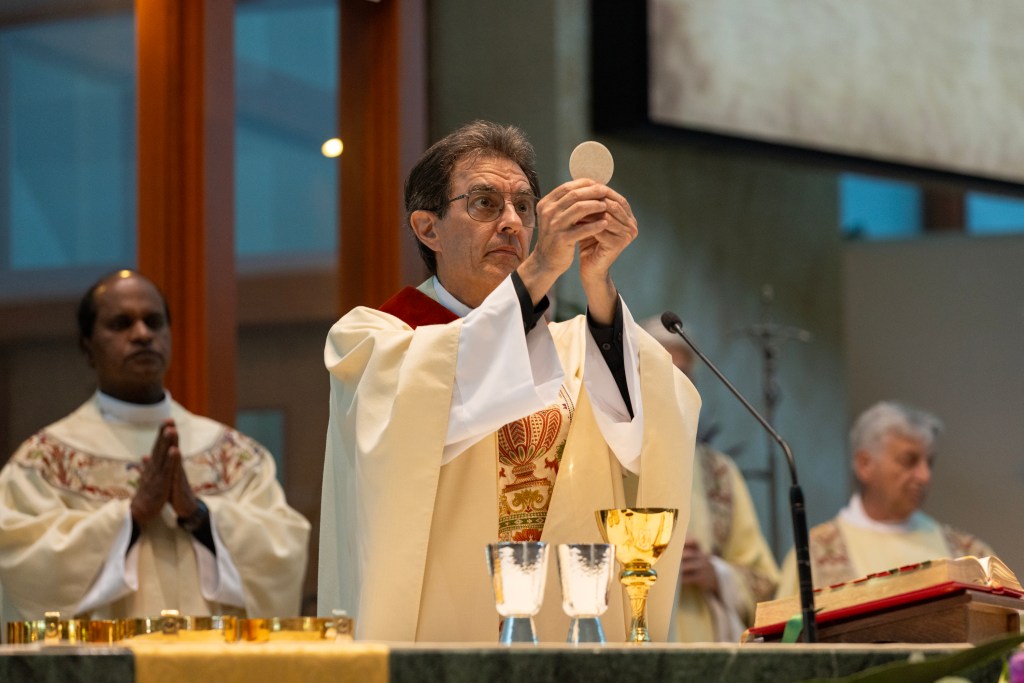
Photo: First Mass of Thanksgiving at St Peter Catholic Church; I am blessed at each Mass to hold in my hands, the Body and Blood of Christ.

Link for the Mass readings for Sunday, August 11, 2024

Let us die to selfishness, and rise in love for one another.

Jesus said to his disciples: “Amen, amen, I say to you, unless a grain of wheat falls to the ground and dies, it remains just a grain of wheat; but if it dies, it produces much fruit.(Jn:12:24).

In reading this verse, I was transported back to Middle School. Our sixth-grade class was dismissed to head to the cafeteria for the Science Fair. As I drew closer, I could hear some unintelligible chanting going on. Of course, I was curious and craned my neck to see over the other students filing in as we entered our destination. As I drew closer and saw a circle of kids taunting and circling someone, I stopped. I heard muffled groans and then saw one of my friends standing in the center of the circle, his forearms pulled up to cover his face. No one was laying a hand on him, but the heckling was inflicting enough damage. I froze not knowing what to do or how to act.

I don’t remember how the situation was resolved, but I do remember how badly I felt that day, and still do for not doing anything. I also withdrew from my friend when I saw him later because I felt so bad for not speaking up or stepping in. I wasn’t there for him as he was harassed nor did I provide comfort later because I was still only thinking of myself, my shame, and not his feelings or his need. That day, I remained just a grain of wheat that did not fall to the ground and die. I was unwilling to die to myself, unwilling to stand up for my friend, and unwilling to provide any comfort.

When we find ourselves in situations when another human being’s dignity is being diminished, Jesus implores us to resist loving our life, assessing first our own self-interest, or we will lose it. Instead, we are to “hate our life” in this world (cf. Jn 12:25) by thinking of others first, instead of ourselves. Challenging.

We start where we are instead of seeking some abstract ideal of changing the world in some utopian way. Jesus worked person to person, encounter by encounter, and invites us to do the same. We start with family and friends. Resist taking any moment we have with them for granted. We reach out then to our workplaces, schools, and/or community in our everyday interactions. No matter who we meet or interact with may we be respectful, engage with courtesy, patience, kindness, and understanding. As we take these concrete steps, we might be more willing to help the next time we witness the opposite.

Jesus, please grant us the courage to love, to will the good of the other. Give us the eyes to see and the ears to hear the cry of the poor; those who are demeaned, belittled, or dehumanized. Holy Spirit, inspire us to be that grain of wheat that dies to our own self-centered and fallen self, such that we are not just silent bystanders. Loving God and Father, empower us to stand, speak up, and act on behalf of the dignity of those who are vulnerable, those who do not have access, and/or the avenue to speak up for themselves.

———————————————————————–

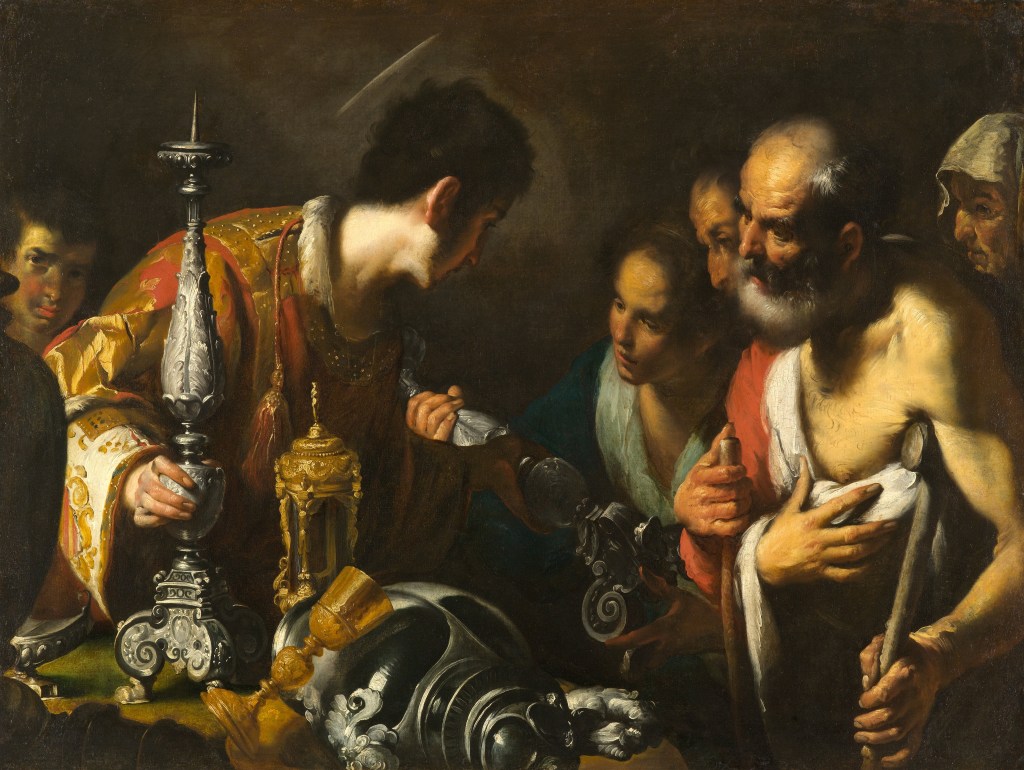
Painting by Bernardo Strozzi of St Lawrence, the third-century deacon and martyr. Lawrence was asked by the Roman prefect to bring the wealth of the church to help maintain the Roman army. Three days later, Lawrence returned with the blind and lame, lepers, orphans, and widows and said to the prefect, “These are the treasure of the Church.” St Lawrence on this your feast day, pray for us!

Link for the Mass readings for Saturday, August, 10, 2024

“Drawn to the Path”, will we go our own way or follow?

Jesus said to the disciples: “The Kingdom of heaven is like a net thrown into the sea, which collects fish of every kind.” (Mt 13:47).

The invitation of God is universal, and we are all lured by his invitation of love and intimacy. We long to belong, our very substance and essence as human beings is the reality that our ultimate fulfillment can only be reached in communion with the God who created us. Yet, though drawn, we resist being caught.

St Augustine (354-430), bishop of Hippo, came to a point in his life when he realized that the flame of his desire for wealth, fame, and pleasure was dimming. He felt moved toward “one reality that cannot decay, from which all other realities are derived.” Though he was caught in God’s net and being pulled in, Augustine still sought to wriggle free, for: “Though drawn to the Path, who is my savior, I shied from its hard traveling” (Augustine 2008, 161).

How many of us could echo Augustine’s dilemma? We have experienced God in our lives and feel the invitation to go deeper, and yet, we still seek to wriggle free. We are attracted to God while at the same time there are other things that have a stronger pull. We may also buy into the thought that God’s path is too hard. It is. Anything that has been worthwhile in our lives, haven’t we found that we have needed to be disciplined to obtain or even maintain it? Also, when we allow ourselves to be yoked to Christ, our load is lighter.

Mixed metaphors aside, it is harder and takes more effort to work against God’s will, just read the Book of Jonah! May we instead surrender to the current of the Father’s Love and allow ourselves to be caught in the net of his Grace. At first, anxiety and fear may arise, because the pull may appear too strong, his love too pure. Yet, when we align our discipline and effort with his will, the anxiety will wane, we will begin to feel safe, and we will indeed be free to swim again. This time with more exhilaration and joy than we had ever experienced before.

———————————————————————–

Photo: Following Mary’s lead, Rosary walk through Vero Beach.

Link for the Mass readings for Thursday, August 1, 2024

St Augustine. Confessions. Translated by Gary Wills. NY: Penguin Books, 2008.


There is a treasure of great value hidden and yet in our midst.

Jesus said to his disciples: “The Kingdom of heaven is like a treasure buried in a field, which a person finds and hides again, and out of joy goes and sells all that he has and buys that field” (Mt 13:44).

God is hiding in plain sight. God is in our midst, present to all of us, a wonderful treasure just waiting to be found. God’s eternal love and grace is ever reaching out to us. Our soul hungers, yearns, and seeks for that love, whether we know it or not. It is when we seek satisfaction, filling this deepest of our desires in material and finite pursuits alone, that we miss the true treasure. When we sin, create idols, seek the allure of apparent goods, we block our access to the very union we seek, we are not satisfied, and our desire increases all the more because we are seeking to fill that deepest void with everything but the one who wants to fill us to overflowing.

The saints and the mystics are those who have found the treasure of God’s will in their lives, they have experienced his love and mercy, and they have given themselves fully to God. They have encountered the living God in the mundane events of their lives and given all to be immersed in his communion. They “are amplifiers of every person’s more hidden life of faith, hope, and love. Their lives help us to hear the interior whispers and see the faint flickers of divine truth and love in ourselves and others. The Christian mystics point the way to fully authentic human life by illustrating what it means to be a human being, what life means: eternal union (which begins here) with the God of love” (Egan 1996, ix-xx).

God speaks in the silence of our hearts. Setting aside regular time to be still will help us to hear his whisperings. Opening our hearts and minds to God and seeking him in all things will help us to recognize those faint flickers and God-incidences present in our daily experiences. We can also experience Christ by reading and meditating on his Word, as well as reading the lives of the mystics and the saints, those who have found the treasure of Jesus’ presence and want to share it: St Francis of Assisi, St Teresa of Avila, St John of the Cross, St Therese of Lisieux, St Mother Teresa, and so many others are leading and urging us on to experience the rich encounter of the loving God of Jesus Christ.

Another who found this great treasure was St. Ignatius of Loyola (1491-1556), whose memorial we celebrate today. “While reading the life of Christ our Lord or the lives of the saints, he would reflect and reason with himself: ‘What if I should do what St. Francis or St. Dominic did?'” (Luis Gonzalez, The Liturgy of the Hours, vol III, 1975, 1566).  Might we ask this same question and so find the great treasure in our midst which is to experience the love of God in the depths of our souls, to love as Jesus loves us, as we continue our journey to become saints.

St. Ignatius, Pray for us!
———————————————————————–

Photo: Rosary walk Riomar Beach, Vero Beach.

Egan, Harvey D. An Anthology of Christian Mysticism, Second Edition. Collegeville, MN: Liturgical Press, 1996.

Link for the Mass readings for Wednesday, July 31, 2024

No darkness will overcome the love of the Holy Spirit.

“Explain to us the parable of the weeds in the field.” He said in reply, “He who sows good seed is the Son of Man, the field is the world, the good seed the children of the Kingdom. The weeds are the children of the Evil One, and the enemy who sows them is the Devil.” (Mt 13:36-39).

In this parable of the wheat and the weeds, Jesus is addressing the ancient question of why God allows evil and how are we to deal with it. Why do bad things happen to good people? As a starting point, we need to recognize that God is God, and we are not; meaning that we are not capable of reading the mind of God. Any answer to explain how and why God allows suffering will be insufficient. A second reality is that the Devil exists, though he is a created being. An angelic being, yes, but not equal in any way to God.

God is not a being. At best we can say he is Infinite Act of Existence, he is, or as God told Moses, “I am who am” (Exodus 3:14). God did not create evil, he only created good. “God looked at everything he had made, and found it very good” (Genesis 1:31). The Devil, Satan, the one who opposes, was created good also, as a high archangel, Lucifer, yet he chose to turn away from the will of God, and those angels who followed him are demons. God is greater than the Devil and his demons, and his good is greater than the evil they sow.

Evil is not so much a created thing, but a deprivation, or distortion of the good. God does not create evil, but he does allow it, and even though we cannot understand the reasons why God allows or permits evil or suffering, it is not a sufficient reason to say that God does not exist. This is especially true if we are seeking to grasp spiritual realities and truths from purely physical and rational means alone. We are indeed rational beings, who seek to know and to understand that which is good, but we are so much more. As human beings, we are physical AND spiritual, so need not limit ourselves to the merely sensate and empirical realm alone.

To better be guided by God, to hear his voice in the silence of our soul, to be fulfilled, our hearts and minds need to be open to the will of the Holy Spirit working in our lives. We are called to be people of prayer. As we mature spiritually and deepen our relationship with God, we will come to experience God as did Job: “I know that you can do all things, and that no purpose of yours can be hindered. I have dealt with great things that I do not understand; things too wonderful to me, which I cannot know” (Job 42: 2-3). In essence, Job acknowledged and accepted that God was in control, and he was not, and though he could not grasp everything, he trusted in the will of God for his ultimate good.

How do we deal with evil then? We need to surrender our pride and control over to God and acknowledge that he is in charge and knows what is best for us. We need to choose to put God first above ourselves and everything and everyone else. Our fundamental option, our telos, our end goal, is to embrace the reality that we are striving to be in a relationship with God. From the moment of our conception, we are a living, craving, hunger, and desire to be one with God and one another. This is true of the atheist and the mystic alike, whether we believe it or not. As we embrace this reality, put God first and focus on him, no matter what arises, we will begin to experience his presence in not only our everyday lives but begin to feel his presence with us in the midst of our suffering. We will come to know that he is stronger than any pain or evil, his grace is greater than any of our sins, and he will guide us through and give us what we need to endure.

Our loving God and Father has given us the means to understand suffering and evil especially in sending his Son to enter into our humanity, to suffer with us, even suffering his own unjust death on the cross. Our deepest prayer is when we willingly offer up our suffering and enter into the Mystery of the Passion of Jesus. Jesus, the pure and innocent one, beaten and crucified, understands our pain and agony, our cry for the horrors of injustice, and he understands the presence of evil. Jesus himself, asked not to be crucified, though he relinquished in saying, “Not my will but yours be done” (Lk 22:42).

In that acknowledgment, Jesus faced the utter evil, horror, betrayal, and injustice of humanity, his crucifixion. In taking upon himself the sin of the world on the Cross, he even felt his separation from his and our Father. Through his complete surrender into God forsakenness, into his death, and descent into hell, Jesus made the Resurrection possible. He conquered suffering, evil, and death forever, he brought about a greater good, through the evil of the crucifixion. No matter what trials we face, our Father has the last word over sin, suffering, and even our death.

We may not receive a sufficient answer or justification to suffering but we can experience the challenges we face with our hope intact by trusting that God hears our prayers and is present in our trials and tribulations. We receive help best when honest in our prayer, even when we are angry, afraid, doubtful, or frustrated. We will not find Jesus when we deny or run from our challenges. We will find him with his arms wide open and waiting for us when we are willing to ask and accept his help, and then enter into, face our suffering and pain.

We are not alone in our suffering. When we resist running from our pain, denying, or trying to distract or divert ourselves, and bring what we are going through to Jesus, he will provide a way and accompany us through every twist and turn. He understands what we are going through because he experienced the worst of human sin; he was betrayed, beaten, crucified, and died. We experience hope because Jesus has already won the battle and he sends us the Holy Spirit to give us the strength to endure.

No darkness can or will overcome the love of the Holy Spirit. Aligned with God we will be victorious even in the face of the greatest evil that confronts us. Let us trust in Jesus and each other, face whatever storm that arises with confidence and courage as did Jesus when he set his face toward Jerusalem. Empowered by the Holy Spirit we shall overcome.
———————————————————————–

Photo: Prayer connects us to the Light that shines in the darkness and is not overcome by it. Rosary walk North Hutchinson Island looking back at the mainland, Vero Beach, FL.

Link for the Mass readings for Tuesday, July 30, 2024

Are we weeds or wheat?

“’Master, did you not sow good seed in your field? Where have the weeds come from?’ He answered, ‘An enemy has done this.’ His slaves said to him, ‘Do you want us to go and pull them up?’ He replied, ‘No, if you pull up the weeds you might uproot the wheat along with them. Let them grow together until harvest” (Mt 13:27-30).

The master warned his servants to let the wheat and weeds grow together until they were more mature at the time of the harvest, so as not to pull up the wheat with the weeds. Weeds in this verse is translated from the original “Greek [as] zizanion [which] refers to a noxious weed that in its early stages closely resembles wheat and cannot be readily distinguished from it” (Harrington 2007, 204). Both, in their immature state, were indistinguishable.

Jesus is helping his disciples and to resist the temptation of condemning one another. Even when there are those who commit heinous acts of evil, and we may feel justified, Jesus says no. We are to convict another of their actions, and we are certainly to hold each other accountable, but condemn, no. The Father is the ultimate arbiter and judge. The Father sent his Son, not to condemn, but to save. There is always hope for repentance and a change of heart.

All of humanity has been created in the image and likeness of God, each of us are a unique gift to this world. We have been created good, yet all of us fall short of the glory and grace of God and because of our fallen nature our image and likeness to God has dimmed. God the Father will judge at the end of time between the wheat and the weeds and only he knows the time or the hour. Let us leave the judgment to God. Our invitation is to repent and align ourselves to the will of God, to encourage each other in the maturation process which can include, convicting others when needed, yes, but above all with love, willing each other’s good.

We are to resist the temptation the poisonous practices of gossip, prejudice, and self righteousness that create division and separation. Instead let us welcome, nurture and care for one another, promote unity while respecting the diversity of each person and their thought. We can disagree and have a good argument when we keep it at the level of an exchange of ideas while refraining from dehumanizing one another, and in the end accompany and be there for one another through thick and thin.

Not an easy path. What will help us, is to recognize that we are all in need of healing and transformation. Let us pray for patience, understanding, seek forgiveness, as well as be willing to forgive each other. Life, even when going well, is hard. We need the encouragement and support of each other if we are to mature and actualize the fullness of who God calls us to be as we strive through God’s grace to restore our image and likeness to God. “Encourage each other while it is still today” (Hebrews 3:13)!
—————————————

Photo: No wheat on Rosary walk but did find some sea oats. Riomar Beach, Vero Beach, FL.

Link for the Mass readings for Saturday, July 27, 2024.

Harrington SJ, Daniel J. “The Gospel of Matthew”. In vol. 1, Sacra Pagina Series, edited by Daniel J. Harrington. Minnesota, Liturgical Press, 2007.

Let us reflect the light of the mercy of Jesus as the moon reflects the light of the sun.

I say to you, something greater than the temple is here. If you knew what this meant, I desire mercy, not sacrifice, you would not have condemned these innocent men. For the Son of Man is Lord of the sabbath.” (Mt 12:6-8).

Jesus continues to rock established regulations and practices. Here he is challenging the understanding of the Sabbath itself when justifying the accusations leveled toward his disciples who were picking and eating grain on the Sabbath, and he does so in a profound way by saying that,“something greater than the temple is here.” Present in the heart of the temple, the area called the Holy of Holies, was the ark of the covenant. Atop the ark was the lid called the mercy seat of God. Jews believed that this was where God sat and when the blood of atonement was offered from sacrifices, God’s mercy was offered to the people. In the temple then, was the mercy seat, the very presence of God.

Jesus’ claim that he is greater than the temple is putting him on the same level as God. A blasphemous statement to say the least, unless of course, he is God. Jesus even doubles down by claiming that he is the Lord of the sabbath; Jesus used this latest challenge by those Pharisees seeking to trap him to help to reveal to them, his disciples, and us today that Jesus is God!

In quoting Hosea 6:6: “I desire mercy, not sacrifice”, Jesus is not only saying that he is the something greater, but that his Way is something greater. One of the foundational points of the Way of Jesus is mercy. Through the incarnation, the Son of God dwelt among us, became one with us in our humanity. He restored our dignity in the midst of our brokenness and sin. What Jesus said, in defending his disciples eating from the grains of wheat on the Sabbath, he is saying to us today: “What is owed to every human being on the basis of his or her human dignity is personal respect, personal acceptance, and personal care” (Kasper 2014, 202).

We grow closer to God and one another when we put Jesus’ teachings into practice. This is especially true when we bestow acts of mercy on our neighbor. “The works of mercy are charitable actions by which we come to the aid of our neighbor in his [or her] spiritual and bodily necessities. Instructing, advising, consoling, comforting are spiritual works of mercy, as are forgiving and bearing wrongs patiently. The corporal works of mercy consist especially in feeding the hungry, sheltering the homeless, clothing the naked, visiting the sick and imprisoned, and burying the dead. Among all these, giving alms to the poor is one of the chief witnesses to fraternal charity: it is also a work of justice pleasing to God” (Catechism of the Catholic Church).

Jesus came among us not to condemn us, but to forgive, instruct, and advise, to comfort, console, and provide care and accompany us in our needs. He extends mercy as his starting point, as his invitation. Jesus was and continues to be willing to join us in the midst our chaos. He does not wait for us to be perfect or worthy. He only asks if we are willing to allow him to love and heal us and then are we willing to enter the chaos of others and allow him to work through us to provide the same. Reviewing and examining our consciences with the spiritual and corporal works of is a good place to start. Praying about and deciding which one(s) to put into practice is a good next step. 

—————————————

Photo: Rosary walk, view from the midpoint of the Merrill P Barber Bridge, Vero Beach, FL.

Link for the Mass readings for Friday, July 19, 2024

Kasper, Walter. Mercy: The Essence of the Gospel and the Key to Christian Life. NY: Paulist Press, 2004.

Catholic Church. Catechism of the Catholic Church: Revised in Accordance with the Official Latin Text Promulgated by Pope John Paul II. Vatican City: Libreria Editrice Vaticana, 1997.

Following Jesus and St. James, we can learn to listen, love, and serve.

“The mother of the sons of Zebedee approached Jesus with her sons and did him homage, wishing to ask him for something. He said to her, ‘What do you wish?’ She answered him, ‘Command that these two sons of mine sit, one at your right and the other at your left, in your Kingdom’” (Mt 20:21-22).

The context of this request from the mother of the sons of Zebedee, James and John, comes from reading a few verses before the quote above. Start reading at Matthew 20:17 and you will see that Jesus and his twelve apostles are heading toward Jerusalem. Jesus stops to share with them, for the third time, that he will be condemned and crucified.

Jesus’ statement of his imminent suffering and death appears to be ignored by the mother of James and John. The other ten are indignant, not because of the apparent lack of acknowledging Jesus’ statement, but about who is the greatest among them! It is easy to imagine how a chaotic scene could then insue! As Saint John Chrysostom wrote: “See how imperfect they all are: the two who tried to get ahead of the other ten, and the ten who were jealous of the two” (Chrysostom 1975, 1552)!

This event is recorded in Matthew, Mark, and Luke. Mark has James and John speaking for themselves, not their mother, as in Matthew. Luke does not even record the initial request of James and John at all but comes in at the point of the apostle’s dispute. What all record, including the Gospel of John, is Jesus’ interjection where he made it clear to his apostles that he came to serve, not to be served. To follow Jesus meant, not that James and John would be given positions of honor and power in the worldly sense, the sitting at his right or his left, but that they were to serve as he served, to love as he loved.

As disciples of Jesus, one of the most powerful ways we can serve, the most powerful ways we can love, is to be truly present, done most effectively when we actively listen. This is done when we look at each other, resist the temptation of thinking about our own needs, and/or thinking about what we are to say. We put the book down, set the work aside, turn off the tv, put away the cell phone, disengage our thoughts, and instead look at and listen to what the person before us has to say.

This discipline becomes easier when we are willing to do the same with God who we can’t see. We do so when we are willing to be still, to stop, breathe and set everything aside, even our thoughts, to be present with and listen to Jesus. One does not have to come before the other. In the course of the day, it is good to have quiet times with Jesus and also intentional time with family members, friends, colleagues, as well as those to whom, in the past, we may not have given the time of day.

Jesus came to love, to listen, and to serve. May we too give of ourselves with our time and undivided attention toward those he directs us to love, listen, and serve. When we are present with one another the other gift of grace is that we experience the love of the Holy Spirit between us. St. James surrendered his pride and learned this practice well, and he has helped me on multiple occasions. St. James, pray for us!

—————————————

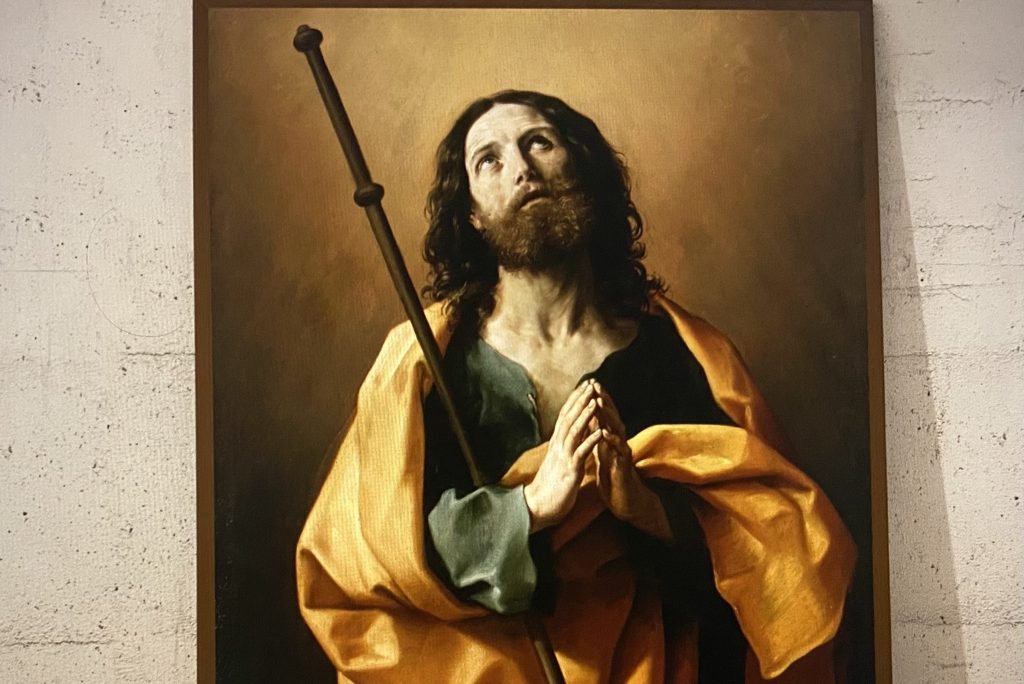
Painting: St. James by Guido Renin (1636-38)

Chrysostom, St John. Homily. The Liturgy of the Hours: According to the Roman Rite. Vol. 3. NY: Catholic Book Publishing, 1975.

Parallel Gospel passages to review:
Mark 10:35-45; Matthew 20:20-28; Luke 22:24-27 and John 13:12-17

Link for the Mass readings for Thursday, July 25, 2024