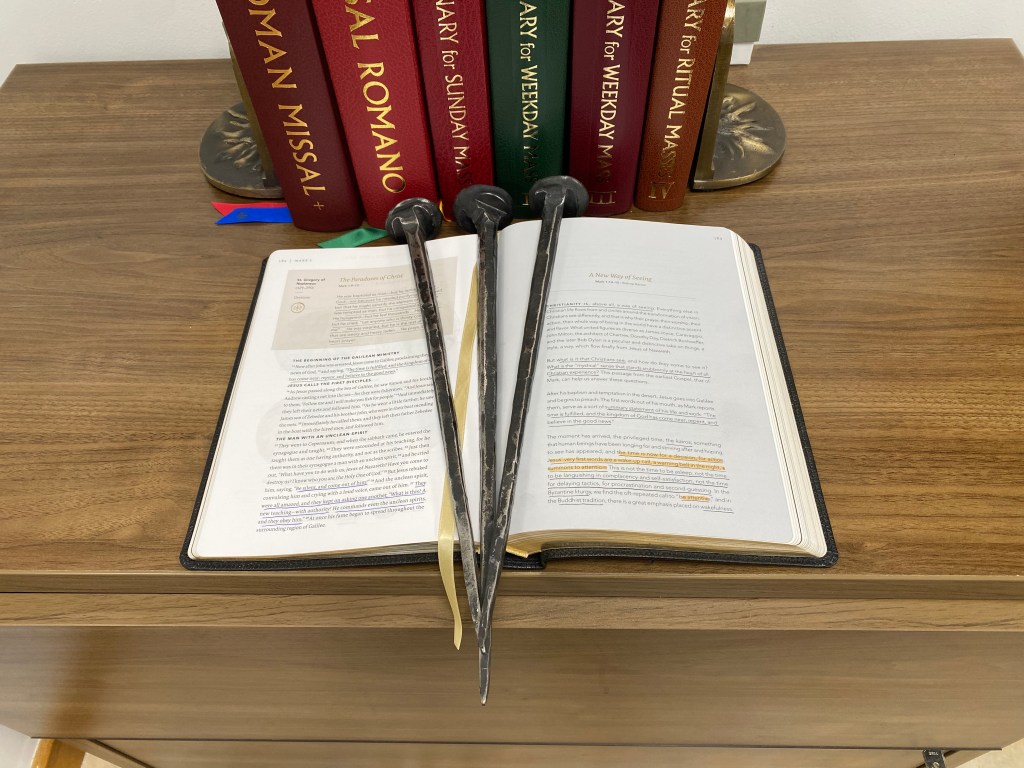
Surrender all to Jesus.

We are now beginning the fifth week of Lent. We are coming closer to the cross, to remembering the suffering, crucifixion, and death of Jesus. In today’s Gospel, Jesus is sharing with those in his midst that he will lose his life in fulfillment of his Father’s will: “I am troubled now. Yet what should I say? ‘Father, save me from this hour’? But it was for this purpose that I came to this hour. Father, glorify your name” (Jn 12:27-28). Jesus has come among us, to be one with us and to experience the fullness of being human. In becoming human, he is opening the door for us to experience his divinity.

To be able to experience the divinity of Jesus, we have to die to our self. Death is not a partial thing, it is a total surrender. As Christians, our first experience of this death is Baptism. In Baptism we die with Christ, and we rise to new life with him. We are purified from the condition of Original Sin as we are born again in water and Spirit. We are conformed and indelibly marked to Jesus and incorporated into the living organism of the Church, the Body of Christ. We become a part of his new creation.

In Confirmation, we continue the path of giving more of our life to Jesus. We are sealed with the gift of the Holy Spirit, we are empowered through the imposition of the laying on of hands and the anointing with chrism. We join in the apostolic mission of those who were and continue to be sent by Jesus to proclaim the Gospel, the Good News, that Jesus has become one with us so that we can be one with him. Jesus has given his life and returned to the Father in the fullness of his humanity, so to unleash the power and fullness of the love that he shares with his Father.

This is possible because what one human being experiences, sin or grace, all people experience. Each one of us are distinct and unique, one of a kind, while at the same time in communion with God and one another and all of creation. The Son of God, in becoming human, and in his willingness to experience our suffering and death, has risen from that experience and returned to the Father in the fullness of his humanity. What Jesus experiences with the Father, we have access to, in the degree that we are willing to accept our humanity and his invitation to participate in his life and divinity.

When we reject our humanity, reject the fact that we are created beings, not self-sufficient within ourselves; when we assume, grasp at, and appropriate for ourselves, self-autonomy, and stand firm that we need no help from God, we assume that we are the center of the universe and all revolves us instead of God, we separate ourselves from the source of the very communion we live, crave, and hunger for.

Any disordered affections or attachments toward anyone or anything that we place before God must be renounced, let go of. To the extent that we can surrender our whole mind, heart, soul, and strength to Jesus, is the extent to which we will participate in his life and divinity. Jesus died for us so that he can also be with us always. We are abandoned and not left as orphans, for he continues to be with us in the Mass. We come to receive him, Body and Blood, Soul and Divinity, during each liturgical celebration. We consume him and so continue to be nourished, to be transformed into his Body. When we are dismissed from our time of worship and communion, we are sent to be bearers of Christ. We are sent to bring him to those we encounter in our realm of influence through the corporal and spiritual works of mercy. At the very least we are to respect the dignity of each person we interact with.

By participating in the Sacraments of Initiation; Baptism, Confirmation, and Eucharist, we become the grain of wheat that dies, germinates in the ground, then sends forth roots and shoots. As we continue in our daily surrender to God and participate in the disciplines of prayer, fasting, worship, study, service, and almsgiving those shoots will become stalks and eventually bear fruit. For whoever serves Jesus, must follow him, and wherever he is, there his servants will be. The Father will honor whoever serves his Son (cf. Jn 12:26). Surrendering our lives in this way to Jesus we can say with St. Mother Teresa of Calcutta: “Each time anyone comes into contact with us, they must become different and better people because of having met us. We must radiate God’s love” (Mother Teresa, pp. 18-19).

Let us, like the grain of wheat, die to our false self, allow the shell of our ego to be cracked open, so to rise with Christ in his glory of being fully alive in him, to actualize who he calls us to be, and to bear the fruit of his mercy and love with others!

———————–

Photo: Sun setting as I began my Rosary walk, St. Vincent de Paul Regional Seminary, Boynton Beach, FL.

Mother Teresa and Devananda, Brother Angelo, ed. Total Surrender. Ann Arbor, MI: Servant Publications, 1985.

Link for the Mass readings for Sunday, March 14, 2024

Can we disagree and still listen to and respect one another? Yeap!

Jesus affirms who he is and whose he is in today’s Gospel of John. Despite those who do not believe that he is the Messiah, Jesus again makes his point very clear: “I did not come on my own, but the one who sent me, whom you do not know, is true. I know him, because I am from him, and he sent me” (Jn 7:28-29). Jesus is the Son of God made man and he belongs to the One who sent him, God the Father.

As Jesus was challenged in his time, he continues to be challenged today. That level of challenge has increased even to the degree that his human existence is even dismissed in some circles as a mere legend. Even as a historical figure, some speculate that Jesus did not walk the roads of Galilee and Judea. This need not be a reason for alarm. Though it is a reason to know our Tradition, the deposit of faith that has been preserved and passed on from Jesus to his Apostles and disciples, and to those early Church Fathers and Mothers named and unnamed and passed on up to this day in an unbroken apostolic succession. It is important to read the Bible, immerse ourselves in the sacred texts, pray with and meditate upon these words, and allow Jesus to speak to us again and again.

It is important to know what we believe, who we believe in, and whose we belong to. In this way when we are challenged by others, we do not need to stoop into a defensive crouch, but instead listen to the person’s points, their critiques, and ask questions of what they believe and why they believe what they believe. We can share our position while at the same time being open to understanding where our questioners are coming from. We can then respond with an open mind and heart of surrender to allow the Holy Spirit to be present through us.

When we are anxious, defensive, seeking to be right, or fearing to be wrong, we limit what Jesus can do through us. God is not about numbers and quotas, he is about building relationships, one person at a time. It is more important to build relationships than to win arguments! We can learn much from St. Bernadette of Soubirous who after her visions with the Blessed Virgin Mary was challenged time and again regarding the validity of her experiences. She simply responded, “My job is to inform, not convince.”

Social media platforms can be good platforms to exchange ideas as well as horrific experiences of the worst of our humanity. It is important that we remain respectful face to face and remember that screen to screen there is another human being on the other end. All of us are on a journey in this life. We can learn much from each other when we are willing to share our experiences while remaining committed to engaging in a spirit of charity and dialogue.

All of us seek the True, the Good, and the Beautiful. Especially during times of uncertainty and instability, it is important to respect and love those who have differing perspectives outside of and within the Church and be open to the reality that we can learn from one other. We do better when we are willing to listen to and allow God to guide each of us through our common challenges.

————————————————————————–

Photo: Making time for quiet and quieting our minds, we can better listen to others. Rosary walk, St. Vincent de Paul Regional Seminary, Boynton Beach, FL.

Link for the Mass readings for Friday, March 14, 2024

Be still and allow the light and love of Jesus to rise within your heart.

We hear often in the Gospels how those who believed in Jesus received healings, exorcisms, and were forgiven of their sins. We have also read accounts such as from the Gospel of Matthew that he “did not work many mighty deeds” in Nazareth “because of their lack of faith” (Mt 13:58).

In today’s Gospel account from John, Jesus speaks to a royal official whose son is close to death. Jesus said to him, “You may go; your son will live.” The man believed and in that moment his son was healed.

What do faith and belief have to do with Jesus being active in our lives? The way of the Gospel, the good news, is all about invitation and acceptance. Jesus entered our world, our reality, gently and humbly. He came as a poor infant, completely dependent on Mary and Joseph for his very survival. He lived most of his life in the obscure village of Nazareth most likely working with Joseph as a day laborer. When he began his public ministry, he did so by inviting people to be a part of his life, to enter into a relationship with him and his Father. People are free to say no or to say yes to that invitation.

Faith is trusting that what Jesus says is true and that he is who he says he is. Belief is the act of our will that aligns with our faith, our trust in him. Jesus invited the man to believe that his son was healed, and the man believed and walked away with full confidence that his son would be healed. Belief is followed by an affirmative act of the will. I can believe my car will run, but unless I get in it and turn the key, I am not going anywhere.

Just as the sun rose this morning, whether we saw it or not, Jesus is present to each and every one of us, whether we are aware or not. Jesus is inviting us to be a part of his life. Just as Jesus invited Andrew and Peter, James and John to follow him, Jesus invites us to follow him as well.

Even though the clocks have moved forward an hour, if your schedule affords you the opportunity to wake up with the sun or early in the morning while the sun is still rising this week, I invite you to do so. Find a quiet place inside or outside, call to mind anything that you are grateful for, ponder your hopes and dreams, allow any struggles, confusions, sinful patterns, needs for healing and/or forgiveness for yourselves or others to arise. As the light of the sun pierces the darkness, allow it to be an icon of Jesus’ invitation to enter your life and share with him what came up for you.

“From the east comes the one whose name is Dayspring, he who is mediator between God and men. You are invited then to look always to the east: it is there that the sun of righteousness rises for you, it is there that the light is always being born for you… So that you may always enjoy the light of knowledge, keep always in the daylight of faith, hold fast always to the light of love and peace” (Excerpt from a homily on Leviticus by Church father, Origen, who lived from 184-253).

If not that early in the morning, any time will do! Make some time to be still, embrace and be grateful for the light of Christ, the Dayspring, who rises in your heart. Breathe in deeply the love of his and our Father, believe in the truth that Jesus is the Son of the Living God, and trust that he will be with you today in all you do. Then, when you are ready, arise and walk on with the peace, confidence, and assurance that you are loved more than you can ever imagine and more than you will ever know.

——————————————————————————–

Photo: Morning prayer during 30 day silent retreat last summer,  Joseph and Mary Retreat House, Mundelein, Illinois.

Link for the Mass readings for Monday, March 11, 2024

We are invited to participate in a dance of love.

Jesus recognized that the scribe, who asked him about which commandment was the greatest, “answered with understanding,” and then he said to him, “You are not far from the Kingdom of God” (Mk 12:34). What is it that the scribe understood?

The scribe understood that God “is One and that there is no other”. God is the true source of our being, our very existence. We have been created with an innate desire to be one with him. This is the longing we all feel in the depths of our soul, this is why nothing that is finite or material will ever fully satisfy us, why we are always wanting more. This is as true for the mystic as it is for the atheist and everyone in between.

God is “One and no other” also means that we are not God, we are his created beings. God is not just one being among many, not even the supreme being. This orientation is important for we can only see from our limited perspective. What we think or believe we might need, may in fact not be truly good or beneficial for us, the shimmer may be an apparent good, a distraction, a temptation, that will lead us away from the authentic fulfillment and meaning of life that we seek. God will guide us away from any unhealthy want, he will lead us away from any temptation when we are willing to seek his guidance over and above our own. God will give us what we truly need, he will lead us to that which is, in reality, true, good, and beautiful.

Once we come to believe that God is God and we are his created beings, then we can take the next step and surrender: “to love him with all [our] heart, with all [our] understanding, with all [our] strength”. In our surrender to God and his will, we become capable of receiving his love and so are better able to love him in return. We all long to be loved and to love. Experiencing the love of God helps us to unconditionally love “our neighbor as our self”. Through our surrender to his will we allow God to love others through us.

God invites us to open our minds and hearts to receive his love, to love him in return, and to love others as he has loved us. To love God is like any other relationship. We need to spend quality time with God in stillness, be present One on one, as well as come to an awareness of God’s nearness in our daily activities. We are to resist compartmentalizing God and instead seek his presence in everything we do. The sacrifice he seeks is our willingness to allow him to love others through us, especially those for whom we do not have a warm and fuzzy feeling, as this is not the unconditional love God loves with. We are to will the good of the other as they are.

Each of us is prone to sin. We are wounded but not destroyed. God loves us as we are, and when we are willing to receive his forgiveness and confess, are sorry for our sins, willing to do penance, he forgives us, he heals our wounds, and he transforms us. We need to stop running away from him and start running to him. One way we can do this is to love our neighbor as our self, for if we cannot love those that we can see, how can we love God who we can’t?

There is a wonderful dance of love that Jesus invites us to engage in. As we answer God’s invitation to spend time with him in prayer, we will see him in each other as well as in all things. As we love one another, by being there, listening, supporting, and empowering one another, we will experience more of God’s love and each other’s love. Our lives will expand, we will experience more healing, and be free from those lies and temptations that limit us and we will love ourselves more.

Jesus’ arms are wide open before us in our time of prayer, our own struggles and challenges, and in our neighbors. May we surrender all our heart, soul, mind, and strength into his loving embrace, to receive his love and love him in return, and be willing to love our neighbors and ourselves in the same way. When we get this commandment of loving God, our neighbor and ourselves right, the other commandments will be something we will do naturally. As we put this commandment into practice, we too will hear Jesus say to us, “You are not far from the kingdom of God.”

—————————————————————————-

Photo: Many ways we can see God’s hand at work. Rosary walk, last Fall. St. Vincent de Paul Regional Seminary, Boynton Beach, FL.

Link for the Mass readings for Friday, March 8, 2024

“When the perfect comes, the partial will pass away.”

Pilgrims numbering two to four million would ascend to Jerusalem to participate in the annual observance of Passover. During this time the Jewish officials were on edge because their primary concern was to keep order and peace for fear that the Roman military occupation also in presence would step in if need be. If the centurions asserted their enforcement, it would be swift and brutal. Even the slightest infraction of civil unrest would be dealt with harshly.

Jesus whirling a whip made out of chords, driving out the merchants, turning over tables, sending coins flying would have been quite the scene! The disruption certainly would not have gone unnoticed and some biblical scholars believe this was the main incident leading to his crucifixion. In this act of cleansing the Temple, Jesus gave a visual display to his sometimes figurative teachings. Jesus came to shake things up, to wake people up from their spiritual slumber, to bring people back to right worship and praise.

Let us enter the scene of today’s gospel. We are those among the vast crowd in the temple precincts, shoulder to shoulder amidst the hustle and bustle of the day. A cacophony of words echoes about, haggling of prices for animals being purchased for sacrifice mingle with arguments over unjust money exchanges. Then we experience a lull in the crowd, we look over our shoulders and see people stepping aside, parting, and opening. Then Jesus, rope chords in hand, his face hard, and eyes set on the tables ahead of him, strides by us. We can feel the electricity of a gathering thunderstorm, and then he lets loose like a lightning bolt. The first table goes over, coins launch into the air and jingle as they scatter across the stone amidst a chorus of the money changer’s cries of outrage.

The scene shifts. A knock is heard at the door of our own home as we are in the midst of what we do on any given Sunday. We walk to the entrance and spy the same Jesus we just experienced in the temple precincts standing outside. We feel the drop in pressure of a gathering storm, we witness the same hard expression on his face, and in his hand are the same chords. If we do let Jesus in, where does his stride take him, what does he overturn and toss aside? We are invited to allow Jesus full reign and access to every nook and cranny of our home, as well as our heart, mind, and soul.

In both cases, these are not acts of Jesus having a temper tantrum or bad day. They are acts of love and purification. “For when the perfect comes, the partial passes away” (I Corinthians 13:10). Jesus, the perfect, knows what does not and what does belong in the temple as well as our homes and in our hearts. He knows what is preventing us from receiving the fullness of his and his Father’s love. Are we willing to know, to purge, and allow that which is partial to pass away, so that we may enter into a deeper life of authentic prayer, worship, intimacy of relationship with God, and service to each other?

———————————-

Painting: Rosary walk last Fall, St. Vincent de Paul Regional Seminary, Boynton Beach, FL.

Link for the Mass readings for Sunday, March 3, 2024

Are we willing to receive the Kingdom of God which is at hand?

The ten brothers of Joseph are envious of and hated him so much that they plotted to kill him. The Pharisees are planning to do the same with Jesus. Both Joseph and Jesus are beloved sons of their father, both will be sold for silver, and betrayed. Joseph remains faithful to God in his slavery in Egypt and through God’s providence will save the same brothers who betrayed him as well as all of his people from famine such that: what his brothers meant for ill, God would bring about for a greater good.

Jesus, the Son of God, is sent after his Baptism to call the descendants of the same people Joseph saved back to the God of Abraham, Isaac, Jacob, and Joseph. And yet, many of the Pharisees and priests are not about to receive this message or the invitation to repent and believe the Gospel, because most of them do not believe they need to or are not willing to. Joseph was able to save his own father and brothers and his people for a time, but they would eventually die. The offer of the salvation that Jesus presented is an eternal one and yet many of the chief priests and the Pharisees closed their minds and hearts to him, so much so that they were seeking to arrest and kill him. Jesus appealed to them to change by sharing the parable of the Tenants.

At the close of the parable, Jesus said to them, “the Kingdom of God will be taken from you and given to a people that will produce its fruit” (Matthew 21:43). The leaders were the stewards of God’s Kingdom and could inherit and be a part of it, but they would not accept the Son sent by his Father, the landowner, who is God, and it would be taken from them.

Who then is the Kingdom of God to be given to? Those who are willing to repent and believe in the Gospel for the kingdom is present in Jesus. Jesus reaches out his hand to us. Will we refuse or are we willing to place our hand in his and walk with him where he will lead us?

When we take his hand, we will still feel the wound of the nail that pierced him through. Like Thomas, do we realize that we are holding the hand of our Lord and our God? Do we realize that Jesus was willing to give his life for you and me for this very moment in time?

Receive this gift to spend with Jesus. Share with him what is in your heart and on your mind. Breathe and be still and listen to what he would like to share with you. Trust in Jesus and this time together.


Photo: Some quiet time with Jesus this past Sunday, St. Vincent de Paul Regional Seminary, Boynton Beach, FL.

Link for the Mass readings for Friday, March 1, 2024

Jesus sets a high bar, but will also give us the strength we need to reach it.

There are many polls, surveys, and discussions about why fewer people participate in formal faith traditions, while at the same time many people are still hungry for God. Some people still profess to be spiritual but identify less with organized religion. There are a handful of causes why, but Jesus may be shedding light on two possible ones. Jesus discusses in today’s Gospel from Matthew: “For they preach but they do not practice. They tie up heavy burdens hard to carry and lay them on people’s shoulders, but they will not lift a finger to move them” (Mt 23:3-4).

We have an innate sense that alerts us to hypocrisy and when many seek something deeper in their life and they get slapped in the face with leaders and practitioners in faith traditions preaching one way in public while living another, it is damaging. The Catholic Church is still reeling from not only those clergy who have abused children, but those bishops who have covered up the abuse. This certainly is the height of hypocrisy in that those entrusted to shepherd the people of God were preying on their own flock.

As horrific as these acts are, there are so many other ways we are not practicing what we preach. It is easy to give up and walk away and say this is not my problem, to point fingers and justify our own acts of hypocrisy by saying well at least I am not that bad. Yet even this evil within the Church does not change the truth that Jesus is the way, the truth, and the life. He is the source of our being and fulfillment.

We are followers of Jesus, and that means the standard we strive for is how he lived his life. Jesus always pointed the way to the Father. We as human beings are finite and so are going to make mistakes and sin. While Jesus is our model, even more, he is the source for our living faithfully to his teachings. When we open our hearts and minds to him, his love will work through and transform us. He will reach others through us as well when we are willing to stand up for the dignity of those entrusted to us within our realm of influence.

If we want to guide someone it is not enough to say this is what you need to do and live accordingly. We need to practice and live what we are guiding others to do, be willing to accompany, assist, and walk with someone along the way. As a Christian, just giving someone the Bible and say there you go, that’s all you need, and quote a couple of scripture passages is not enough. If we are sharing a principle to put into practice and we are not willing to lift a finger to help them, or worse do the opposite, we do more damage than if we said nothing.

Jesus calls us to resist judging and condemning, to love our enemies, to be forgiving, and merciful. Powerful actions to live up to, heavy burdens to lift indeed. To say that the bar Jesus sets is high is an understatement, but he lived them out. We not only learn how to act from reading about the life and teachings of Jesus but even more importantly, he still gives us the power and assists us to live them out too.

Jesus challenges us even more than the scribes and Pharisees, but he is willing to help us carry the load. When we are willing to see where we fall short of the goals that he sets for us, ask for his forgiveness, and accept his help, we will grow. From our own experiences of falling down and getting back up, we are better able to help others to be disciples, by guiding, modeling, and walking with them. The most important guidance we can give anyone is to lead people in such a way that they have an encounter and experience of Jesus for themselves, so even when we fall, they will still have Jesus as their ultimate guide and they can then help us up and we can continue to journey together, side by side.

————————————–

Photo: Attending Mass at St. Luke Catholic Church, Ellington, CT over Christmas break. Nice to experience Mass in different parishes each day while away!

Link for the Mass readings for Tuesday, February 27, 2024

Let us reflect the love of Christ with our thoughts and our words.

Jesus calls us to be holy, each and every one of us. Our life is to be lived with the end goal being our ascent to heaven, to be in union with our Loving God and Father for all eternity, and to assist others to do the same. Jesus provides for us a concrete example of the heights to which we are called to reach: “You have heard that it was said to your ancestors, You shall not kill; and whoever kills will be liable to judgment. But I say to you, whoever is angry with his brother will be liable to judgment, and whoever says to his brother, Raqa, will be answerable to the Sanhedrin, and whoever says, ‘You fool,’ will be liable to fiery Gehenna” (5:21-22). Jesus is building on the Torah, the Law or the Teachings, by helping us to realize that we can not only kill with weapons but also inflict dehumanizing damage with our words.

To resist this temptation of inflicting mortal wounds, we need to start participating in a deeper examination of conscience which gets to the roots of our own thoughts, words, and actions. If we are not able to discipline our thoughts, what will follow is undisciplined words, and then undisciplined actions, which can lead to entertaining and embracing the deadly sin of wrath. Wrath is unbridled anger that leads someone away from the capacity to think or behave in a rational manner, such that this individual would no longer acknowledge the dignity of the person they would inflict their wrath upon.

Jesus is helping us to see that we can be free of the temptation of wrath if we recognize the danger and destruction of unleashing words as weapons. He offers us the examples of calling someone, Raqa, meaning something along the lines of an air-head or an idiot, and calling someone a fool. These words directed at another have no other cause than to demean, degrade, and belittle. This language, and worse, has no business coming out of the mouths of a disciple of Christ if we are serious about being one of his followers.

I remember a moment in sixth or seventh grade unleashing a derogatory word or two directed at a classmate. Even though they were loosed in jest, I felt a sinking feeling in my gut after hearing myself say them. God gave me a graced moment to feel, contrition, actual sorrow for the negativity and poison I had unleashed with my words. I remember making a commitment to myself not to speak that way toward another person going forward.

We need to be aware that words have the power to wound or to heal. If we are serious about following Jesus, then a wonderful practice this Lent can be to commit to fasting from gossip and from words that belittle, divide, diminish, or dehumanize and replace them with words that empower, unite, uplift and acknowledge the dignity of others. Even when we disagree with another’s point of view, we can do so by still respecting the person and fostering a posture of dialogue.

May we also commit to resisting and not feeing negative or dehumanizing thoughts when they arise. Even when we have defensive musings, resulting from another’s disparaging tone, words, or actions, we need to resist entertaining them. Instead, we can ask for the strength from the Holy Spirit to develop a more mindful disposition that seeks to understand instead of react and to hold each other accountable with respect. We can also give ourselves time regularly to be still and enjoy time outside to let go and unwind. It is important to get enough rest as well. Ultimately we need to consciously choose to love: to will the good of each other as our first step in encountering one another as human beings, as beloved daughters and sons of God.

—————————————————————

Photo: The simple act of looking up can make a difference in our attitude and emotional state. Give it a try and see! Rosary walk, St. Vincent de Paul Regional Seminary, Boynton Beach, FL.

Link for the Mass readings for Friday, February 23, 2024

“Who do you say that I am?”

Jesus asked, “Who do people say that the Son of Man is” (Mt. 16:13)?

Peter answers Jesus by saying that Jesus is: “The Messiah, the Son of the Living God” (Mt: 16:16).

What does Peter’s response have to do with our lives? Does he really care about our everyday challenges, struggles, and tensions? Yes, he does because Jesus is the Christ the Son of the living God. Jesus is Emmanuel, God with us. Jesus is one with us. The infinite reality of God is present within each human being that exists because Jesus became one with us in our humanity so that we can be one with him in his divinity.

We have been created in God’s image and likeness and this is true from the moment of our conception through each stage of life until natural death. The unfortunate effects of Orignal sin are that our image has been distorted and our likeness to God has been lost. We have not been totally corrupted but we have been wounded and we need to be healed and restored.

Jesus experiences our suffering personally. Whatever we may be going through, whether it be a temporary or chronic illness, loss of job, conflict and tensions with family, friends, colleagues, and/or classmates, as well as experiencing feelings anxiety, confusion, and/or lack of direction, mourning and grieving over the death of those we hold close to our hearts: Jesus feels our pain and suffering.

The suffering of humanity is not something abstract for Jesus because Jesus knows each and every one of us intimately and uniquely. He knows us better than we know ourselves and is the one who cares about us and what we are experiencing. Also, he is no stranger to suffering.

Jesus not only cares, he loves us and will walk with us no matter what we may be facing right now. Jesus is inviting us this morning and this Lent to trust in him, to allow his light to shine in those places of darkness, those places where anxiety and fear have a hold, and those places where we need to let go because we give them more priority in our lives than we do God.

A good question to ponder and meditate on this morning is: Who is Jesus for us and are we willing to invite him into our situations and allow God to happen in our lives?

—————————————————————————–

Photo: Closeup of a 6th century icon of Jesus from St Catherine’s Monastery.

Link for Mass readings for Monday, February 22, 2024

Allow the words of the Our Father to enkindle the fire of his love into your heart.

There is a creative power to God’s word. “In the beginning was the Word, and the Word was with God, and the Word was God” (John 1:1). God’s word is alive and present to all of us. And as Isaiah conveys in today’s first reading, God’s word “shall not return to me void, but shall do my will, achieving the end for which I sent it” (Isaiah 55:11).

This happened most profoundly in time when “the Word became flesh and dwelt among us” (John 1:14). God the Father through the overshadowing of the Holy Spirit and the ascent of Mary’s will, sent his Son to be human while remaining fully divine. Jesus lived, suffered, died, conquered death, rose again, and ascended into heaven bringing our humanity through his humanity back to the Father. God’s Word achieved the end for which he was sent, that salvation of the world!

God’s word, the Holy Spirit, and Jesus are still alive and active today. The gift of the Bible is that the story of salvation is there for us to experience. The Bible is not just a compilation of dead letters on a series of pages to be gathering dust. These words are most alive when they are proclaimed at Mass and read, prayed and meditated upon within our own time of prayer, and put into action in our daily lives.

God still speaks to us today through his living word when we make the time to listen and hear him speak in the silence of our hearts. In today’s Gospel, Jesus teaches us how to pray by sharing the words of the Our Father or the Lord’s Prayer. This is the same prayer that he taught his Apostles and has been prayed ever since then each and every day over the past two thousand years.

If you have been wanting to learn to pray and meditate with the Bible and haven’t been sure where to begin, the Our Father is a great place to start. Settle into a quiet place, take some deep breathes, and let the words come off the page and land on your lips. This can be silently or aloud. Read or recite slowly God’s word given to us by the Word, the Son of God, Jesus.

If you know these words well, resist the temptation to fly through them without a second thought. Say each word slowly, allow the mystery of God’s love to enfold you, allow Our Father to embrace you. The same Father who is in heaven, whose name is hallowed, holy. The God and creator of all that exists who is so far beyond our comprehension, while at the same time closer to us than we are to ourselves.

Contemplate on the wonderful truth that he wants us to be a part of his kingdom now and forever. God wants his will and our will to align as one so that we can be collaborators with him in creation so that we can put into practice what God guides us to on earth as it is in heaven. For heaven is the intimate communion with our loving God and Father that he seeks, and we have been created for.

We can then ask him for our daily bread, that which we need each day, most of all his Word among us made present again on Catholic altars throughout the world. Jesus, the Bread of Life, who we can consume and become transformed.

One of the most powerful transformations comes when we are forgiven by God who never tires of forgiving us. May we not only never tire of asking for forgiveness but also be willing to forgive as we have been forgiven. Sin, which causes separation and death from God and each other, is healed and we are redeemed by God’s forgiveness. As we are forgiven, we then are to forgive others and so God’s love is made manifest on earth as it is in heaven.

And as we prepare for each day, may we seek God’s guidance so that we may know his will and resist the temptations, distractions, and diversions of the enemy. God does not tempt us and he can help us to resist temptation when we follow his light. We will then not only avoid evil, but in the name of Jesus cast it out.

I invite you to pray with the Our Father in a similar way allowing Jesus to speak to you through your mind and heart as you meditate on each word. You may find that you want to stay with one particular word or phrase that calls to you and not even finish the prayer. Allow the Holy Spirit to guide you where he wills. May you feel his peace, love, and joy arise from within you as you do so, and enjoy!


Photo: The tree tops reflecting the rays of the setting sun. May we do the same as we receive and reflect the light of the Son from our experience of Jesus in prayer!

Link for the Mass readings for Tuesday, February 19, 2024