Jesus and Mary are with us in our experiences of Holy Saturday.

This is Holy Saturday. We remember how Jesus was in the tomb and wonder how the disciples of Jesus feel. Were their hopes dashed by the death of their teacher as they hid in fear that they might be next. Could he really have been the Messiah if he has died? Anguish, fear, doubts, and despair are heavy weights.

Some glimmer of hope though may come as they gathered and recalled what Jesus had said and taught. Peter, James, and John were especially privileged to have seen the transfiguration of Jesus. Jesus had raised Jairus’ daughter, the widow’s son, and Lazarus from the dead. Was Lazarus with them now? Could he have provided some possible hope that since he was raised, that Jesus may indeed rise again as he promised?

A powerful claim. But could it really happen?

Holy Saturday is that in between time. In between the death of Jesus and his resurrection. A place between despair and hope. All may appear to be lost, but then again there is the promise of Jesus. Did Mary and the Apostles trust him? Do we? As I shared yesterday, it is our pain and suffering that we carry into our Holy Saturdays. To heal, we need to be willing to carry those emotions that we would rather not experience and not deal with, because we might fear that if we do, we will be undone or that they will be too overwhelming. And yet, it is in taking that risk, entering into and experiencing our pain that we experience the comforting presence and love of Jesus. Jesus who experiences our pain with us as well as his Mother, whose heart was pierced when the centurion’s lance pierced her Son’s heart. And it is in experiencing our suffering with them that there can be a path to healing.

We often find ourselves in the same emotional maelstrom as did the disciples. We have heard that he is with us and that he loves us no matter what, but there is this period of dead silence. Holy Saturday is that time of waiting, that time of silence, and that time to draw deeper into believing even when we cannot see or experience with our senses. Holy Saturday is also a time to ponder and embrace the truth that it is not all about us. In looking beyond ourselves to the Passion of Jesus: his suffering, crucifixion, and death, our problems and sufferings may be adjusted with our focus and perspective on him instead of us.

Too often our minds tend to focus on the worst case scenario, and in times when we don’t feel or experience Jesus’ presence, we need to trust that he is not absent and that he has not abandoned us. Jesus is right by our side. We may not be aware because of our focus or he just might be challenging us to go deeper in our trust and faith in him. When we do, instead of feeling like we are sinking in the mud, we will come to find that our feet are set on solid rock, the Christ the Son of the living God.


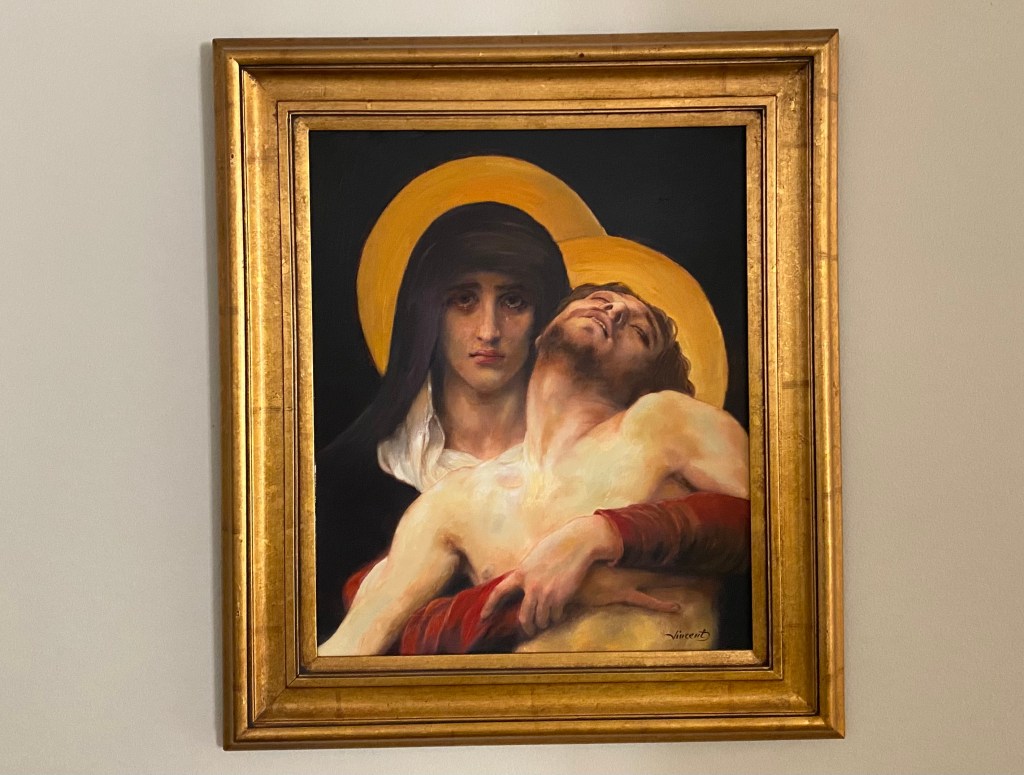
Photo of a closeup painting of William Bouguereau’s, Pieta, hanging in the main conference room at the Our Lady of Florida Retreat Center, North Palm Beach, FL.

The sun is setting on Lent as we begin Holy Week.

A core group within the leadership of Israel has decided. They will not deny themselves their power, prestige, and their place. They will not take up their cross and follow Jesus, the way, the truth, and the life. They will not allow the teaching and momentum of the growing number of those following Jesus to continue unchecked. As Passover drew nearer, thousands of people were coming up to Jerusalem to purify themselves for the great feast.

This meant the Romans would have many more centurions in place to keep the peace. The division and commotion that Jesus was causing could cause conflict and unrest and then swift and violent retribution from the Roman presence. The Sanhedrin, the Jewish High Council, followed the lead of the high priest, Caiaphas, who said, “You know nothing, nor do you consider that it is better for you that one man should die instead of the people, so that the whole nation may not perish” (Jn 11:49-50). With these words, they began to plan how to put to death the carpenter of Nazareth.

With the words of Caiaphas, the sun began to set on the life of Jesus. These words affect us even today as they usher in the sunset of our Lenten observance. The gift of our liturgical readings allows us to relive the story of our faith. Lent has given us a time to reflect and to meditate upon who Jesus is. Is he just a carpenter, another teacher, a holy man from the past, or is he each of these, but someone so much more. Is he the Son of God who became one with us in his humanity so that we can become one with him in his divinity?

Do we see his teachings and life as a threat as did the Sanhedrin? Do we like our life the way it is, such that we do not want Jesus to come into our home and start turning over the tables and disrupting our order and comfort? Or do the Gospels cut us to the heart and inspire us to shake off our complacency, our indifference, our cynicism, our comfort, our routine.

Jesus evades the centurions, because his hour is not yet, but when his Father willed it, Jesus was willing to give his life, not just in an abstract way, but very personally: for each and every one of us. Does that mean anything? Jesus gave everything for us. Does this truth spark a desire to acknowledge our sins, to repent, and to begin anew? Are we willing to open our hearts and minds to his love that transforms, are we willing to spend some time in quiet and allow Jesus to speak in the silence of our hearts, are we willing to be encouraged to fast, to pray, meditate, and to be moved with compassion to help those in need?

As Holy Week begins with the Vigil Mass for Passion Sunday may we meditate on the words of Caiaphas, “consider that it is better for you that one man should die instead of the people, so that the whole nation may not perish” (Jn 11:49-50). Caiaphas did not know that what he proclaimed would be so true, that the One, Jesus, would die, not only so the nation would not perish, but that all humanity could be saved.

Jesus died for each and every one of us that we might have life and have it to the full. As the sun sets this Saturday evening, may it not be just another rotation of the earth on its axis, but an opportunity to commit once again to die to our false selves, our egos, our self-centered postures, to be forgiven, and healed, and take up our cross and follow Jesus into Holy Week.
———
Photo: From Rosary walk last fall, SVDP Regional Seminary, Boynton Beach, FL

Link for the Mass readings for Saturday, March 23, 2022

Jesus, blasphemer or human and divine?

Two groups of Jews emerged in today’s Gospel account. There were those about to stone Jesus for blasphemy and those who began to believe. The first group did not recognize the good works that Jesus did as coming from God, nor his reasoning that “even if you do not believe me, believe the works, so that you may realize and understand that the Father is in me and I am in the Father” (Jn 10:38). They listened to the claim that Jesus was making but they refused to accept the fulfillment of the assertion: Jesus did the works of his Father because he was then and still is today the Son of God.
The more that Jesus sought to help them to understand that he was who he says he is, the more they dug in their heels. They left the stones on the ground but then moved to have him arrested. Jesus evaded their grasp and moved on to the region across the Jordan where John first baptized. John did not preach in the Temple precincts either, even though he was the son of a priest. John followed the lead of God to prepare the way for Jesus and his eternal priesthood. The Temple had not been the seat of God for some time. Jesus would become the new and living Temple.

Jesus returned to the place of his baptism, where he joined in solidarity with sinful humanity. This visible image of consecration revealed what happened silently in his conception and birth: the Son of God took on flesh and paraphrasing St. Irenaeus, became man to open up heaven for us in the humanity he assumed. As people came to John in the Jordanian wilderness, so too, people came to Jesus. Not all rejected his message. Many came to him and said, “John performed no sign, but everything John said about this man was true.” And many there began to believe in him (Jn 10:41-42).

The question that arises for us as our steps take us closer to Palm Sunday and Holy Week is, will we label Jesus as a blasphemer or accept that Jesus is the Son of God? Today’s scriptural account does not reveal indifference as an option. There is no room for Jesus being only human; a good teacher, a wise man, or a revolutionary radical.

We either accept Jesus is fully human and fully divine or we don’t. If he isn’t who he claimed to be: God, then Christianity is just another philosophical, theological pursuit and in the words of St. Paul, our faith is in vain. Yet, when we accept that Jesus is the Christ, the Son of the Living God, then our lives are to be aligned with his. Our thoughts, words, actions, and even our faces need to reflect that truth. This does not mean we, or our lives are going to be perfect. We and our lives aren’t, but as we surrender our lives to Jesus, repent when we fall, seek his guidance, and invite him to be at the core and center of our lives, we will be perfected, slowly and surely by his love.

A good way to begin each day is affirming this fact by stating with an attitude of prayer, “Jesus I believe in you, you are my God and my all, and I need you.” Ask him what works of the Father he would have us offer in his name this day. In what ways can we be of help and support to another? May we have the openness of mind and heart to hear his words and the courage to act upon his guidance, so to be the precious, living stones we are, reflecting the light from our source, Jesus the Christ, the Son of the Living God.

————————————————————————-

Photo: As the moon reflects the light from the sun, so are we to reflect the light of Jesus.

Link for the Mass readings for Thursday, March 22, 2024

Jesus is the Son of God? Yeap.

Jesus’ listeners “picked up stones to throw at him” (Jn 8:59). Though less violent, this interaction has some similarities found in Jesus’ Bread of Life discourse (cf. John chapter 6), where Jesus made the statement, that, “I am the bread of life” (Jn 6:48). In both cases, the people do not understand what Jesus is sharing and yet Jesus resists softening his approach and instead doubles down.

In John 6, Jesus holds firm to the truth that his followers will consume him and in today’s Gospel Jesus does not equate himself as being just a representative of God, a prophet or a rabbi, but that he is, in fact, God when he states: “Amen, amen, I say to you, before Abraham came to be, I AM” (Jn 8:58). With these words, Jesus has just done the unthinkable, the unimaginable for the people of his time. He not only has spoken God’s sacred name, which is not to be uttered because it is considered to holy to do so, he equates this sacred name, “I AM”, with himself. Jesus is making his point very clear. Jesus is God. During the Bread of Life discourse, people walked away from him because they were repulsed and most likely considered him mad, here they may also think he is mad, but the issue is that to them he is speaking blasphemy. The reactions would be appropriate in both cases, unless of course, Jesus is who he said he is.

As his listeners then, we too have a choice to disbelieve or believe in the words of Jesus. One option that is off the table, if we give the Gospel accounts any rational reading, is that Jesus presented himself as just another teacher, philosopher, or prophet. Jesus, during his public ministry, is consistently embroiled in conflict, which is evident in all four Gospels because Jesus presents himself as God incarnate. Jesus heals on the Sabbath because he is the Lord of the Sabbath, Jesus is the Bread of Life, Jesus is: “I AM.”

The Apostles struggled time and again to make sense of the words and actions of Jesus and we may also struggle as well. We may have doubts, concerns, and unanswered prayers and/or questions. To walk the path of discipleship is not to walk with constant assurance, for we walk by faith and not by sight (cf. 2 Corinthians 5:7). Walking by faith though does not mean that we just throw up our hands, toss out all reason, and believe blindly. Dr. Holly Ordway defined faith as, “trust based on a reasoned knowledge of the evidence.” We trust that Jesus is who he claimed himself to be based on the scriptural evidence, our own experiences with the truth based on these claims, and our encounters with him in our everyday interactions and times of prayer.

We are to follow the apostles in that, even though we don’t fully understand, when Jesus calls, we also trust him and follow where he leads. He does not give us the full picture all at once, but as we step out with each faithful step, he will reveal a little more light and truth. He will be present with and work through us as we continue to turn our life over to him and one another more and more each day.

When doubts arise, we can lean on Peter’s claim, “Master, to whom shall we go? You have the words of eternal life.” (Jn 6:68). Peter made this claim based on his experience and trust in his relationship with Jesus. Our relationship and belief in Jesus will also grow more deeply and intimately, moment by moment, with each yes to the invitation of Jesus, the Holy One of God.

———————————————————————————-

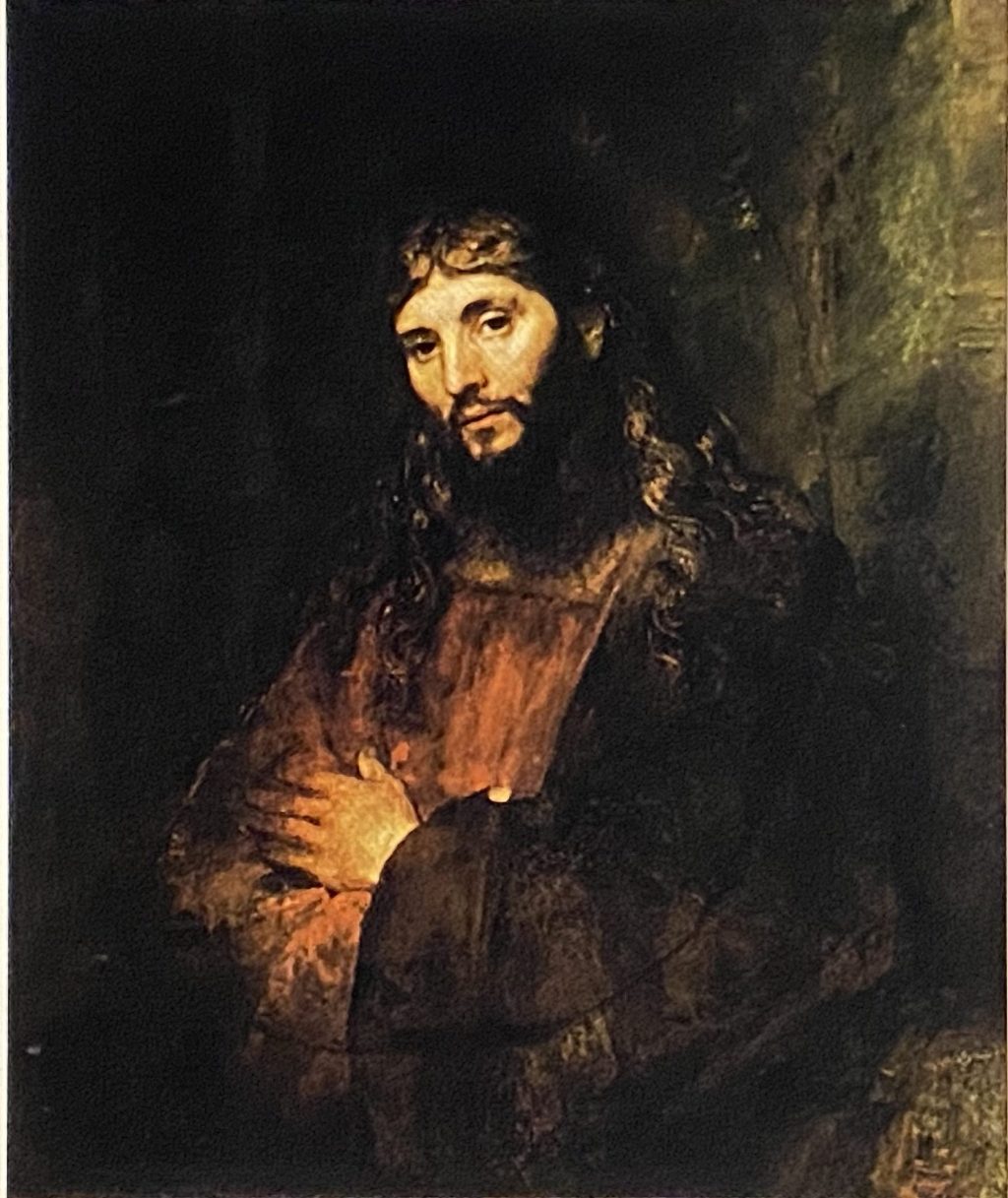
Photo: Rembrandt’s Christ With Arm’s Folded

Holly Ordway’s quote comes from Lesson 2: Bridging the Meaning Gap in her course: Imaginative Apologetics which can be accessed by registering for the Word on Fire Institute, the home page of which can be accessed: https://wordonfire.institute/

Link for the Mass readings for Thursday, March 21, 2024

Jesus took our sin upon himself to forgive and free us.

It is interesting to note that in today’s Gospel reading from John, Jesus spoke to those who “believed in him” (Jn 8:31). But the more he talked, the less they seemed to understand who he was: “If you remain in my word, you will truly be my disciples, and you will know the truth, and the truth will set you free.” His listeners balked at the word, “free”, asserting that because they were ancestors of Abraham they have never been enslaved by anybody.

In the United States of America, freedom is also highly valued. Many of us would probably react very much in the same way. We may have different ways of expressing why we feel that we are free, but we would certainly assert that we are not enslaved to anybody or anything.

Jesus’ words ring just as true then as they do today: “Amen, amen, I say to you, everyone who commits sin is a slave of sin.” Jesus shined his light on the truth that many of us do not see, which is our enslavement to sin. If we truly seek to be free, then we need to acknowledge this point. What many of us claim to be freedom, doing whatever we want to do, when we want to and how we want to do it, is not true freedom. We cannot even hear the clanking of the chains or feel the weight of the shackles chaffing at our skin as we raise and shake our fists to assert our freedom of indifference!

Our response to Jesus’ statement: “who commits sin is a slave of sin” ought not to be one of hiding, denying, rationalizing, attacking, or fleeing. It is better to embrace the truth that Jesus is placing before us. In this way, we allow his light to expose the darkness in our hearts where sin speaks, and we realize that we have said yes. Becoming aware of our fault for those things we have done and have failed to do is the first step in becoming truly free. Recognizing with St. Paul that we do what we don’t want to do and do what we don’t want to do, is another step.

When Pope Francis was asked in an interview, “Who is Jorge Mario Bergoglio?” he answered, “I am a sinner, but I trust in the infinite mercy and patience of our Lord Jesus Christ, and I accept in a spirit of penance.” We are all sinners because we all in some form or fashion place idols before God. When we think our life is about us first and foremost and ignore or rationalize our sin then we are enslaved, such that it chokes and threatens to undo us. Then we experience its debilitating effects and succumb or attempt to free ourselves, yet the process becomes likened to a Chinese finger trap. The more we pull to escape, the tighter the grasp.

This is not a negative or defeatist attitude, quite the contrary. We are children of God, created in his image and likeness. We have just forgotten who and whose we are. When we call out our sin in truth, we can be freed from it. Jesus became human, and took our sin upon himself to free us from death and sin.

We become free from our sins by acknowledging that we are sinners. This does mean we are awful people. We are good. It just means that we have fallen for an apparent good instead of the true Good that God wants for us. We also cannot ultimately be freed by our efforts alone. We need to work in collaboration with the mercy of Jesus. We need a savior. Jesus accepts us as sinners, as we are. He loves us as we are and wants the best for us.

We do not have to be perfect or have our house for him to come to be present with us, for he is already waiting for us. We do not need to be worthy, we just need to be willing to open the door when he knocks and invite him into the chaos of our lives so he can forgive and heal us with his grace, love, and mercy. “So if the Son frees you, then you will truly be free.” 

——————————————————————

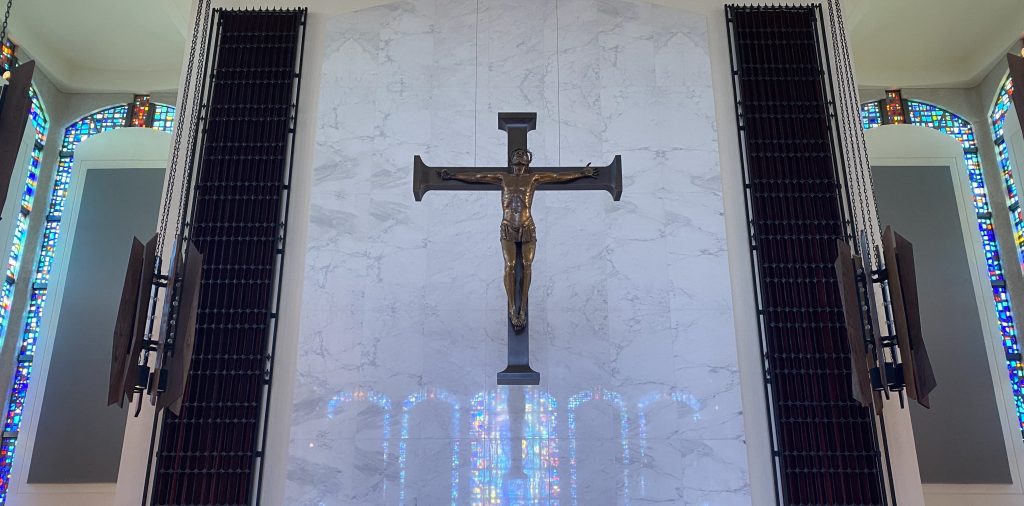
Photo: Crucifix in the sanctuary of SVDP chapel, SVDP Regional Seminary, Boynton Beach, FL.

Link for the interview with Pope Francis from America Magazine, September 30, 2013

Link for the Mass readings for Wednesday, March 20, 2024

When making decisions, prayer and reason are a good place to start.

Who do we want to be? It is so easy to get caught up in being busy, taking care of children, the home, school assignments, work, as well as a myriad of other activities that each of us, experiencing our own unique station in life, can add to this list. These can all be good things, but we can lose ourselves in our busyness and responsibilities such that we slip into a state of survival mode or merely existing. One day can move into one week, into one month, into one year, and then we wake up one morning and wonder where the last ten years went!

We can fall into the trap of being defined by what we do instead of who we are and who God is calling us to be. God has a plan for us with the end result being eternal communion with him in heaven. Living a life of holiness and becoming saints is our call. We need to remind ourselves of this from time to time, more often rather than less actually, by assessing where we are now and being more open to the guidance of God.

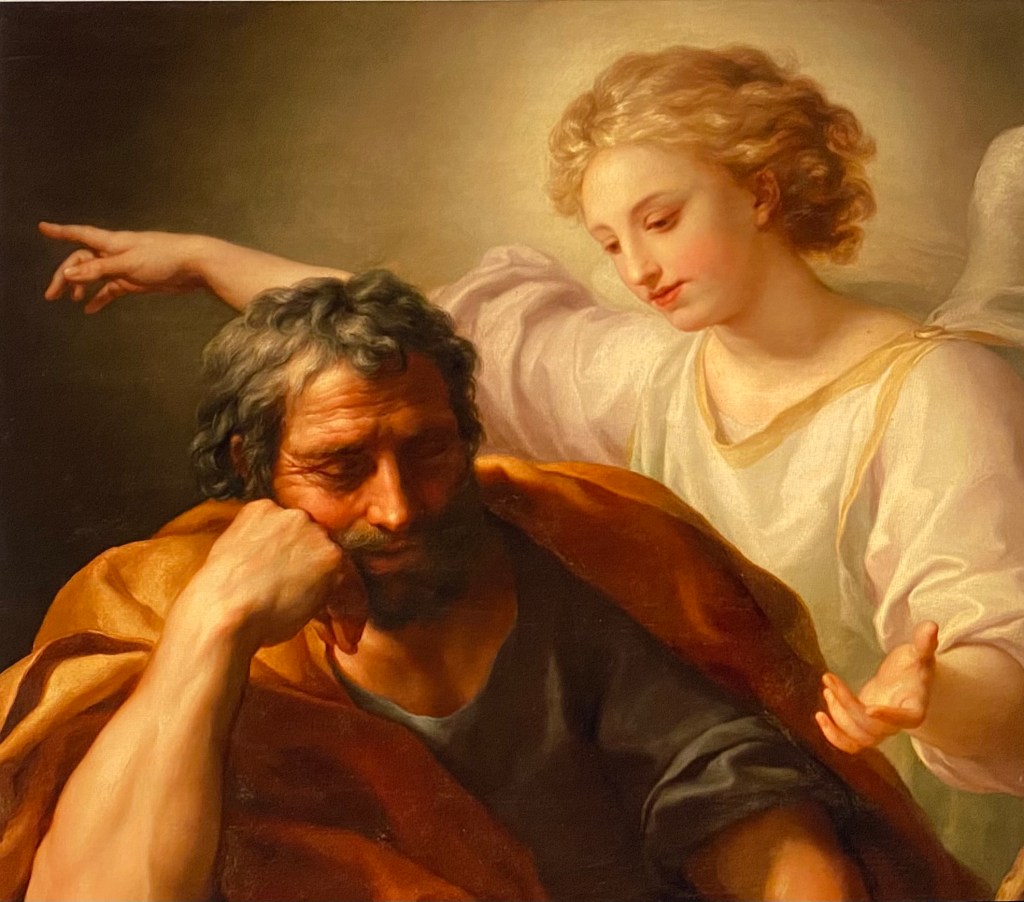
In today’s Gospel, Joseph has become aware that Mary, his betrothed, is with child and he is not the father. We can forget about the humanity of the moment, reading now from so many years removed. I am sure there was some serious anguish that Joseph dealt with even as we read that he is “a righteous man” who follows the law, but is “unwilling to expose her to shame, decided to divorce her quietly” (Mt 1:19). Joseph’s life of righteousness pulls him to follow the law, yet he shows that discernment in matters of the dignity of the person is just as important. Joseph not only was unwilling to make Mary into a public spectacle but was also unwilling to allow the possibility of her to be stoned to death.

Joseph pondered the idea of divorcing her quietly and again no mention of the mental maelstrom, intestinal upheaval, or emotional roller coaster as he pondered. Yet, a very good piece of guidance we can glean from this account. Before he made his final decision, Joseph slept on the matter, which is often a good course of action when weighing such a heavy issue. How many times do we rush into decisions only to regret them later? Because Joseph is willing to wait a bit, he receives God’s direction through the angel of the Lord in a dream.

When Joseph arose that morning, he did not dig in his heels feeling he knew best and then return to his original decision, he did not let fear or anxiety or whatever emotions he may have experienced about the possible scenarios that played out in his mind sway him, nor did the very possible and reality of the difficulties he could envision deter him. Joseph trusted God. With the confidence and assurance of who he was and who God called him to do, Joseph acted on the guidance he had received.

This is why St. Joseph is a model for us. When faced with decisions, we need to remember who we are, whose we are, and who we are called to be. We are children of God. That means we belong to God, a God who loves and cares for us. He has a plan for each of our lives. Every decision and action is a step in fulfilling that plan.

When we are discerning, no matter how large or small, we are invited to gather information, look at the reasonable options available, all the while, continuing to seek God’s guidance. God will guide and accompany us through many means and ways such as a thought, a family member or friend sharing an insight at an opportune time, experiences, through our dreams, as well as many other ways, including angelic support. God granted Joseph not only the guidance he sought but the support to fulfill the commission he received. We can be assured that God will do the same as we discern his direction as well.

St. Joseph, pray for us!

——————————————————————–

Painting: “The Dream of St Joseph” by Anton Raphael Mengs about 1774

Link for the Mass readings for Tuesday, March 19, 2024

Cast the first stone or confess?

“Let the one among you who is without sin be the first to throw a stone at her” (Jn 8:7).

As these words came forth from the mouth of Jesus, there must have been a deafening stillness. A mob had gathered around a woman seeking to stone her for being caught in the act of adultery. Had this woman actually been caught in the “very act”? Were there those that were scheming so scrupulously that they would spy on her at that moment, or like our first reading from the Book of Daniel was this a false accusation because the woman refused the advancement of someone who wanted to commit adultery with her, and she refused? Either way, Jesus helped to restore the dignity of this woman by showing the common shortcoming of our fallen humanity.

Today’s Gospel account from John helps us to come to terms with the reality that we are all unified in the reality that we all fall short of the glory of God that we were originally created for. Fortunately, there was no one present who thought himself so self-righteous that he had not committed any sin. All left and only Jesus and the woman remained. It was only then that he spoke to her.

Jesus’ goal for each person he encounters is that we come to terms with our own sin, repent, and believe in the Gospel. Yet, he does so not by condemning us but by showing us how we are off the mark and bestowing his mercy and love upon us. In this way, he guides us to the path that will lead to what is truly good, not the false allures of apparent goods that may glitter in the moment, but then fade.

Jesus does not define us by our worst mistakes, but he does not want us to remain in our sin either. By doing so, we are separating ourselves from a more real and intimate relationship with God and one another. Jesus reveals to us those choices, behaviors, habits, prejudices, and vices that separate us from him and each other.

Lent is an intense season when we make the time to become more aware of that which divides and in humility admit to and confess these behaviors so that through the love and mercy of God and in collaboration with him, we can be transformed.

Jesus does not forgive us so that we will then call out another’s sins publicly to condemn them. If we truly care about saving another, we are to do so as Jesus did and has guided. We are to meet them one on one, convict and correct with tender chords of love that they may be more able to see their sin and willing to confess. We are better able to do so when we have the humility to see our own sins, be contrite, and go to Jesus through the priest, confess them, and receive absolution, healing, and forgiveness.

May we examine our conscience, call to mind those areas in which we have fallen short of the glory of God in our lives, where we have sinned, and with humility share them with Jesus. In this way, we with the woman caught in adultery may also hear his words, “Neither do I condemn you. Go, and from now on do not sin anymore” (Jn 8:11).

—————————————

Photo: From the stone moat around St. Vincent de Paul Chapel, St. Vincent de Paul Regional Seminary, Boynton Beach, FL.

Link for the Mass readings for Monday, March 18, 2024

Jesus cares.

Jesus is recorded, a few verses before (cf. 7:37-39) today’s Gospel,  speaking about quenching the thirst of those gathered around to listen to him. The thirst he is talking about fulfilling is spiritual thirst, that thirst which we all desire to be refreshed by, that which we have been created to receive; the thirst to belong, to be in communion, to be loved and to love in return. Jesus speaks of coming to those who thirst to be refreshed with: “Rivers of living water [that] will flow from within” (Jn 7:38). Jesus spoke of the day when he would send the Holy Spirit to well up from within the soul of each person who would follow him. All who participate in the life of Jesus would come to experience also the love shared between God the Father and God the Son, who is God the Holy Spirit.

Some who heard Jesus speaking in this way were deeply moved, they believed him to be the Prophet, others believed him to be the Messiah. Yet, there were those who could not see past their own preconceived notions. They heard his teaching, may have even been moved as well but said, “The Messiah will not come from Galilee, will he” (Jn 7:41)? Remember Nathaniel’s first reaction when Philip had told him that they had found the Messiah? Nathaniel asked if anything good could come out of Nazareth (cf. Jn 43-47). Jesus was also rejected by his own hometown crowd most likely because they knew him most of his life and there was nothing special about him. He was a tekton, a carpenter or a day laborer, like Joseph.

Why the region of Galilee, the town of Nazareth itself, would be disparaged is a matter of speculation. The fact was that there were those, unlike Nathaniel, that could not see past their initial prejudices. Even though Jesus spoke and taught with authority, though as the Temple guards who were sent to arrest him said, “Never before has anyone spoken like this man” (Jn 7:46), and even when Nicodemus spoke out rationally, requesting they hear Jesus out and give him the opportunity to make his case, there were those in authority and among the people who could or would not hear Jesus. They closed themselves off to the invitation to receive the gift of the love of God. Their charge was that he was not from Bethlehem, he was not of the line of David, case closed.

It is helpful to come to terms with our ingrained, prejudicial attitudes and our limitations of thought that prevent us from seeing as God sees, otherwise, we will become like a stagnant pool. Like those in today’s Gospel, we can close ourselves off from the invitation of Jesus and his very life that he would like to impart within us. Many times, this happens because we buy into our anxieties and allow them to limit us. We can be paralyzed by them or on the other extreme act out impulsively. Aristotle wrote that virtue is the means between two extremes. In this case, courage is the means between being paralyzed with fear and excessive reckless abandon.

A more reasonable and rational approach is helpful for our spiritual life as well. We can pay more attention to fear and not trust Jesus. We can believe that Jesus has abandoned us or that he doesn’t care, that he does not exist. Or we can follow the lead of Pope Francis who shared in his Ubi et Orbi message at the height of the pandemic in 2020 that Jesus, “more than anyone, cares about us.” Jesus cares.

He his extending his hand out to us right now. We can reject it or grasp it, the choice is ours. Jesus is the source of living water, he is the eye in the midst of any storm, he is the light leading us through the darkness, and he celebrates with us in our victories. When we choose to breathe more and react less, when we are willing to be still and look, when we trust in Jesus and his love for us, we will experience his presence and we will be more likely to recognize and accept his invitation of love. By taking his hand and allowing him to lead us, we will act with more prudence, be more present and mindful, and better prepared to support one another each day going forward.

———————————————————————————-

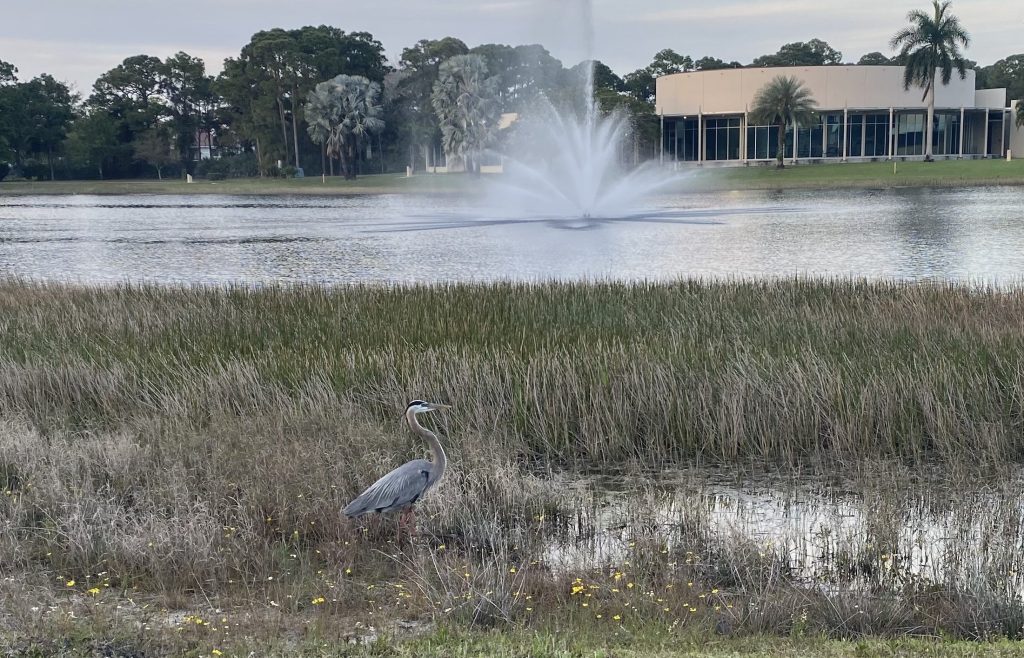
Photo: Great Blue Heron landed next to me as I began my Rosary walk. St. Vincent de Paul Regional Seminary, Boynton Beach, FL.

Link for the Mass readings for Saturday, March 16, 2024

Can we disagree and still listen to and respect one another? Yeap!

Jesus affirms who he is and whose he is in today’s Gospel of John. Despite those who do not believe that he is the Messiah, Jesus again makes his point very clear: “I did not come on my own, but the one who sent me, whom you do not know, is true. I know him, because I am from him, and he sent me” (Jn 7:28-29). Jesus is the Son of God made man and he belongs to the One who sent him, God the Father.

As Jesus was challenged in his time, he continues to be challenged today. That level of challenge has increased even to the degree that his human existence is even dismissed in some circles as a mere legend. Even as a historical figure, some speculate that Jesus did not walk the roads of Galilee and Judea. This need not be a reason for alarm. Though it is a reason to know our Tradition, the deposit of faith that has been preserved and passed on from Jesus to his Apostles and disciples, and to those early Church Fathers and Mothers named and unnamed and passed on up to this day in an unbroken apostolic succession. It is important to read the Bible, immerse ourselves in the sacred texts, pray with and meditate upon these words, and allow Jesus to speak to us again and again.

It is important to know what we believe, who we believe in, and whose we belong to. In this way when we are challenged by others, we do not need to stoop into a defensive crouch, but instead listen to the person’s points, their critiques, and ask questions of what they believe and why they believe what they believe. We can share our position while at the same time being open to understanding where our questioners are coming from. We can then respond with an open mind and heart of surrender to allow the Holy Spirit to be present through us.

When we are anxious, defensive, seeking to be right, or fearing to be wrong, we limit what Jesus can do through us. God is not about numbers and quotas, he is about building relationships, one person at a time. It is more important to build relationships than to win arguments! We can learn much from St. Bernadette of Soubirous who after her visions with the Blessed Virgin Mary was challenged time and again regarding the validity of her experiences. She simply responded, “My job is to inform, not convince.”

Social media platforms can be good platforms to exchange ideas as well as horrific experiences of the worst of our humanity. It is important that we remain respectful face to face and remember that screen to screen there is another human being on the other end. All of us are on a journey in this life. We can learn much from each other when we are willing to share our experiences while remaining committed to engaging in a spirit of charity and dialogue.

All of us seek the True, the Good, and the Beautiful. Especially during times of uncertainty and instability, it is important to respect and love those who have differing perspectives outside of and within the Church and be open to the reality that we can learn from one other. We do better when we are willing to listen to and allow God to guide each of us through our common challenges.

————————————————————————–

Photo: Making time for quiet and quieting our minds, we can better listen to others. Rosary walk, St. Vincent de Paul Regional Seminary, Boynton Beach, FL.

Link for the Mass readings for Friday, March 14, 2024

Jesus wants to heal and save us. Do we want to be?

Has there ever been a time when you were picked last for the team, whether on the playground, P.E., or gym class? I remember being on both sides, being picked last, and picking others to join and having to pick someone last. I preferred being chosen last much more than having to be in the situation to choose a classmate last, and it was often an agonizing situation. In our Gospel reading today, Jesus comes upon a man who has experienced even worse.

He has been in need of healing for thirty-eight years. Apparently, there was a limited time to get into the waters of the pool of Bethesda to experience the healing properties that it afforded, for each time the water stirred, while the man moved to get closer to and enter the water, “someone else gets down there before” him. This is worse than getting picked last, as he doesn’t in a sense even make the team!

But with Jesus, the last shall become first. Key ingredients are belief, faith, and a willingness to be healed. Jesus does not impose, even in the case of healing, Jesus invites. He asks the sick man, “Do you want to be well?” The man is stuck in the limitations of someone getting him to the pool. That is all the affirmation Jesus needs. The man is willing if there is someone to help. Jesus commands him to rise, pick up his mat and walk. The man is no longer the one picked over, the one ignored, the one unseen. In his encounter with Jesus, he is healed by Jesus’ word.

Jesus meets us in our need as well as the man at the Pool of Bethesda. He meets us where we are, no matter our station in life. He does not leave us on the outside looking in, he does not leave us wondering if we are loved or if we belong. He does not only come to encounter us but if we are willing, to empower us to be about the mission given to us by his Father. Jesus gives meaning and purpose to our lives. Jesus has come to save us. Each and every one of us is a gift from God and has been graced with something to contribute to others, something unique to help make the kingdom of God a reality.

Give yourself a moment of silence and stillness, without and within. Settle into a place with no or little distractions, breathe in deep and exhale a few times, then close your eyes. See yourself as you are in your present seated position, breathing, experiencing your shoulders relaxing, and just being still. Then notice Jesus. He is walking toward you as he did with the man at the Pool of Bethesda. Does Jesus remain standing, does he sit beside you, or kneel before you? As he assumes whatever posture, allow your thoughts to reflect on what you need. As you are pondering, does Jesus ask you a question? What does he ask or what does he say?

Jesus is present, right here and right now, for you. There are no boundaries, no limitations, only those you impose on yourself. Share with Jesus your need. You are no longer misunderstood, left out, or picked last. Jesus is present. Embrace this moment of time together, of knowing that you are loved, heard, and that you belong in the kingdom of God.

————————————————————————-

Painting: Some quiet time of prayer in between studying, St. Vincent de Paul Regional Seminary, Boynton Beach, FL.

Link for the Mass readings for Tuesday, March 12, 2024