“Whoever does the will of God is my brother and sister and mother.”

Even a surface reading of the Gospels will offer a glimmer of Jesus making things new. We can read and imagine the scene today. Many are gathered around him. The crowd is large but focused intently on Jesus as he taught. His family, presumably the relatives that only a few verses earlier came to seize him because he was out of his mind (cf. Mk 3:21), had arrived, were standing outside, and sent word. The message passed among the people was: “Your mother and your brothers [and your sisters] are outside asking for you” (Mk 3:32).

Jesus seized on the opportunity for a teachable moment. Most would have expected him to immediately get up and welcome his family. Instead he looked not beyond and past the crowd that encircled him to his family who had sent word, but to those who were nearest to him and said: “Here are my mother and my brothers. [For] whoever does the will of God is my brother and sister and mother” (Mk 3:35).

The true measure of the family in the kingdom of God is not a bloodline but faith in and following the will of God. Those who have experienced or still experience the gift of a close, tight-knit, extended family can come close to the dramatic moment of silence that must have followed after this statement. For anyone living in the ancient Near East, familial, clan, and tribal relations were paramount to survival. To say that family bonds were strong is an understatement. Yet, Jesus challenged this societal norm by raising the bar even higher and expanded the bond of family beyond blood or marriage ties.

The relatives of Jesus were not present in this inner circle, they were on the outside. Imagine who might have been sitting in that circle; sinners, the unclean, tax collectors, and possibly even Gentiles – non-Jews, and Jesus said that they were his brother and sister and mother! If his relatives thought he had lost his mind before, I cannot imagine what kind of mental conniption they entered into after these words.

Jesus was not devaluing or delegitimizing family, he was restoring the family to its proper place and extending it out beyond what anyone of his time could have conceived of. As Bishop Robert Barron writes, “when we give the family a disproportionate importance, in short, it becomes dysfunctional” (Barron 2011, 17). We as the baptized are united in a deeper way into the Mystical Body of Christ, which is an even more powerful call to unity here than the blood-line of family, clan, or tribe.

The end goal is that as each person draws closer in their encounter and relationship with God, they also draw closer together. As we are conformed more and more to the life of Christ we begin to bear his fruits of love, joy, peace, patience, kindness, goodness, gentleness, and self-control (cf. Galatians 5:22).

In sharing the fruit of the spirit, in giving this gift away to one another, our relationships will grow and our bonds will become stronger. Our love grows as we give it away, person to person, out beyond our comfort zones, to the peripheries, where there are those who feel set apart, and/or are on the outside looking in. We are even to share with our enemies. Not possible? True, if we enclose ourselves within our own bubble and focus on protecting our ego. Possible, when we deepen our relationship with Jesus and allow him to love through us.

Too many today are choosing to encase themselves in their own protective bubble wrap. Instead of embracing diversity, we are going backward, we are regressing. By choosing to close ourselves off from other viewpoints, talking over each other and at each other, if we are talking at all, and embracing fear instead of love, we are distancing ourselves from God and each other. Our strength as a people, as a nation, and as a world increases when we embrace the human dignity of each person, and the rich diversity bestowed upon us through the unconditional love of God. May we embrace the teaching of Jesus who in his emphasis on following God’s will “was insisting that the in-gathering of the tribes into God’s family is of paramount importance” (Barron 2011, 17).

In today’s Gospel account from Mark 3:31-35, Jesus did not define those gathered around him by race, ethnicity, gender, or any other label. He defined them then, as he still defines his family today, as those who are willing to follow the will of God his Father. Mary his mother being the primary model.

Jesus, please help us to open our hearts and minds to receive the Love of the Holy Spirit so as to will the good of our family and friends, our colleagues, classmates, and neighbors, as well as those we may consider as other, and even our enemies. Help us to resist asking who does or does not belong in your inner circle, but instead be willing to surrender to God, follow his will, and sit at your feet, not only to learn from you but also to be empowered and transformed by you, so to care for one another as brothers and sisters and mothers, sharing the love of our one God and Father.

———————————————————————

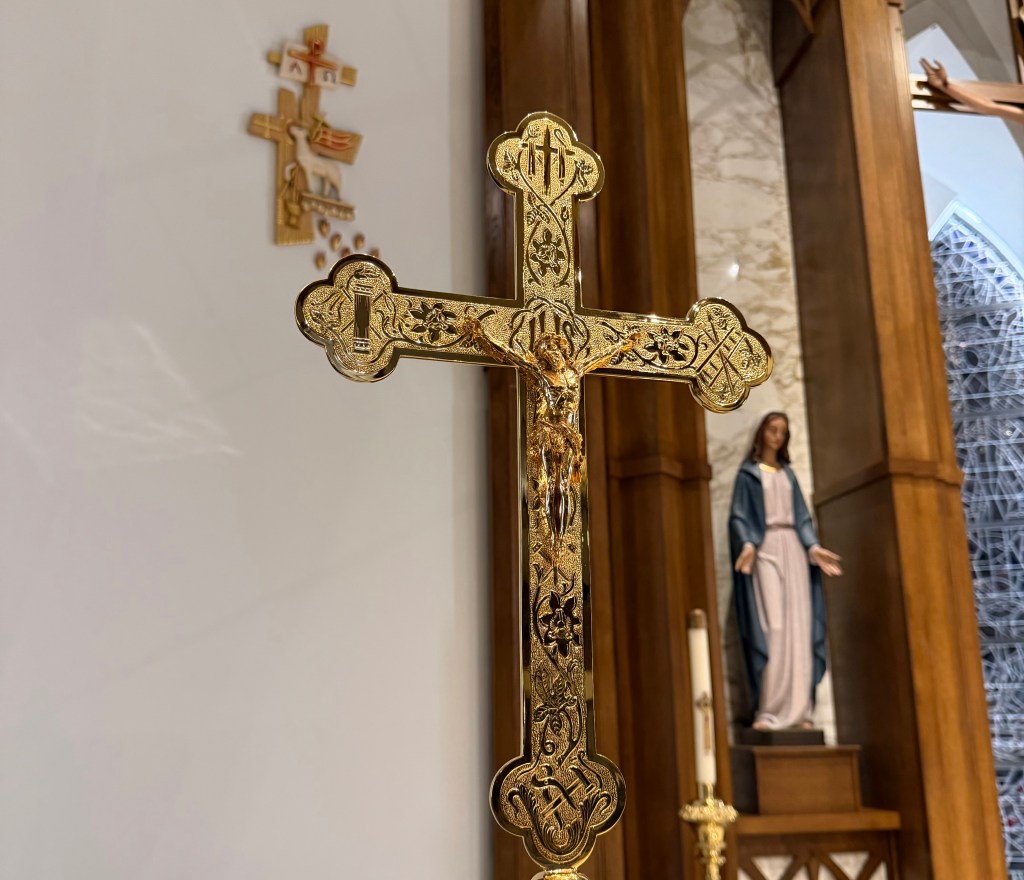
Photo: Who better than Mary follows the will of Jesus and our Father?

Barron, Robert. Catholicism: A Journey to the Heart of Faith. NY: Image, 2011.

Link for the Mass readings for Tuesday, January 28, 2025

As Jesus purified the Temple, may he purify each of us.

Jesus entered the temple area and proceeded to drive out all those who were selling things, saying to them, “It is written, My house shall be a house of prayer, but you have made it a den of thieves” (Lk 19:45-46).

Luke’s account of Jesus casting out the money changers is the most succinct of all four Gospels. Luke uses the Greek term for “drive or cast out” – ekballō, eight other times. Each time he used it, Luke was making reference to exorcising demons and unclean spirits. The profanation of the body through possession of evil is equivalent to the desecration of the Temple precincts.

Jesus justified his actions of driving the sellers out of the Temple precincts by saying: “Destroy this temple, and in three days I will raise it up” (Jn 2:19). Jesus showed the dignity of our humanity, when he, as the Son of God, he entered our humanity. He entered into the chaos of our lives, our faults, and foibles, and our sins while remaining sinless himself. He showed that even though we have turned away from God, we were not destroyed and lost beyond hope. He reminds us that what God has created is good and that includes us. Even when we turn away, he continually and infinitely reaches out to us in love and calls us home.

One of the wonderful features of the upcoming holidays is that many families seek to come together and to return home. For some coming home has been longer than for others, for some there may be many miles of separation, and for others, coming home is no longer possible because they have changed their address from this life to the next. There are also those suffering today that are estranged from their families, those who are homeless, displaced, refugees and immigrants, or living in fear of deportation.

No matter who or where we are, Jesus is close. He became one with us to restore our communion with God and one another. He provides the living water that quenches the thirst of our deepest longings. Jesus, our Temple, our new covenant, the dwelling place of God, is alive and present to each one of us in every condition, situation, time, and the place we find ourselves. Through his resurrection, ascension, and our participation in his life, we can become precious stones, each a piece of his Temple.

Jesus meets us where we are and loves us as we are, yet he wants more for us. Jesus, please cast out, as you did in the temple precincts, all from our being that would defile, distract, or divide us, and purge anything that would keep us bound in sin. Send the Holy Spirit to reign in our hearts that we may embody and bear his love with all we meet so to be reconciled with God and one another. May we be inspired to work toward the unity of our human family so that all may have a place at the table.


Painting: By El Greco, 1600 – Christ Driving the Traders from the Temple

Link for the Mass readings for Friday, November 22, 2024

We are one with the Holy Family when we “hear the word of God and act on it”!

He said to them in reply, “My mother and my brothers are those who hear the word of God and act on it” (Luke 8:21).

There are many popular genetic testing kits that are advertised on TV and through the internet. People have asked me is it possible to be a blood relation to Jesus. Jesus’ reply today can help you to save some money. Asking if we are a blood relation with Jesus is missing the point of Jesus’ life and ministry. What is important are “those who hear the word of God and act upon it.” God is to be first, even before family. We may experience a subtle shudder from this statement but to those of Jesus’ time, it would have been apoplectic. Family meant everything in the Ancient Near East.

Jesus is not making the point that we disregard family, he is instead teaching us that if we are to be authentically present to our family this will come about best by following the will of his Father. As we deepen our relationship with Jesus and put his teachings into action, we begin to bear the relational fruits of the Spirit. Would not our familial relationships be much better if we were more loving, joyful, peaceful, patient, kind, generous, faithful, gentle and practiced self-control? Jesus taught and showed from his own life that the path to fulfilling and intimate relationships flourish best when we put God first because as we grow closer in relationship with him, we also do so with those around us.

Another point we can glean from Jesus’ response in today’s Gospel is that our “family” is to transcend bloodline, tribe, and nation. Any one of “those who hear the word of God and act upon it” is spiritually akin to Jesus the Christ. The point is not that we have a genetic, lineal relation with Jesus, but that when we live and act according to his Father’s will, we are part of the universal family of God’s grace and mercy and our relationship with him and one another grows as we continue to bear the fruit of the Spirit.

As brothers and sisters in Christ, we will act with more caring and kindness, seek common ground through dialogue, be more willing to walk and accompany one another and seek to understand instead of judge. The bottom line is that we are to love one another as Jesus loves us! When we do so our lives are transformed.

To hear the word of God, we must have our hearts, minds, and souls open to hearing it proclaimed during Mass. We are also invited to read his word in our own daily time of prayer. In both situations, God’s word comes alive as he shares something of himself with us, to nourish, and give us his life. As we then receive, at times struggle with, seek to understand, and put into practice God’s word, we come to know the Father, and the Son, and the Holy Spirit, the saints, and our brothers and sisters in Christ. We are one family in the Body of Christ when we “hear the word of God and act on it.” Just imagine what our parishes and communities would look like if we all did this.

————————————

Photo: Praying with the Holy Family in the sacristy of St. Philips Catholic Church, East Windsor, CT. The church where I received my first communion and concelebrated Mass as a priest there for the first time this past Sunday.

The Mass readings for Tuesday, September 24, 2024