We need to be willing to see each other beyond surface judgments.

In the Gospel reading today, Jesus is accused of being an agent of Beelzebul, the prince of demons, because he was exorcising a demon from a man that was mute. Jesus addressed the critique and showed the polarizing nature of the onlookers who were unwilling to see the healing before them for what it was. Jesus then stated the obvious: “Every kingdom divided against itself will be laid waste and house will fall against house” (Lk 11:17).

If Jesus was an agent of the prince of demons, he was not a very good one. Satan seeks to sow discord and division. Jesus seeks to bring about unity. Now it is true, that five verses later in the Gospel of Luke, Jesus is recorded as saying: “Do you think that I have come to establish peace on the earth? No, I tell you, but rather division” (Lk 12:51). Anyone feeling a bit confused? Welcome to the wonderful world of the Bible!

To understand Scripture, we need to understand the context of the whole of Scripture, not just isolated verses. Throughout the ministry of Jesus, he seeks the unity that all may be one as he and the Father are one (cf. John 17:21), yet he has consistently experienced those that rejected his message and healings as witnessed in today’s Gospel account. Because of their hardness of heart, they are unwilling to acknowledge that Jesus is the Son of God and so there must be a reason for how he performs exorcisms and miracles.

The reason is that Jesus drives out demons, “by the finger of God” (Luke 11:20). His listeners would have picked up on this referential term, for the Pharaoh’s magicians and sorcerers made this same statement when they could no longer produce the effects of Moses and Aaron’s plagues after their infesting the land with gnats (Exodus 8:19). So just as Moses and Aaron were operating through the will, the finger of God, so too was Jesus.

In so doing, Jesus demands a choice. Then and now. We need to decide if we are either going to be for him or against him (cf. Lk 11:23). The division Jesus is talking about results from those who choose not to recognize that Jesus is who he says he is and reject him and those who accept him for who he is and follow him. This choice continues to cause division within households, families, and friends even today.

The greater take away from this verse and Jesus’ teachings as a whole, is that when we are unified, embracing the gift of our diversity, we are stronger than when we are divided by limiting ourselves to mere labels. In our modern context, labels, such as liberal and conservative are not helpful, whether they are being used in a political or religious context. Life is not as black and white as many would like it to be. It is certainly easier to cast labels, but interactions with people and developing relationships are much more nuanced. We are not mere cardboard cut outs, or caricatures.

To better understand the essence of who we are as human beings demands greater time and experience of each other than an outward appearance or isolated statement may portray. Many more of us, if we shake off any label for a moment, could honestly admit to believing in and supporting issues that are important to us from both sides of the so called left or right.

Many times, once we have cast a label, we believe that we have “defined” the person. They are classified in their box and tied up in a neat and pretty bow, and woe to the person who resists being boxed and bowed. I remember reading from one of the books from the tracker, Tom Brown, Jr., in which he described how many people when seeing a bird, such as a blue jay, robin, or crow, are often satisfied with the label, the naming of it, and move on from that sighting self-satisfied. They think that in that simple identification they now have come to understand all that there is to know about that particular species of bird. So much of the essence of one of God’s amazing creatures is missed by such a simplistic and limiting classification!

Unfortunately, we do the same with each other. We can prejudge others, as did some of the crowd who said that Jesus cast out this demon because he was in league with Beelzebub instead of through the power of God. We can also falsely believe we know everything there is to know about a person or group we prejudge. This is a very limiting and divisive approach. Jesus invites us to encounter people, to spend time, get to know one another, and break bread with each other just as Jesus did. In spending time with one another and being open to dialogue, the caricatures can be filled in with some substance and we can come to know a little better the person beyond the prejudgment.

If it walks like a duck and quacks like a duck, it may very well be a duck, but the duck is also so much more than its classification. This is much truer for us as human beings as well.

———————————————————————————

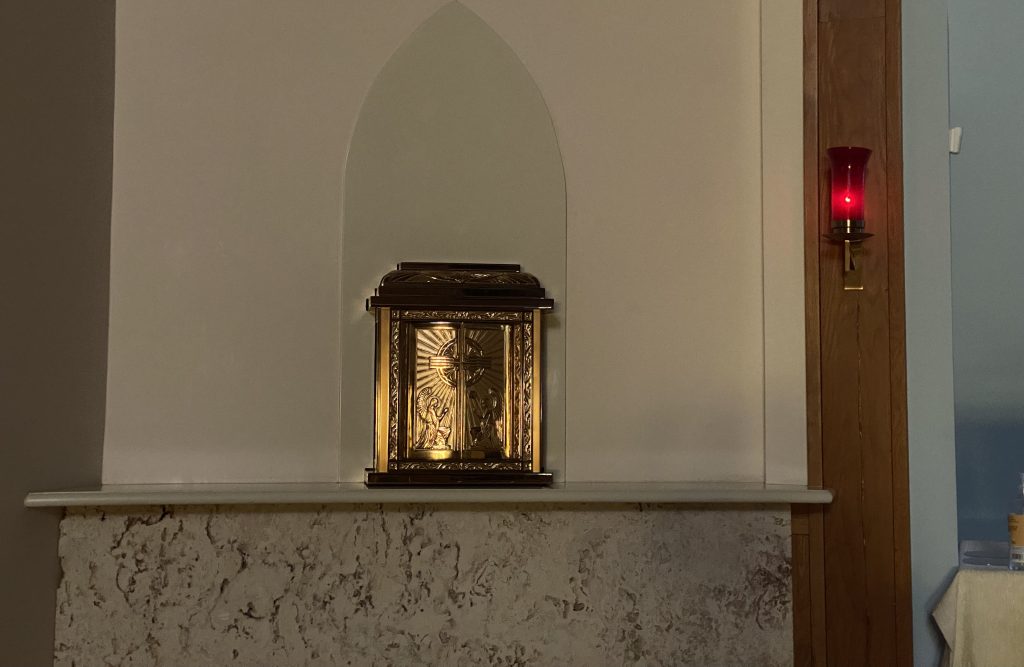
Photo: Spending quiet time with Jesus helps us to know him and to better see others as he sees them.

Link for the Mass readings for Thursday, March 27, 2025

Let us honor God with open minds and hearts to his will.

Jesus reacted to the criticism of not observing ritual washing prior to eating that was leveled at him from the Pharisees and scribes by recalling the tradition of the Prophets through the words of Isaiah: “This people honors me with their lips, but their hearts are far from me” (Mk 7:6). For Jesus, following the law for the law’s sake is an empty act. What is more important is encountering God, experiencing his love and forgiveness, developing a relationship with him, being transformed by him, and restoring what has been lost. Human beings were created in God’s image and likeness, but through sin, lost that likeness. Jesus sought to help bring God’s children back into right relationship with his Father so as to be able to glorify him by serving others and inviting others into communion with him. Jesus challenged the hyper scrupulosity and exactitude of the rules that had nothing to do with being humble servants of and growing in relationship with God.

Just laws and practices are enacted to build up and empower through discipline and clear boundaries. They help keep us from being enslaved to our passions and sins and instead lead us to freedom for excellence, for fulfillment, and to experience a heart on fire with an ever-growing love that yearns for a relationship with God and each other, like a deer does for running streams.

As with any game we play, there are rules and regulations, there are referees and officials to keep order. When the rules enforced encroach on the flow of the game, such that they inhibit the freedom of play, the game is stunted. When there is no enforcement, the game quickly devolves into chaos. When the rules are consistent, they provide the structure and boundaries that limit abuse, allow for the game to flourish, and the players to experience the freedom to actualize their potential, and as such, there is the experience of the true, the good, and the beautiful.

The first time I saw people skate, at around seven years, I was enraptured. My father was working on a project at our local, ice rink. We had not gone there to skate, and yet, I refused to leave until he took me on the ice. It didn’t matter that the only skates to fit my feet were figure skates or that my first attempt was a dismal failure. What mattered was that I made it to the ice and the joy of that experience inspired me as I learned the rules of balance, how to stop, and what a toe kick was and was not for. Soon I had the freedom not only to skate but to join a hockey team. The freedom and joy I felt any time I skated or played hockey, I still carry with me.

The Church, when we are at our best, is the same. We don’t lead with the rules and moralizing, but instead, we share our time, presence, and the joy of our faith. We empower and support one another as we enter into the play between our finite freedom and God’s infinite freedom. We have been created for and seek a deep and intimate relationship with him that will lead us to a deeper transformation of our hearts and minds. With both open to God’s guidance, we can better identify and discern between the voice of the enemy and God. There is a unique balance between the rules and the freedom of play in ice skating as well as our relationship with God.

Loving someone does not mean we allow them to do whatever they want, but in willing their good, we offer invitations, options, establish boundaries, and offer corrections, that will provide opportunities for growth, maturity, and authentic freedom. We are going to make mistakes, I have made plenty. The key is recognizing that we are on a journey together. As we walk together, we support and learn from one another. In this way, the boundaries and rules we follow are meant to set a foundation for healthy relationships and actualizing who God invites us to be; joyful, human beings that are fully alive!

———————————————————————————

Photo: Getting back on the ice with Jack and Christy, Christmas Eve day, 2023, in the city of my birth, Hartford, CT.

Link for the Mass readings for Tuesday, February 11, 2025

Jesus is stronger than any evil and will free us from anything that binds us.

Jesus and his disciples have entered the Gentile territory of the Gerasenes. As soon as they get out of the boat a man possessed by an unclean spirit rushes up to him. He himself was in a worse state than the storm that Jesus had stilled. He called himself Legion as he was possessed by many demons. He had been living in the tombs, away from society, family, and friends, some of whom had made multiple attempts to restrain him, cure him, bring him back to his right mind, but to no avail. The encounter with Jesus ultimately brought about the result of this man “sitting there clothed and in his right mind” (Mk 5:15). Jesus was able to liberate this man from his desperate state. If you have not done so, I recommend reading the full account (Mk 5:1-20).

Many scoff at the healing power and miracles of Jesus, and they certainly would also discount demonic possession. Though rare, there are still cases today. A strict approach of scientism that only accepts the empirical, only that which can be measured by the five senses, discounts not only the divinity of Jesus and the reality of God but any talk of a spiritual realm. This is unfortunate because this is a limited approach to understanding the fullness of creation. We ourselves are both physical and spiritual. A healthy embrace and experience of both will help us to better appreciate and understand the world around us.

Too many today are in the same need of experiencing the liberating power of Jesus as the Gerasene. Just as chaotic and tumultuous, especially among too many of our youth, are those who are consumed and imprisoned by the vice grip of addiction. Family members and friends reach out desperately to help, to provide aid, and find themselves in the same situation as those who sought to care for this man who had been living in the tombs. Somehow this man caught “sight of Jesus from a distance, he ran up and prostrated himself before him” (Mk 5:6). There must have been some ember at the core of who he was that could still move and bring himself to Jesus.

Far too many are suffering, bound, and shackled by a wide range of addictions, obsessions, disordered affections, and oppressions that plague far too many today, as well as the rare cases of possessions. Evil seeks to distort, disfigure, divide, dehumanize, and separate all of us from the goodness and wholeness that God intends. This growing epidemic damages individuals, families, and friends and could benefit from a unified approach of the best that science, psychology, counseling, prayer, the sacraments, spiritual direction, and when needed, exorcisms can offer.

Jesus can reach into even the deepest darkness of our internal entanglements and help to reveal any disordered affections. Yet we must choose, as did the Gerasene demoniac, to surrender to Jesus. May we resist the temptation to flee from him, and instead run into his open arms. Resting in the grip of his loving embrace, we will come to know that we are not alone in our suffering, that our deepest anguish, sin, and wounds can be healed.

Jesus is stronger than any evil that seeks to bind and separate any of us. He shared this in his parable of “tying up the strong man” (Mark 3:27) which is on vivid display as he casts out Legion from the Gerasene man. Let us continue to place our trust in the name of and the power of Jesus and intercede for all those who are suffering from any form of disordered affections, addictions, and/or afflictions emotionally, psychologically, or spiritually. May Jesus lead all of us to experience deliverance and freedom from any affliction no matter how small or large, so that we may experience the right ordering of our minds, hearts, and souls to God’s will, and like the Gerasene man, not only experience the fullness of his healing but also go to share the good news of our experiences to help to bring the invitation of healing to others.

—————————————————————————————–

Photo: Not even the strongest of chains can bind us when we seek the healing power of Jesus to free us.

Link for the Mass readings for Monday, February 3, 2025

This Advent, let us trust more in Jesus and step free from the gloom and darkness and into his light and love.

St. Augustine taught that the New Testament is hidden in the Old Testament and the Old is revealed in the New. We see this presented in our readings for today. Isaiah presents how “the deaf shall hear” and “out of the gloom and darkness, the eyes of the blind will see” (Isaiah 29:18).

Jesus heals the blind men who call out to him believing that he is indeed the Son of David, the messiah, the anointed one. Jesus recognizes their faith that has healed them but he also points out that they are still in need of healing. They see, but they, like the apostles and others who are seeking the coming of the messiah, a messiah that is like David, a political and military leader that will lead a revolution to overthrow the occupying power of Rome. 

Jesus told them clearly not to tell anyone what had happened, because he was not about to promote a cult of personality and nor have them portray him in a false way. Yet, share they did, their encounter with Jesus with great joy. 

Though we may have eyes to see and ears to hear, are we too are also spiritually blind to who Jesus truly is. Jesus came into the world just over two thousand years ago as the visible reality of the embodiment of God who is love. Jesus calls us to be conformed to this same love. No easy task, for we are called to humility, repentance, and transformation.

The apostles and saints were those who followed Jesus and were willing to be transformed by the fire of his love. They encountered Jesus, had faith in him and believed. They then went out to share with all they met about their encounter. Will we follow the same path? Do we believe that Jesus is truly who he said he is, the Son of God, the second Person of the Trinity, who became one with us so that we can become one with him and his Father to experience the love of the Holy Spirit?

Let us pray together:

Jesus, this Advent, help me to choose to walk out from the gloom and darkness of anxiety, fear, and insecurity, and place my trust in your revealing light that I may walk with confidence on your path of love. Free me from any distractions and diversions such that I may experience the closeness you know with your Father. Please help me to place my trust in you, and heal my blindness so that I can see more clearly and reject the lies that lead me astray. 

——————————–

Photo: Rosary walk back home in Palm Beach Gardens, Florida.

Link for the Mass readings for Friday, December 6, 2024

Jesus took up his cross and invites us to do the same.

I can visualize the opening scene of today’s Gospel in my mind’s eye. Jesus striding along with a gathering of people walking, talking, and moving about, and then he just stops and turns. Those closest to Jesus pull up to a stop with him, others continue right past, while at the same time others bump into and trip over those who had stopped before them. The subtle hum of random conversation then slowly comes to a halt, a stillness ripples through the crowd, and then there is silence. The dust begins to settle. Those closest have their eyes locked on his, while those further back are craning their necks, moving left and right to get a better look, while still others are cupping their ears to catch the sound of Jesus’ voice.

These crowds most likely consisted of some disciples, while the greater majority were those on the periphery gathering because of curiosity, intrigue, and maybe even wonder. Jesus then begins to speak, “If anyone comes to me without hating his father and mother, wife or children, brothers and sisters, and even his own life,…” and then, “Whoever does not carry his own cross and come after me…” and then he finishes with  “In the same way, everyone of you who does not renounce all his possessions cannot be my disciple” (cf. Lk 14:25-33).

Those who may be hearing these words second hand, as they were further away from the point of direct hearing, may not believe that the message was transmitted to them correctly. These words cut to the quick, just as surely as when Jesus shared about eating his flesh and drinking his blood, and when he told another follower, who wanted to bury his father to let the dead bury their dead. Luke does not say, but I am sure that many of those gathered around him were just as shocked and began to walk away.

The familial bond for ancient peoples was strong. Though the invitation of salvation that Jesus offers is for all to be saved, he is not going to dumb down or sugar coat his message just to get numbers. Jesus presents, time and again, that the way to live a life of fullness and wholeness, to restore that which has been lost, is to put God first in our lives. God must be the primary focus, the primary relationship in our life, nothing else can have priority of place before him. When we do so, everyone and all other things will fall into their proper place.

Do we want to be an onlooker, just someone looking at Jesus from a distance, or a disciple, willing to be his servant sent forth to share the Gospel and invite others into relationship with him? Are we attached to any possessions, false substitutes, even members of our family, such that we place them before our relationship with God? Idols are anything that we put before God and will distract and divert us from the very flow of his life force that fuels our existence. If we are willing to walk the path of discipleship, we must be willing to surrender our will to God, place him first in our lives, take up our cross, and be open to being transformed by his love.

Jesus is the interpretive key that opens our understanding. All that which is material and finite in our lives find meaning in relation to him. Only when we are able to let go of the attachments to the things of this world will we then truly begin to be free. St. Francis embodied this in a radical way. One of his foundational prayers, which he sometimes would pray for hours was, “My God and my all!” And that is the life he lived and which Jesus invites us to live.


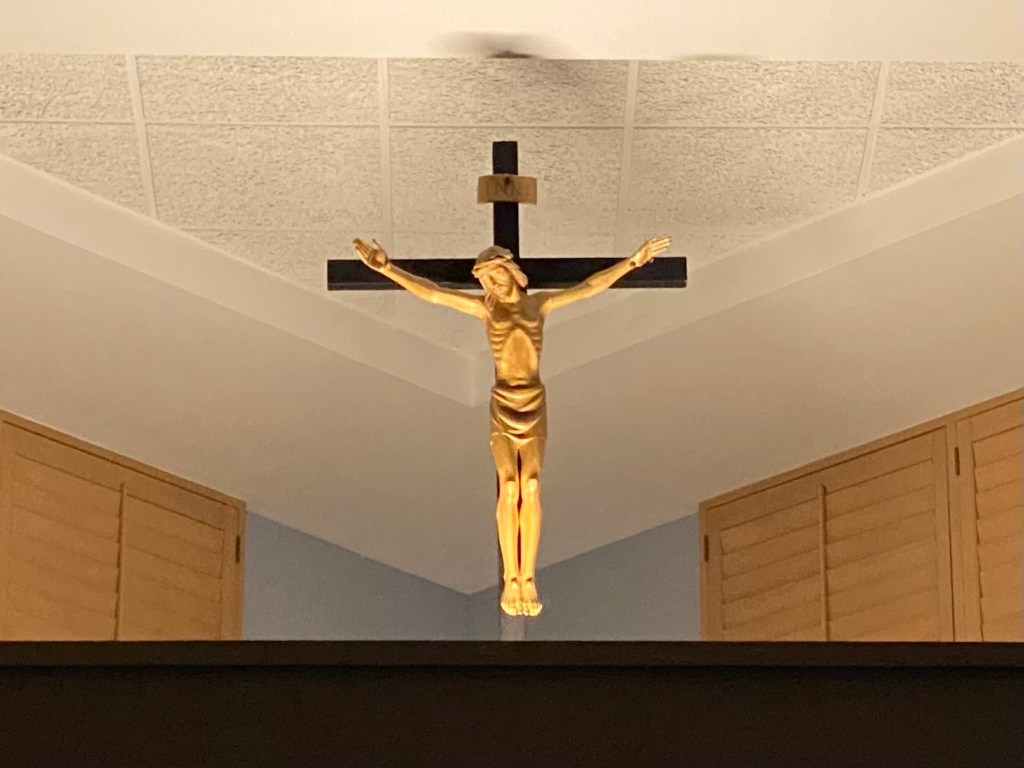
Photo: The crucifix hanging above our altar in our temporary place of worship in our hall, Holy Cross Catholic Church, Vero Beach, FL.

Link for the Mass readings for Wednesday, November 6, 2024

May God’s word enkindle a flame in our hearts and transform us.

Jesus said to his disciples: “I have come to set the earth on fire, and how I wish it were already blazing” (Lk 12:49)!
What has been burned does not remain the same. What fire touches, it transforms. Jesus wants us to be consumed so as to be transformed by the fire of the Holy Spirit. Encountering Jesus affects a change in us. When we are open to allow the Holy Spirit to breathe on the embers in the depths of our souls they are fanned like tinder and ignite. We continue to fuel the fire by getting in touch with what God has called us to do in our place and in our time.
We are not to be a Christian in name alone but in thought, word, and deed. Pope Francis, in his exhortation The Joy of the Gospel, wrote: “THE JOY OF THE GOSPEL fills the hearts and lives of all who encounter Jesus. Those who accept this offer of salvation are set free from sin, sorrow, inner emptiness, and loneliness” (Francis 2013, 9). Joy is a gift, a holy flame, that is given to us by the Holy Spirit, it wells up within, and rises up and out to be shared with others. It is different than pleasure which has its source in the stimulation of the senses being aroused but fades once the external stimulus has ended.
Happiness is also external and fleeting. It lasts longer than pleasure in that the memory of the experience will linger on but it too will also fade away. Joy wells up from within, as it is imparted to us by God and can be present even when the external experiences are stressful or chaotic. I experienced this when I was still teaching 5th and 6th Grade Religion and acting as the dean of students at Rosarian Academy. At the same time, I was also immersed in family and parish life, as well as my studies and formation activities for the permanent diaconate.
One particular morning I woke up exhausted. When the alarm went off my first response was to skip my morning prayer and hit the snooze button to get an extra twenty minutes before rising. Instead, I literally crawled to my small chapel area, lit the candles, and opened my breviary. When I read the words in Psalm 42: “Hope in God; I will praise him still, my savior and my God”, something ignited within. I felt an energy well up within me that I cannot to this day describe. I felt an inexpressible joy. Not only did the experience carry me into the day but lasted throughout the whole week.
God is the foundation of our lives and seeks to transform us with the fire of his love, and even when we are at our lowest, such that in our soul there are only smoldering embers, we need to resist the temptations of indifference and complacency and remember to turn to Jesus. Instead of brooding over what we don’t have, we will encounter him when we are thankful for that which he has given to us and for those he has placed in our lives. We will experience him in his Word, in prayer and worship, and in serving one another. We need to keep showing up, even if sometimes we have to crawl to get there, and allow God to fan the embers within our soul to set us ablaze.
This flame St. Paul experienced and shared in today’s first reading from his letter to the Church in Ephesus and he invites us to experience this gift of grace as well. May we, “know the love of Christ that surpasses knowledge, so that [we] may be filled with all the fullness of God” (Ephesians 3:19). To know the love of Jesus is more than knowing about him. We don’t read and study the Bible as we study a history text, but to experience the love of the Holy Spirit bringing alive the word into our hearts. In meditating, pondering, and praying with Sacred Scripture, we experience, breathe, rest, and receive his love and so become filled with the fullness of God.
Nothing else in this world can satisfy us as much as experiencing and being transformed by the love of God! When we seek God first, we resist the temptation of being attached to finite things. When we trust Jesus and align our will with his, we know him and experience his love for us and then our relationships and possessions are properly ordered. Knowing his love we can then experience fullness of his Father, we will no longer seek substitutes to place before God. We will experience fulfillment and better enjoy our relationships and those goods in our lives that God has blessed us with.

Photo: Rosary walk at sunset on Veteran’s Memorial Island, Vero Beach. Great way to ponder and mediate upon the mysteries of Jesus and his life.
Pope Francis. Evangelii Gaudium: The Joy of the Gospel. Frederick, MD: The Word Among Us Press, 2013.
Link for the Mass readings for Thursday, October 24, 2024

Jesus conquered sin on the cross that we may be free from sin in our lives.

“That servant who knew his master’s will but did not make preparations nor act in accord with his will shall be beaten severely” (Lk 12:47).
Jesus, as did the prophets, spoke in ways that can be jarring. The purpose was to shake his listeners out of a dull stupor and to make clear his point. In today’s Gospel passage, Jesus addressed Peter’s question: “Lord, is this parable meant for us or for everyone” (Lk 12:41)? Jesus was most likely speaking to Peter and the Twelve. They are the ones he entrusted with continuing his mission. And just as he had been clear to point out those Pharisees who had abused their positions, he was being just as clear with Peter and the apostles. Jesus wanted to make sure that his successors were not to continue on with business as usual. What Jesus required of them was not just for themselves, but those whose care they had been entrusted with and beyond them to all the nations. His parable was for both the Twelve first and foremost, and then to everyone.
Unfortunately, we have witnessed those in Church leadership who have in effect, “beat the menservants and the maidservants, to eat and drink and get drunk” (Lk 12:45) on their own power. Those who have: abused children, covered abuse, skimmed off the top of the donations from the blood, sweat, and tears of their parishioners’ donations, limited access to positions within the leadership of the Church to only male or clergy, been unmerciful confessors, held up the sin of one group or groups while turning a blind eye to others. These and other forms of hypocrisy do irreparable damage.
The world has been darkened by sin and it has crept into the Church. Even though all of us have been wounded we have not been destroyed by sin. The Son of God entered into the condition of our fallen nature, became one of us, one with us, in all things except sin and yet was willing to take the sin of the world upon himself on the Cross, conquering sin and death. Even when those in his name have participated in and perpetuated in that which Jesus warned his Apostles against, we are not to lose heart nor hope. I agree with Bishop Robert Barron that we are called out of “the realm of hatred, racism, sexism, violence, oppression, imperialism, what Augustine termed the libido dominandi (the lust to dominate).”
We are called to be children of the light. We do so by doing whatever Jesus tells us to do. There have been many throughout the ages as well as up to and including our own present time who have done just that. The saints have embraced the light of Christ allowing it to reveal to them their sins. With humility and contrition, they confessed their weaknesses, failures, sins, and from this place of surrender, they have been forgiven, healed, and transformed. They have become an empty cup able to be filled to overflowing with the love of Jesus. May we too be willing to be emptied of that which is not of God, so that we may receive the healing salve of the Father’s Love and be filled to overflowing also. May the love that we have received then spill over into the lives of those within our reach.

Photo: Stained glass behind the altar of Holy Cross Catholic Church.
Barron, Robert. Catholicism: A Journey to the Heart of the Faith. NY: Image, 2014
Link for the Mass readings for Wednesday, October 23, 2024

Behold Jesus on the Cross and be healed.

“In punishment the LORD sent among the people saraph serpents, which bit the people so that many of them died” (Numbers 21:6).

What kind of God would bring poisonous snakes upon his children? When Jesus taught his disciples about prayer didn’t he say, “Is there anyone among you… if a child asks for a fish, will give it a snake? If you then, who are evil, know how to give good gifts to your children, how much more will your Father in heaven give good things to those who ask him” (Mt 7:10).

Is God a loving Father or a harsh taskmaster?

He is a loving Father who not only wants his children to live but to live life to the full. God freed his people from slavery and was not only leading them to the promised land but also providing for and protecting them on the way. And yet, the people consistently grumbled and then rose up against Moses.

God chose to share with them a stark image of their choice of opposition to him by sending the serpents. The imagery of the serpent would have come to mind quickly to the people. For it was the serpent who tempted Eve and Adam and led them to their Fall. As St. Ephrem the Syrian (306-373 AD) wrote: “The serpent struck Adam in paradise and killed him. [It also struck] Israel in the camp and annihilated them” (Word on Fire Bible, p. 643).

We as Christians interpret the serpent in Genesis as Satan, which in Hebrew means adversary or opposer. Those of the people who rose up against God opposed him as Satan did. God revealed to them who they were serving in their rebellion and also showed them that if they rejected God and his love, protection, and provision, what the consequences to that choice would look like. Apart from God they will die. Trusting in and following God, even when the desert held no promise, they will live. “This particular punishment is another way of insisting that negativity necessarily follows from rebellion against God’s will” (Barron, p. 641).

When the people saw their sin in opposing God, they correctly repented. Moses again interceded for them, and God provided the healing antidote. He guided Moses to place a bronze image of a poisonous serpent on a pole. All who then looked upon it, were cured. In seeing clearly what had led to their poisoning, they could renounce it and receive God’s mercy, forgiveness, and healing. “Somehow, seeing sin for what it is serves to disempower the hold it has upon us” (Barron, p 641).

Jesus, the divine Son of God becomes one with us in our humanity to reveal to us the path to participate in his divinity. He shows to us our own rebelliousness, pride, and sins that separate us from God. Jesus has not come to condemn us for our sin but to save us, to free us from our slavery to sin. Jesus took the sin of the world upon himself as he was lifted up on the Cross. As he shared with Nicodemus, “just as Moses lifted up the serpent in the wilderness, so must the Son of Man be lifted up, that whoever believes in him may have eternal life” (Jn 3:14-15).

This is why we celebrate the feast of the Exaltation of the Holy Cross this day each year. What was a wicked sign of oppression and horrific suffering has now become a sign for our salvation. As we look upon the crucifix, we are reminded of the suffering that Jesus bore. Jesus took upon himself “all the dysfunction of the fallen human race” (Barron, p. 642).

When we look upon Jesus hanging on the cross, we see death but also the path to eternal life when we are willing to renounce, repent, atone for, and seek forgiveness for our sins. For on that Cross is where Jesus died for each and every one of us, and in so doing conquered the sin and death brought into the world by Adam and opened up for us the door to eternal life through his resurrection.


Photo: St Mary Chapel, St, Vincent de Paul Regional Seminary, Boyton Beach, FL.

Link for the Mass readings for Saturday, September 14, 2024

Word On Fire Bible: The Pentateuch. Elk Grove Village, IL: Word on Fire, 2023.

Stillness counters the threat of thorns.

“Some seed fell among thorns, and the thorns grew up and choked it” (Mt 13:7).

God wants all of us to be in relationship with him. His love for us in unconditional. He is willing to risk that we will say, “No” to his invitation of relationship rather than force us to love him, which is not love at all. God also wants the best for us, he knows the deepest desires of our heart beyond our even knowing for he sees the fullness of time, while we only see and experience a small part.

Jesus came to share the seed of his Father’s word through the teachings, healings, and exorcisms that he offered. We are recipients of each through the deposit of faith passed on generation after generation. One area that prevents us from allowing his seeds to germinate and bear fruit in our lives is when we allow the diversions, distractions, anxieties and worries to fill our mind such that they choke out the good that Jesus seeks to have develop within us.

On a physiological level, what we pay attention to fires neurons in our brains that form neural pathways. Each time we are attentive a new pathway is formed. After time, this is how our habits form and why after we do something consistently and are disciplined, the act is easier to do. It is also why a habit is hard to change in the beginning because we need to rewire those pathways.

To prevent the growth of our spiritual life from being choked out we need to practice each day stillness and focusing on God’s word. As we consistently sit in the same place each day, spend some time breathing and then focusing on reading a passage of scripture, praying, and/or pondering what God may be sharing with us, for that time we do so, we are to focus on Jesus alone. As thoughts and diversions to the contrary arise, we just bring ourselves back to Jesus and God’s word.

In time, with consistent, daily practice, we will begin to feel safe, we will experience God’s love and presence, his insights and guidance, we will heal, we will rewire our neural pathways such that it becomes easier to pray than not to pray. The thorns lose their sting, the distractions, temptations, and diversions lose their power as we begin to recognize God’s voice and follow his guidance.

Turning around unhealthy or sinful habits is not easy. When we decide to make time to spend time with God each day, while together we are attentive to only to him for that time we set aside and return to him as soon as we notice we are distracted, his seed with grow within us. Even when we feel like nothing is happening, God is happening, and we are growing and maturing.


Photo: Rooted and abiding in God’s love, we can grow free of that which seeks to choke us. Rosary walk Vero Beach, FL.

Link for the Mass readings for Wednesday, July 24, 2024

God’s commandments are invitations to grow in love.

Two points jump out of the Gospel of John today: commandments and love. How is each one of these related to living life as a disciple of Jesus? Often, many who hear the word commandments, often react, and are immediately put off. “There goes the Church again telling me what I can and cannot do.” Yet what Jesus is doing showing how the following of his commandments is a true expression of loving him.

Love is another word that evokes reactions. One reason is that, even though the English language has a plethora of words to utilize and choose from, there is only one word for love, and it is interpreted in many ways. In Ancient Greek, there are four words that are used to connote love. There is eros, which has to do with attraction. It is the beginning stage of love because we are drawn out of ourselves as we are attracted to another. The next word for love is philios, which has to do with friendship. This is the love between friends. If our love matures it moves from attraction or infatuation to friendship. The third word is storge or the deeper love shared with family members. The fourth word is agape, which is unconditional love.

When Jesus shares that we are to follow the commandments, he is not demanding that we do so as a tyrant. He is providing the boundaries and parameters for us to grow and mature as people who love, who, in the words of St Thomas Aquinas, will the good of the other as other. As humans, we are social beings. We want to belong, to be accepted, and to be a part of. We seek meaning, purpose, and fulfillment. This is best done through cooperation and collaboration with God and one another, striving for agape, to love unconditionally.

If we operate from a self-centered posture in which we are only turned in upon ourselves, and we only seek to manipulate and get from others, instead of working together and sharing a common vision with others, we will ultimately be empty with the exchange on any level, because we will be left wanting more. This is true because once the immediacy of the stimulation, whether material or sensual, ends, so does the experience of the feeling. Some happiness may linger from the effect, but we will never be filled or satisfied with anything finite. We will continue to seek more and more until the pursuit of instant and constant gratification ensnares us and we are entangled in a web of addiction.

The commandments, grounded in love, are meant to provide boundaries for us, training wheels, and to keep us free from enslavement to sin, while at the same time help us to be persons who move away from being self-centered to maturing as other-centered instead. Discipline in this way is meant to be a means of freedom for excellence such that we can become who God calls us to be and who we truly desire to be. Ultimately, we are to love God as he loves us and love our neighbor as ourselves in our own unique way. God is not in competition with us. He is our biggest fan. As St Irenaeus wrote, the glory of God is the human being fully alive!

Commandments and morality imposed, is a bludgeon. Love and mercy without accountability and justice can be enabling. Jesus provides the blueprint for a balanced both/and approach of invitation and shepherding. May we surrender to his loving guidance and correction, align ourselves with the Holy Spirit, who is the Love expressed and shared between the Father and the Son. May we seek ways to improve our lives, to be more honest with our weaknesses, so Jesus can be our strength, and to seek God when we are tempted to choose him so he can lead us away from the enticement to sin, and seek his forgiveness when we have fallen.

As we journey in this life, we do not do so alone. As we seek to follow Jesus’ lead, as we grow and mature, we do so while in the midst of encountering and forming relationships with others. Conformed by following the commandments, we are to reach out in love to each other as Jesus has done with us. As we form and deepen our relationships, new and old, may we encourage, support, and love one another while at the same time, challenge and hold each other accountable as we strive to be who Jesus invites us to be.
———————————————————–
Photo: The discipline of nightly Rosary walks over these past two years has been a blessing! St. Vincent de Paul Regional Seminary, Boynton Beach, FL.

Link for the Mass readings for Monday, April 29, 2024