When we come to sit at the feet of Jesus we experience healing and are nourished.

“Jesus walked by the Sea of Galilee, went up on the mountain, and sat down there. Great crowds came to him, having with them the lame, the blind, the deformed, the mute, and many others. They placed them at his feet, and he cured them” (Mt 15:29-30).

There is a key yet subtle point before Jesus began to heal that might be missed. Before great crowds came to him, Jesus “went up on the mountain, and sat down there.” This is no insignificant sentence. The posture of sitting on the mountain would have been recognized right away by the people of Jesus’ time. This was the posture of the teacher and sitting on the mountain a reference to Moses. Prior to the healing in this setting, as he did throughout the Gospels, Jesus most likely taught about the reign of God. In fact time and again, Jesus’ “works of healing took place in this context of his preaching of the kingdom of God” (Lohfink 2014, 58).

A great multitude of people came to Jesus to hear his message and also they came with a full range of needs. Jesus made himself available, exorcised, restored, and healed those who were brought to him. He encountered them as they were in their present condition of need. There is no record in this Gospel account that Jesus asked for any identification, that he discussed their belief system before healing them, nor did he ask if they were Jewish or Gentile, and nowhere in this account did Jesus deny anyone who came to him. The response of those to being healed and restored was that “they glorified the God of Israel“. This is because, “where God is master, there is salvation and healing” (Lohfink 2014, 62).

These recorded accounts of mass healings, are but a foretaste of the heavenly realm of eternal communion with the Father. Jesus is the kingdom of heaven at hand, for as St Irenaeus wrote, “Jesus opened up heaven for us in the humanity he assumed.” Jesus though was not done. The whole process took some time, which is probably an understatement, and as people were getting ready to leave, Jesus showed compassion yet again. He sought the assistance of the disciples because he did not want to send the people away hungry.

The disciples of course are taken aback because of the reality of the undertaking Jesus proposed. Jesus asked what they had and they shared just some bread and fish. Jesus took “the seven loaves and the fish, gave thanks, broke the loaves, and gave them to the disciples, who in turn gave them to the crowds. They all ate and were satisfied. They picked up the fragments left over–seven baskets full” (Mt 15:36-37).

This Advent let us surrender our will to God. May we pray with and meditate upon the Gospels such that they become relevant in our lives, so that we can serve God as Jesus did. Not stopping to ask for identification, religion, race, gender, creed, or political affiliation, but to see each person as God sees them as his children, human beings with dignity and value. In reading, meditating, and praying with the Gospels, we too come to sit at the feet of Jesus. We too can express our need, be nourished, and satisfied. We can then share what we have received.

Let us also not be dismayed by how little we have, but let us give what we do to Jesus in solidarity for his purpose, as did the disciples, so to experience with those we serve, the multiplication and abundance of the love, and grace we have received from our loving God and Father. For when God is our master, “there is salvation and healing.”

—————————————————————————

Photo: Where I come to sit at Jesus’ feet during my holy hour each evening since returning to our renovated church a few weeks ago.

Lohfink, Gerhard. No Irrelevant Jesus: On Jesus and the Church Today. Collegeville, MN: Liturgical Press, 2014.

Link for the Mass readings for Wednesday, December 3, 2025

We pray, love, and serve because we are loved by the One who is Love.

“[W]hen you hold a banquet, invite the poor, the crippled, the lame, the blind; blessed indeed will you be because of their inability to repay you” (Lk 14:13-14).

Jesus means what he says here, though I am not sure many of us are ready to live this Gospel out. If we are going to get to the point where we can, we must understand the deeper point that he is making. The words of Jesus above give us an example of what it means to love unconditionally. We are to resist the temptation of doing anything with the primary purpose of receiving thanks or praise. We are to instead reach out to those in need because they are in need seeking nothing in return. We embrace our dignity as human beings when we recognize the inherent dignity of another and serve them without hesitation, without holding anything back.

This is the root of what we mean when we say that we are believers in the God of Jesus Christ. God is a divine community of persons, Father, Son, and Holy Spirit. The Father gives all that he is to the Son perfectly, infinitely, holding nothing back. The Son receives all that he has been given perfectly, infinitely and returns, in like fashion, what he has received back to the Father, holding nothing back. The infinite love shared between the Father and the Son is the Holy Spirit.

The Son of God became incarnate, one with us in our humanity, and he also gave all of himself to us on the cross, holding nothing back. He conquered death, rose from the dead, ascended to the Father so that we now can participate in that same divine love given and received between Father, Son, and Holy Spirit. We do not give of our time, talent, and treasure, so that we will receive more of each. We give, we love, we will the good of each other, because we have been loved into existence and are continually loved more than we can ever imagine by God. We are to receive his love and love in return because that is who he created us to be.

The very fact that we exist, that we have life, is a gift, yet we are not meant to merely exist. Jesus teaches us that the height of our humanity is to allow him to love us and through us, love others unconditionally. When we look into the eye of each and every person we meet, we are to see a brother, sister, mother, father. With each smile, each embrace, each listening ear, each act of invitation to walk not ahead, not behind, but with another, and by simply being present, we reaffirm to each other that we have dignity. This is true because each and every one of us has been created in the image of God, who is Love.

——————————————————–

Photo: St. Martin de Porres lived out this gospel literally. From the Dominican monastery in Lima, Peru, he fed several hundred people a day, provided healing, financial support, and began a school for street children. St. Martin, pray for us that we also may be people of prayer and service.

Link for the Mass readings for Monday, November 3, 2025

Greed corrupts our hearts, giving sets our hearts free.

Take care to guard against all greed, for though one may be rich, one’s life does not consist of possessions” (LK 12:15).

Jesus wisely warns us to resist the temptation of greed, which can be defined as an intense, selfish desire for something. Here Jesus addresses the greed of material wealth, but we can also have unhealthy selfish desires for anything. Jesus also stated that “one’s life does not consist of possessions.” Material goods are finite and will not fulfill us. They can be good when used for the purpose they were intended for and in moderation.

God provides for our needs. Fostering an attitude of thanksgiving for that which we have received and then being good stewards helps us to resist the temptation of greed. St Clement of Alexandria (150-215 AD) wrote: “How could we do good to our neighbor if none of us possessed anything.” God does bless us, and from what we have been given we are to assist those in need. The problem comes when we interfere with the flow of receiving what God has given us by hoarding what we have received and rationalizing our unwillingness to share. Also, when we look to our wealth as our safety net, instead of God’s providence, we begin to cling to what we have and develop an unhealthy attachment. We buy into a false security in placing our trust in material wealth. We need to remember that the material and finite here below will not satisfy nor will it last, we need to set our heart and mind to God and the things above first and foremost.

Acts of almsgiving, willing the good of and support for one another in need, will help us to resist the temptation of greed and help us to be open conduits of God’s mercy. Pope Leo XIII (1810-1903 AD) wrote that “Once the demands of necessity and propriety have been met, the rest of your money belongs to the poor.” How many of us are willing to put that quote on our bathroom mirror? More so, put it into practice? How about posting this quote from John Chrysostom (349-407 AD) over our closet and reading it before we enter: “The man who has two shirts in his closet, one belongs to him; the other belongs to the man who has no shirt.”

God has given us the greatest gift we could ever receive, his Son, Jesus. In so doing, he has given us the gift of our salvation which is a reason to rejoice! He loved us and all of creation into being and is loving us into eternity. We are invited to participate in the love experienced between the Father and the Son and the Holy Spirit.

We do this best when we resist clinging to the material and finite and instead being thankful for the gift of life and invitation to be in relationship with his Son. May we resist clinging to and instead share that which we have received from God, our infinite source and spring of eternal Love. We will be fulfilled and joyful, not by how much we have saved up in our bank accounts, but by how much love we invest in serving one other.


Photo: No sunset is the same. Each one has its own unique beauty and to watch provides a wonderful gift. We receive the gift God gives us and let it go. A good rhythm to practice in our daily lives.

Link for the Mass readings for Monday, October 20, 2025

Envy and greed are deadly, thankfulness and generosity give life.

A foundational quality of a good leader, whether he or she be a political or religious leader, would be that they are seeking the best interest of those they serve. They also seek to be good stewards. Unfortunately, self-interest is a tremendous temptation. For how long are they willing to approach the position as one who is willing to serve instead of being served? Another important attribute in a leader is their openness to critique and guidance when they are in need to hear it.

Jesus in today’s parable presents a landowner who turns his vineyard over to tenant farmers. They are to oversee the crops to bring about a productive yield of grapes come harvest time. A mutually decided upon part of the harvest would then be offered to the landowner. Unfortunately: “When vintage time drew near, he [the owner] sent his servants to the tenants to obtain his produce. But the tenants seized the servants and one they beat, another they killed, and a third they stoned” (Mt 21:34-35). Eventually, the owner sends his own son, and the tenants kill him.

Jesus offered this parable as a mirror to the “tenants” of his time, the chief priests and Pharisees. The vineyard is an image used to represent Israel. Clearly, the owner is God, and the tenant farmers are those in leadership positions overseeing the care of Israel. We do not know which leaders hearing this parable took it to heart and changed their minds and repented from their self-centered focus. We do know that there were those who carried out exactly what Jesus laid out in the parable. They persecuted, beat, and killed the prophets, and would do the same to Jesus.

Jesus offered this parable hoping to soften the hearts of the leaders who were seeking to arrest him. He was hoping that they would repent, like Isaiah and the prophets had sought to influence the generations before him. The leaders that Jesus shared this parable with unfortunately did not receive Jesus’ message, as was highlighted vividly when Jesus asked what the owner ought to do to with the wicked tenants. The chief priests and the elders did not show any mercy at all but instead, called for the death of the unfaithful tenant farmers. In refusing to repent and condemn those in the parable, they heaped punishment upon themselves.

Jesus said, “the kingdom of God will be taken from you and be given to a people that will produce its fruit.” The parable was not just for the chief priests and the elders, nor just for his disciples then, but also is for us today. All of us are stewards awaiting the return of the Son of the Land Owner. May we have eyes to see and ears to hear so that we may resist the temptation of the unfaithful tenant farmers. Let us not grasp at but instead receive and be grateful for what God has given us, resist the deadly sins of envy and greed, and be good stewards, as generous as God is with us.

—————————————————————————————-

Photo: 6th century, Eastern Orthodox icon of Jesus. Grateful for his life, teachings, love, and guidance.

Link for the Mass readings for Friday, March 21, 2025

Can we trust God so as to also give as extravagantly, as generously, as radically?

Last week Jesus challenged us with the great commandment which is to love God with all our heart, soul, mind, and strength and to love our neighbors as ourselves. Our readings this week give us two radical examples of how to do just that. We begin by trusting in God.

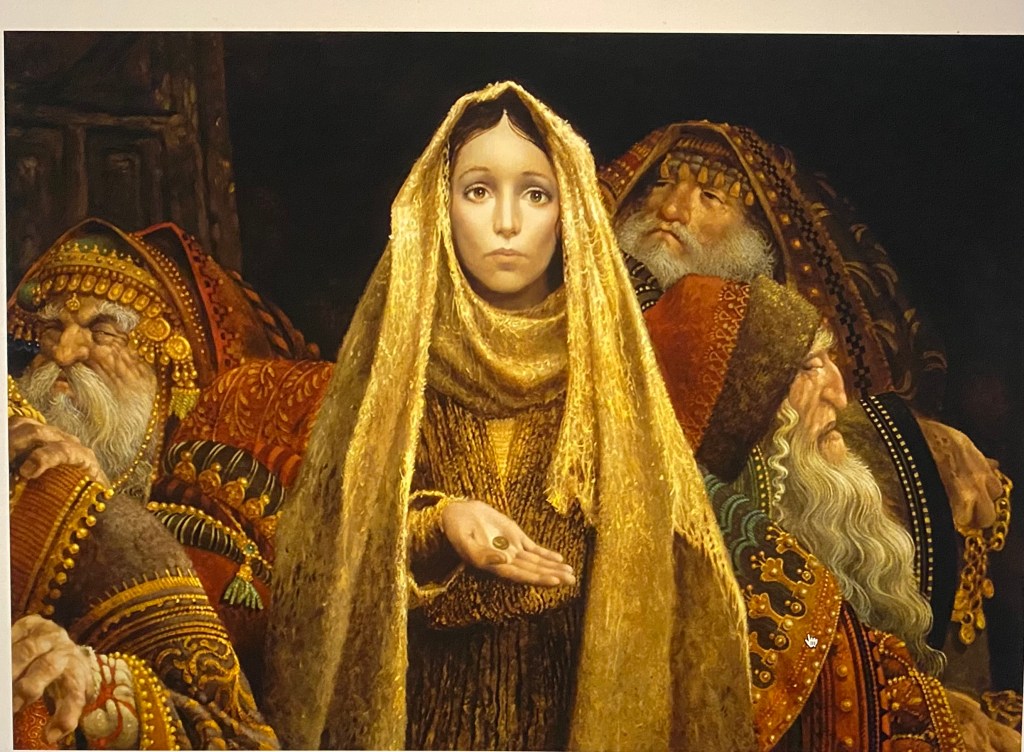
We are to trust as did the widow of Zarephath from our first reading and the poor widow giving her last two coins to the temple treasury in the Gospel,“…she, from her poverty, has contributed all she had, her whole livelihood” (Mk 12:44). Each of these women were practicing a spiritual physics and being generous that defied what appeared to be the reality before them. Each had barely anything, one her last meal and the other her last two coins, yet they gave all they had, trusting that God would provide for them. They trusted in God’s providential care.

Each of us, the baptized, are the Church, and as we gather together each week to worship, we receive encouragement, seek to learn and grow deeper our faith, become transformed by the Body and Blood of Jesus made present again in the Eucharist, and pray for the needs of our world. This is a good way to build a foundation of loving God, self, and neighbor.

As people of faith we are to aspire to care for one another and creation, to resist the temptation to divide, demean, and define people as other and instead see each other as God sees us, as brothers and sisters. Elijah and the widow of Zarephath saw each other as human beings not people of different ethnicity or faith traditions. Each were in need, trusted in God, and supported one another.

St. Mother Teresa often recounted a story in which she brought a cup of rice to a Hindu woman because she knew how hungry her and her children were. As soon as the woman received the rice, she poured half into another container and left. When she came back Mother asked her where she went. The woman said, “They are hungry too.” “They”, were her Muslim neighbors.

Are we willing to have the kind of trust as these three women did? Do we have the courage to give not out of our excess but out of our need? On our own, most likely not. That is why God invites us to pray and spend time with him in our communal worship so we experience Jesus’ radical gift of himself in his word proclaimed and Body and Blood shared for us. He was willing to give himself, all of himself, holding nothing back.

Jesus gave his life for each one of us, what are we willing to give in return? Often we hedge our answer to this question because we are placing our trust not in God but in something else. For where our treasure is, there our heart lies. We would do well to meditate upon the accounts of the widow of Zarephath, the woman with two coins, and the Hindu woman this week. Meditating upon how each were willing to give the little they had, each expressing extravagant generosity, each trusting in God may help us to open our hearts and minds to the extravagance and generosity of God’s love for us so that we can trust him more and give as he invites us to give.


Painting credit: The Widow’s Mite by James Christensen

Link for the Mass readings for Sunday, November 10, 2024

Resist greed and embrace almsgiving and charity.

Take care to guard against all greed, for though one may be rich, one’s life does not consist of possessions” (LK 12:15).
Jesus wisely warns us to be careful to resist the temptation of greed, which can be defined as an intense, selfish desire for something. Here Jesus addresses the greed of material wealth, but we can also have unhealthy selfish desires for anything. Jesus also stated that “one’s life does not consist of possessions.” Material goods are finite and will not ultimately fulfill us but they can be good when used for the purpose they were intended for and in moderation.
God provides for our needs. Fostering an attitude of thanksgiving for that which we have received and then being good stewards helps us to resist the temptation of greed. St Clement of Alexandria (150-215 AD) wrote: “How could we do good to our neighbor if none of us possessed anything.” God does bless us, and from what we have been given we are to assist those in need. The problem comes when we interfere with the flow of receiving by hoarding what we have received and rationalizing our unwillingness to share. Also, when we look to our wealth as our safety net, instead of God’s providence, we begin to cling to what we have and develop an unhealthy attachment. We buy into a false security in placing our trust in material wealth. We need to remember that the material and finite of below will not satisfy nor will it last, we need to set our heart and mind to God first and foremost.
Acts of almsgiving, willing the good of and support for one another in need, will help us to resist the temptation of greed and help us to be open conduits of God’s mercy. Pope Leo XIII (1810-1903 AD) wrote that “Once the demands of necessity and propriety have been met, the rest of your money belongs to the poor.” How many of us are willing to put that quote on our bathroom mirror? More so, put it into practice? How about posting this quote from John Chrysostom (349-407 AD) over our closet and reading it before we enter: “The man who has two shirts in his closet, one belongs to him; the other belongs to the man who has no shirt.”
God has given us the gift of his Son, Jesus. In so doing he has given us the free gift of our salvation which is a reason to rejoice! He loved us and creation into being and is loving us into eternity. We are invited to participate in the love experienced by the Father and the Son and the Holy Spirit. We do this best when we resist clinging to the material and finite and instead being thankful for the gift of life and invitation to be in relationship with his Son. May we resist clinging to and instead be willing to share that which we have received from God, our infinite source and spring of eternal Love. We will be fulfilled and joyful, not by how much we have saved up in our bank accounts, but by how much love we invest in serving one other.

Photo: For the past few years, I have been blessed with God’s gifts of these wonderful evening views. In our time with God, we receive is love and generosity. May it inspire us to freely give as we have received!
Link for the Mass readings for Monday, October 21, 2024