Each moment we choose who we serve.

“No servant can serve two masters. He will either hate one and love the other, or be devoted to one and despise the other. You cannot serve God and mammon” (Lk 16:13).

Jesus consistently emphasizes the priority of making God primary in our lives. Anything that moves into the slot of preeminence before God is idolatrous. Anything, even family, as we heard a few days ago. We cannot have two firsts, because either we will “hate the one and love the other, or be devoted to one and despise the other.” This balancing act is not an easy discipline.

It becomes especially challenging when we look at mammon, money, or material wealth. Many of us seek our security in having a home, insurance policies, savings, retirement plans, market investments. Setting up this security is often considered prudent. The problem is when material security becomes the foundation of our life, our fulfillment, our god.

This has certainly influenced the Church at times with movements governed by a prosperity gospel. The approach to a faith life that is not so much building up a relationship with our loving God and Father, but one of seeking God as a holy investor. There is a perspective offered on verses such as the Parable of the Sower (cf. Mark 4, Matthew 13, and Luke 8) in which the primary intent in giving is to reap a financial return of ten, twenty, or a hundredfold. God certainly wants us to be good stewards, and he will indeed bless us and wants us to be generous and cheerful with our giving, but again, if in our giving the primary intent is to receive more of our treasure, we are serving Mammon and not God.

We are not to seek the gift, but the giver of the gift. The greatest gift we can see is the love and affirmation of our Father. The cost is to place ourselves in a position to breathe, receive, rest, and abide in his love. Also, we are to place the love of God before any other affections. By making this shift, then any wealth that we have we realize is gift from God. We have no need to cling to the gift, but recognize we are to be good stewards of the gifts that we have received.

Following are two scriptural verses and two Church Father quotes that may help us to see that in giving away and not accumulating the material, trusting in God for our security, is the more prudent path:

“If one of your kinsmen in any community is in need in the land which the Lord, your God, is giving you, you shall not harden your heart nor close your hand to him in his need. Instead, you shall open your hand to him and freely lend him enough to meet his need” (Deuteronomy 15:7-8).

“For I was hungry and you gave me food, I was thirsty and you gave me drink, a stranger and you welcomed me, naked and you clothed me, ill and you cared for me, in prison and you visited me” (Matthew 25:35).

“When giving to the poor, you are not giving him what is yours; rather, you are paying him back what is his” (St Ambrose of Milan, 340-339).

“If each one of us took only what is necessary for his sustenance, leaving what is superfluous for the indigent, there would be no distinction of rich and poor” (St Basil of Caesarea, 330-379).

Our reactions to the above can be a barometer as to whether we are putting gold first or God first. God is to be our source, security, and foundation. The blessing we receive, the hundredfold we seek, is to be measured in love, mercy, and generosity received and given.

Do we place our trust, faith, and security in Mammon, or God? Do we build up treasure for ourselves at the expense of or indifference toward others or build up our treasure in heaven, aware of and reaching out to those who are in need? Were someone to observe us objectively, and closely would they say about us, “There goes someone that lives their life believing: In Gold we Trust.” Or would they say, “There goes someone that lives their life believing: In God we Trust?”


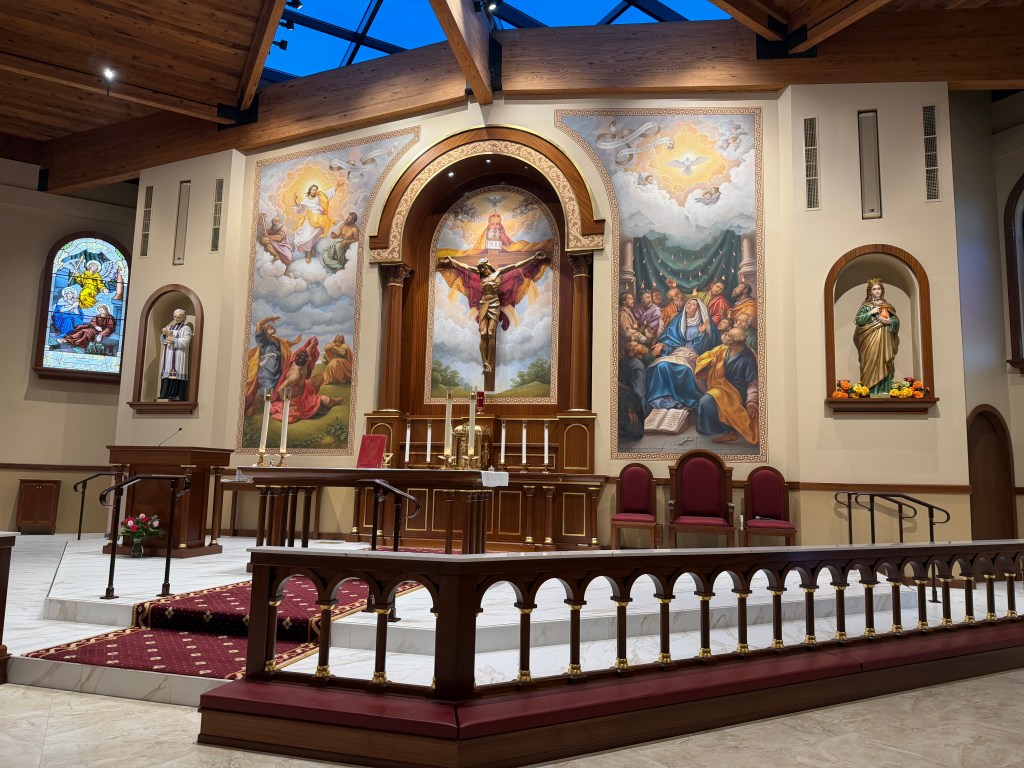
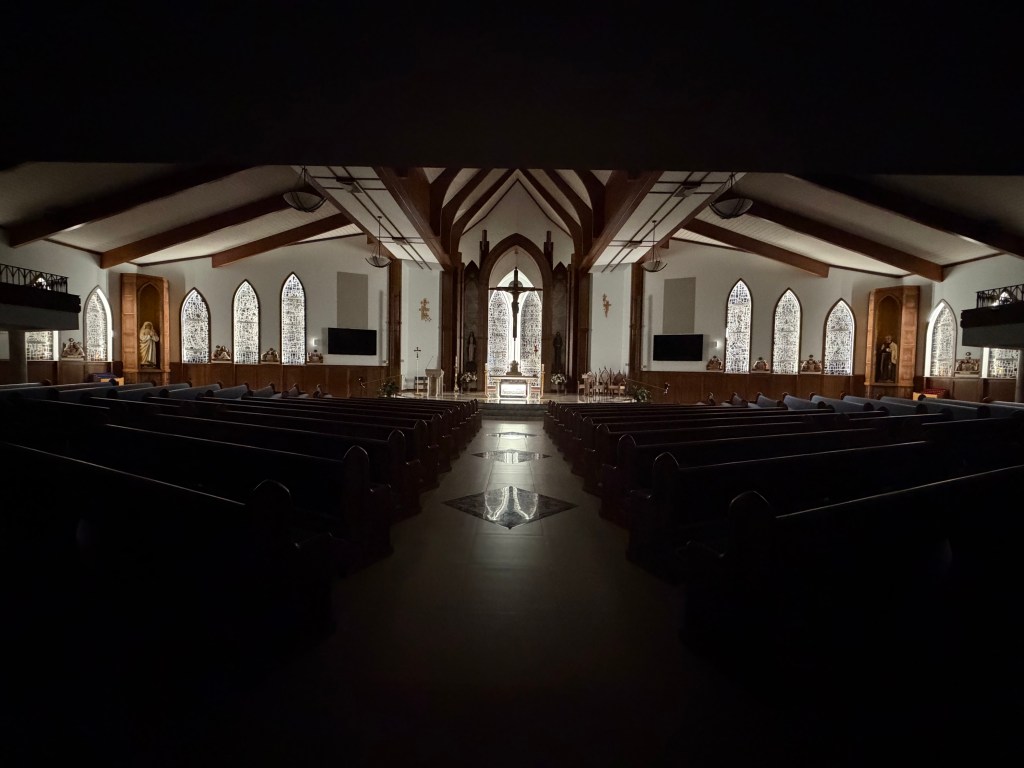
Photo: God is the light that shines in our darkness and reveals the truth that sets us free from our attachments and disordered affections.

Link for the Mass readings for Saturday, November 7, 2026

We are to love Jesus more, than our possessions, our family and friends, even our own life.

I can visualize the opening scene of today’s Gospel in my mind’s eye. Jesus striding along with a gathering of people walking, talking, and moving about, and then he just stops. The turns. Those closest to Jesus pull up with him, others continue right past, while at the same time others bump into and trip over those who had stopped before them. The subtle hum of random conversation then slowly comes to a halt. A stillness ripples through the crowd, and then there is silence. The dust begins to settle. Those closest have their eyes locked on his, while those further back are craning their necks, moving left and right to get a better look. Still others are cupping their ears to catch the sound of Jesus’ voice.

Those following Jesus consisted of disciples to be sure, while the greater majority were those on the periphery gathering because of curiosity, intrigue, and maybe even wonder. Jesus then begins to speak, “If anyone comes to me without hating his father and mother, wife or children, brothers and sisters, and even his own life,…” and then, “Whoever does not carry his own cross and come after me…” and then he finishes with “In the same way, everyone of you who does not renounce all his possessions cannot be my disciple” (cf. Lk 14:25-33).

Those who may be hearing these words second hand, as they were further away from the point of direct hearing, may not believe that the message was transmitted to them correctly. These words cut to the quick, just as surely as when Jesus shared about eating his flesh and drinking his blood, and when he told another follower, who wanted to bury his father to let the dead bury their dead. Luke does not say, but it is likely that many of those gathered around him were just as shocked and began to walk away.

The familial bond for ancient peoples was strong. Though the invitation of salvation that Jesus offers is for all to be saved, he is not going to dumb down or sugar coat his message just to get numbers. Jesus presents, time and again, that the way to live a life of fullness and wholeness, to restore that which has been lost, is to put God first in our lives. God must be the primary focus, the primary relationship in our lives, nothing else can have priority of place before him. When we do so, everyone and all other things will fall into their proper place, will be properly ordered. We will experience a peace and rest.

Do we want to be an onlooker, just someone looking at Jesus from a distance? Or do we want to be a disciple, willing to be his servant sent forth to share the Gospel and invite others into relationship with him? Are we attached to possessions, false substitutes, even members of our family, such that we place them before our relationship with God? Idols are anything that we put before God and will distract and divert us from the very flow of his life force that fuels our existence. If we are willing to walk the path of discipleship, we must be willing to surrender our will to God, place him first in our lives, take up our cross, and be open to being transformed by his love.

Jesus is the interpretive key that opens our understanding. All that which is material and finite in our lives only find true meaning in relation to him. Only when we are able to let go of the attachments to the things of this world will we then truly be free and experience then healthier relationships to each other. St. Francis embodied this in a radical way. One of his foundational prayers, which he sometimes would pray for hours was, “My God and my all!” And that is the life he lived and which Jesus invites us to live.


Photo: Blessed to concelebrate Mass at St. Anastasia a few weeks ago as we gathered to pray and prepare for World Youth Day in South Korea.

Link for the Mass readings for Wednesday, November 4, 2026

God first, helps us to experience his love and healing that we can share.

Uncertainty, upheaval, and unrest in our country and world appear to be the water we are all swimming in right now. Our readings give us some guideposts for hope and light to help us to see through the haze to what and who truly matters.

In our first reading from the Second Book of Kings, we are introduced to the Shunammite woman and the prophet Elisha. Upon their first meeting, the Shunammite woman invites Elisha to have dinner with her. There is no evidence that they knew each other at that point. She recognized his need after traveling and offered him hospitality. Their time together must have been positive because Elisha continued to visit with this woman and her husband each time he came through the area. Their friendship grew to such a point that she was even willing to have a room built for him to stay. What began with a simple gesture of empathy and hospitality would be blessed with new life.

There is an echo here of the Genesis account where three men come to visit Abraham and Sarah (Genesis 18:1-15). Abraham immediately invites the men to stay with them and appeals to Sarah to make bread and he would go and he would fetch a calf. Their welcome and hospitality are met with the praise that when they return the following year, Sarah would be with child.

We may not have the opportunity to invite a three Persons of the Trinity or a prophet to dine or live with us in our homes, but we can start with some smaller acts of interaction. When our kids, no longer kids anymore but adults, returned home from California to visit on holidays, my wife, JoAnn, would take them to Publix to stock up on food for their stay. They were constantly amazed at how many of the workers there knew their mom.

The reason was that JoAnn took small moments during each visit to interact with them. Initially, she would say hello and ask how they were doing, then slowly on subsequent visits got to know a little more about their families and their lives. Instead of rushing through the store and taking the presence of the workers for granted, JoAnn saw real people with real lives and built real relationships through small gestures of empathy.

In our Gospel reading, Matthew records Jesus saying to his apostles: “Whoever loves father or mother more than me is not worthy of me, and whoever loves son or daughter more than me is not worthy of me” (Mt 10:37). This may seem the exact opposite of the hospitality that we just encountered! These words would have been abhorrent to the people of his time. Family ties meant everything. Jesus is sounding more like a gang leader than a messiah. They need to be loyal to him first and foremost even before their own parents or children.

Jesus was making two key points. First, he is restating the Ten Commandments in that our most important relationship, even more than our family, is to be with God. You are to love the Lord your God with all your heart, all your soul, your mind, and your strength. We are to put God first before all things and all people, even family. Second, and even more startling, Jesus is equating himself with God which is the only way this statement makes any sense. Jesus is no mere rabbi, teacher, or prophet. Jesus is the Son of God incarnate. As we deepen our relationship with Jesus and follow him first before all, we will not only grow closer to God, our relationships, our activities, our very thoughts, words, and actions will be more properly ordered.

To enter the diaconate program, the wife of the applicant must sign that she is in agreement with the process and that goes right up until the day of ordination. If she is not on board, she can pull the plug at any time. Initially, JoAnn was not fully behind the idea. With the challenges to my time already high because of the demands of my teaching schedule, formation would add more challenges. I was taking a risk even presenting the idea to JoAnn. Yet, I believed Jesus was calling me forward. We both trusted that this was God’s will and we followed through with formation, to ordination, and beyond.

There were indeed challenges and tensions because of this decision and we learned to lean on Jesus through each ebb and flow. God first in our lives, meant changes and sacrifices made for each other, and fortunately, we didn’t grow apart but together. And growing not only closer to God and each other but we grew closer in our relationships at our parish of St Peter and Cardinal Newman HS where I taught then as well.

Not to be left in the lectionary gathering dust, in our second reading, St Paul helps us to understand that our relationships even transcend death. For those of us who have been “baptized into Christ Jesus were baptized into his death” (Romans 6:3). Jesus has conquered death and he has risen and will die no more. This he promises for us as well. Those who have died with Christ shall rise with him. Death does not have the final say, Jesus does.

In three months, it will be seven years since JoAnn died. We shared twenty-three wonderful years together. She taught me how to be less selfish, less contemptuous and judgmental, she taught me how to come out of myself and how to love. In the first few months after her passing, I was having trouble recalling memories of our time together and began to fear that I would forget her. Over those first months and first two years, I realized that the sorrow and grief of loss was strong and I had been holding on too tightly to who I lost.

The past five years has been a time of healing and letting go of my grip. I have started not only to experience some spontaneous memories like her laugh while doing the dishes one night, her presence when I made time for walks, and activity we did almost nightly, but even more wonderful, feeling brief moments of her being close in unexpected moments, especially during Mass. 

JoAnn had often tried to think of a business idea that we could all do as a family. Our youngest daughter, Christy, came up with a creative business idea a few years back and shared it with me. I was still living in our home then, and after our discussion went out to mow. As I was thinking about Christy’s idea, and after a few circles around the lawn, I felt this deep feeling of joy and warmth in my chest, and tears welled up in my eyes. I knew it was JoAnn’s joy that Christy was adopting JoAnn’s entrepreneurial spirit. 

So yes, we are continuing to experience times of uncertainty, upheaval, and unrest. What has helped me is to not focus on what is beyond my control but what is in my sphere of influence. What has helped me tremendously has been setting non-negotiable practices to spend with God throughout the day. I am just as busy now if not more than I have ever been, but find myself less defined by my external circumstances. I feel much less anxious and stressed, even when the external wave of activity and demands become overwhelming.

What was true during the time of our biblical readings is still true for us today. God must be first in our lives, he calls us to be in a relationship with him and each other, and the more we attend to both, the better we will weather the storms, even death, and the more joyful we will be even as we go through trials together. 

We can’t change the country and the world, but we can change ourselves. We can reach out to others in our realm of influence. Wherever and whenever we interact, we can make an extra effort to be understanding, kind, respectful, and hospitable. We can resist taking each other for granted and be more present and listen to one another and our stories. We can choose to resist reacting to and instead see each other as God sees us. 

Then as we begin to change, and those around us change that can begin to ripple out to begin to bring healing and reconciliation to the many who need to experience it. Life is short, even in the best of circumstances. God loves us more than we can ever imagine with a love that even transcends death. When we experience God’s love, we will seek him more. Let us make a deeper commitment today to love God first so to better love ourselves and one another as God loves us. 


Photo: Taking up our cross as Jesus did will help us to keep our eyes fixed on him, who is our light through the darkness.

Mass readings for Sunday, June 28, 2026

May we awaken each morning seeking to decrease so God may increase in our lives.

“So this joy of mine has been made complete. He must increase; I must decrease.”(Jn 3:29b-30).

How could John be feeling joy with decrease? This is counter to what many aspire to in our country. Aren’t we supposed to obtain more, be more popular, and not rest on our laurels if we are to be happy? If our end goal is, fame or honor, wealth, power, and/or pleasure, then yes, that would be true. But John is giving us an insight here about what brings us real joy.

True joy comes from within when we have found our meaning and purpose in life, our mission. John was clear about his mission. John came to prepare the way of the Lord. He experienced this from the time when he leaped in the womb when Mary first arrived to see Elizabeth. From that moment, he was preparing the way for Jesus and continued to do so into his adult life. He was not distracted by how many people he was or was not baptizing, but instead was focused on preparing people to be ready for the coming of the “Lamb of God, who takes away the sins of the world” (Jn 1:29).

John was not threatened by Jesus as was Herod, he is overjoyed that the time of fulfillment had come. What John had been called to do by God he had been doing. The reality that Jesus increased and John decreased brought John joy because this was the fulfillment of his mission. How many of us get to experience the fruits of our labor?

If we want to be happy, experience joy, and be fulfilled in our life, then following the lead of John the Baptist is a pretty good way to start. I do not necessarily mean selling off everything, moving to the wilderness, and subsisting on a staple of locusts and honey. The important point is that John cultivated a relationship with God. He came to know his voice, was open to his direction, acted on God’s leading, because he was clear of the part he was to play in salvation history.

Each and every one of us come to know our mission, our specific role to play in God’s plan when we slow down daily, pray, spend time reading and meditating on his word. We  become consciously aware of the relationship God is inviting us to participate in. As we do so, we will better experience the Holy Spirit who “impels us to open the doors and go forth to proclaim and bear witness to the good news of the Gospel, to communicate the joy of faith, the encounter with Christ. The Holy Spirit is the soul of mission” (Francis 2014, 48).

I have been blessed to have been instilled with a sense of mission during my days with the Franciscans in my early twenties, my twenty-three years of marriage to JoAnn, and my twenty-five plus years teaching. Each of these as well as all of my other experiences have prepared me well for this next chapter of my life serving as a priest. The key practice that has helped me during each step along this path has been to ask God what he wanted me to do, to trust in his guidance, and follow him.

When we make the time to listen, we will hear and begin to recognize the voice of Jesus in the silence of our hearts, we will better discern where we are placing our time and energy, and will be better able to discern what and who we have placed before God as idols and let them go. When we are willing to have eyes to see and ears to hear, we will see where God is inviting us through his creation, our experiences, and relationships. As we step out of our comfort zones and risk, follow the lead of the Holy Spirit, and are willing to allow Jesus to increase within us, he will not only confirm for us but provide for us the means to accomplish our mission.

—————————————————————————–

Photo by Josh Sorenson from Pexels

Pope Francis. The Church of Mercy: A Vision for the Church. Chicago: Loyola Press, 2014

Link for the Mass readings for Saturday, January 11, 2024

We do better when we depend on God.

The Apostle John attempted to prevent someone from casting out demons in Jesus’ name because he was not one in their “company”, he was not one of those handpicked by Jesus as one of the Twelve. This person casting out demons in Jesus’ name was not like Simon the Magician (see Acts 8:9-25) who sought to buy the power of God from the Apostles to perform feats to boost his own fame and ego. He was doing what the apostles were doing and in the proper way, by invoking the name of Jesus.

Jesus said to him, “Do not prevent him, for whoever is not against you is for you” (Lk 9:50). The important part about being a disciple is surrendering to the will of God. Jesus consistently pointed this out to his followers. Being a disciple of Jesus had nothing to do with whether or not someone was in or out of their company, or whether or not they were related to Jesus, as was recorded just in the last chapter, “My mother and my brothers are those who hear the word of God and do it.”

Jesus, in today’s Gospel, is pointing out the danger of groupthink for its own sake. This is something we desperately need to get in our present-day and age. What is important is not putting our self, our family, our tribe, our party, or our nation first. What is important is putting God first.

The man in today’s Gospel did not rely on his own strength or willpower but called on the name of Jesus to cast out demons and he did so not because he was seeking to be great but following the lead of the Holy Spirit. John was more focused on the fact that this man wasn’t in their company, instead of being amazed that he was exorcising demons in the name of Jesus. The man was doing what Jesus had called the apostles to do. Maybe John had been a bit jealous that this man was doing a better job of it as well.

We and John can learn a bit from the humility of Job from our first reading. After losing all his livestock, workers, and children, Job turned to God in humility and said: “Naked I came forth from my mother’s womb, and naked shall I go back again. The LORD gave and the LORD has taken away; blessed be the name of the LORD” (Job 1:21-22).

“Blessed be the name of the LORD!” Job felt the anguish and pain of his loss but kept the proper perspective and trusted in God. God gave, took away, he would give again. John’s misstep and rash judgment of the man could have come from the fact that he and the other apostles were arguing about who was to be the greatest. They had taken their focus off of God and were focusing upon themselves. Jesus reminded them that the one who is least is the greatest. The one who is willing to depend on God, as a small child depends on their parent for everything, will have greater access to God as did this man and Job.


Photo: Flowers I came upon on my Rosary walk, “they neither toil nor spin, yet I tell you, not even Solomon in all his glory was not clothed like one of these” (Luke 12:27). Let us seek God’s will for our lives and radiate his love!

Link for the Mass readings for Monday, September 30, 2024