Let us believe in the one whom God sent.

One of the best ways to celebrate the Easter Season is to continue to conform our lives to the one who gave his life for us that we may experience and be engaged in our life to the full. We can accomplish this better by putting into practice what we read in the Gospels as well as being open to encountering God in our daily experiences and one another.

Today’s Gospel reading continues after Jesus not only fed the 5,000 but also after he had walked across the Sea of Galilee and guided his disciples safely to the shore. When the crowd caught up to, found, and gathered around Jesus, he continued to teach them, guiding them to “not work for food that perishes but for the food that endures for eternal life, which the Son of Man will give you.” The people asked him what they could, “do to accomplish the works of God?” Jesus answered and said to them, “This is the work of God, that you believe in the one he sent” (cf: Jn 6:27-29).

The people asked Jesus what they were to do to accomplish the work of God, and he said to believe in the one he sent. The response of Jesus may not appear to fit the request. But to believe is not passive. Belief is to be followed by action. If we say that we believe in Jesus, do we pray with him, do we worship him independently and in communion with fellow believers, do we sing songs praising him, do we serve him through the giving of ourselves to one another by practicing the corporal and spiritual works of mercy?

When we experience setbacks, interruptions, conflicts, or are weighed down by tribulations, do we turn to cursing and yelling or turn instead to Jesus for guidance and direction? By the way, yelling or expressing our anger at Jesus is turning to him in honest prayer instead of turning our back on him. We are honestly letting him know how we feel. The key is to vent, but then let it go, and not stay there.

Do we turn within ourselves or only surround ourselves with those of like mind, color, political and/or religious views, and make others into scapegoats, or do we embrace the richness, uniqueness, and diversity of God’s people, open ourselves to dialogue, and new possibilities? When life goes well, do we thank God for the wonderful things that happen? Where are we spending our time, talent, and treasure?

Answering these questions is a good way to assess what and in who we truly believe. If our diagnosis today is that we are not as faithful as we would like, we don’t believe as much as we thought we did, that is not an invitation to beat ourselves up. It is a gift to begin again, to take a spoonful of belief in Jesus, spend a few silent minutes with him, begin the journey from our head to our heart, and put into practice one small thing today in his name with great love.
——————————————————-
Photo: Jesus is the One whom God sent to die and conquer death that we might have life and have it to the full. Good Friday sunrise at Our Lady Of Florida Spiritual Center, North Palm Beach, FL.

Link for the Mass readings for Monday, April 15, 2024

Each day is an opportunity to experience the miracles and wonders of God.

The feeding of the five thousand that we encounter in today’s Gospel from John is reported in each of the four Gospels. The only other incident that is recorded in all four is the Resurrection accounts. This point is relevant because biblical scholars look to the multiple attestation theory as one means as to whether an account in the Gospel record is more or less plausible. Having the same account present in each of the four is strong evidence in support for that event happening.

From a different perspective, there are those that embrace scientism meaning that they will not believe in anything that cannot be measured, experimented upon, or proven within the realm of the five senses. For those ascribing to this strict interpretation, religion and accounts of miracles are often dismissed as superstition, that if something indeed did happen, there is a scientific explanation to dismiss the miraculous. Even some believers may discount the record of the feeding of the five thousand as more of a symbolic representation of the generosity and service encouraged by Jesus such that everyone gave their small share and there was enough for all, not that he was able to multiply the bread and fish.

These perspectives of downplaying the miracle of multiplication seek to reduce or limit Jesus to just his humanity, but he is so much more. Jesus is human, fully human, yes, but he is also fully divine. Coming to understand the wonder of the unity of the divinity and humanity of Jesus can help us better understand the reality of our world and cosmos. One of the core aspects of who we are as human beings is that we are people of wonder. The physical sciences are tools that we have in our toolbox that we can access to help us to understand our physical realm, while at the same time we also have spiritual tools that aid us in understanding both physical and spiritual realities. The physical sciences actually emerge precisely because of our spiritual pursuit to understand the wonders of God’s creation. In accessing both faith and reason, we come to have a broader picture, more pieces of the puzzle in which to put together and better experience our world.

When we limit or explain away the miracles of Jesus, we rob ourselves of a more accurate picture of the reality of creation. One concrete example of this is when our third president, Thomas Jefferson, took a sharp object and painstakingly cut out verses from the Bible and pasted them to blank pages. He did so in columns of Latin and Greek on one side of the paper and French and English on the other. This eighty-four-page tome is commonly called the Jefferson Bible, but the president titled it: The Life and Morals of Jesus of Nazareth. This text offers a human portrayal of Jesus that dismisses anything divine.

If we remove ourselves from the divine, and 99.9% of our life, experience, interests, and thought is spent in the finite material realm, we will miss a deeper expression of who we are as human beings and disconnect ourselves from much of the joy and gift of life. It stands to reason then why we would find it hard to believe in miracles, the mystical, the spiritual. In the miracles is not a self-aggrandizing move on Jesus’ part, but a move of love and empathy. Jesus is moved, time and again, to reach out in love, to care for and support those who are in need. Even more, the miracles are pointing to our final destination which is beyond the limits of this finite reality! As we read in today’s account of the feeding of the five thousand, Jesus is showing what living life to the full is all about: being in communion with God and one another.

We need to resist the temptation to write off too quickly the miracles of Jesus presented in the Gospels and still happening today. May we also not dismiss the gift and value of the sciences. By approaching our world with a both/and approach, we will get a better understanding of and appreciation for not only the gift and wonder of creation but also who we are as human beings. God has imparted within us the ability to access and develop both our faith and reason, to think critically, and to pray and meditate deeply.

Jesus, as the firstborn of the new creation, embodies the reality of the fullness of who God in the depths of our souls has created us to be, human and divine. Jesus is still present to us today, knocking on the doors of our hearts, minds, and souls. If we only follow the moral and social teachings of Jesus, as did Thomas Jefferson, we will experience some benefit, but we will limit ourselves because we will be cutting out the very life force that sustains those virtues we hope to aspire to. We will access the fullness of all that God the Father offers us when we open the door to his Son this Easter Season, let the Holy Spirit in, and offer the little we have and watch how much he can multiply our simple gifts.

Let us continue to journey together, to read and pray together the Gospels of Matthew, Mark, Luke, and John. May we resist rejecting outright what we do not understand or comprehend, and instead be willing to ponder the wonders of miracles, the gifts of God’s grace that builds on our nature, the reality of God-incidences all around us, and embrace the eternal foundation and ground of our being which is the Trinitarian Love of God.


Photo: Morning prayer back on retreat at Our Lady of Florida Spiritual Center, North Palm Beach, FL.

Link to the Mass readings for Friday, April 12, 2024

We are to give all like Mary, without counting the cost.

“Mary took a liter of costly perfumed oil made from genuine aromatic nard and anointed the feet of Jesus and dried them with her hair; the house was filled with the fragrance of the oil” (Jn 12:3). This is indeed some gift that Mary shares with Jesus, though Judas’ critical response showed that he missed the point of her offering, which went well beyond the material cost of the perfume. Mary even exceeded the gesture of hospitality by going beyond washing Jesus’ feet and anointing them as well. This act of caring could have been a bestowal of appreciation and gratefulness toward Jesus who brought Lazarus, her brother, back to life, but it was even more than that.

In Jesus’ correction of Judas, “Leave her alone. Let her keep this for the day of my burial” (Jn 12:7), he shows us that Mary comprehended better than the Apostles that Jesus’ death was imminent. Mary’s washing the feet of Jesus, anointing them, and drying them with her hair was a gift of love, of giving herself in service to the Son of God. This exchange mirrors the communion between God the Father, God the Son, and the love shared between them, God the Holy Spirit. Mary follows the will of the Father and plays her part in salvation history.

We do not know how Mary came to possess this precious oil, but what we do know is much more important. She did not grasp or cling to the oil, she did not count the cost and just pour out a little bit. When she felt moved to pour the costly nard and anoint the feet of Jesus, she freely poured all the perfume out in an act of love to serve the need of Jesus by anointing him for his death and burial.

What is something that we may hold as precious that God may be calling us to give up, not just for the sake of doing so, but in service to Jesus? The path to holiness is coming to a place in our lives in which we can surrender all to Jesus, so to clearly hear the will of God, know what is required of us, and give freely in love and service without counting the cost, without holding anything back, to be as St. Mother Teresa has said, just a pencil in God’s hand.

————————————————————————————–

Picture: The gift God continues to give, the beauty of his creation! SVDP Regional Seminary, Boynton Beach, FL.

Link for the Mass reading for Monday, March 25, 2024

Holy Week invitation, unplug for a bit and be still with God.

In yesterday’s reading, Caiaphas and the Sanhedrin plot to bring about the death of Jesus. The results of their planning will be on full display today in the Gospel account of Mark. Though long, these verses are well worth the time and effort to read (cf. Mark 11:1-10, 14:1-15:47).

The scene from the Passion account that I would like to reflect upon is Jesus in the Garden of Gethsemane (Mk 14:32-42). Jesus invited Peter, James, and John, the same three apostles that witnessed the raising of Jairus’ daughter and the Transfiguration of Jesus on Mt. Tabor to be with him again, this time in his hour of dire need. As Jesus entered the garden, he expressed to them that he felt “sorrowful even unto death”, reflecting the full weight of what was about to take place. Jesus asked the closest of his inner circle to watch and pray while he went off at a distance. Through Mark’s account we are given a glimpse of Jesus’ humanity and divinity.

The most primal of our human instincts is the preservation of our life. Jesus, faced with his imminent death, acknowledged this primal urge by requesting, “Abba, Father, all things are possible to you. Take this cup away from me”. The agony is palpable. Jesus has done all that the Father has asked of him, he has preached, taught, healed, exorcised demons, followed his Father’s will, and now finds himself on death’s door. He can probably sense Judas and the Temple guards drawing close. He will be turned over to those who have turned their back on his Father. All appeared to be hopeless.

Yet, Jesus was not done, he continued, “but not what I will but what you will.” These are not words of despair. In Jesus’ surrender of his human will to the Father, he surrenders in hope. The same hope that we see in Psalms 42 and 43: “Hope in God, I will praise him still, my savior and my God.” Even faced with his imminent and brutal death, Jesus accepted the will of his Father, his Abba. He trusted that there would be a greater good to transpire through his death, through the giving of his life.

With those words, Jesus surrendered his human will to that of his divine will. With each and every yes to his Father’s will through his life, his human nature was more and more conformed to his divine nature. In this account, we see that Jesus is one divine person, the Son of God, while at the same time having two natures and two wills, the human and divine.

As Jesus arose, he came to Peter, James, and John and found them asleep. He said to Peter, “Simon, are you asleep? Could you not keep watch for one hour? Watch and pray that you may not undergo the test. The spirit is willing but the flesh is weak.” Jesus returned to prayer and returned two more times to find his three closest disciples asleep each time. Jesus was ready to face the cross even if they were not. As with the apostles, Jesus commands us to watch and pray this Holy Week. How will we do?

Often, this Lent we may have felt the desire to pray, but the business of life has worn us down – “the spirit is willing but the flesh is weak.” In the evenings, we just want to be numb and zone out. Sometimes this is necessary to recharge. What we choose to do during our winding down time though may not be renewing or restful, but even more draining. Scrolling through social media, surfing through TV channels can lead to 20 – 30 minutes to a couple of hours. Passive activities like these can also affect our attentiveness and bleed into the decisions we make each day and can create a rhythm and pattern of tiredness and fatigue that continues and is perpetuated. We may find ourselves creating a cycle that we have less energy to exercise, to pray, and to take care of our basic needs.

We are invited this next week to follow Jesus. He who certainly did not want to die, was willing to let go of his life to follow his Father’s will. He also did so for each of us. May we be willing to take the same approach. With each choice we make this Holy Week, may we take a moment to breathe and say, “Not my will but yours, Father.” And then wait a moment for a response. Maybe we can fast a little more this Holy Week, from food and diversions that we know are not healthy. When we feel the pangs of hunger and diversions calling and tempting, let us pray for someone we know is in need. Instead of an automatic reaching for the remote or the phone, find a quiet spot and be still, breathe, and review the day in quiet and call to mind what and who we are grateful for. Read a few verses from one of the gospels and see what God might be saying to us. Then ask Jesus how best you might spend the rest of your evening.

Sometimes, just taking five minutes to unplug, stop, breathe and be sit still or to go for a quiet walk with Jesus can be renewing and life changing. We can feel better about ourselves, closer to God, and better able to be present for others.

————————————————

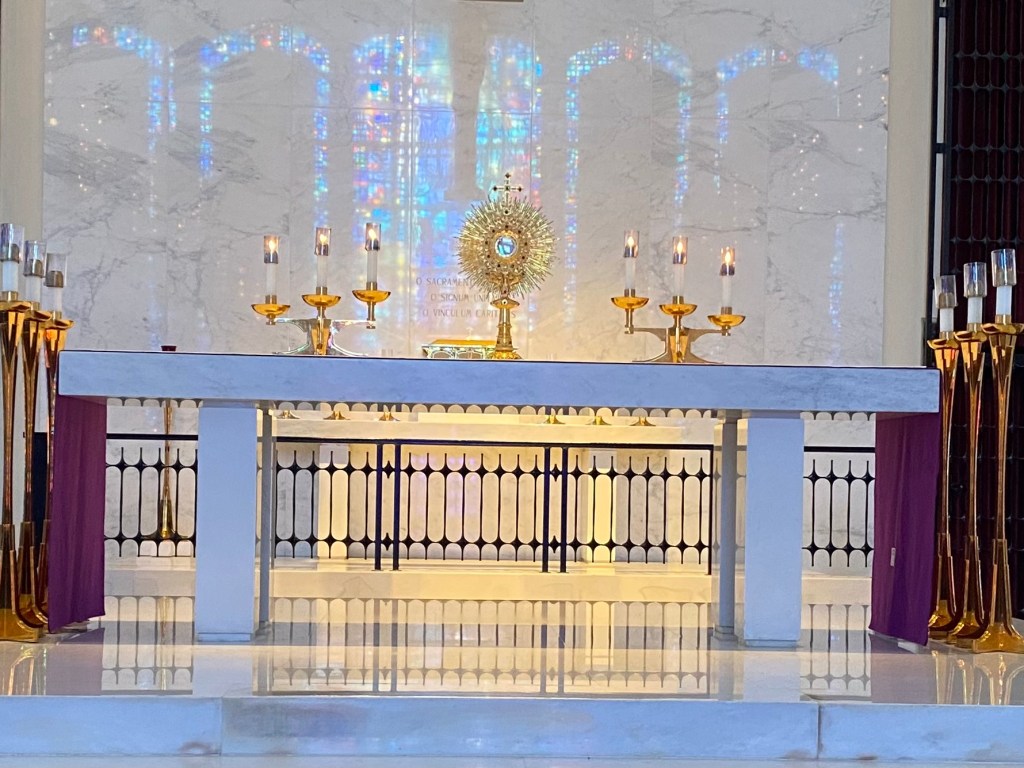
Photo: Some quiet time during our 40 Hours of Devotion to the Most Blessed Sacrament last week, SVDP chapel, SVDP Regional Seminary, Boynton Beach, FL.

Link for the Mass reading for Sunday, March 24, 2024

Be still and allow the light and love of Jesus to rise within your heart.

We hear often in the Gospels how those who believed in Jesus received healings, exorcisms, and were forgiven of their sins. We have also read accounts such as from the Gospel of Matthew that he “did not work many mighty deeds” in Nazareth “because of their lack of faith” (Mt 13:58).

In today’s Gospel account from John, Jesus speaks to a royal official whose son is close to death. Jesus said to him, “You may go; your son will live.” The man believed and in that moment his son was healed.

What do faith and belief have to do with Jesus being active in our lives? The way of the Gospel, the good news, is all about invitation and acceptance. Jesus entered our world, our reality, gently and humbly. He came as a poor infant, completely dependent on Mary and Joseph for his very survival. He lived most of his life in the obscure village of Nazareth most likely working with Joseph as a day laborer. When he began his public ministry, he did so by inviting people to be a part of his life, to enter into a relationship with him and his Father. People are free to say no or to say yes to that invitation.

Faith is trusting that what Jesus says is true and that he is who he says he is. Belief is the act of our will that aligns with our faith, our trust in him. Jesus invited the man to believe that his son was healed, and the man believed and walked away with full confidence that his son would be healed. Belief is followed by an affirmative act of the will. I can believe my car will run, but unless I get in it and turn the key, I am not going anywhere.

Just as the sun rose this morning, whether we saw it or not, Jesus is present to each and every one of us, whether we are aware or not. Jesus is inviting us to be a part of his life. Just as Jesus invited Andrew and Peter, James and John to follow him, Jesus invites us to follow him as well.

Even though the clocks have moved forward an hour, if your schedule affords you the opportunity to wake up with the sun or early in the morning while the sun is still rising this week, I invite you to do so. Find a quiet place inside or outside, call to mind anything that you are grateful for, ponder your hopes and dreams, allow any struggles, confusions, sinful patterns, needs for healing and/or forgiveness for yourselves or others to arise. As the light of the sun pierces the darkness, allow it to be an icon of Jesus’ invitation to enter your life and share with him what came up for you.

“From the east comes the one whose name is Dayspring, he who is mediator between God and men. You are invited then to look always to the east: it is there that the sun of righteousness rises for you, it is there that the light is always being born for you… So that you may always enjoy the light of knowledge, keep always in the daylight of faith, hold fast always to the light of love and peace” (Excerpt from a homily on Leviticus by Church father, Origen, who lived from 184-253).

If not that early in the morning, any time will do! Make some time to be still, embrace and be grateful for the light of Christ, the Dayspring, who rises in your heart. Breathe in deeply the love of his and our Father, believe in the truth that Jesus is the Son of the Living God, and trust that he will be with you today in all you do. Then, when you are ready, arise and walk on with the peace, confidence, and assurance that you are loved more than you can ever imagine and more than you will ever know.

——————————————————————————–

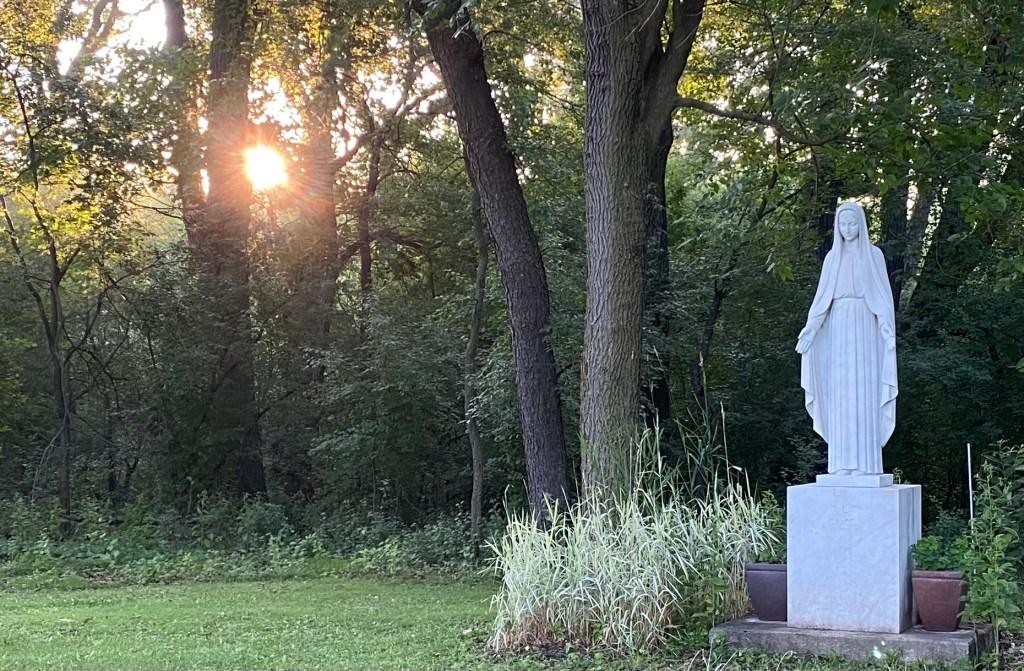
Photo: Morning prayer during 30 day silent retreat last summer,  Joseph and Mary Retreat House, Mundelein, Illinois.

Link for the Mass readings for Monday, March 11, 2024

Peace comes when we align our will with our Father’s will.

Look at me, serve me, I want, are attitudes and dispositions that tempt us. Fame, honor, power, prestige may be another way of making the same point, which is that we often have a hyper-focus on self and self-promotion. Social media offers more of a platform to fuel this temptation. If we think this is something new with the advent of modern technology, we can look at today’s Gospel of Matthew to see that we have been operating from this posture for a very long time.

Jesus, for the third time, was attempting to prepare his disciples for his passion. He said: “Behold, we are going up to Jerusalem, and the Son of Man will be handed over to the chief priests and the scribes, and they will condemn him to death and hand him over to the Gentiles to be mocked and scourged and crucified, and he will be raised on the third day” (Mt 20:18-19).

The response of the mother of James and John (the two brothers make the request themselves in the Gospel of Mark) is actually not that surprising if we spend any time with people. She disregards what Jesus just mentioned about his imminent death and requests that when Jesus assumes his seat of power that her two sons will be number one and number two. The other disciples were quite indignant, and I can imagine what followed was not a pretty sight.

Jesus shares directly with the brothers that to give them a place at his right and left “is for those for whom it has been prepared for by my Father” (Mt 20:23). He addresses them all by letting them know that the preeminent place in his kingdom, whoever is to be first, is the one who serves his brother and sister.

Jesus is encouraging us this Lent to take the focus off ourselves and get out of our heads. To let go of I, me, and mine. Even when we let go a little, we will feel more peace. We will be able to take a few more deep breaths. We can experience this as well when we get outside, look up, and see the expanse of the sky. We’re no longer thinking about ourselves but touching the gift of our eternal nature and call to be one with God. Instead of feeling contraction, we can experience a sense of expansion.

When we allow ourselves to take a breath, we can then let go of the stress and the strain and the needless energy we expend following the distractions, diversions, and temptations that keep us on a treadmill pace. We can then instead spend a few moments with Jesus, and he can, as he did today with the apostles, correct any ways in which our mindset is not aligned with his Father’s will. We can then place God’s priorities for our life first, properly order our own, or let go of any that are not of his will.

When we are able to breathe, receive, and abide in God’s love, discern and make decisions from his guidance, we are changed and transformed. We will experience healing and renewal. We will begin to experience the fruit of the spirit: “love, joy, peace, patience, kindness, generosity, faithfulness, gentleness, self-control” (Galatians 5:22-23). In this way we can let go of being first or best, sitting at the right or left of Jesus, and instead, rest in being who we are as loved by God. As we experience more of the love of God, it is easy to let go of the need to be served and be more willing to serve and share the love we have received.

——————————————————————————

Photo: Looking up and outward, and breathing deep! St. Vincent de Paul Regional Seminary, Boynton Beach, FL.

Link for the Mass readings for Wednesday, February 28, 2024

“You did it to me.”

How we treat each other matters. How we speak to each other or about each other matters. Even how we think about each other matters because most of our actions come from our thoughts and/or our reactions. When we are in the present then we can better see our options and better choose our actions. We really do not have or need to immediately react. We can think before we act. We can discern how what we are about to think, say, or do will affect the person before us.

One way to put this into practice is to follow the psychologist, Dr. John Gottman’s 5:1 principle. When a negative thought arises about someone and before texting or emailing, think and write down five affirming thoughts about that person. If we are engaging with another person, before reacting and speaking, think five affirming thoughts. Many times, we will find that by the time that we get to the fifth compliment we will have forgotten the original negative response we were ready to unleash.

Jesus is very clear in today’s Gospel from Matthew, “Amen, I say to you, whatever you did for one of these least brothers of mine, you did for me” (Mt 25:45). All of us are interconnected. What we do to one another affects everyone. When we throw a stone into the middle of a pond, the ripples of the water circle out to touch the bank and go even beyond the bank. This same ripple effect happens with our thoughts, words, and actions. Our inaction also matters.

When we are moved by the Holy Spirit to reach out to help someone in need, to be more understanding, kind, and to be willing to move beyond our prejudices and biases, we build up the Body of Christ. When we don’t, we are cutting ourselves off from Jesus and wound his Body. When we listen to our conscience and the urging of the Holy Spirit, when we are willing to risk, and move out toward another in love, we put Jesus’ teaching into practice, we begin the healing of our relationship with God, ourselves, and each other.

St. Mother Teresa called this verse her five finger gospel. She taught each person in her order and each person she had the opportunity to pass it on to that each finger on her hand represented the words: you – did – it – to – me.

When we entertain a thought today, are about to form a word, and are about to follow through on an action, may we first look at the five fingers of our hand before following through. Would we continue to think the thought, say the word, or follow through on the action if Jesus was in front of us? Because he is. For what we do to each other we do to Jesus.

Give somebody a Gospel five today!

———–

Photo: From Mother Teresa exhibit, Ave Maria University, July 10, 2022.

Link for St Mother Teresa sharing her five finger gospel starts about 30 seconds in:
https://www.youtube.com/watch?v=oL2aQWeWAmE

Link for the Mass readings for Monday, February 19, 2024


We are family.

Jesus consistently stretches the norms and social constructs of his time. He does so not just for the sake of stirring things up, but to help the people of his time and us today to see the reality that God has created. He is leading us from our fallen nature to the truth of who God has created us to be and is calling us to be.

Today’s gospel is no different. What seemed to be a very simple and straight forward statement, “Your mother and your brothers and your sisters are outside asking for you”(Mark 3:32). Jesus turns this on its head when he responds: “Who are my mother and my brothers” (Mark 3:33)? And he is taking a risk here as well because of the deep familial bonds of his culture. What most people then and now would agree on would have been for Jesus to ask those listening to make some room for his family to come in and join them or at the least, let everyone take a ten-minute break while he said hello.

Instead, Jesus is extending the parameters of family. Family is not just bloodline. He is saying that his family members are those who do the will of his Father. Those who do so then are his “mother, brothers, and sisters.” We have been created in his image and likeness and are God’s beloved children. This is the reality Jesus is leading us to return to.

We are invited to be a part of his family. An exciting proposition and no genetic testing needed! We just need to do the will of God. The foundation of God’s will is to allow ourselves to be loved by him and to love him and each other in return. If this is our goal today and each day and we intentionally put this into practice in our own unique ways, our lives would be transformed and so would our world! When we really believe and live this truth, we will treat each other much better as well.

I invite you to read today’s Gospel account for yourself, Mark 3:31-35. It is only five verses. Make the Sign of the Cross, breathe slowly and deeply, read the account a few times slowly, and then ask Jesus to bring you into his memory. Jesus was there and he remembers. Ask him to guide you as you enter into the scene by allowing your senses to come alive.

What do you see, smell, hear, feel, and even taste? What stands out for you? Was there a word or phrase that you were drawn to that you can think more about or visualize? As Jesus teaches, is there anything he shares with you? When he asks, “For whoever does the will of God”, what might that mean to you? Allow Jesus to lead you and let God happen. Enjoy!


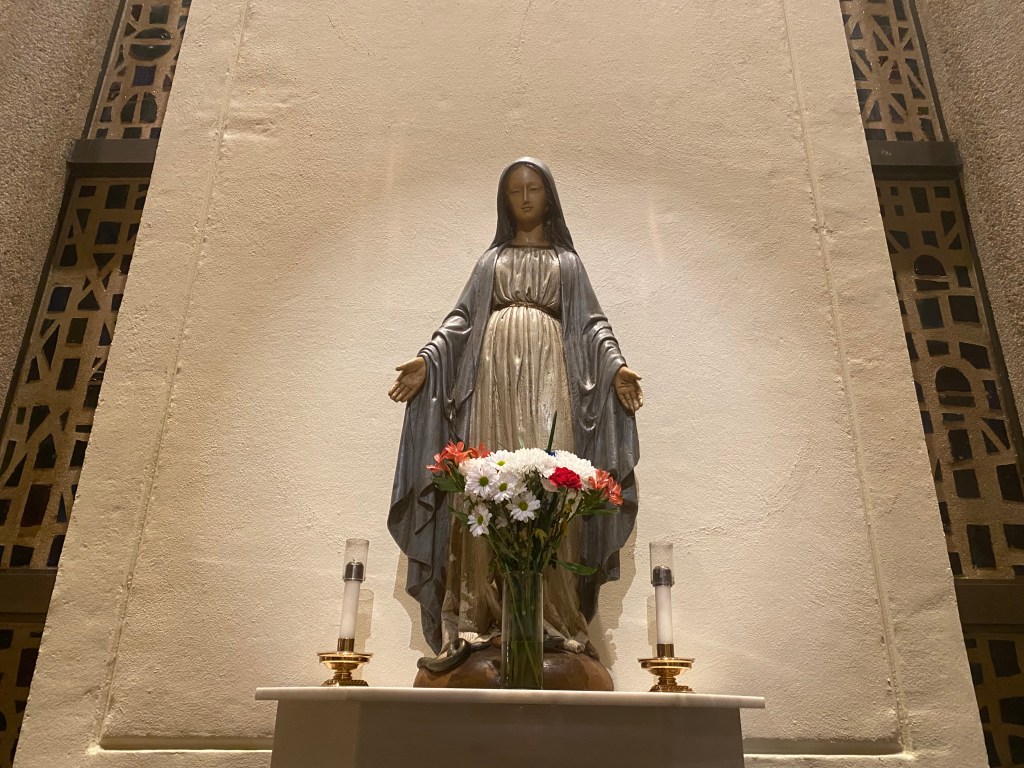
Photo: Our Mother Mary. Who followed God’s will better than she? St. Vincent de Paul chapel, St. Vincent de Paul Regional Seminary, Boynton Beach, FL.

Link for the Mass readings for Tuesday, January 23, 2024

Out of our mind or following the lead of the Holy Spirit?

Jesus has been on a whirlwind tour since beginning his public ministry, by healing the sick, casting out demons, teaching with authority, and the number of people gathering around him continues to increase. He has just called the Twelve Apostles to himself, and he has gone home for a visit.

He is not exactly welcomed back with a tickertape parade though. Instead, When his relatives heard of this they set out to seize him, for they said, “He is out of his mind” (Mark 3:21). What exactly causes his family to think that he is out of his mind? Is it that Jesus has called Apostles, is it that people are following him in such great numbers to come to be healed? Both?

There are many speculations about the “hidden years” of Jesus referring to the fact that there is no mention of Jesus in the gospels from the moment he is twelve years old when Joseph and Mary lose him, until he is about thirty and beginning his public ministry. I am sure Mary didn’t tie him to the table all those years so he wouldn’t wander off again. The more I read the Gospel accounts, the more I believe that nothing special happened during that time. Jesus led an ordinary and very simple life and that is why nothing is written.

This could be the reason why his relatives are thinking that he is out of his mind. How can this simple carpenter all of a sudden be getting all of this attention? Who does he think he is? Does he think he is better than us?

It also reveals, as we have been seeing with the scribes and Pharisees, and possibly now with Jesus’ relatives, that when we get stuck in our routines, grind ourselves into a rut, and find our definition and security there, feel safe only in our comfort zones, we are not going to grow. When we are challenged to do so, we can be open to take the risk or dig in our heals. Many of Jesus’ relatives as well as the scribes and Pharisees, unfortunately are doing the latter.

Jesus, as he shared when he offered the image of the new wine skins, is inviting us to be open to the leading of the Holy Spirit. He challenges us not to settle, but to be open to risk and to move out of our comfort zones. We have not been created to merely survive. God created us to thrive and experience our lives by being fully alive.

I invite you to give yourself some quiet time, breathe slow and deep, and ask Jesus where he might be inviting you to stretch a bit and take a risk, and take a step or two out of your comfort zone. When we follow Jesus, it may get bumpy, but it will be well worth it!


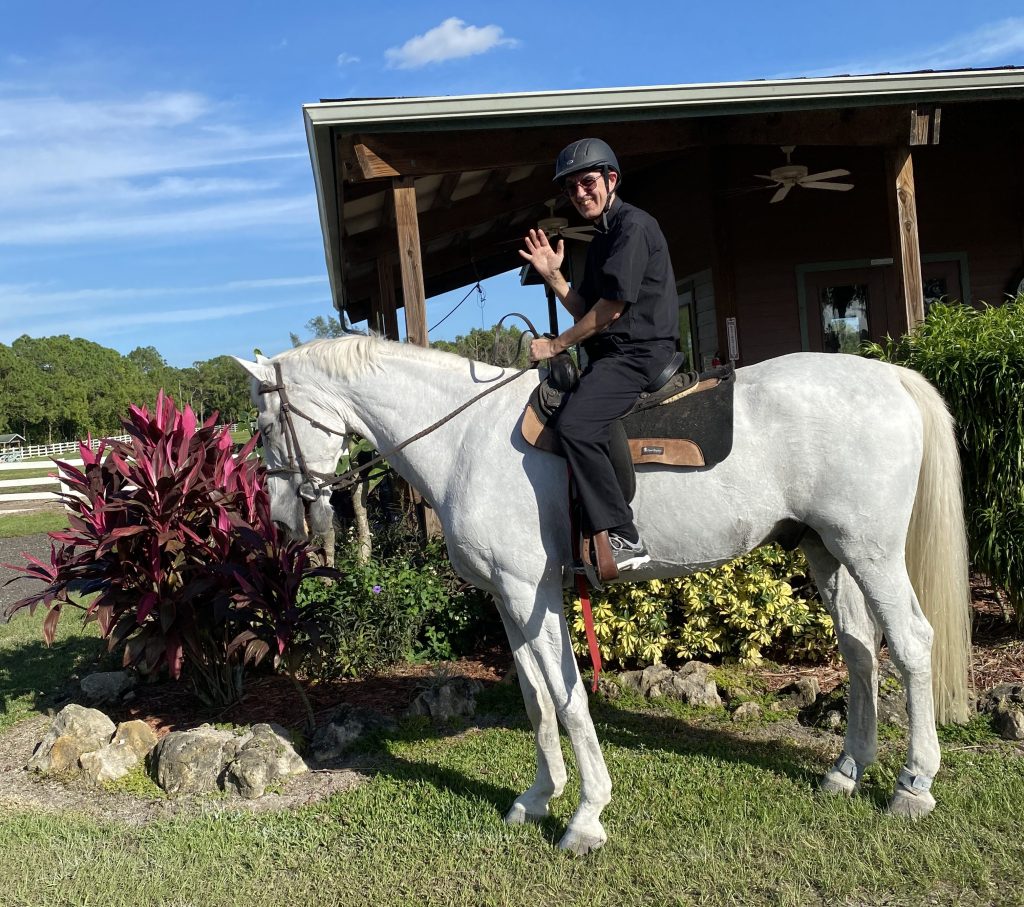
Photo: Over the Thanksgiving break, felt inspired to get back in the saddle. First time in 30 plus years. Very happy I did! What is God inspiring you to do?

Link for the Mass readings for Saturday, January 20, 2024

Foretaste of Heaven

The word about what Jesus is doing is getting out. He is a healer, an exorcist, a blasphemer. All of which draw people from the surrounding region. Those gathering around Jesus surpass now the number of those who were coming to see John the Baptist and with the interest and growing need, people are moving in at such a steady number in an effort to touch Jesus that he asked his disciples to get his boat ready. He could then get in it and avoid being crushed by the crowd.

Jesus is meeting the need of the hunger of the people. Who doesn’t want to be free of physical ailments and unclean spirits? Ultimately, the account in today’s Gospel is a foretaste of the heavenly kingdom, for Jesus as he announced at the beginning of his ministry is the “kingdom of God at hand.” He who is united with the Father through the love of the Holy Spirit has become one with us in our humanity so that we can become one with him in his divinity.

Jesus can still meet the deepest needs we yearn for in the depths of our souls of wanting to belong, be seen, heard, healed, and loved. What ushers in this reality for us is the same choice that needed to be made back in Jesus’ time. Do we believe that Jesus is who he said he is? And the answer to this question is not a one and done answer. This needs to be answered and on our mind more often than not if Jesus is going to be relevant in our lives.

Who and what is important to us we make time for. When we make time for Jesus, Jesus will become more real to us. Setting aside time to pray, to participate in Mass, read and meditate upon the gospels, invite him into our decisions, thank him for our daily successes and ask him for help in our struggles, see him in our relationships with others, and being silent and still together, are ways that we will encounter Jesus and grow in our relationship with him so that we too can experience a foretaste of heaven.


Photo: Mass at St. Joseph Catholic Church, Poquonock, CT during my visit back home during our Christmas break. Mass, where heaven and earth are wedded together.

Link for the Mass readings for Thursday, January 18, 2024