In choosing God’s will, we will experience more peace and love.

Although the chief priests and elders evaded the question about whether or not John’s baptism was “of heavenly or human origin” (see Mt 21:26) by saying, “We do not know” (Mt. 21:27), Jesus did not let them off the hook. His intent was not to call them out or prove himself right, but to call them to conversion. Jesus, as he does with all he meets, seeks to shine a light on where our hearts and minds are in need of opening and expanding.

And so, in today’s account from Matthew, Jesus offers the Parable of the Wicked Son. The first son says he will not do the will of his father and then changes his mind and does it. The second son said that he would do the work his father asked him to do but did not. “”Which of the two did his father’s will?’ They answered, ‘The first'” (Mt 21:31). Jesus went on to reveal to the priests and elders how those who sinned had indeed gone against his Father’s will, but heard John, came to him for baptism and were willing to repent. They recognized they were off course and made a correction. The priests and elders, saw no need for John’s baptism for themselves, and in also rejecting Jesus, were not only going against God’s will, but his Son.

These men who stood before Jesus and challenged him were likely received the call received by the Pharisees and Sadducees: “You brood of vipers! Who warned you to flee from the coming wrath” (Mt 3:7)? For they, like the chief priests and elders, were not interested in repenting, they thought themselves well and good, thank you very much.

Jesus not only compared them to the second son who did not follow the will of God, but he also said that the “tax collectors and prostitutes are entering the kingdom” (Mt. 21:31) before they would. If their hearts were hardened before, the grip only tightened. They did not take kindly to Jesus’ invitation to repent.

The call for repentance that John, Jesus, and the Apostles all proclaimed was, and still continues to be, an invitation to experience God’s grace and love. We are good but something has gone terribly wrong and we need to set things right. Jesus is the one to help us to do just that. We just need to be willing to admit there is a problem. We need to come to the awareness that Paul came to, when he wrote: “What I do, I do not understand. For I do not do what I want, but I do what I hate” (Romans 7:15).

If we think we are fine and not in need of any help, let alone that are we in need of a savior, then we are going to  keep coming back to Paul’s anguish as he pulled out what little hair he had left. We can’t white knuckle our way to healing, there is no three point plan that will free us from our sin, breathing deep alone will not help us to experience freedom from anxiety.

We have to place ourselves first, less, and Jesus first, more. The more we make that transition, then we can also say with Paul, and keep a little more hair while doing so, “I have been crucified with Christ; it is no longer I who live, but Christ who lives in me” (Galatians, 2:20). When we are willing to repent, to change our mind, and are willing to be transformed, then like the first son, we will follow the will of the Father. Instead of isolation and unrest, we will come to experience more of his communion and love.


Photo: We still have time this Advent to repent and experience our Father who loves and thirsts for us.
Link for the Mass readings for Tuesday, December 16, 2025

Mary’s Son will forgive us and fill us with joy!

“Mary set out and traveled to the hill country in haste” (Lk 1:39). Why? Because she was filled with joy. She had just experienced an incredible encounter with the angel Gabriel telling her that she was to bear the “holy, Son of God” (Lk 1:35). She also learned that her relative Elizabeth, who had been barren, was six months pregnant. Who better to understand and appreciate what she had gone through than Elizabeth? When we hear good news we want to share it with someone, especially when we believe another will fully appreciate our experience.

Is there a time when you felt overjoyed about something that you felt like you were going to burst and you couldn’t wait to share your experience? A memory may have already started forming in your mind, a smile and glow may already be radiating from your eyes as you re-experience that moment.

One such graced encounter I had was when I was in my early twenties and dealing with a heavy personal issue. I was living in Sharon, Connecticut at the time and had an opportunity to go to the Shrine of Divine Mercy in Stockbridge, Massachusetts to participate in a penance service. I walked up hesitantly to a kind-looking, elderly, polish Marian priest. His name alludes me now, but not his face. He radiated invitation and mercy. After a few stammering words, I let loose and shared what I had been dealing with. When he offered absolution, I felt the burden physically lift, I felt almost like levitating. Then a surge of joy welled up in me that lasted for days.

There is a great gift in sharing a burden with a trusted friend or family member, being heard and supported, and/or receiving absolution from a priest. We need to resist the temptation of turning within ourselves, trusting in the lie that we can handle our conflicts, challenges, and trials all on our own. There is a pearl of great price, God’s healing grace, that is available to us when we share our experiences. In this way, we come to realize concretely that we do not have to go through our pain and suffering alone!

Many of us are struggling with a lot, and sometimes we are not at our best, nor do we make our best decisions. We react instead of act, we get caught in the momentum of behavior that we know is not acceptable, and we continue to slide. The key is not to beat ourselves up and walk around feeling guilty. There are enough people who would be happy to sign up to do that. Instead, we will be better off to choose to practice a healthy sense of guilt, examine our conscience, be mindful, and admit when we have done something inappropriate, sinful, or wrong.

The key to reconciliation is to embrace in humility and  admit our sin, be contrite – sorry for what we have done, not upset, defensive or rationalize away our behavior, and to follow the counsel of James and “confess your sins to one another, and pray for one another so that you may be healed” (James 5:16). Having experienced the joy of forgiveness, while still experiencing the grace of our reconciliation, may we be like Mary who is full of grace, and go in haste to share with others the wonderful gift we have received!


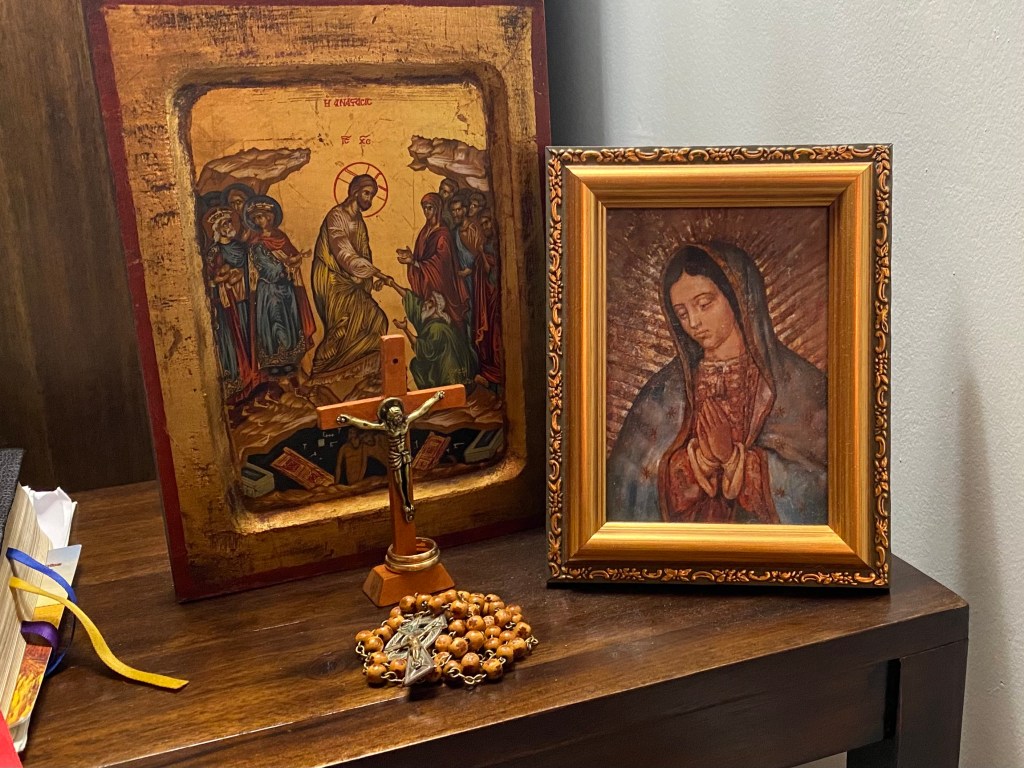
Photo: Our Lady of Guadalupe, pray for us!

Link for the Mass readings for Thursday, December 12, 2024

Forgiveness is possible. We just need to be willing to ask Jesus to help us.

Forgiveness is a wonderful gift of grace and mercy. If we asked many people if they would like to receive forgiveness most would say yes. The number would most likely be less if we were to ask them how many would be willing to forgive others. If we were asked to forgive someone seven times, that number would shrink significantly, and if we were invited to forgive someone seventy-seven times, is there any among us who would say yes, any among us willing to consider doing so?

Why is forgiveness so hard for most of us? I do say most because there are those who have an openness to being forgiving. One reason could be that we have few role models. I would imagine those that are more forgiving have not only experienced positive role models but have received forgiveness themselves.

How often do we seek forgiveness from others when we have done something wrong, inappropriate, or made a mistake? We often seek to explain first, make excuses, justify, or ignore our behavior altogether. When we resist being humble, confronting our offenses, and do not seek reconciliation, we do not experience the healing balm of forgiveness. We are then less likely to be willing to offer forgiveness and more likely to hold a grudge or to seek revenge.

Yet, even if we receive the gifts of mercy and forgiveness, as the servant did in today’s parable (Mt 18:21-35), we may still choose to be unforgiving toward others. We may resist forgiveness because we have already created patterns of distancing ourselves, making someone else as other, somehow justifying the hurt and pain we feel. We think that by holding a grudge or offering another the cold shoulder, we are giving them just what they deserve.

Unfortunately, patterns of not seeking forgiveness, not willing to forgive others, allowing ourselves to bear grudges, to distance ourselves, or project negative feelings on others to cover up our own inadequacies, not only perpetuate a climate of isolation and divisiveness, but continues to multiply mistrust and further distance. When allowed to left unchecked leads to violence in too many forms.

Even in a case when someone has truly wronged us in some way, Jesus is guiding us to forgive, to make an attempt to understand why someone might act in such a way, and to shift the momentum away from the perpetual cycle of hurt and to seek to bring about healing and reconciliation.

Jesus is clear that if we are not willing to forgive, we will not be forgiven. This is true because when we are unwilling to forgive, we cut ourselves off from the love of God. We choose the hurt and pain inflicted upon us over the healing balm that God offers. The Sacrament of Reconciliation is a gift of healing, and a pattern of regular confession helps us to receive the healing and forgiveness of our loving God and Father. As we develop a regular practice of examining our conscience, experiencing contrition – true sorrow for our sins, confess, and are willing to complete our acts of penance, we are absolved and forgiven from our sins, and we will experience healing.

Forgiveness does not mean we condone another’s inappropriate actions. It means we choose to no longer participate in the cycle of hurt. Even when we feel forgiveness is impossible, are we willing? That is all Jesus requires. We forgive in the beginning when we are willing to ask Jesus to forgive through us until we can learn to forgive ourselves, like Doha Sabah Abdallah.

Doha lost her son during the bombing of her city in 2014. Doha shared her story with Pope Francis while he visited Iraq back in 2021. She said: “By imitating him [Jesus] in our sufferings, we testify that love is stronger than everything,”

Pope Francis shared how touched he was by Doha’s story of forgiveness. On his plane trip back home, Pope Francis said, “I forgive. This is a word we have lost. We know how to insult big time. We know how to condemn in a big way… But to forgive, to forgive one’s enemies. This is the pure Gospel. This hit me in Qaraqosh.”

Let us take up the mantle that Jesus holds out to us today and this Lent, seek forgiveness, be healed, and willing to forgive.

————————————————————————-

Photo: Statue of St. Vincent de Paul our patron saint. St. Vincent de Paul Regional Seminary, Boynton Beach, FL

Link for the Mass readings for Tuesday, March 5, 2024