With God we can experience sorrow and still be thankful.

They stood at a distance from him and raised their voices, saying, “Jesus, Master! Have pity on us!” (Lk 17:12-13). They raised their voices and asked Jesus to have pity on them. Did the ten seeking a healing all call in unison? Did one shout out first and then each, not wanting to be left out, all call out? Did their calling reach a fever pitch? Luke is not specific as to how they called out but that all of them did. Jesus then healed the their leprosy with his word, they began to praise God and may have walked away in even a more joyful raucous than their calling for their healing. Yet one, a Samaritan, after realizing he was healed, returned to thank Jesus.

It is a good practice to spend some time each day to reflect on what we are thankful for. To see where God has entered our lives and provided assistance. At times when we feel a bit down and out, or in a bit of a funk, often the reason may be that we are focusing, on what we do not have instead of on what we do have. There is a quote, I am not sure of the source, that goes: “I cried because I had no shoes, and then I came upon a man with no feet.” We can be so bombarded by the mass appeal to the material, that we forget the truly important realities of this life and the many blessings that we have been given.

Today is Thanksgiving Day in the U.S., unless you are reading this the night before. Thanksgiving is a time of family coming together, which hopefully will be as joy filled as those lepers walking away realizing that they are healed. But with the promise of such gatherings, there is all the cleaning, setting up and the prep for the big dinner, clean up and breaking down, the travel, unresolved issues, as well as the wonderful gifts of diverse personalities and points of view. Making time to periodically stop and take a few breaths can make a big difference in how the day is played out. A moment of quiet may help us to be like the Samaritan leper who when realizing that he was healed, was thankful. Slowing down a bit, might just help us to appreciate each other a bit more and grumble a little less.

As Jesus reminds us, we do not know the time or the hour. Life is finite and fragile in the best case scenarios. We will not be here forever nor will the ones we love. November is a time in the Church when we remember those who have joined the communion of saints as well as those on the way. This is especially true for those of us today who have lost a loved one. And since becoming a priest, I have been blessed to walk with around forty who will no longer be celebrating Thanksgiving this side of heaven. My prayer is that they and JoAnn are now home with God.

May each of us remember those who have gone before us and be thankful for the time that we have had together, while at the same time, appreciate those still in our lives. May we allow the warm embracing arms of our loving God and Father to embrace us in a moment or two of silence so that we can remember that we are never alone, that God cares for each and every one of us, and as we grow closer to him, we grow closer to each other.

Life is a precious gift that God has given, and it helpful to appreciate every moment. May we be thankful for our lives and the lives of those near and far that we are blessed to call family and friends. May we also remember and pray that the Holy Spirit may provide comfort and aid for those who are alone, struggling, or without family, food and/or a home this day.

———————————————————————————————-

Photo: One of my favorite pictures at my maternal grandparents for Thanksgiving. I miss all three of them and am grateful for our time together. Happy Thanksgiving!!!

Link for the Mass reading for Thursday, November 27, 2025

Good to reflect as we end each day what we are grateful for.

Jesus said in reply, “Ten were cleansed, were they not? Where are the other nine? Has none but this foreigner returned to give thanks to God?” Then he said to him, “Stand up and go; your faith has saved you” (Lk 17:17-19).

Bloodline doesn’t matter, gender doesn’t matter, nation doesn’t matter, ethnicity or race doesn’t matter. Ask Mary the mother of Jesus, ask Mary Magdalene, ask the woman who suffered from hemorrhages for twelve years, ask the Roman centurion whose slave was dying, ask the Samaritan leper what matters. Each of them will share with us that what matters is our belief and faith in Jesus the Christ.

The lifeblood of Christianity is our belief in and developing of our relationship with Jesus, the Son of God, who made his dwelling among us. St Irenaeus of Lyons (born in Smyrna about 135-140 AD and died about 202-203 AD) in his work Against the Heresies wrote: “The Word of God, our Lord Jesus Christ, who did through His transcendent love, become what we are, that he might bring us to be even what He is himself.”

That Jesus became one with us in our humanity so that we can become one with him in his divinity is something to be thankful for! Many times when we are feeling down, maybe it is because we are focusing on what we do not have or who is not in our life instead of being thankful for who or what we do have. A way to adjust our perspective is to stop for a few moments and think about three things we are grateful for.

The leper from today’s Gospel helps us to take the next step. Once we allow ourselves to be aware of what we are thankful for, let us thank the One who made what we have possible. Our time on earth is too short to allow the temptations of indifference and complacency to take hold. May we be more aware and choose to reach out to those who are important in our lives and tell them how thankful we are that they are in it, how much they mean to us, and how much we love them. Including God the Father for his constant and abiding presence, the wonderful gift of the invitation of his Son, Jesus, to share in his divinity, and the Holy Spirit who loves us so that we may love one another.


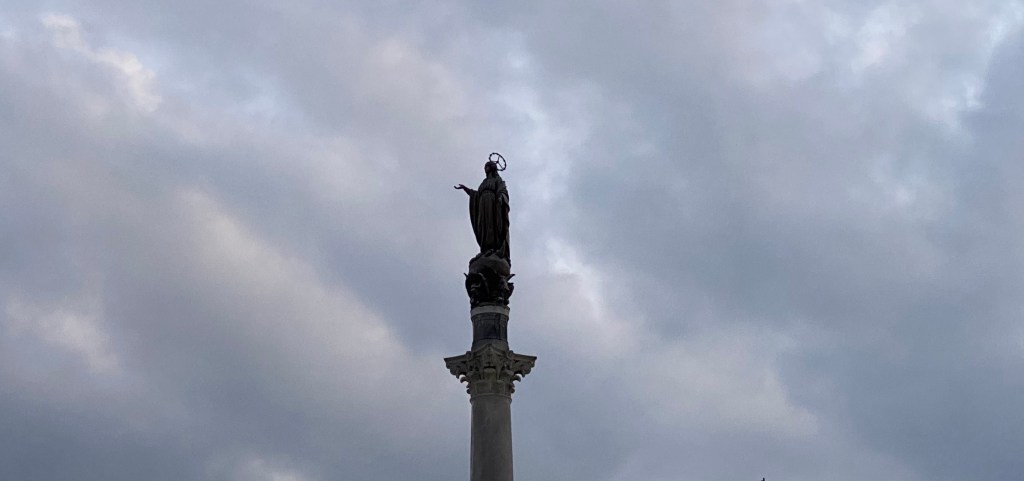
Photo: Looking up can help us to pause and be grateful.

Link for the Mass readings for Wednesday, November 12, 2025

“Your faith has saved you.”

“Ten were cleansed, were they not? Where are the other nine” (Lk 17:17)?

Jesus makes this statement to the Samaritan who fell at his feet praising God and thanking him for his healing. The other nine received the same physical healing. Some of them may have seen this man turn back and go to Jesus, yet each one of them continued on their way to see the priests as Jesus had directed them. The purpose of this was so that they could be pronounced clean, and so re-enter the life of communal worship and living among their people. I am sure they were ecstatic to do so.

Jesus healed all ten of their leprosy without even saying a word of healing. The catalyst to receive this miraculous healing was their obedience to Jesus’ command to show themselves to the priest. They did so without hesitation and as they walked they all experienced healing. Yet, one of them sensed something deeper still.

Could the others have experienced something similar? If so, many were probably so excited about the healing that they did sense anything beyond the healing. Others may have sensed something but dismissed it, and a few, may have noticed the Samaritan turn back to Jesus, but could not or would not change course to return to say thank you.

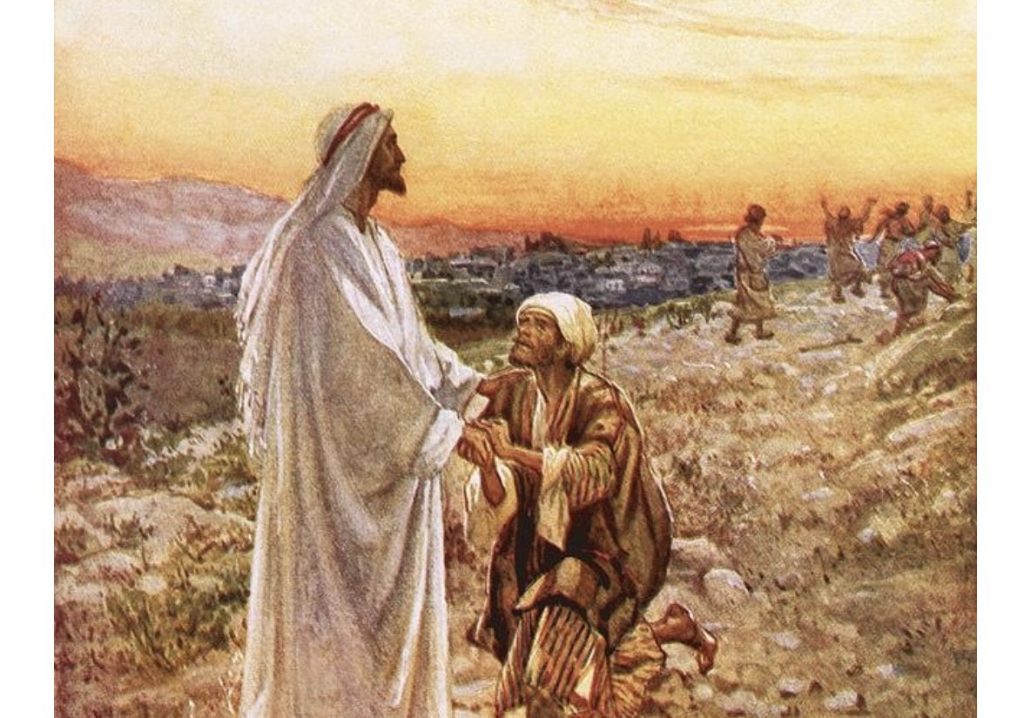
The Samaritan that comes to Jesus in gratitude experienced something deeper than his physical healing. He recognized God’s activity in his life and so praised God at Jesus’ feet. He then also praises Jesus, placing Jesus on the same level as God and opening himself to a relationship and communion with him. Jesus acknowledged this step of faith. This man heard an invitation from within, in the quiet of his heart, and resisted any distraction that may have tried to dissuade him. Jesus then said, “Stand up and go; your faith has saved you” (Luke 17:19).

In following the gratitude that welled up from within, this man received more than just physical healing that day, he received salvation, “your faith has saved you.” This means not just that his body was restored and made whole again, but that the separation from his relationship with God had been reconciled.

God invites us in so many gentle and small ways in the silence of our hearts to be more engaged: in a relationship with him, in our own lives, and the lives of others. We too can crowd out the invitation by keeping ourselves busy, distracted, and/or diverted. We can hear the whisper but discount it outright for many selfish reasons, we can also be led astray by the cacophony of mind noises that is fed by our fears, prejudgments, or apprehensions. Yet, we can also be like this Samaritan. We can hear and experience the invitation of God, act on his lead, surrender to Jesus, and be saved.

———————————————————————

Painting: “Jesus With the One Leper Who Returned to Give Thanks” by William Brassey Hole

Link for the Mass readings for Sunday, October 12, 2025

We can choose to be envious or grateful for God’s generosity to others.

Jesus told his disciples this parable: “The Kingdom of heaven is like a landowner who went out at dawn to hire laborers for his vineyard…” (Mt 20:1).

At dawn, nine, noon, three, and five o’clock the landowner hired day laborers to go into the field to bring in the harvest. Many, familiar with this parable, find themselves a bit bemused, bewildered, or even angry at the ending when they read or hear that the landowner had his foreman pay everyone the same pay. The immediate cry is, “That is not fair!” Those, more often than not, who respond this way are focused on the hired hands who started at dawn, worked all day, and were paid the same as the laborers who started at five o’clock.

The workers who started at dawn agreed to a certain wage and the owner paid that agreed amount. The landowner explained, “to one of them in reply, ‘My friend, I am not cheating you. Did you not agree with me for the usual daily wage” (Mt 20:13)? What is missed, if someone is feeling as perplexed as were some of the dawn laborers, is the generosity of the landowner.

We see this similar scene of generosity given and played out in some of Jesus’ other parables. The older son who refused to listen to his father’s invitation to come in to share in the celebration of the feast when his wayward brother had been lost but now was found (Lk 15:11-32); the man who was forgiven his entire debt from the king and then when he had the same opportunity to forgive the one who owed him, did not (Mt. 23-35), and in the parable of the Good Samaritan the priest and Pharisee left the man on the side of the road yet the Samaritan, the despised one, was the one to provide aid (Lk 10:25-37). Each of these parables represents the generosity and mercy of God.

There is a reason Jesus shared the parable of the workers in the vineyard after warning about the dangers of riches. Jesus is inviting the disciples and us to be generous with our time, talent, and treasure. He is also calling us out of our group think or tribal mentality. He is showing us that God’s invitation is for all and he is free to bestow his mercy, grace, and forgiveness on those for whom he chooses, whether we approve or not. Ideally, he seeks to bestow his mercy on others through us. We too are to be agents of his grace.

Are we aware of how generous and merciful God has been with us? If not, instead of focusing on what we do not have, may we give some daily thought to the blessings we do have in our life, otherwise, we will fall prey to the temptation of envy with the generosity that God shows to others. Envy arises when we don’t only seek what another has but begrudge what another has received. This attitude can even grow into wishing harm to befall them. And for what, because they have been blessed?

The parables of Jesus are great to pray with and it is important to be honest with our answers. Do we relate to: the laborers who worked all day for their fair share and begrudged those who received the same pay for an hour’s work, the older brother unwilling to be grateful for the return of his brother, the servant unwilling to show mercy to a debtor, and/or the priest and Pharisee that took the long way around the wounded man on the Jericho Road? If we answer yes, to any or all of the above, allowing the light of Jesus’ mercy and forgiveness can lead us to repent, experience forgiveness, and be grateful for God’s love, which is unmerited. Resting in gratefulness, we can rejoice in the generosity that God bestows upon others, even at the eleventh hour.

———————-

Photo: Mary can lead us through the clouds of our self-preoccupation to experience the light of her Son, taken at University of Mary of the Lake.

Link for the Mass readings for Wednesday, August 20, 2025

Jesus gave his life that we might have life.

Jesus said to them, “The Son of Man is to be handed over to men, and they will kill him, and he will be raised on the third day.” And they were overwhelmed with grief (Mt 17:22-23).

This is the second time in the Gospel of Matthew that Jesus shares with his disciples that he will die soon. They are overwhelmed with grief because their focus is on the first part of Jesus’ statement that he will be handed over to death. They do not understand or yet comprehend the second part about how he will be raised on the third day. How could they? There was no point of reference for them. Jesus did bring three people back to life during his ministry, but Jesus would not be merely resuscitated as they were and just die again. Jesus would resurrect and conquer death.

For us, we can read today’s Gospel about the impending death of Jesus and gloss over it a bit too easily. Because we celebrate Easter each year, we celebrate that Jesus has risen. Yet, do we give ourselves time to ponder the wonder and reality of the Resurrection of Jesus? Does the fact of the Resurrection, the reality that Jesus has conquered death and become the firstborn of the new creation really have relevance in our lives?

The life, death, and Resurrection of Jesus matters! The missing piece for those for whom this statement doesn’t register any relevance may be that they do not want to think about death all that much. To be honest, none of us really want to come face to face with our own mortality, and most of us don’t until we or a loved one is forced to.

Beginning the summer after my freshman year of college, I began working the second shift in a nursing home as a CNA. It was the first time that I experienced death up close through the care of the residents. They were not merely patients, they had become more like family.

The first death I experienced surprised me. I was with a woman holding her hand as she peacefully gave up her last breath. I was surprised and blessed by the peace I felt. Another time, I had the opposite experience. When I arrived at work and went directly to a man named Richard whose health had been slipping, only to find his bed empty. I felt the loss and the grief begin to rise and then found out he had not died, only his room had been changed.

The important lesson that I learned from these, the other experiences of death since then, and especially when faced with JoAnn’s diagnosis of pancreatic cancer, is that life is fragile. To appreciate life, the people in our lives, and not to take anyone or any moment for granted is important. Life goes too quick, even in the best-case scenarios. All that God has given us is a gift and it is important to appreciate and thank God for those people he has brought into our lives as well as all that he has given us.

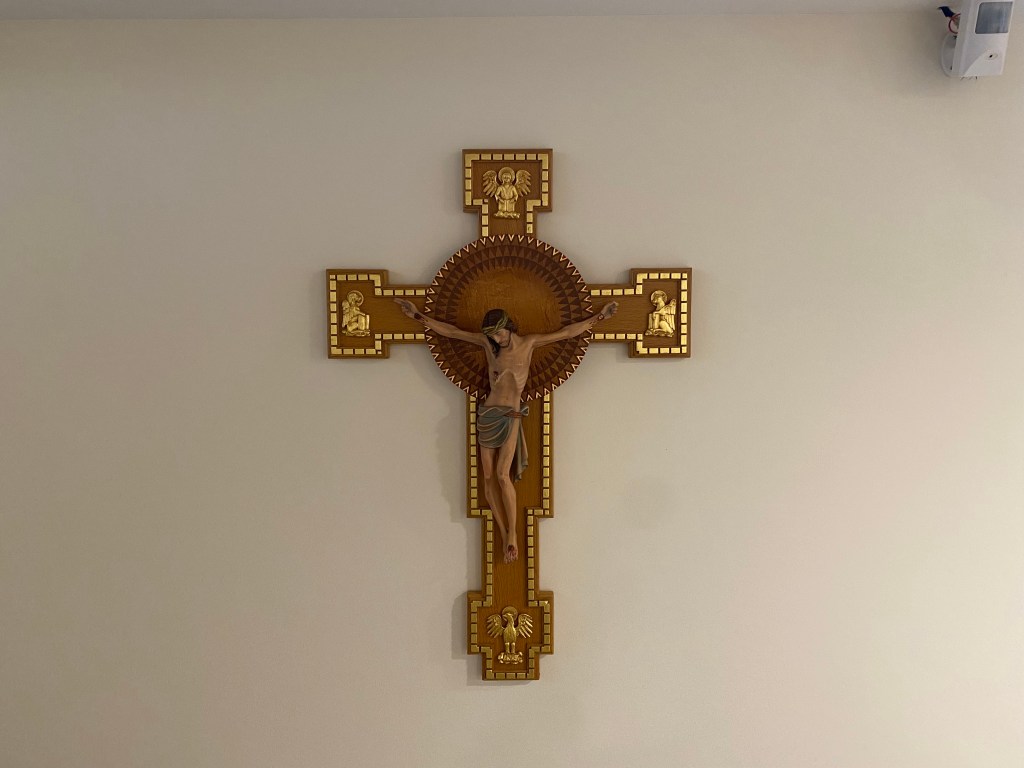
Jesus understands each of our struggles and tribulations, our sins and our failings, as well as our deepest hopes and dreams. Jesus also knows about our deepest fear of death, for he, as a human being, experienced the reality of his impending death in the Garden of Gethsemane. He sought to help his apostles prepare for his death though they did not understand. The crucifix, the beautiful sacramental object of Jesus on the Cross, is a reminder to us all that death does not have the final answer, Jesus, fully human and fully divine, does.


Photo: Crucifix in the adoration chapel of Holy Cross Catholic Church, Vero Beach, FL.

Link for the Mass readings for Monday, August 12, 2024