“Take courage, it is I, do not be afraid” (Matthew 14:27).
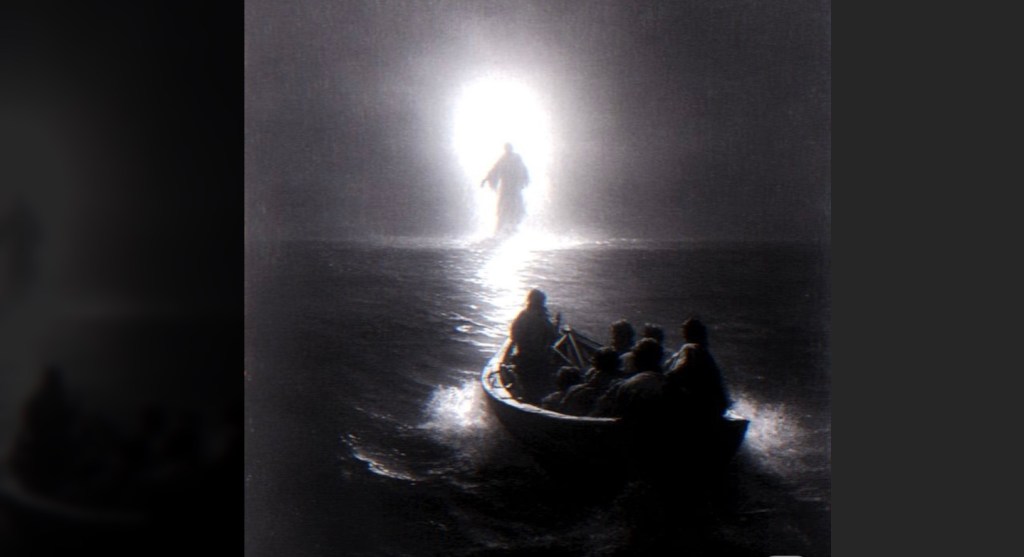
Jesus speaks these words at the fourth watch, sometime between three and six a.m. The disciples are in the middle of the Sea of Galilee, some four miles from shore. He is walking to them in the midst of a storm at sea, on the water. Because of the ferocity of the storm, there most likely is no moon, no stars. It is dark, the wind is howling, the waves are rising and falling, and it is dark – can barely see hand in front of face dark. In the midst of this tumultuous scene, being pelted by rain and waves, deafened by the wind, somehow the disciples see a figure approaching.
That they could see anything implies that some light was emanating from ghostly image. Jesus is assuring them that he is no ghost. He is providing comfort to his band of followers in the midst of their fear. The intensity of the storm may have waned a bit for them to hear Jesus speak. Emboldened by Jesus’ words, Peter then addressed him, “Lord, if it is you, command me to come to the water.” He said, “Come” (Matthew 14:28).
The storm roared again. Peter was undeterred and fixed his gaze on Jesus. He got out of the boat, and walked toward the light that was overcoming the darkness. As he walked on and got closer to Jesus he realized how far away he was from the boat, maybe realized what he was doing, then the strength of the wind led him to turn his gaze away from Jesus, and sank. “Lord, save me!” Jesus immediately grasped him and pulled him up. Peter may not have realized how close he was to reaching Jesus. Together they then walked back and “got into the boat and the wind died down. Those who were in the boat did him homage, saying, ‘Truly you are the Son of God.” (Matthew 14:32-33).
Just the day before, Jesus had multiplied five loaves and a two fish and fed thousands. They all rose up to make them their king. He removed himself from their sight and told his disciples to go ahead of him. Jesus was not the messiah the people sought. A military king or great prophet from their frame of reference. Jesus was and is so much more. He is the Son of God incarnate come to love us and help us to build a foundation of security and safety so that we can move beyond our defensive postures, heal from our wounds, and confess our sins. Jesus is the light that shines in our darkness and the darkness will not overcome it.
When Jesus said, “Take courage, it is I, do not be afraid”, he was not only encouraging the disciples in the boat, he was revealing to them his divinity. A clearer translation of the Greek is egō eimi, meaning “I am.” A more literal translation of Jesus’ statement is, “Take heart, I am.” This could have been the source of Peter’s courage to step out of the boat. More than his impetuousness, he would have remembered “I am” as how God spoke to Moses, God said, “I am who am.”
Peter recognized Jesus as God and so boldly stepped into the turbulent sea and walked toward Jesus. He was able to do so through the power of Jesus as long as he was connected to him. Once he turned his eyes away and focused on the wind, then he sank. The good news is that he immediately called out to Jesus and Jesus saved him.
Once, they returned to the boat, Jesus calmed the sea and all “did him homage”. The Greek word proskyneō is better akin to each of them fully prostrating themselves before Jesus. An act only offered for God. The disciples recognized the Son of God, I am who am, was in their midst. This account is just as powerful an account as the transfiguration moment we read a few days ago.
This truth is not just for Peter and the disciples. The reality that Jesus is both fully God and fully man is just as relevant for us today. For we too experience our own storms and Jesus comes to us as he came to his disciples being tossed about at sea. The challenge is, do we have the eyes to see him and the ears to hear his voice when he calls out to us, “Take heart, I am.” Will we have the courage of Peter to take the risk and come to Jesus and even when we fall, to call out for Jesus’ help?
We are able to develop the ears to hear when we do as Jesus at the beginning of this account. When we too make time to go off by ourself alone to pray. When we come to a place of stillness and quiet, God speaks in the silence of our hearts. When he speaks, he speaks words of encouragement. God’s words throughout scripture has always been one of – be calm, do not be afraid, trust in me, and let me fight for you. Let us come to a place of quiet today, trust in Jesus, brings our trials and challenges to him, walk on the water with him by rising above our posture of fight or flight and instead experience God’s peace.
Photo: May Jesus also be our light in the darkness that calms or guides us through any storm.


