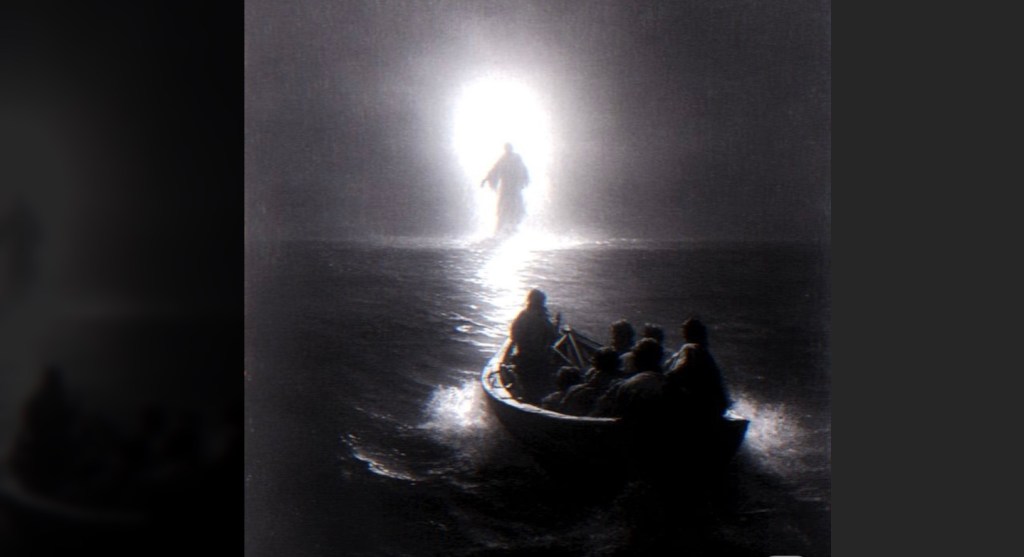
“Take heart, I am.”

“Take courage, it is I, do not be afraid” (Matthew 14:27).

Jesus speaks these words at the fourth watch, sometime between three and six a.m. The disciples are in the middle of the Sea of Galilee, some four miles from shore. He is walking to them in the midst of a storm at sea, on the water. Because of the ferocity of the storm, there most likely is no moon, no stars. It is dark, the wind is howling, the waves are rising and falling, and it is dark – can barely see hand in front of face dark. In the midst of this tumultuous scene, being pelted by rain and waves, deafened by the wind, somehow the disciples see a figure approaching.

That they could see anything implies that some light was emanating from ghostly image. Jesus is assuring them that he is no ghost. He is providing comfort to his band of followers in the midst of their fear. The intensity of the storm may have waned a bit for them to hear Jesus speak. Emboldened by Jesus’ words, Peter then addressed him, “Lord, if it is you, command me to come to the water.” He said, “Come” (Matthew 14:28).

The storm roared again. Peter was undeterred and fixed his gaze on Jesus. He got out of the boat, and walked toward the light that was overcoming the darkness. As he walked on and got closer to Jesus he realized how far away he was from the boat, maybe realized what he was doing, then the strength of the wind led him to turn his gaze away from Jesus, and sank. “Lord, save me!” Jesus immediately grasped him and pulled him up. Peter may not have realized how close he was to reaching Jesus. Together they then walked back and “got into the boat and the wind died down. Those who were in the boat did him homage, saying, ‘Truly you are the Son of God.” (Matthew 14:32-33).

Just the day before, Jesus had multiplied five loaves and a two fish and fed thousands. They all rose up to make them their king. He removed himself from their sight and told his disciples to go ahead of him. Jesus was not the messiah the people sought. A military king or great prophet from their frame of reference. Jesus was and is so much more. He is the Son of God incarnate come to love us and help us to build a foundation of security and safety so that we can move beyond our defensive postures, heal from our wounds, and confess our sins. Jesus is the light that shines in our darkness and the darkness will not overcome it.

When Jesus said, “Take courage, it is I, do not be afraid”, he was not only encouraging the disciples in the boat, he was revealing to them his divinity. A clearer translation of the Greek is egō eimi, meaning “I am.” A more literal translation of Jesus’ statement is, “Take heart, I am.” This could have been the source of Peter’s courage to step out of the boat. More than his impetuousness, he would have remembered “I am” as how God spoke to Moses, God said, “I am who am.”

Peter recognized Jesus as God and so boldly stepped into the turbulent sea and walked toward Jesus. He was able to do so through the power of Jesus as long as he was connected to him. Once he turned his eyes away and focused on the wind, then he sank. The good news is that he immediately called out to Jesus and Jesus saved him.

Once, they returned to the boat, Jesus calmed the sea and all “did him homage”. The Greek word proskyneō is better akin to each of them fully prostrating themselves before Jesus. An act only offered for God. The disciples recognized the Son of God, I am who am, was in their midst. This account is just as powerful an account as the transfiguration moment we read a few days ago.

This truth is not just for Peter and the disciples. The reality that Jesus is both fully God and fully man is just as relevant for us today. For we too experience our own storms and Jesus comes to us as he came to his disciples being tossed about at sea. The challenge is, do we have the eyes to see him and the ears to hear his voice when he calls out to us, “Take heart, I am.” Will we have the courage of Peter to take the risk and come to Jesus and even when we fall, to call out for Jesus’ help?

We are able to develop the ears to hear when we do as Jesus at the beginning of this account. When we too make time to go off by ourself alone to pray. When we come to a place of stillness and quiet, God speaks in the silence of our hearts. When he speaks, he speaks words of encouragement. God’s words throughout scripture has always been one of – be calm, do not be afraid, trust in me, and let me fight for you. Let us come to a place of quiet today, trust in Jesus, brings our trials and challenges to him, walk on the water with him by rising above our posture of fight or flight and instead experience God’s peace.


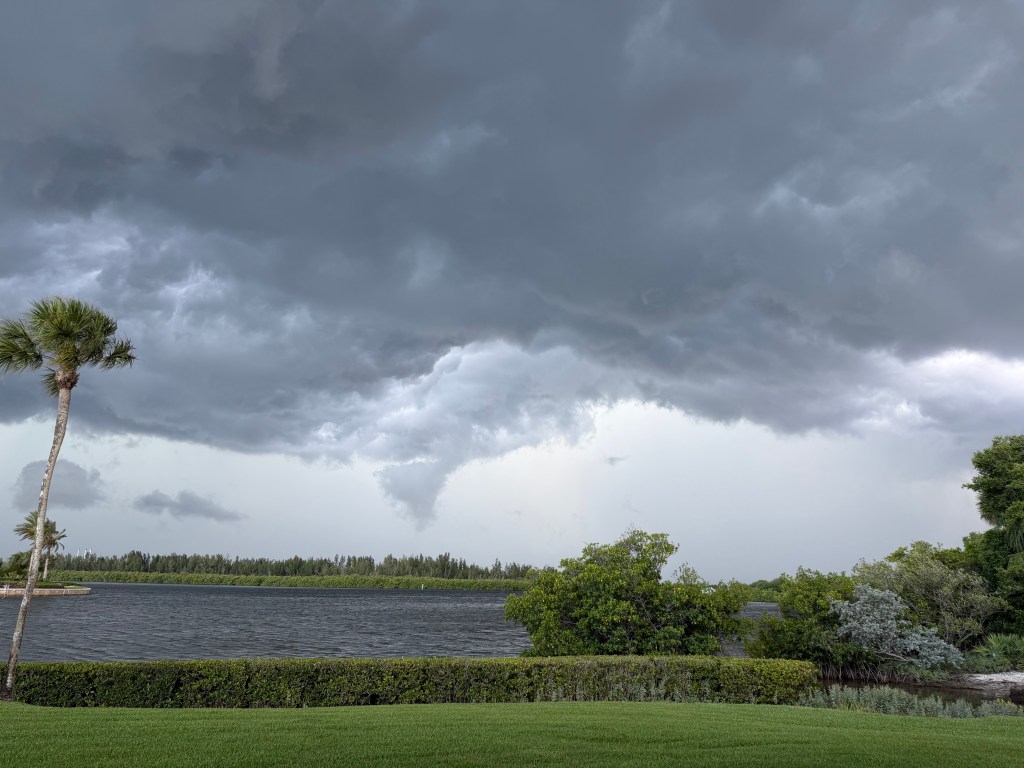
Photo: May Jesus also be our light in the darkness that calms or guides us through any storm.
Link for the Mass readings for Sunday, August 9, 2026

When the storms come, Jesus is present to calm the storm or to help us ride it out.

As Jesus got into a boat, his disciples followed him. Suddenly a violent storm came up on the sea, so that the boat was being swamped by waves; but he was asleep (Mt 8:23-24).

Noah’s ark, as well as the boat in today’s Gospel pericope, has often been a symbol for the Church. The storms may rage without, but those who remain in the boat will be secure. The image of Jesus sleeping can also be a sign of the storms within the boat, within the Church – where it may appear that Jesus is absent or that he doesn’t care about our problems.

We are human beings, made in the image and likeness of God, we are good, but we are also fallible and wounded. We are wounded by the very gift of the free will we have been given. God loves us so much he is willing to risk that we will choose to place other people, places, and things before him. We may often pursue the promises of wealth, fame, honor, and pleasure as substitutes instead of our true and abiding happiness which can only come from God. God does not cause our suffering. He will allow us to reap the consequences of our choices as well as allow the enemy to tempt us where we are at our weakest.

He is not being cruel, he is allowing us to see what our lives are like without him and what our lives are like when we place him first and as a priority. Also, when we are willing to identify those weaknesses, and then when we come to realize that we can’t overcome them on our own and reach out for God’s help, we grow closer in relationship with him. Also, those areas of weakness are shored up by God’s love and strength. Temptations when they arise and we turn to God become now invitations to experience God’s grace.

Hopefully, we will learn from our mistakes and grow to realize that we need to remember that God is to be first in all we think, say, and do. Even in our darkest moments, even in the darkest moments of the Church, we need to remember that God has not abandoned us. When we are experiencing the storms in our lives that come from without caused by others or the enemy, or the storms from within caused by our own sinful choices, or the anxieties, worries, and fears that we feed, Jesus may appear to be distant, he may seem not to care, and may seem to not even exist. Yet, just as Jesus was calmly sleeping in the boat with the disciples, he was present with them and he is present with us. Once the disciples turned to Jesus and implored his help, Jesus calmed the stormy sea.

Our focus on Jesus through the good times and the bad is the key. Our faith in Jesus grows as our trust and relationship in him grow. We just need to remember to turn to him in all our circumstances in life, to be thankful when all is going well and to seek his assistance when we need his help. This is what St Paul meant by praying unceasingly. Turning to God consistently is to be a regular practice in our daily lives and then when we are in need, we will know he is there.

This is to be true regarding our own mental storms of anxiety, whether we are dealing with conflict in a relationship, with some crisis physically, economically, or spiritually, or even while experiencing challenges that go far beyond just ourselves. Just ten minutes of news will show a wide array of examples of issues way beyond our control.

We need not even fear death because Jesus has conquered death. Jesus chided his disciples, who feared the worst, as they were tossed about in the boat on the raging sea, for having little faith. He knew they could have stilled the wind as he had done or that God would have helped them to ride the storm out. They just needed to place their focus on God instead of their fear.

In all of these areas and more, even when Jesus may appear to be asleep, or absent, even when he doesn’t answer our questions of, “Why?”, we just need to realize that he is present in our midst. He hears every prayer and he cares. When we trust him, even while the waves of our trials and tribulation toss us about, we will be able to experience his peace, that peace that surpasses all understanding. As we deepen our relationship and continue to experience his peace we can then be a healing balm for those around us who struggle and help those close to us to realize they have a choice and someone to turn to who will help.

———————————————-

Photo: When we turn to Jesus in every situation and will realize that we have never been alone.

Link for the Mass readings for Tuesday, June 30, 2026

“Quiet! Be still.”

On display in Mark’s recounting of the calming of the storm at sea is the humanity of Jesus. He had finally succumbed to the exhaustion from being pulled and touched, challenged and accused, the constant interaction through his service of teaching, healing, forgiving, and exorcising, such that he not only fell asleep on the boat but was in such a deep state that he was as if dead, even during the height of the storm.

What is also on display is his deep and abiding faith in his Father. For those aboard with Jesus were seasoned fishermen and had experienced sudden storms arise before. This must have been some storm to raise such panic. And yet, Jesus is sound asleep. He only arises because of his disciples insistence: “Teacher, do you not care that we are perishing” (Mark 4:38)? They unconsciously echo their ancestors in the desert with Moses when they moaned that it would have been better if the Lord had killed them in Egypt instead of their perceived starvation in the wilderness (see Exodus 16:1-3). Even though God had freed them from their slavery, they did not trust he would provide for them in the desert.

Despite the grumbling of the disciples and the fatigue of Jesus, he also reveals a glimpse of his divinity. Jesus arises. He does not invoke God’s aid but commands: “Quiet! Be Still” (Mk 4:39)! Just as Mark recorded that Jesus exorcised demons earlier in his Gospel, Jesus hear rebukes the wind and the waves and all is calm and peaceful.  This does not escape the disciples who are filled with awe.

The disciples have grasped his uniqueness, have accepted him as their rabbi, their teacher, but they are still grappling with the reality that Jesus is at the same time the Son of God. They will continue to experience his miracles, exorcisms, and teachings, but their faith is still small like a mustard seed. Though germinating, the stalks will not break through to maturity until after his resurrection and ascension. It is then that their faith will begin to bear fruit as they participate in the fullness of the ministry that Jesus is about to begin to train them for.

Similar to the disciples, storms arise in our lives, sometimes just as unannounced and as quickly as the squall from today’s Gospel. A health issue, an injury, an economic shift, a conflict, the effects of a mistake in judgment, or a sinful choice, all can arise at a moment’s notice. The most recent and devastating plane crash in DC shows how fragile our lives are and how quick life can change.

We, like the disciples, can sometimes only hold on so as not to be tossed into the sea, or bail out water so we don’t sink. Sooner or later, we need to turn to Jesus to seek his aid. A helpful point to keep in mind that I have learned from one of our past retreat directors, Fr. RB, was: “Sometimes the Lord calms the storm, and sometimes the Lord lets the storm rage on and calms his child.”

No matter the severity of the storm, let us place our trust in Jesus. Let us hold firm to the truth that Jesus remains present, accompanies, and cares for us and what we are going through. In every challenge he remains our anchor. We are never alone. Whether we brought the storms upon ourselves or they arose from another source, Jesus does not leave us to fend for ourselves.

When we remember to call on his name, he will either calm the storm or bring us a sense of peace as he guides us through, and empowers us to ride it out to the other side. With each storm that has arisen over the years, I have felt less fear and insecurity and more peace as I trust in Jesus. My faith has grown because time and again when I have turned to Jesus he has been there. The outcome has not always been the one I sought, but that he has been with me through each storm, I have no doubt.

As we experience Jesus and his love, we come to understand Jesus’ teachings as well as our lives better. The maturity of our faith begins to bear fruit when we are willing to allow Jesus to work through us so to be there for others in their storms. We can be a conduit of calm assurance for those who need Jesus even and especially when they do not know him or are focusing on the anxiety and fear of the storm instead of him. May God grant us the presence of heart and mind to be his peace and stillness for those who invite us into their boats as we ride out their storms with them.


Photo: Thankful all is calm and peaceful this night.

Fr RB Williams home page and link to his homily – http://www.rbwords.com/wttw/date/2018-01-27

Link for the Mass readings for Saturday, February 1, 2025