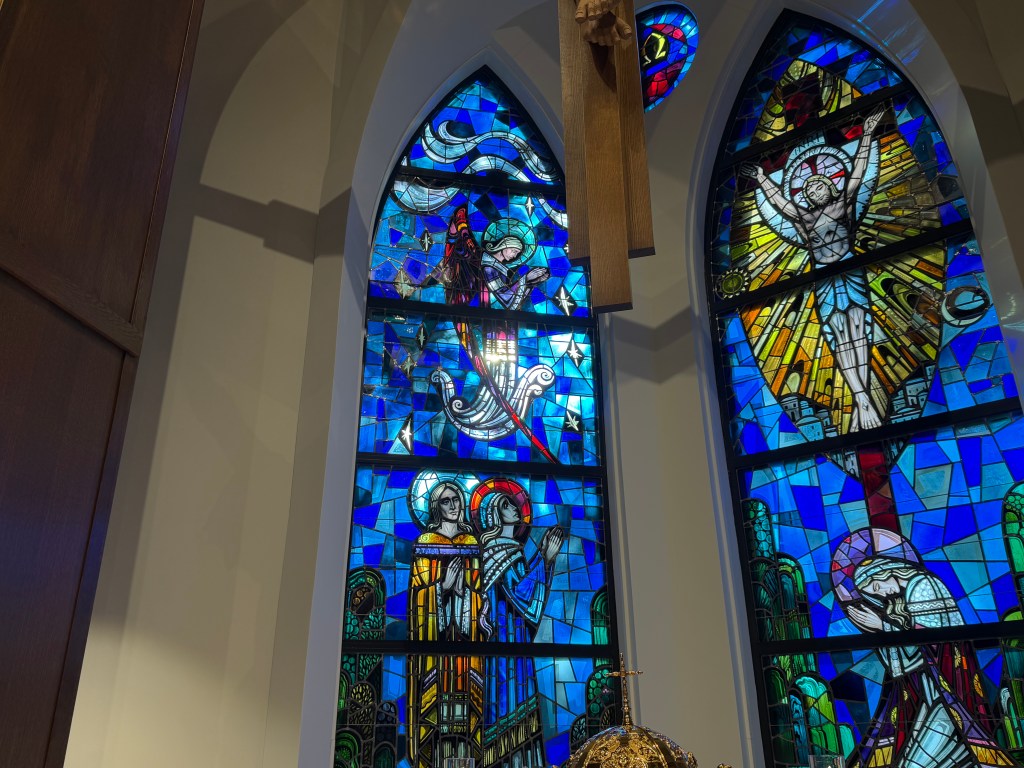
Jesus will help us to remove the log from our own eyes so we can help others to remove their splinter.

For many of us, judging one another is almost as automatic as breathing. As we encounter someone we have instant internal judgments. We judge looks, clothes, actions, inactions, homes, cars, and material items. We judge our family, spouses, friends, colleagues, classmates, leaders, enemies, celebrities, as well as those we consider different as well as those we determine to keep at arm’s length. Much of what gets our attention is what Jesus is addressing in today’s Gospel, negative judgments.

Jesus said to his disciples: “How can you say to your brother, ‘Let me remove that splinter from your eye,’ while the wooden beam is in your eye? You hypocrite, remove the wooden beam from your eye first; then you will see clearly to remove the splinter from your brother’s eye” (Mt 7:4-5).

There are positive judgments that bring about effective change for the good. In a court case, our hope is that the judge is learned in the law and guides the lawyers and jury in ways of sound judgment such that justice with mercy is served. For us to do likewise in our everyday interactions with one another, Jesus shares that we need to remove the wooden beam from our eye first before we are able to remove the splinter in another’s.

Jesus presents this hyperbolic image, a common rhetorical device for rabbis, of someone attempting to remove a splinter in someone else’s eye all the while the wooden beam protruding out of his or her own eye. This beam prevents the person from even being able to get close enough to actually be of any help! That is the point. Often in our rash judgements, we distance ourselves from our brother and sister, we not only judge them but condemn them. We don’t see the heart and mind of the person, we do not know what people are struggling with at any moment, and yet we allow ourselves to play judge and jury and so create further distance and so worse, separation.

Jesus is inviting us to remove the beam. We do so when we are willing to change our hearts and minds such that we are no longer callused and hardened by negative and condemning judgments toward others based on our own unbridled biases and prejudices. Softening happens when we take the risk and trust Jesus with those places in ourselves where we are believing the lies of the enemy, when we are judging and allowing ourselves to be poisoned by shame and self criticism. When we allow Jesus in to love us, we can then confess because we feel accepted and affirmed for who we are despite what we have allowed ourselves to do and not do.

Jesus is willing to lovingly enter our chaos, to embrace any and all of us who will receive the invitation of his healing embrace. Jesus walks with us, convicts us, and shines his light to reveal to us our where we are addicted, giving in to disordered affections and enslaved by sin. When we repent, allow ourselves to be loved at our worst, we experience God’s forgiveness, mercy, and grace.

We are then healed from our own limitations, weaknesses, self-centered perceptions, insecurities, denial and suppression of our anxieties and wounds that so often fueled our biases and prejudices. As we experience God’s forgiveness and love, we begin to heal, and that wooden beam shrinks. We are able to see others as God sees them, as human beings endowed with dignity because we have been created in the image and likeness of God. We come close as our hearts open wider to compassion and empathy.

Repentance, forgiveness, and growing in love helps us to collaborate and participate in Jesus’ work of redemption. Having removed the log from our own eyes, we can better assist others in removing their splinters. Admitting to our own shortcomings, weaknesses, and failures, and opening ourselves to healing, learning, and growing from those experiences, we are then in a better position to meet others in their own moments of chaos, to journey side by side, help others to repent, heal, and to be transformed by the love of God we have received.

Jesus helps us to remove our beams of judgment so that we can be more understanding, merciful, and forgiving. We will be blessed in doing so, for Jesus also taught us that as we judge, so will God judge us. As we repent and are forgiven, so may we forgive and show mercy. In receiving forgiveness and forgiving, in repenting from sin and judgmentalism, our souls will find rest and from that place of peace, we are better able to come close to help others as Jesus has done for us.


Photo: Allowing the light of Christ to shine within our hearts helps the logs in our eyes to dissolve.

Link for the Mass readings for Monday, June 22, 2026

What or who do we place our trust in?

“Before all this happens, however, they will seize and persecute you, they will hand you over…” (Lk 21:12).

The followers of Jesus have faced and continue to face persecution from the moment of Jesus’ Passion and death by crucifixion, continuing on with his Apostles, and the disciples in each generation thereafter up to and including the present day. There are estimates that there have been more Christian martyrs in the last century than in the whole history of the Church. Persecution was also true for the prophets before the time of Jesus. By entering Jerusalem, Jesus knew that his own persecution and death was imminent.

With today’s readings, we receive the last words from Luke for Sundays. Next week will be the last week in Ordinary Time as we celebrate the Solemnity of Christ the King and the following Sunday, we will begin Advent. So, as we end the liturgical year, our readings reflect not only the time of tribulation but also the end of time and the second coming of Jesus.

Why tribulation and this animosity to those who spoke for God before the time of, during the life of Jesus, and continuing on after with his followers? One reason is that to live by the will of God challenges not only those attempting to do so, it challenges those they interact with. Followers of Jesus who authentically practice the teachings of Jesus become a mirror. The disciples of Jesus have accepted where and how they fall short of the glory of God and welcome the opportunity to be freed from their ego and sin. Others may not be ready and are challenged by the idea of doing so.

The more entrenched into our ego and self-centered view we are, the greater the threat the Gospel is. The more we want to determine our own path and rationalize for ourselves our own truth, to define our own morality, and determine who is with us or against us, the more we distance ourselves from and set ourselves apart from the guidance of God. A clash has and continues to arise.

Jesus seized on the opportunity to present this reality when some of his disciples expressed their wonder with the Temple, and in its time, it truly was a wonder. Yet, Jesus said, “All that you see here – the days will come when there will not be left a stone upon another stone that will not be thrown down” (Luke 21:6). In his discourse, Jesus echoed the Prophet Jeremiah who said in his own time, “Do not put your trust in these deceptive words, ‘The temple of the Lord! The temple of the Lord! the temple of the Lord” (Jeremiah 7:4).

Jeremiah was calling his people to repent from their wicked and disobedient ways (cf. Jeremiah 7:1-15). They chose not to repent and in 587 the Babylonians destroyed the temple that the people placed their trust in. They missed the point that Jeremiah consistently sought to make. What was most important was their faithfulness to God, and that he alone would protect them. Living their lives any way they wanted and apart from God and believing that the temple would protect them was idolatry. Solomon’s Temple fell and as Jesus, stood from the Mount of Olive looking at the second temple that was rebuilt and was still being completed, offered the same judgment. Might and arms would not overthrow the Roman occupiers. It would only happen by trusting in God, allowing him to fight for them, that they would overcome times of persecution to come.

After Jesus’ death a movement of Zealots mounted a military strike against the Roman occupiers and for four years Rome would lay siege against Jerusalem. In 70 AD, Jesus words would be fulfilled. The Romans crushed the rebellion, killing up to a million Jews and destroyed the temple not leaving a “stone upon a stone.” All that was left and what remains to this day are the remnants of the western retaining wall securing the temple mount, better known as the wailing wall.

What do Jesus’ words mean for us today as we come to the end of another liturgical year? Who and what are we placing our trust in? There is nothing and no one in the physical world that will save us nor will be our stronghold other than God. We do not know the time or the hour of the final judgment to come, but for each of us, our time on this earth is limited. This thought, well pondered, is not morbid, but can be joyous, because in contemplating our end, we will be less tempted to take the time we do have for granted.

It is important to reflect upon how we have lived our lives daily and how we want to live each day going forward. Do we live only for ourselves and our own pursuits, or do we seek to align our wills with the will of God? Most of us fall somewhere in the middle. Do we feel pressured to compartmentalize and/or privatize our faith or are we willing to stand up for what we believe, not in a belligerent and in your face manner, but with calm assurance and steadfast?

In reading the lives of the saints and reflecting on how they dedicated their lives, even those willing to die as Jesus did, we will see that all were authentic and courageous witnesses. They lived their lives dedicated to the way, the truth, and the life of Jesus with each thought, word, and action. They were not born saints but each encountered Jesus, and at some point decided to follow his lead, and became who he called them to be. We each have a unique role to play in God’s plan and we begin one breath, one prayer, and one act at a time.

—————————————————-

Photo: Jesus was willing to give his life for us, are we willing to live for him?

Link for the Mass readings for Sunday, November 16, 2025