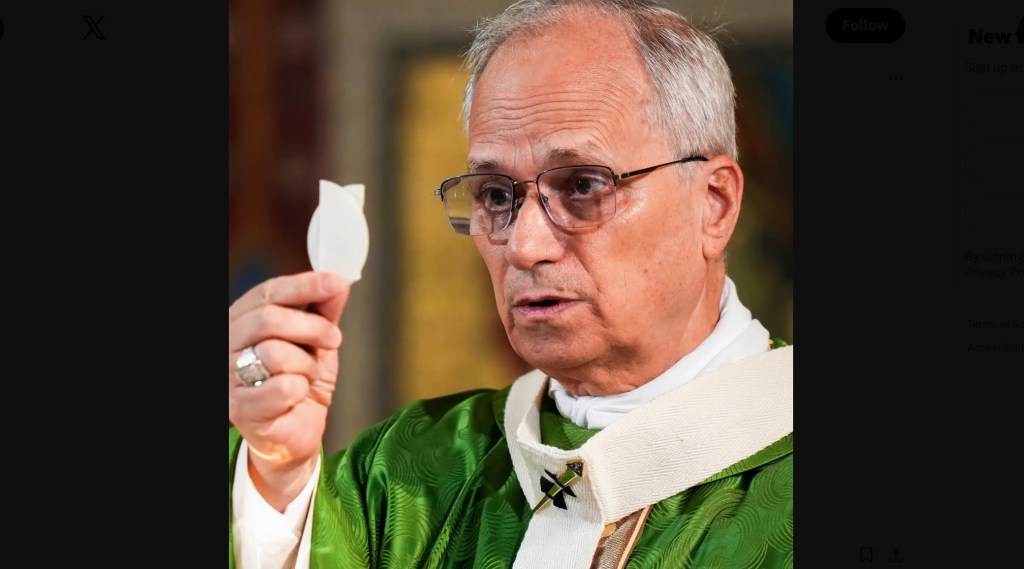
On a significant day in the history of the world, those who gathered around John the Baptist to be baptized in the Jordan heard John speak, “Behold, the Lamb of God, who takes away the sin of the world” (Jn 1:29). The phrase would have brought back the imagery of the blood of the lamb that was placed on the doorposts to save their ancestors from death and also remember the beginning of the Exodus and freedom from slavery. We who attend Mass hear the priest invoke this same phrase as he holds up the consecrated host. Jesus, of whom John said, “Now I have seen and testified that he is the Son of God” (Jn 1:24), was present to testify that the Son of God was in their midst and at Mass the priest does the same, now to free each of us from our slavery to sin.
Jesus is truly present to us in the Eucharist. This is no mere remembrance nor just a symbol. Jesus came to us, to become one with us in our humanity. He continues to do so in the Eucharist so that we can be nourished by his very Body and Blood and so become one with him in his divinity. This gives new meaning to the words we are what we eat! In receiving Jesus in this way, we are transformed and conformed to him so that when we return to our everyday experiences we can see Jesus present in each other. This intimate encounter with Jesus is a gift that we are invited to receive and partake of often, even daily if at all possible.
Many times we struggle in our lives because we may not feel heard or misunderstood, we may not feel accepted for who we are, and/or we feel alone, we may not experience being seen or we make allowances, self ourselves short to attempt to fit in. Jesus comes to us in our places of doubt and confusion, disfunction and disorder, to remind us who we are: beloved daughters and sons of his Father. Through his physical manifestation and presence in the Eucharist, we are reminded that God loved us so much that he sent his Son, not just at one historical point in history, but again and again at each Mass.
Jesus understands our trials and tribulations because he experienced them first hand. He was rejected by the people of his own hometown, many walked away from him when he was offering the bread of life discourse, and even his closest friends betrayed him in his most dire hour. Yet, he experienced joy even in these moments because he followed his Father’s will. He teaches us how to experience that same trust and love in the Father as he experienced then and continues to experience.
As we gather around the table of fellowship to experience the sacrifice of Jesus that is re-presented in his real presence, we experience again that Jesus has died for us and rose again conquering death, that we might have life; not just mere existence but instead a life of consolation and fulfillment. He died for us so he could be present to us in the very simple elements of bread and wine anywhere and everywhere in the world, to remind us that we are never alone and that our lives, as well as those we care for, can be better.
When we come to Mass we do not come for ourselves alone. We come to participate in the heavenly banquet feast that happens on earth as it is in heaven. We come to pray for the salvation of the world. We come to be transformed by the Son of God and as we consume him in such an intimate way, we become more and more conformed to his Body. “The Lord receives, sanctifies, and blesses the bread and wine that we place on the Altar, together with the offering of our lives, and transforms them into the Body and Blood of Christ, a sacrifice of love for the salvation of the world” (Pope Leo XIV, Angelus June 22, 2025).
Come to the feast and invite others to join you so that together we may, “Behold, the Lamb of God, who takes away the sin of the world” (Jn 1:29). Together, we may be saved, healed, and know that we are not alone but loved more than we can ever imagine and given the mission to go forth to heal and love others as we have been.
Photo: Pope Leo XIV celebrating Mass at the Shrine of Santa Maria della Rotonda in Albano Laziale, Italy, Aug. 17, 2025 (CNS photo/Lola Gomez).

 Spiritual Stepping Stones