We care for one another when we are willing to see God in one another.

Jesus said to the Pharisees: “There was a rich man who dressed in purple garments and fine linen and dined sumptuously each day. And lying at his door was a poor man named Lazarus, covered with sores, who would gladly have eaten his fill of the scraps that fell from the rich man’s table” (Lk 16:19-21).

Two key points stand out right from the beginning of today’s Gospel regarding the two main characters of Jesus’ parable. The first is that this rich man has all he needs, and more, and is quite comfortable, and in his wealth and excess, he never even noticed the man Lazarus or his need. Lazarus who sat at his door presumably for some and died there from neglect.

Biblical scholars from the Church Father, Tertullian, living in the second and third century, to modern scholars today see in this telling of the rich man an allusion to Herod Antipas (Gadenz, 287). Herod who was compelled as well as feared, and then had John the Baptist killed, also “kept trying to see Jesus” (Luke 9:9). Had he spent some time himself with the poor, he would have had a better chance of that happening. Herod would later get his chance and was “very glad to see Jesus” when Pilate sent Jesus to him to be judged.

Whether or not Jesus intends the rich man to be Herod, the Pharisees, or anyone who does not follow the will of his Father in being generous to the poor, In sharing this parable, Jesus is not just pointing out something new. He is echoing the prophets such as Amos who said “Woe to the complacent in Zion” (Amos 6:1). The rich man is complacent, indifferent to the dire need of Lazarus who is right at his door. How many times did this rich man just walk by him paying him no notice?

The second point in this account is that the poor man, Lazarus, a homeless, hungry, and dying man is named, and the rich man is not. For ancient people’s, those without a name were those that had no status, were outcasts, lost. Jesus is turning over the table on this man from the very beginning of his parable in leaving him unnamed. The tragedy, because of this man’s unrepentance while he is alive, is that he will remain unnamed after his death.

The man’s indifference and complacency toward those he kept at arm’s length, highlighted by his treatment of Lazarus, allowed there to be a separation between them instead of the unity God calls for. This choice became an eternal choice and created the wide chasm between him and Abraham. This distance was of his own making because he did not seek to come close to Lazarus in life. In separating himself from Lazarus, he separated himself from God.

Jesus makes this same point in Matthew 25:31-46 when he taught that what we do not do to the least of these: the hungry, thirsty, the stranger, the naked, the imprisoned, you do not do to me. Jesus identifies himself with the poorest of the poor. Lazarus also dies and experiences an opposite fate as he is brought to the bosom of Abraham.  Jesus here is echoing the Beatitude he shared earlier: “Blessed are you who are poor, for the kingdom of God is yours” (Luke 6:20).

The parable of the Rich Man and Lazarus that Jesus shared speaks an important truth to us today. Jesus is showing the importance of our interconnectedness and call to nurture relationships. He is not calling us to create a utopian ideal but to repent and allow the Holy Spirit to transform us as we learn and follow the commandments of God. We are to be open to meeting each other not as the rich man regarded Lazarus with indifference and contempt but to instead be aware of the needs of our neighbors, our brothers and sisters, to care, and to love one another person to person by willing their good.

Pope Leo offered similar advice a few weeks ago: “We need an extensive ‘covenant of humanity,’ founded not on power but on care; not on profit but on gift; not on suspicion but on trust. Care, gift and trust are not virtues to be practiced only in one’s spare time: they are pillars of an economy that does not kill, but deepens and broadens participation in life.”

Jesus encourages us to resist the temptation of callousness, cynicism, and indifferentism and to be open to breathing, receiving, resting and abiding in his love and to follow his lead to love others in concrete ways. A good place to start is to be willing to come close, to offer a smile, or to listen to another in need. In being willing to see Jesus in each other, “God in every human being” (St. Mother Teresa), we can then learn and put into practice the corporal and spiritual works of mercy. In doing so, we love God, our neighbor, and ourselves and help to make our corner of the world a little better.

————————————————

Painting: “The Poor Lazarus at the Rich Man’s Door” by James Tissot.

Link for the Mass for Sunday, September 28, 2025

Link for Pope Leo XIV’s address to the 3rd world meeting on human fraternity, September 12, 2025

Jesus the Christ, the Son of God, will make all things new.

Hospitality was a key virtue for people of the ancient Near East. Martha approached Jesus as he was teaching looking for support from her sister Mary in preparing the meal. Mary was sitting at Jesus’ feet with the male disciples gathered around him while Martha appeared do be doing all the work. Martha was hoping that Jesus would support her in her request. Jesus not only did not, but said that Mary had chosen the better part and that Martha was “anxious and worried about many things” (cf. Luke 10:38-42).

We don’t know how Martha reacted to Jesus. A subtle key in today’s Gospel account from John may shed light on their last encounter and Martha’s reaction. Martha’s boldness was on display again. As soon as she was aware that Jesus was coming near, she did not wait for him to arrive but “went to meet him” (Jn 11:20). Martha’s brother, Lazarus, had now been dead for four days and Jesus, who had the time to arrive before his death, was not present to help his friend, her brother, Lazarus in his time of need.

How many times have we been in Martha’s position? Feel that Jesus was not there when we needed him most? Why do bad things happen to good people? Part of the answer is that we live in a fallen world of sin and self-centeredness. God does not bring about suffering but he does allow it. God loves us so much that he is willing to give us the free will to reject him. The cost of our freedom to choose means that there are consequences to our choices which can be detrimental or beneficial. We are all interconnected so when we choose to act on our own apart from God’s guidance and the welfare of others, the damage that ensues affects not only those around us but everyone. On the other side of the coin, there is the presence of grace, forgiveness, and love when we choose to draw close to God, especially in challenging times.

When we choose God, we will find out that we are not alone in our suffering, especially, when we do as Martha did and go out to meet Jesus. She most likely did not holding back any of the full range of her hurt and pain. Martha’s words expressed her anguish, “Lord, if you had been here, my brother would not have died” (Jn 11:21). We can only see from our limited point of view, especially with our own experiences of grief. Yet God sees far beyond our finite perspectives and Jesus helps to not only bring about a greater good, though it may take time to come to understand and experience, he accompanies us in each agonizing breath of our suffering.

Jesus came too late to heal his friend, which Martha and Mary could not understand. What he came to do, was beyond their wildest imaginings. Jesus came to restore Lazarus to life, which would also be a foreshadowing of his own Resurrection. The difference being that Jesus would not merely be resuscitated as Lazarus was and die again.

Martha was not holding a grudge from their last exchange. She came directly to him. She knew he could have healed her brother if he had been there, but did not say so accusingly. Martha immediately followed instead with: “But even now I know that whatever you ask of God, God will give you” (John 11:22). Then even before Jesus called Lazarus back to life, Martha showed her faith. Jesus asked if Martha believed. Martha, as did Peter, made the affirmation of our faith: “Yes, Lord. I have come to believe that you are the Messiah, the Son of God” (John 11:27).

We have been blessed by the witnesses of Martha, Mary, and Lazarus. Each show their trust in Jesus in their own unique way and follow his guidance. Those of us who have suffered the loss of a loved one, or more, know something of the pain that Martha and Mary experienced. May we also all trust in Jesus, the Son of God, the “resurrection and the life” who conquered death and became the firstborn of the new creation. We need not fear our time of suffering or death, our own, or for our loved ones as long as we give our lives to him. When we call on Jesus he will give us the strength to endure and overcome, in this life and into the next.


Painting: The Raising of Lazarus – Caravaggio, Martha, Mary, and Lazarus help us to trust and have faith in Jesus as you did. Pray for us!

Link to the Mass readings for Tuesday, July 29, 2025

May we, like Mary, give without counting the cost.

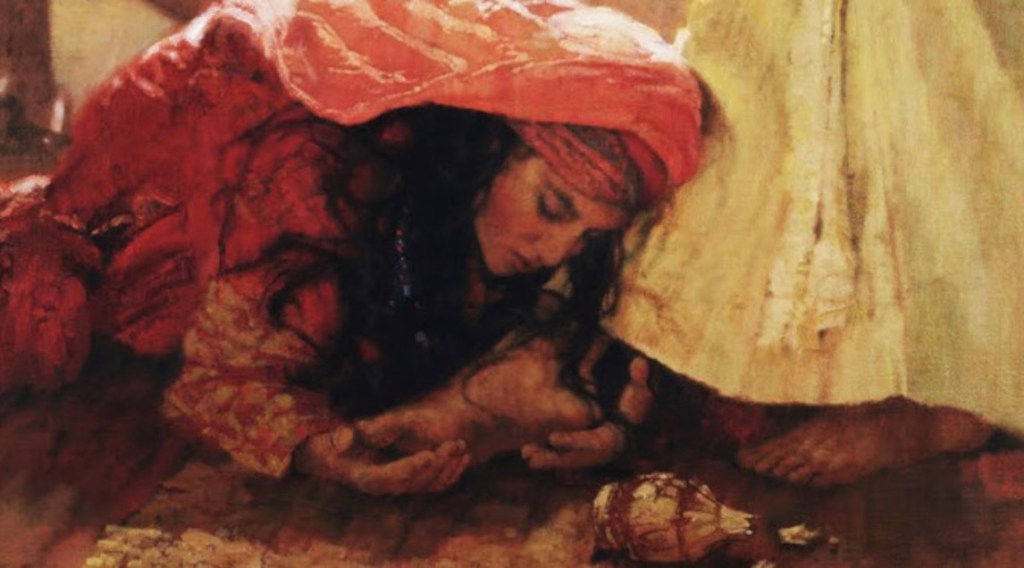
“Mary took a liter of costly perfumed oil made from genuine aromatic nard and anointed the feet of Jesus and dried them with her hair; the house was filled with the fragrance of the oil” (Jn 12:3). This is indeed some gift that Mary shares with Jesus, though Judas’ critical response showed that he missed the point of her offering, which went well beyond the material cost of the perfume. Mary even exceeded the gesture of hospitality by going beyond washing Jesus’ feet and anointing them as well. This act of caring could have been a bestowal of appreciation and gratefulness toward Jesus who brought Lazarus, her brother, back to life, but it was even more than that.

In Jesus’ correction of Judas, “Leave her alone. Let her keep this for the day of my burial” (Jn 12:7), we may intuit the best source for interpreting Mary’s act. Mary comprehended better than any of the Apostles that Jesus’ death was imminent. Mary’s washing the feet of Jesus, anointing them, and drying them with her hair was a gift of love, of giving herself in service to the Son of God. This exchange mirrors the communion between God the Father, God the Son, and the love shared between them, God the Holy Spirit. Mary follows the will of the Father and plays her part in salvation history.

Martha is again present and seemed to have learned from their last encounter. She is again serving the meal, but this time she is not complaining. Martha was not anxious and worried about many things. Judas was the one corrected this time when Jesus told him to, “Leave her alone.” Mary has shown her spiritual growth as well. She is no longer sitting at Jesus’ feet but anointing them for his imminent death. Her generosity in pouring out such a large amount of perfumed oil which was evident because the fragrance filled the entire house. Mary’s generosity foreshadowed the generosity of Jesus not just in his eventual washing of the feet of his apostles but ultimately, his total self-gift that he will give of himself on the cross.

We do not know how Mary came to possess this precious oil, but what we do know is much more important. She did not grasp or cling to the oil, she did not count the cost and just pour out a little bit. When she felt moved to pour the costly nard and anoint the feet of Jesus she freely poured the perfume out in an act of love to serve the need of Jesus by anointing him for his death and burial.

What is something that we may hold as precious that God may be calling us to give up, to let go of, to pour out, not just for the sake of doing so, but in service to Jesus? The path to holiness and sanctity, is coming to a place in our lives in which we can let go of that which we are attached to, so to hear clearly the will of God, know what is required of us, and give freely in love and service without counting the cost. May we follow the lead of St. Mother Teresa who said that she sought to be just a pencil in God’s hand. May we come to spend time in prayer and quiet meditation and contemplation each day so we may know, hear, and act without hesitation on God’s voice.

————————————————————————————–

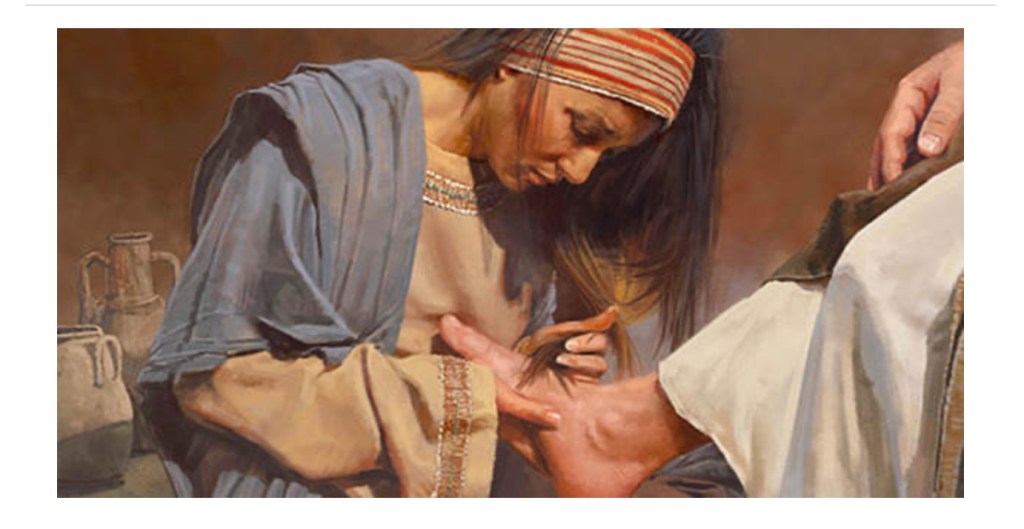
Painting: Mary anointing the feet of Jesus.

Link for the Mass readings for Monday, April 14, 2025

Ourselves first or God first, will impact our discernment in helping others.

The Parable of the Rich Man and Lazarus that is offered for us today from the Gospel of Luke 16:19-31 is well worth the read. Jesus challenges us through parables such as these. For the people of his time, those who had wealth and status in society did so, it was believed for the most part, because they were blessed by God. And likewise, those who were poor, were so because of God’s punishment. When the rich man and the beggar, Lazarus, die, I am sure Jesus paused to allow his listeners to imagine what would happen to these two men and to give their presumptions some time to ferment. Many would not have predicted what happened next.

Lazarus was taken up “by angels to the bosom of Abraham” (Lk 16:22). The rich man found himself suffering from the torment of flames, such that he was parched, begging just for a drop of water from Lazarus (cf. Lk 16:23-24). Abraham, the model of faith and father of Judaism, was not sitting with the rich man, who must have always been seated at the highest places in his day. Now that seat, at the bosom of Abraham, was offered to Lazarus. There was no hope at this moment for the rich man to cross over because of the wide chasm that separated them. An ironic subtlety was afoot as well in Jesus’ telling of the parable to the Pharisees. Lazarus the poor beggar is named, whereas, the rich man is not. Some biblical scholars, based on the context of this exchange with Jesus and the Pharisees, believe that Jesus was alluding to the rich man to be Herod Antipas and indirectly calling out the Pharisees for their too close of an association with Herod, especially in leading to the death of John the Baptist.

This state of suffering and separation for this rich man, the uncrossable chasm, is a revelation of the life he lived prior to his death. He walked over or by Lazarus day after day not giving him even a second look. Lazarus would have been grateful even for the mere scraps that fell from the rich man’s table, just as the rich man now sought just a drop of water from the finger of Lazarus. The rich man committed the root offense from which sprouts much of our sin; he failed to bother, to care, to love his brother, to will his good. He failed to come close to Lazarus who was in need.

Jesus’ parable of the Rich Man and Lazarus, echoes very closely Matthew 25:40, “whatever you did for one of the least brothers of mine, you did for me.” How we treat others matters. Failing to care, to reach out to those in need around us is sinful. We, probably like those who first heard this parable, experience time and again, a wicked mind storm that swirls with reasons, rationalizations, and justifications as to why we do not reach out to help others. The majority, if any, are not valid. We are invited to give and to love joyfully from a natural, not a hesitant disposition, to provide aid and support.

Almsgiving is one of the three pillars of Lent. The first step is to be aware of those who are in need. This can be in our own home! Second, when we see someone in need and we feel the wind and the waves of our mind surging with reasons of why not to help, it is important to take a breath and call on Jesus to calm the storm of our minds. In that moment of pause, may we allow our eyes to adjust so that we can see the person before us as a human being, as a brother or sister with dignity, value, and worth.

What we are to seek in each moment of encounter with another is the guidance of Jesus. We are to allow him to work through us so that we may be present and allow God to happen in whatever form or act of kindness that he directs us to take. We can do this best when we are daily entering into God’s word and allowing the Old and New Testament readings to shape and transform us. In this way, when we trust “in the Lord”, we will be “like a tree planted beside the waters” (Jeremiah 17:7-8).

Almsgiving as one of the pillars of Lent is a helpful practice that will help us to grow in compassion and generosity. What will help us to grow in the practice of this pillar as disciples of Jesus is to seek to be nourished by God’s word and his laws that teach us how to love one another. If not sure where to begin, we can pause and listen to Mary and do the same as she directed the servants at the wedding feast, “Do whatever he tells you” (John 2:5).

——————————————————————-

Photo credit: “The Rich Man and Lazarus” by John Everett Millais

Link for the Mass readings for Thursday, March 20, 2025

May we embody the boldness and faith of St. Martha.

Enough of waiting. They had sent word to Jesus while Lazarus was dying but still alive, and he did not come. Now Jesus is close to their home, and Martha does not wait for him to come to her but “went to meet him” (Jn 11:20). She went boldly, and most likely, did not hold back any of the full range of her hurt and pain.

Martha’s words expressed her anguish. “Lord, if you had been here, my brother would not have died” (Jn 11:21). She believed in Jesus, knew of his power to heal, but could not understand why he did not come. She could not understand because she could only see the loss of her brother which was right in front of her. He was dead and now in a tomb.

It is true that Jesus came too late to heal his friend, it is also true that he felt the pain of his friends. What Lazarus had to go through in his death and what Martha and Mary were experiencing in their grief. That is why he wept. But Jesus came with a purpose, and what he came to do was beyond their wildest imaginings. Jesus came to restore Lazarus to life.

What is so amazing is that as Martha speaks with Jesus, she is not aware of what Jesus is about to do. And when Jesus asks her if she believes that he is the “resurrection and the life” she says without missing a beat: “Yes, Lord, I have come to believe that you are the Christ, the Son of God” (Jn 11:27). Martha believed Jesus was the Christ before the raising of her brother and even while still experiencing the rawness of her grief.

Martha’s boldness and faith give us a model of how to face the challenges in our lives. We are to go to Jesus with them directly and believe that he is the Christ the Son of God. What may at first appear to be hopeless is not. Our loving God and Father will always bring about a greater good, even when it does not seem possible in the moment of our trials and tribulations. And even death, our own or of our loved ones, no longer has the final say, Jesus does. For those of us who die with Christ will rise with him because Jesus opened up heaven for us in the humanity he assumed.

Let us begin and continue our day ahead with the boldness and faith of Martha. We, like her, will not be free of the pain and suffering of life this side of heaven but we will not have to go through any of it alone as long as we believe in and turn to Jesus.

————————–

Icon: Close up of Icon of St. Martha, Monastery Icons.

Link for the Mass readings for Monday, July 29, 2024

We are to give all like Mary, without counting the cost.

“Mary took a liter of costly perfumed oil made from genuine aromatic nard and anointed the feet of Jesus and dried them with her hair; the house was filled with the fragrance of the oil” (Jn 12:3). This is indeed some gift that Mary shares with Jesus, though Judas’ critical response showed that he missed the point of her offering, which went well beyond the material cost of the perfume. Mary even exceeded the gesture of hospitality by going beyond washing Jesus’ feet and anointing them as well. This act of caring could have been a bestowal of appreciation and gratefulness toward Jesus who brought Lazarus, her brother, back to life, but it was even more than that.

In Jesus’ correction of Judas, “Leave her alone. Let her keep this for the day of my burial” (Jn 12:7), he shows us that Mary comprehended better than the Apostles that Jesus’ death was imminent. Mary’s washing the feet of Jesus, anointing them, and drying them with her hair was a gift of love, of giving herself in service to the Son of God. This exchange mirrors the communion between God the Father, God the Son, and the love shared between them, God the Holy Spirit. Mary follows the will of the Father and plays her part in salvation history.

We do not know how Mary came to possess this precious oil, but what we do know is much more important. She did not grasp or cling to the oil, she did not count the cost and just pour out a little bit. When she felt moved to pour the costly nard and anoint the feet of Jesus, she freely poured all the perfume out in an act of love to serve the need of Jesus by anointing him for his death and burial.

What is something that we may hold as precious that God may be calling us to give up, not just for the sake of doing so, but in service to Jesus? The path to holiness is coming to a place in our lives in which we can surrender all to Jesus, so to clearly hear the will of God, know what is required of us, and give freely in love and service without counting the cost, without holding anything back, to be as St. Mother Teresa has said, just a pencil in God’s hand.

————————————————————————————–

Picture: The gift God continues to give, the beauty of his creation! SVDP Regional Seminary, Boynton Beach, FL.

Link for the Mass reading for Monday, March 25, 2024

Are we willing to see another as human in their need?

The Parable of the Rich Man and Lazarus from the Gospel of Luke 16:19-31 is well worth the read. Jesus challenges us through parables such as these. For many in Jesus’ time who were followers of the God of Abraham, they believed that those who had wealth and status in society did so, for the most part, because they were blessed by God. When the rich man and the beggar, Lazarus, die, I am sure Jesus paused to allow his listeners to imagine what would happen to these two men. Many would not have predicted what happened next.

Lazarus was taken up “by angels to the bosom of Abraham” (Lk 16:22). The rich man found himself suffering from the torment of flames, such that he was parched, begging just for a drop of water from Lazarus (cf. Lk 16:23-24). Abraham, the model of faith and father of Judaism, was not sitting with the rich man, who must have always been seated at the highest places in his day, but now that seat, at the bosom of Abraham, was offered to Lazarus. There was no hope at this moment for the rich man to cross over because of the wide chasm that separated them. An ironic subtlety was afoot as well in Jesus’ telling of the parable to the Pharisees. Lazarus the poor beggar is named, whereas the rich man is not.

How does the rich man come to this state of suffering and separation? This is the life he lived prior to his death. He walked over or by Lazarus day after day not giving him even a second look. Lazarus would have been grateful even for the mere scraps that fell from this rich man’s table, much like the rich man now sought just a drop of water from the finger of Lazarus. The rich man committed the root offense from which sprouts much of our sin; he failed to bother, to care, to love his brother, to will his good.

Jesus’ parable of the Rich Man and Lazarus, echoes very closely Matthew 25:40, “whatever you did for one of the least brothers of mine, you did for me.” How we treat others matters. Failing to care, to reach out to those in need around us is sinful. We, probably like those who first heard this parable, experience time and again, a wicked mind storm that swirls with reasons, rationalizations, and justifications as to why we do not reach out to help others. The majority, if any, are not valid. We are invited to give and to love joyfully from a natural, not a hesitant disposition, to provide aid and support.

Almsgiving is one of the three pillars of Lent. The first step in giving of our time, talent, or treasure is to be people of prayer. Spending time with God helps us to know him, his will, and his voice and we will then grow to see him in all things and all people. As we experience, rest, and abide in his love and come to know his voice, we will be more apt to say, “Here I am!” We will also be more aware of those who are in need from the unborn to those in the later stages of their life and everywhere in between. This can be in our own families, home, workplaces, schools, or wherever we go!

Once we are aware, the challenge is knowing how best to provide help. Our response will be unique for each person. What we want to resist is feeding the wind and the waves of indecision and excuses for not helping and instead take a breath and stop. Let our eyes adjust so that we can see the person before us as a human being, as a sister or a brother with dignity, value, and worth.

Everyone wants to belong, to be a part of, to be loved. Then, in the next moment seek the guidance of Jesus, be present, and allow God to happen through us in whatever form or act of kindness that may take. No matter how small, loving another makes a difference. Seeing another, seeing another as human, seeing their need, acknowledging their presence, and seeking God’s guidance on how best to help is a good place to start.

——————————————————————-

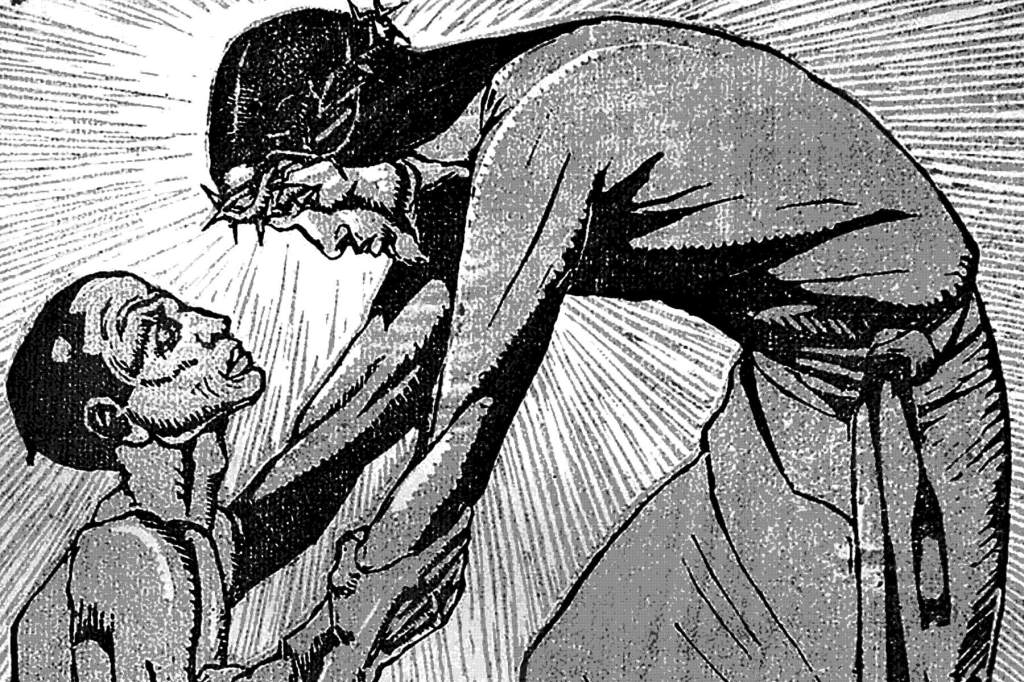
Photo of woodcut Jesus and leper by Mabel Royds. Are we willing to see Jesus in others and allow them to see Jesus in us?

Link for the Mass readings for Thursday, February 29, 2024