life


“Everyone who seeks the Son and believes in him may have eternal life.”
“For this is the will of my Father, that everyone who seeks the Son and believes in him may have eternal life, and I shall raise him on the last day” (Jn 6:40).
This is our hope and what we believe, that we who encounter Jesus and believe in him shall have eternal life. God’s will, what he created all of us for, is to be in communion with him and one another in this life and the next. A word of assurance that I often lean on is from the book of Wisdom from our first reading today, “The souls of the just are in the hand of God, and no torment shall touch them. They seemed, in the view of the foolish, to be dead; and their passing away was thought an affliction and their going forth from us utter destruction. But they are in peace” (Wisdom 3:1-3).
The miracle of Jesus raising the daughter of the Roman official, Jairus, embodies these verses from Wisdom. As Jesus entered the home of the official many were “making a commotion” and Jesus dismissed them stating: “Go away! the girl is not dead but sleeping.” He was ridiculed by the crowd but paid them no heed. He went to the girl, took her hand, “and the little girl arose” (cf. Mt 9:18-26).
Jesus assured his followers as he assures us today that the will of his Father is that all will be saved. Experiences like the raising of Jairus’ daughter, the son of the widow from Nain, and Lazarus, were not only seeds of hope planting the promise of his resurrection to come but a foretaste of the raising of humanity on the last day. His disciples witnessed Jesus’ actions and words, and not only kept these experiences in their hearts but shared them.
Through the Gospels we are able to enter into and experience the encounters Jesus experienced with others again and again. We also experience Jesus each time we pray, participate in the sacraments, communal worship, and in our willingness to love one another. In each of these moments, we are conformed and shaped into who we have been created and called by God to be in this life and the next.
This All Souls Day we celebrate the gift that Jesus was victorious over sin and death, not only for himself but for all of us. Unlike those he raised from the dead and died again: “We know that Christ, raised from the dead, dies no more; death no longer has power over him” (Romans 6:9). The difference between All Saints yesterday, and the commemoration of all souls today, is that we pray for those who have died still in need of the purifying fire of God’s love. Just as “gold in the furnace” (Wisdom 3:6) is purified, so God purifies those in purgatory. Let us pray for them today that they may be freed from any stain of sin so to also join the communion of Saints!
“Merciful Father, hear our prayers and console us. As we renew our faith in your Son, whom you raised from the dead, strengthen our hope that all our departed brothers and sisters will share in his resurrection, who lives and reigns with you and the Holy Spirit, God, forever and ever” (Prayer for All Souls, from the Liturgy of the Hours).
Photo: Rosary walk a few weeks back, Riverside Park, Vero Beach, FL.
Link for the Mass readings for Saturday, November 2, 2024

The horizon we gaze upon has an effect on the life we live now.
The term horizon is often defined as where the earth and sky meet. This is actually an apparent horizon or sensible horizon because we see an apparent plane based on our observation point. If we are able to broaden our viewpoint and look beyond the present location we are standing at on the earth, say from the space shuttle, we could then experience a rational or celestial horizon: where the great circle of the celestial sphere whose plane passes through the center of the earth is parallel to the celestial horizon of a given position. Journeying deeper into space we could discuss event horizons, the boundaries marking the limits of black holes.
Before delving any deeper and getting lost in space, let’s return to earth and today’s Gospel where Jesus stated: “Pay attention to what I am telling you. The Son of Man is to be handed over to men” (Lk 9:44). What Jesus offers to us in this statement is the horizon of the cross, the place where heaven and earth meet, where the physical and the spiritual, where the finite and infinite meet.
Many of Jesus’ followers were and are still confounded by the cross. As Paul wrote to the Church at Corinth: “For Jews demand signs and Greeks look for wisdom, but we proclaim Christ crucified, a stumbling block to Jews and foolishness to Gentiles, but to those who are called, Jews and Greeks alike, Christ the power of God and the wisdom of God” (1 Cor 22-23).
Paul echoes what Jesus was talking about – his imminent fate and our ultimate horizon – death. None of us will be able to avoid the final result of our mortality. Jesus taught both through his words and in his death that to be truly free we need to be willing to lose our life to gain it. We have to face and walk through our deepest fears to grow. Our life is not lived until we give it away.
The more willing we are to face the reality of our own death, the less likely we are to take the time we have for granted, and the better we can live our lives here and now. During our final four months together, JoAnn and I experienced God’s grace because we faced the reality that her time was near, we embraced the gift of the time we had together, and through the prayers of so many, we experienced the infinite presence of the love of God in our midst.
There is so much we can experience and enjoy, but if we only limit ourselves to that which we can experience with our physical senses alone and attempt to deny our own mortality, we limit ourselves and distort the sacredness of life. What makes us fully human, alive, and fulfilled is an embrace of both the physical and the spiritual, of both reason and faith, seeking the horizon where the finite and infinite meet, where earth and heaven come together.
This union happens most perfectly in Jesus Christ, who is fully human and fully divine. Jesus helps us to experience the beauty of God’s creation and our relationships. This happens best when we are willing to enter with him into, instead of resist, the natural rhythm of life and death. We come to appreciate the truth of how fragile our lives really are.
This is not a truth to run from but to embrace. And as we do, we will be less apt to take each other for granted and instead better appreciate one another. We will also be able to slow down and rest more in the moments that God offers in which we can experience foretastes of heaven now. In doing so, we will better prepare ourselves for that time when Jesus will lead us into our own death so that we may rise with him and experience a new and infinite horizon.
Photo: Rosary walk and pause, Riomar Beach, Vero Beach, FL.
Jesus gave his life that we might have life.
Jesus said to them, “The Son of Man is to be handed over to men, and they will kill him, and he will be raised on the third day.” And they were overwhelmed with grief (Mt 17:22-23).
This is the second time in the Gospel of Matthew that Jesus shares with his disciples that he will die soon. They are overwhelmed with grief because their focus is on the first part of Jesus’ statement that he will be handed over to death. They do not understand or yet comprehend the second part about how he will be raised on the third day. How could they? There was no point of reference for them. Jesus did bring three people back to life during his ministry, but Jesus would not be merely resuscitated as they were and just die again. Jesus would resurrect and conquer death.
For us, we can read today’s Gospel about the impending death of Jesus and gloss over it a bit too easily. Because we celebrate Easter each year, we celebrate that Jesus has risen. Yet, do we give ourselves time to ponder the wonder and reality of the Resurrection of Jesus? Does the fact of the Resurrection, the reality that Jesus has conquered death and become the firstborn of the new creation really have relevance in our lives?
The life, death, and Resurrection of Jesus matters! The missing piece for those for whom this statement doesn’t register any relevance may be that they do not want to think about death all that much. To be honest, none of us really want to come face to face with our own mortality, and most of us don’t until we or a loved one is forced to.
Beginning the summer after my freshman year of college, I began working the second shift in a nursing home as a CNA. It was the first time that I experienced death up close through the care of the residents. They were not merely patients, they had become more like family.
The first death I experienced surprised me. I was with a woman holding her hand as she peacefully gave up her last breath. I was surprised and blessed by the peace I felt. Another time, I had the opposite experience. When I arrived at work and went directly to a man named Richard whose health had been slipping, only to find his bed empty. I felt the loss and the grief begin to rise and then found out he had not died, only his room had been changed.
The important lesson that I learned from these, the other experiences of death since then, and especially when faced with JoAnn’s diagnosis of pancreatic cancer, is that life is fragile. To appreciate life, the people in our lives, and not to take anyone or any moment for granted is important. Life goes too quick, even in the best-case scenarios. All that God has given us is a gift and it is important to appreciate and thank God for those people he has brought into our lives as well as all that he has given us.
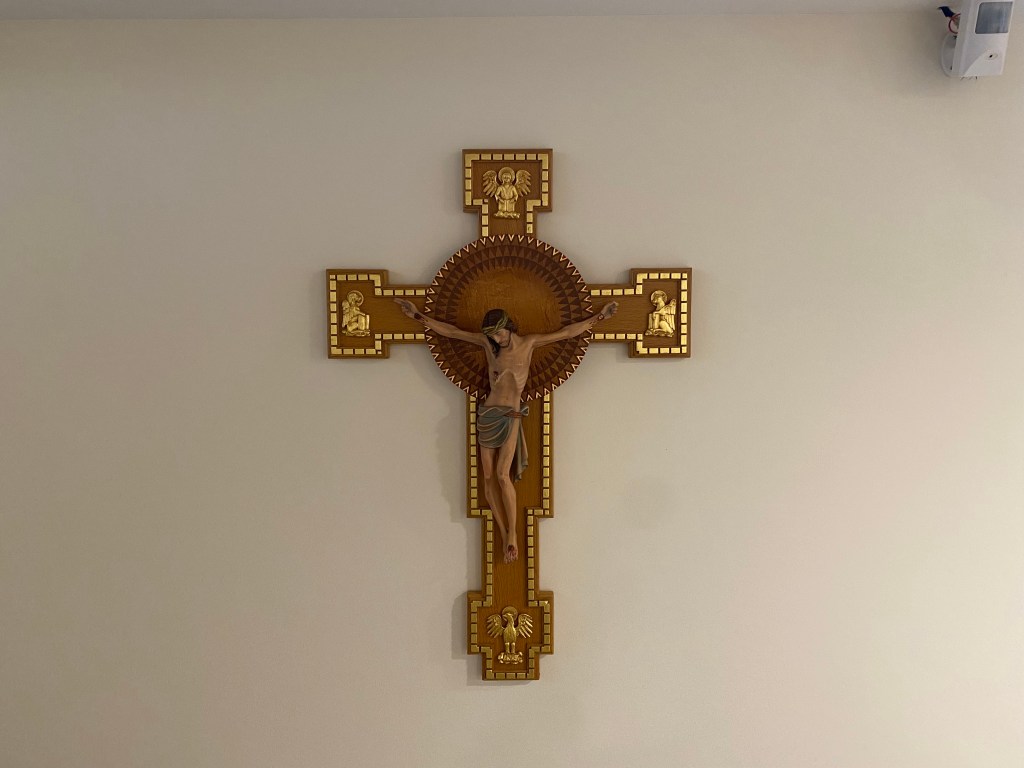
Jesus understands each of our struggles and tribulations, our sins and our failings, as well as our deepest hopes and dreams. Jesus also knows about our deepest fear of death, for he, as a human being, experienced the reality of his impending death in the Garden of Gethsemane. He sought to help his apostles prepare for his death though they did not understand. The crucifix, the beautiful sacramental object of Jesus on the Cross, is a reminder to us all that death does not have the final answer, Jesus, fully human and fully divine, does.
Photo: Crucifix in the adoration chapel of Holy Cross Catholic Church, Vero Beach, FL.

Allow the words of the Our Father to enkindle the fire of his love into your heart.
There is a creative power to God’s word. “In the beginning was the Word, and the Word was with God, and the Word was God” (John 1:1). God’s word is alive and present to all of us. And as Isaiah conveys in today’s first reading, God’s word “shall not return to me void, but shall do my will, achieving the end for which I sent it” (Isaiah 55:11).
This happened most profoundly in time when “the Word became flesh and dwelt among us” (John 1:14). God the Father through the overshadowing of the Holy Spirit and the ascent of Mary’s will, sent his Son to be human while remaining fully divine. Jesus lived, suffered, died, conquered death, rose again, and ascended into heaven bringing our humanity through his humanity back to the Father. God’s Word achieved the end for which he was sent, that salvation of the world!
God’s word, the Holy Spirit, and Jesus are still alive and active today. The gift of the Bible is that the story of salvation is there for us to experience. The Bible is not just a compilation of dead letters on a series of pages to be gathering dust. These words are most alive when they are proclaimed at Mass and read, prayed and meditated upon within our own time of prayer, and put into action in our daily lives.
God still speaks to us today through his living word when we make the time to listen and hear him speak in the silence of our hearts. In today’s Gospel, Jesus teaches us how to pray by sharing the words of the Our Father or the Lord’s Prayer. This is the same prayer that he taught his Apostles and has been prayed ever since then each and every day over the past two thousand years.
If you have been wanting to learn to pray and meditate with the Bible and haven’t been sure where to begin, the Our Father is a great place to start. Settle into a quiet place, take some deep breathes, and let the words come off the page and land on your lips. This can be silently or aloud. Read or recite slowly God’s word given to us by the Word, the Son of God, Jesus.
If you know these words well, resist the temptation to fly through them without a second thought. Say each word slowly, allow the mystery of God’s love to enfold you, allow Our Father to embrace you. The same Father who is in heaven, whose name is hallowed, holy. The God and creator of all that exists who is so far beyond our comprehension, while at the same time closer to us than we are to ourselves.
Contemplate on the wonderful truth that he wants us to be a part of his kingdom now and forever. God wants his will and our will to align as one so that we can be collaborators with him in creation so that we can put into practice what God guides us to on earth as it is in heaven. For heaven is the intimate communion with our loving God and Father that he seeks, and we have been created for.
We can then ask him for our daily bread, that which we need each day, most of all his Word among us made present again on Catholic altars throughout the world. Jesus, the Bread of Life, who we can consume and become transformed.
One of the most powerful transformations comes when we are forgiven by God who never tires of forgiving us. May we not only never tire of asking for forgiveness but also be willing to forgive as we have been forgiven. Sin, which causes separation and death from God and each other, is healed and we are redeemed by God’s forgiveness. As we are forgiven, we then are to forgive others and so God’s love is made manifest on earth as it is in heaven.
And as we prepare for each day, may we seek God’s guidance so that we may know his will and resist the temptations, distractions, and diversions of the enemy. God does not tempt us and he can help us to resist temptation when we follow his light. We will then not only avoid evil, but in the name of Jesus cast it out.
I invite you to pray with the Our Father in a similar way allowing Jesus to speak to you through your mind and heart as you meditate on each word. You may find that you want to stay with one particular word or phrase that calls to you and not even finish the prayer. Allow the Holy Spirit to guide you where he wills. May you feel his peace, love, and joy arise from within you as you do so, and enjoy!
Photo: The tree tops reflecting the rays of the setting sun. May we do the same as we receive and reflect the light of the Son from our experience of Jesus in prayer!
Link for the Mass readings for Tuesday, February 19, 2024

