“Be vigilant at all times and pray.”

“Be vigilant at all times and pray that you have the strength to escape the tribulations that are imminent and to stand before the Son of Man” (21:36).

These are the last words we will hear or read from this liturgical year from the Mass. The season of Advent and the new liturgical year begins tonight at the vigil Mass. They are not only good words to end the year with but that they would also be good words to read at the beginning of each day.

“Be vigilant at all times” are certainly words to abide by. This is not a call to be paranoid or to live in fear. This is a call to be aware, to watch, and pray. What we see, hear, and think is then important to bring to God in prayer. Being vigilant is also a reminder that we need to resist the temptation of speeding through life with blinders on and not taking time to listen to that quiet voice of God that is available to guide us day in and day out. The more we hear the subtle, quiet leading of the Holy Spirit and ignore it, the less we grow in our awareness of his presence in our lives or the presence of those who need his mercy, grace, and love.

Worse yet, the less we take the time to hear and know God’s word, the more we will be distracted, tempted, and persuaded by the myriad of other voices that are not from God, which can lead us astray. That is why prayer is so important, so we can develop an ear for our loving God and Father’s guiding voice heard when we are still. Once we begin to recognize his voice spoken in the silence of our hearts, we will begin to hear him speak in our daily activities.

Being vigilant also requires us to surrender our self-serving ego, for if we want what we want when and how we want, if we just keep up at a fever pitch pace, if we are feeding ourselves with apparent goods, we can open ourselves up to some unsatisfying and pretty horrible scenarios.

There are those who seek to do us harm from self interest and lack of awareness to forms that are unconscionable. Pretending that they aren’t there doesn’t work and being paralyzed with fear makes us more vulnerable. We need to be aware of, and establish clear boundaries for ourselves and communicate them with others. Each time we listen and follow through on the leading of the Holy Spirit, our conscience is better formed, we increase our confidence in who we are and who God is guiding us to be. We can also sidestep scenarios that can lead us down some dark paths.

Being vigilant and turning to God daily and often does not mean that we will be free of challenges. We live in a fallen world. There is imperfect actors within the Church as well. But in each and every case, we are to maintain hope in the one who we will be preparing for this Advent, the return of Jesus. He is the Light that shines in the darkness and will not be overcome by it (cf. John 1:5).

Though others may let us down or seek us ill, Jesus is the one we can trust. Jesus is the one who will accompany and strengthen us as we face any temptations, trials, and tribulations. As St Augustine said in one of his homilies, “while we are still in the midst of this evil, let us sing alleluia to the good God who delivers us from evil.” For, in the end, Jesus the Christ will be the one to lead us home to the Father’s embrace for all eternity. Watch and pray today and all days! It is the most important thing we can do each day.


Painting: Head view of Rembrandt’s Christ with Arms Folded.
Link for the Mass readings for Saturday, November 29, 2025

Praying persistently helps us to grow in our relationship with God and one another.

Jesus told his disciples a parable about the necessity for them to pray always without becoming weary (Lk 18:1).

In the parable that Jesus offered in today’s gospel account, he is not saying that persistence in prayer is changing God or somehow bending his will to our’s. We are not wearing him down like the woman did with the judge. God does not need us. God is completely and totally self-sufficient. We are the ones who need him. Our persistence, our daily habit of prayer, changes us, transforms us, helps us to develop our relationship by interacting with God more consistently. Things happening in our lives help us to see that we are fragile and vulnerable and in need of help. Our persistence in prayer will help us to experience that we are not alone in our challenges. When we are dealing with a crisis or very real trauma, our persistence and faithfulness in prayer will help us to experience the closeness of Jesus in our midst as he accompanies us through our suffering and grants us the strength not just to endure but to overcome.

In fact, the practice of stopping everything and praying for five minutes when a crisis arises, often helps us to resist slipping into a fight or flight mode and helps us to resist reacting automatically based on our emotions. Consciously choosing to breathe while praying helps us to act more prudently than impulsively. We may also come to see that what we thought was a crisis, may have been more of a problem to be solved rather than something catastrophic. Our instant reactions to perceived crises can often escalate an issue rather than de-escalate one.

In the greater scheme of things, God answers all prayers of petition or intercession by saying yes, no, or not yet. Most seem to fall in the not yet or not the way we originally intended category. Remaining patient and faithful can help us to move away from seeking to conform God to our will and instead allow him to expand our hearts and minds to his will. Through this expansion, we can come to see the situation from a broader perspective. Our persistence in prayer also helps us to move away from seeking instant gratification and instead trust more in God’s will and timing. Sometimes we are blessed for unanswered prayers because with time, hindsight, and some distance, we find our original request was more an apparent than an actual good.

Persistence in prayer is also a discipline that deepens the roots of our relationship with God. Ready access through our modern technology, higher internet speeds, one-click access, and overnight shipping, can offer plusses, but we have to be careful that this mindset does not shape our mental, psychological, and spiritual growth. Physical fitness, wisdom, or spiritual maturity is not instantaneous. More importantly, development as human beings and our relationships take time, experience, discipline, prayer, and trust in God’s plan.

Patience, persistence in prayer, freeing ourselves from attachment, developing an authentic and intimate relationship with God and one another are all worth the effort. We need to take some time to breathe deeply, slow down our pace, discipline ourselves to resist even seeking small acts of instant gratification each day. No matter how busy, it is important to slow down. Even when we stop to pray and feel like nothing has happened and that doing so feels like a waste of time, God is present. God loves us, has our back, and we can trust in that.


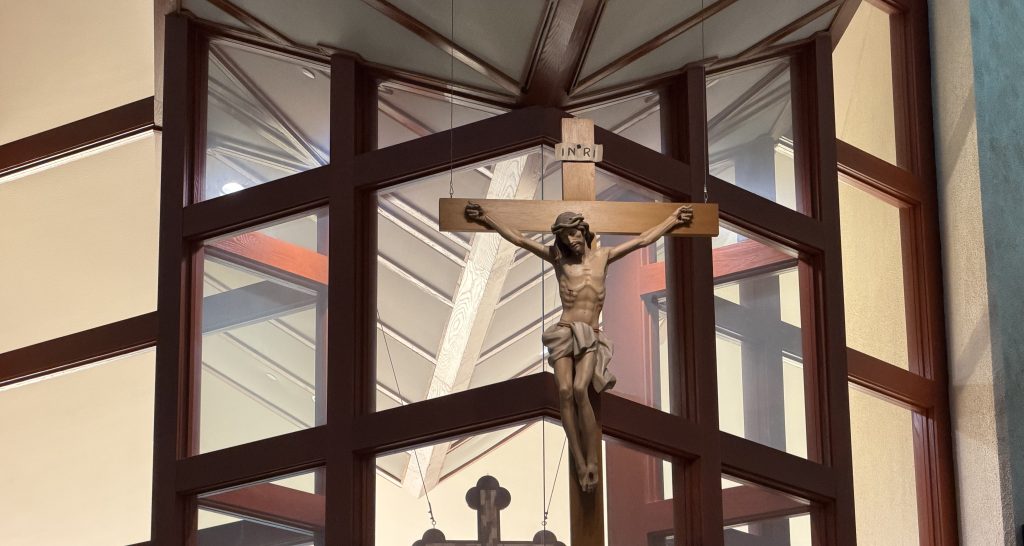
Photo: Blessed to have a moment to pray evening prayer back at St. Peter Catholic Church. Keeping our eyes on Jesus helps us to quiet our minds.

Link for the Mass readings for Saturday, November 15, 2025

Jesus has our back in our successes as well as our failures.

Peter shows, as he did when he walked on and then sank in the water, how our faith journey can be compared to a rollercoaster ride of ups and downs, sometimes more intense than others. As expressed time and again in the Gospels, Peter provides examples of taking a step forward and two steps back.

In today’s Gospel from Matthew, Peter still called Simon at this time, exemplified this balancing act of our growth process as he first answered Jesus’ question as to who Jesus was when he stated, “You are the Christ, the Son of the living God” (Matthew 16:16). Jesus not only commended Simon for being open to sharing this revelation given to him by God the Father, but also added, “And so I say to you, you are Peter, and upon this rock I will build my Church, and the gates of the netherworld shall not prevail against it” (Matthew 16:17-18).

Name changes in the Bible were common when there was a significant change in one’s life. We can see evidence of this in the examples of Abram, changing his name to Abraham, Sarai to Sarah, and Jacob to Israel, just to name a few. Without a doubt, this event was a significant giant step forward for Simon Peter!

Yet, just as Peter reached the heights of theological insight he would just as quickly come crashing down again as he cut his teacher off. Jesus began to share with his disciples about how he would suffer, be killed, and rise again on the third day when, Peter took Jesus aside and began to rebuke him, “God forbid, Lord! No such thing shall ever happen to you.” He turned and said to Peter, “Get behind me, Satan! You are an obstacle to me. You are thinking not as God does, but as human beings do” (Matthew 16:22-23).

From being called the rock upon which Jesus would build his Church in one instant, to Satan in the next, Peter’s experiences offer some solace for us who are on our own faith journeys. Peter apprenticed with Jesus and as in any learning experience, he made mistakes. We need to realize that in our spiritual life this is going to happen to us as well.

We will have days when we feel the joy of the Holy Spirit filling our soul, and yet in the next instant, we may feel empty. We may have clear discernment and direction and then feel indecisive and confused. Some days we discern well our loving God and Father’s voice and some moments we choose to follow the Father of Lies. Some days our prayer is fruitful and we feel energized and other days we may experience dryness and that we are just going through the motions.

Jesus’ admonition of Peter to get behind him was not the end of the story. In fact, it would get worse when Peter gave into his fear and denied Jesus three times! Peter persisted and Jesus did not give up on him. After his resurrection, Jesus asked Peter three times if Peter loved him, and three times, the third a bit exasperated, Peter said yes, undoing the travesty of his denials. After the Ascension of Jesus, Peter lead the early Church and gave the ultimate witness and measure of his spiritual growth and maturity by giving his life.

We too will have fits and starts along the way, but the key is to remain faithful to God and the Way he guides us to walk. We are to continue to dust ourselves off when we have fallen down and be willing to learn from our mistakes, to repent, be forgiven, to seek the help and support of Jesus and one another, and be willing to begin again. The Good News for us today, is that Jesus does not define us by our mistakes or our worst moments. He does not give up on us. He loves us and continues to hold out his hand to us, to lead us onward!


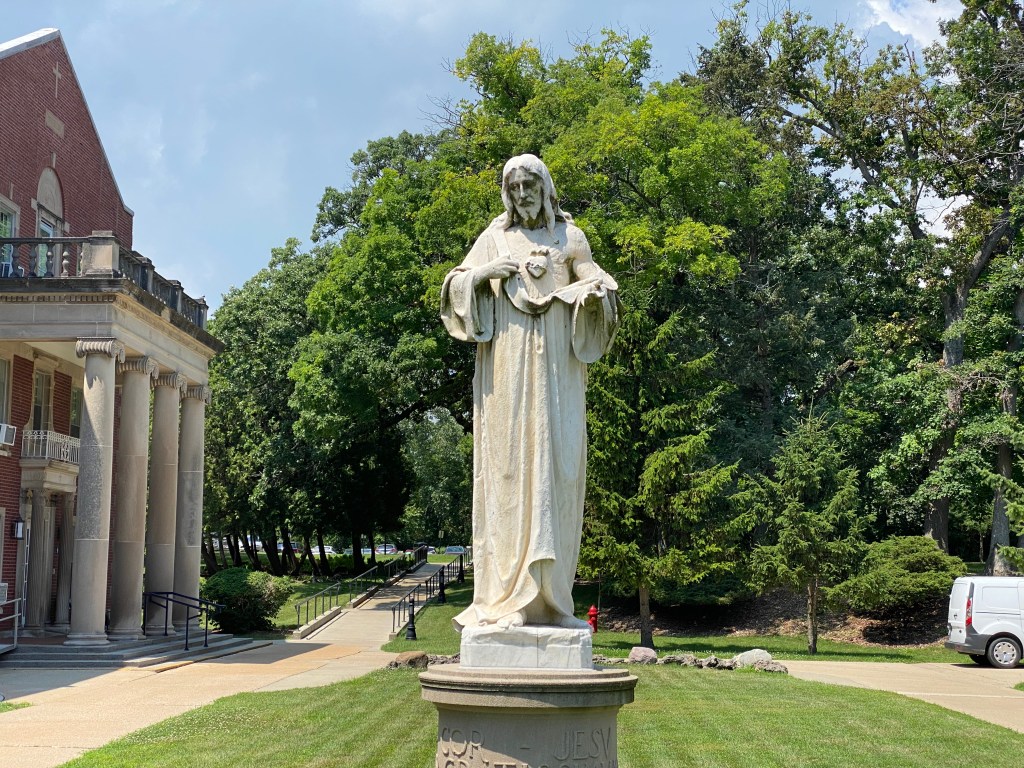
Photo: A great compass to access as we journey is to ask, “Is our heart beating with the same rhythm as Jesus’ Sacred Heart?”

Link for the Mass readings for Thursday, August 7, 2025

Experiencing God with us in everything is the gift of prayer.

“And I tell you, ask and you will receive; seek and you will find; knock and the door will be opened to you. For everyone who asks, receives; and the one who seeks, finds; and to the one who knocks, the door will be opened” (Lk 11:9).
Prayer can become frustrating when we make the time to pray and then we feel or think that nothing is happening or has happened. We may pray for a specific petition for our self, or for a particular intention for another and felt, or thought, that there was not an answer from God. One may pray a sincere, seemingly selfless prayer for a loved one, a child, a spouse, a friend, to be healed and the person still dies. They may be deeply hurt because they did what Jesus said; they asked, they pleaded and begged, but felt they did not receive the healing; that which they sought for, was not given and, instead what they found was nothing but pain and heartache from the loss; they knocked until their knuckles were raw and experienced no one on the other side.
Our attitude and orientation to prayer matters. When we sincerely turn our hearts and minds to God in prayer, something happens between us and God, though it may be beyond our cognitive grasp to understand or our sensory awareness to experience. There may indeed be emotional highs and consolations experienced in prayer, but if seeking those is the primary motivation for prayer we will find ourselves more frustrated than not. There may also be lows in prayer, dryness, even desolations, and even feeling God’s absence. Emotions are fleeting and not a good barometer when measuring the effectiveness of prayer.
Another big misconception is that we pray to God as if he were a gumball machine. It may seem a silly analogy but how many of us really do pray and only pray that way, and when we do not receive the specific thing we asked for, at the time specified, when we wanted and as we wanted, we brood and think God doesn’t care or does not, in fact, even exist. We may even slip into the barter posture. God if you grant me this, I will do that. If we are only open to receive what we want on our terms, again we are setting ourselves up for frustration.
The very desire to pray is the beginning of our awareness of God’s invitation offered to us to join him in prayer. God is the one who reaches out to us first. The answer to what or who we ask, seek, and knock is found at the end of the Gospel reading for today: “If you then, who are wicked, know how to give good gifts to your children, how much more will the Father in heaven give the Holy Spirit to those who ask him” (Lk 11:13)?
God knows what is best for us, he sees our potential, he wants us to experience joy and be fulfilled. How can we best live our lives in this world to attain that reality? We do so by receiving the Holy Spirit. Who is the Holy Spirit? The infinite, communal love expressed between God the Father and God the Son. Our goal in prayer is to enter into God’s reality, the infinite communion of Love.
Through building a relationship with God, which we are able to do through our participation and conformation to the life of Jesus, we come to see the truth of empty promises, apparent goods, substitutes to fill our emptiness and faulty defense mechanisms that we have been utilizing as guideposts to merely survive and get through life. When we stay consistent in an authentic life of prayer, we will change, we be aware and be able to let go of that which is false and will begin to bear the fruit of the Holy Spirit which are love, joy, peace, patience, kindness, goodness, gentleness, and self-control (cf. Galatians 5:22-23)?
We need to resist running away from apparent unanswered prayers, the pain of loss, and accept sometimes not knowing, and to trust that God has not abandoned us. He is with us in everything. Prayer is not primarily what we ask and that we receive. Prayer is a willingness to hear God’s invitation to enter into a deeper and more intimate relationship with him. Accepting this as a starting point will open a doorway leading into the open arms and embrace of his Son, Jesus, who awaits us in the depth of our need, confusion, grief, and pain. Even our loved ones who have died have not come to an end but have experienced a new beginning with our loving God and Father. JoAnn said in her last few weeks that she was just changing her address.
Ultimately, what we ask, what we seek, and what we knock for when we pray is to be loved, to belong, to be a part of someone greater than ourselves. We have been created as a living, craving hunger, and desire to be in relationship with God and each other. This is true for the atheist and the mystic alike. We have been created to be loved and to love. To experience God’s love in our time of prayer, it is important to make time consistently to do so, to then breathe and recollect, to be still and let our thoughts come, go, and settle down. Then we can have a conversation, speak with God and listen to him and experience the Holy Spirit in the silence of our hearts.
The Holy Spirit is the gift of prayer that is open to us all. He is the love shared between the Father and the Son, that we too can experience even during our sorrow, trials, and tribulations, as well as during our times of celebrations, overcoming, and rejoicing. This is why he is the answer to our prayers. Sometimes to be aware of his presence takes perseverance. It may not be that God is not answering, but that we are not patient enough to receive the answer. We may not be silent enough to hear. Prayer is about building a relationship and like any other relationship, we may need more time to heal and/or to build trust, and a willingness to consistently spend time together. Most importantly, we need to learn to communicate and that means learning God’s profound language of silence.

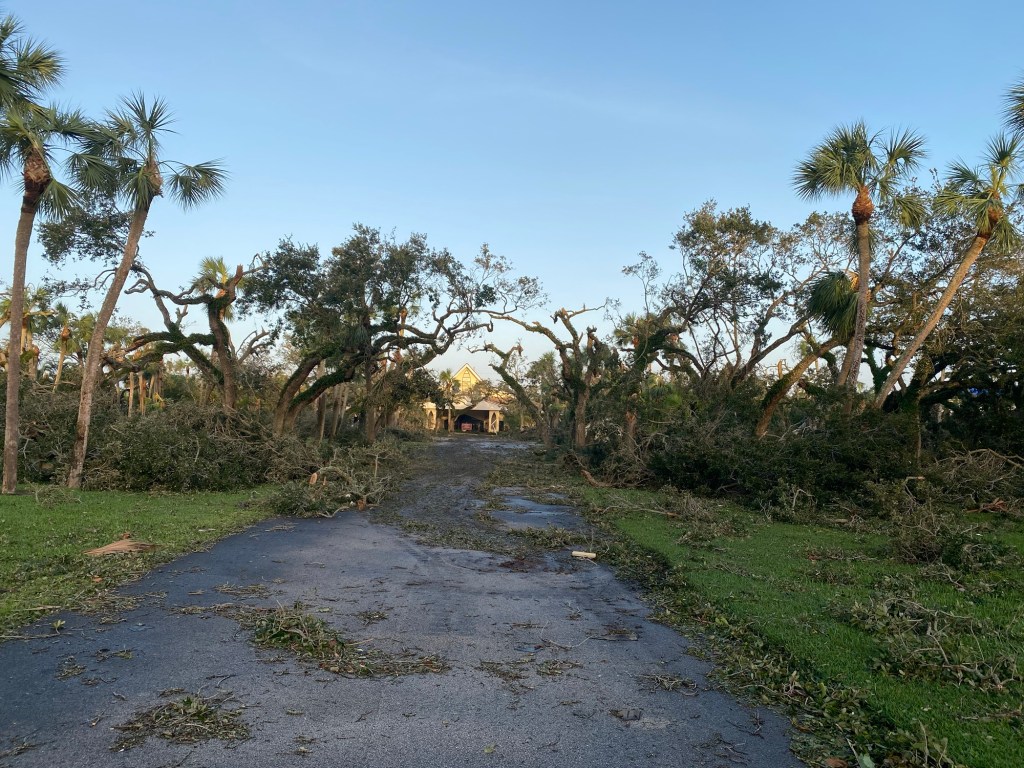
Photo: Damage from tornado taken last night. Compare to picture posted for last Sunday’s reflection. Walking in God’s silence and asking him to help all effected by this storm and us here at Holy Cross Catholic Church, Vero Beach.
Mass readings for Thursday, October 7, 2021